Consider the following statements.
Determine which of the above statements are True (1) or False (2).  |
Homework Answers

Add Answer to:
Consider the following statements.
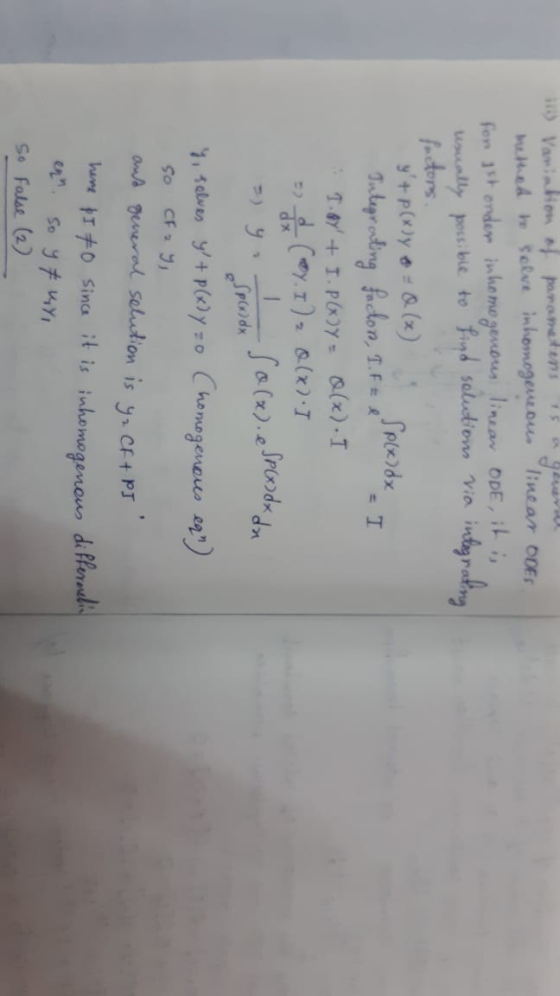
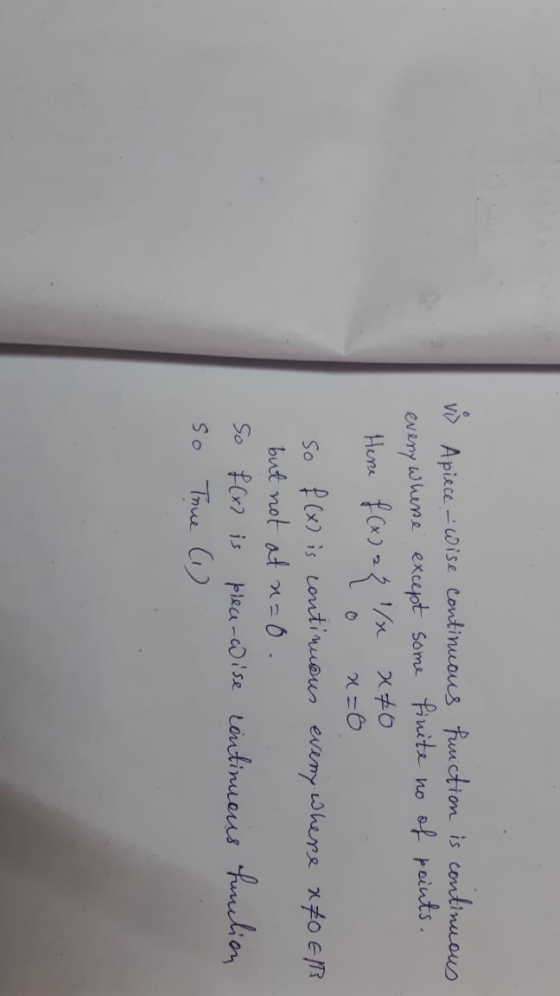
(i) Given a second-order linear ODE, the method of variation of
parameters...
Consider the following statements. (i) The Laplace Transform of 11tet2 cos(et2) is well-defined for some values...
 Consider the following statements.
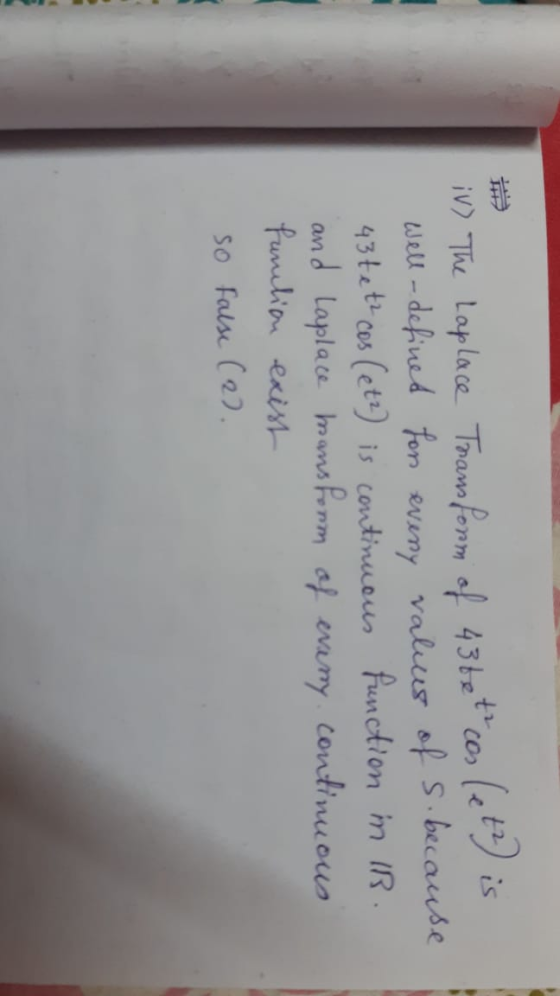
(i) The Laplace Transform of
11tet2 cos(et2)
is well-defined for some values of s.
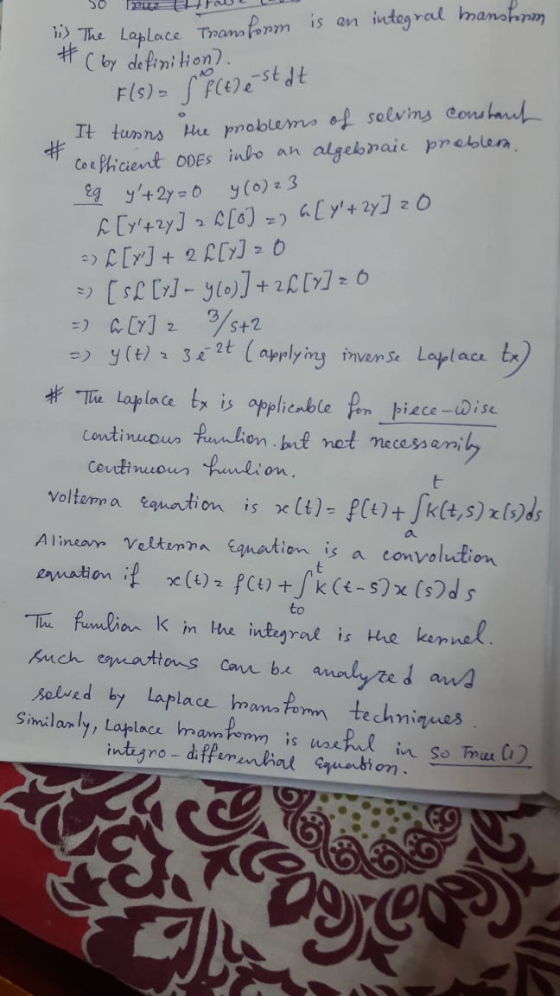
(ii) The Laplace Transform is an integral transform that turns
the problem of solving constant coefficient ODEs into an algebraic
problem. This transform is particularly useful when it comes to
studying problems arising in applications where the forcing
function in the ODE is piece-wise continuous but not necessarily
continuous, or when it comes to studying some Volterra equations
and integro-differential equations.
(iii)...
Consider the following statements.
(i) The Laplace Transform of
11tet2 cos(et2)
is well-defined for some values of s.
(ii) The Laplace Transform is an integral transform that turns
the problem of solving constant coefficient ODEs into an algebraic
problem. This transform is particularly useful when it comes to
studying problems arising in applications where the forcing
function in the ODE is piece-wise continuous but not necessarily
continuous, or when it comes to studying some Volterra equations
and integro-differential equations.
(iii)...
Consider the following statements. (i) Spring/mass systems and Series Circuit systems we covered are examples of...
 Consider the following statements.
(i) Spring/mass systems and Series Circuit systems we covered
are examples of linear dynamical systems in which each mathematical
model is a second-order constant coefficient ODE along with initial
conditions at a specific time.
(ii) The following is an example of a piece-wise continuous
function
f (x) =
{
x
x ∈ Q
0
x ∈ R \ Q
(iii) It is unclear whether series solutions to ODEs even
exist, and knowing about series solutions to...
Consider the following statements.
(i) Spring/mass systems and Series Circuit systems we covered
are examples of linear dynamical systems in which each mathematical
model is a second-order constant coefficient ODE along with initial
conditions at a specific time.
(ii) The following is an example of a piece-wise continuous
function
f (x) =
{
x
x ∈ Q
0
x ∈ R \ Q
(iii) It is unclear whether series solutions to ODEs even
exist, and knowing about series solutions to...
Problem #1: Consider the following statements, [6 marks) 6) There is a systematic way of computing...
 Problem #1: Consider the following statements, [6 marks) 6) There is a systematic way of computing solutions to homogeneous second-order linear constant coefficient ODES. (ii) It is necessary for a function to be of exponential order in order for its Laplace Transform to be defined for some values of s. (iii) It is unclear whether series solutions to ODEs even exist, and knowing about series solutions to ODEs is mostly irrelevant in applications. (iv) There is only one way to...
5. Repeat the same questions in 4.) for the ODE Py"- tt+2)y+(t+2)y2t3, (t>0) (a) Find the general solution of the homogeneous ODE y"- 5y +6y 0. Particularly find yi and (b) Find the...
 5. Repeat the same questions in 4.) for the ODE Py"- tt+2)y+(t+2)y2t3, (t>0) (a) Find the general solution of the homogeneous ODE y"- 5y +6y 0. Particularly find yi and (b) Find the equivalent nonhomogeneous system of first order with the chan of variable y (c) Show that (nvand 2( re solutions of the homogeneous system of ODEs (d) Find the variation of parameters equations that have to be satisfic 1 for y(t) vi(t)u(t) + (e) Find the variation of...
Use the method of variation of parameters to find a particular solution of the following differential...
 Use the method of variation of parameters to find a particular solution of the following differential equation. y" - by' +9y = 2e 3x What is the Wronskian of the independent solutions to the homogeneous equation? W(11.72) = 0 The particular solution is yp(x) =
IGNORE (i) (ii) The procedure of finding series solutions to a homogeneous linear second-order ODEs could...
 IGNORE (i)
(ii) The procedure of finding series solutions to a homogeneous
linear second-order ODEs could be accurately described as the
“method of undetermined series coefficients”.
(iii) The underlying idea behind the method of undetermined
coefficients is a conjecture about the form of a particular
solution that is motivated by the right-hand side of the equation.
The method of undetermined coefficients is limited to second-order
linear ODEs with constant coefficients and the right-hand side of
the ODE cannot be an...
IGNORE (i)
(ii) The procedure of finding series solutions to a homogeneous
linear second-order ODEs could be accurately described as the
“method of undetermined series coefficients”.
(iii) The underlying idea behind the method of undetermined
coefficients is a conjecture about the form of a particular
solution that is motivated by the right-hand side of the equation.
The method of undetermined coefficients is limited to second-order
linear ODEs with constant coefficients and the right-hand side of
the ODE cannot be an...
4. Find the general solution to each of the following non- homogeneous second order ODES. d²y...
 4. Find the general solution to each of the following non- homogeneous second order ODES. d²y dy -2+ y = -x + 3 dx dx2 Hint: Use the method of undetermined coefficients in finding the particular solutio day b) dx2 + y = secx Hint: Use variation of parameters for finding the particular solution. > The following problem is for bonus points. -- Solve the following ODE: dy + 5y = 10e-5x dx
3) Solve for the following ODE using Variation of Parameters y' – 4y' + 4y =...
 3) Solve for the following ODE using Variation of Parameters y' – 4y' + 4y = x?e? a) Determine the characteristic equation and its roots, and solve for the complementary solution yn (6 marks) b) Solve for particular solution Yp using Variation of Parameters (13 marks) c) What is the general solution y ? (1 mark)
2. (Sturm-Liouville Theory) Consider the following linear homogeneous second-order differential e...
 2. (Sturm-Liouville Theory) Consider the following linear homogeneous second-order differential equation and boundary conditions v(T where a and b are finite, p(x), p(x,)) are real and continuous on [a, b), and p(x),w(x) > 0 on a,b]. Show that two distinct solutions to this ODE, Pm(z) and (x), are orthogonal to each other on the interval [a,b]. That is, prove the following relationship 0
2. (Sturm-Liouville Theory) Consider the following linear homogeneous second-order differential equation and boundary conditions v(T where a...
2. (Sturm-Liouville Theory) Consider the following linear homogeneous second-order differential equation and boundary conditions v(T where a and b are finite, p(x), p(x,)) are real and continuous on [a, b), and p(x),w(x) > 0 on a,b]. Show that two distinct solutions to this ODE, Pm(z) and (x), are orthogonal to each other on the interval [a,b]. That is, prove the following relationship 0
2. (Sturm-Liouville Theory) Consider the following linear homogeneous second-order differential equation and boundary conditions v(T where a...
A nonhomogeneous second-order linear equation and a complementary function ye are given below. Use the method...
 A nonhomogeneous second-order linear equation and a complementary function ye are given below. Use the method of variation of parameters to find a particular solution of the given differential equation. Before applying the method of variation of parameters, divide the equation by its leading coefficient x2 to rewrite it in the standard form, y" + P(x)y'+Q(x)y = f(x) x2y"xy'y Inx; y c1 cos (In x) + c2 sin (In x) The particular solution is yo (x)
 Consider the following statements.
(i) The Laplace Transform of
11tet2 cos(et2)
is well-defined for some values of s.
(ii) The Laplace Transform is an integral transform that turns
the problem of solving constant coefficient ODEs into an algebraic
problem. This transform is particularly useful when it comes to
studying problems arising in applications where the forcing
function in the ODE is piece-wise continuous but not necessarily
continuous, or when it comes to studying some Volterra equations
and integro-differential equations.
(iii)...
Consider the following statements.
(i) The Laplace Transform of
11tet2 cos(et2)
is well-defined for some values of s.
(ii) The Laplace Transform is an integral transform that turns
the problem of solving constant coefficient ODEs into an algebraic
problem. This transform is particularly useful when it comes to
studying problems arising in applications where the forcing
function in the ODE is piece-wise continuous but not necessarily
continuous, or when it comes to studying some Volterra equations
and integro-differential equations.
(iii)...
 Consider the following statements.
(i) Spring/mass systems and Series Circuit systems we covered
are examples of linear dynamical systems in which each mathematical
model is a second-order constant coefficient ODE along with initial
conditions at a specific time.
(ii) The following is an example of a piece-wise continuous
function
f (x) =
{
x
x ∈ Q
0
x ∈ R \ Q
(iii) It is unclear whether series solutions to ODEs even
exist, and knowing about series solutions to...
Consider the following statements.
(i) Spring/mass systems and Series Circuit systems we covered
are examples of linear dynamical systems in which each mathematical
model is a second-order constant coefficient ODE along with initial
conditions at a specific time.
(ii) The following is an example of a piece-wise continuous
function
f (x) =
{
x
x ∈ Q
0
x ∈ R \ Q
(iii) It is unclear whether series solutions to ODEs even
exist, and knowing about series solutions to...
 Problem #1: Consider the following statements, [6 marks) 6) There is a systematic way of computing solutions to homogeneous second-order linear constant coefficient ODES. (ii) It is necessary for a function to be of exponential order in order for its Laplace Transform to be defined for some values of s. (iii) It is unclear whether series solutions to ODEs even exist, and knowing about series solutions to ODEs is mostly irrelevant in applications. (iv) There is only one way to...
 5. Repeat the same questions in 4.) for the ODE Py"- tt+2)y+(t+2)y2t3, (t>0) (a) Find the general solution of the homogeneous ODE y"- 5y +6y 0. Particularly find yi and (b) Find the equivalent nonhomogeneous system of first order with the chan of variable y (c) Show that (nvand 2( re solutions of the homogeneous system of ODEs (d) Find the variation of parameters equations that have to be satisfic 1 for y(t) vi(t)u(t) + (e) Find the variation of...
 Use the method of variation of parameters to find a particular solution of the following differential equation. y" - by' +9y = 2e 3x What is the Wronskian of the independent solutions to the homogeneous equation? W(11.72) = 0 The particular solution is yp(x) =
 IGNORE (i)
(ii) The procedure of finding series solutions to a homogeneous
linear second-order ODEs could be accurately described as the
“method of undetermined series coefficients”.
(iii) The underlying idea behind the method of undetermined
coefficients is a conjecture about the form of a particular
solution that is motivated by the right-hand side of the equation.
The method of undetermined coefficients is limited to second-order
linear ODEs with constant coefficients and the right-hand side of
the ODE cannot be an...
IGNORE (i)
(ii) The procedure of finding series solutions to a homogeneous
linear second-order ODEs could be accurately described as the
“method of undetermined series coefficients”.
(iii) The underlying idea behind the method of undetermined
coefficients is a conjecture about the form of a particular
solution that is motivated by the right-hand side of the equation.
The method of undetermined coefficients is limited to second-order
linear ODEs with constant coefficients and the right-hand side of
the ODE cannot be an...
 4. Find the general solution to each of the following non- homogeneous second order ODES. d²y dy -2+ y = -x + 3 dx dx2 Hint: Use the method of undetermined coefficients in finding the particular solutio day b) dx2 + y = secx Hint: Use variation of parameters for finding the particular solution. > The following problem is for bonus points. -- Solve the following ODE: dy + 5y = 10e-5x dx
 3) Solve for the following ODE using Variation of Parameters y' – 4y' + 4y = x?e? a) Determine the characteristic equation and its roots, and solve for the complementary solution yn (6 marks) b) Solve for particular solution Yp using Variation of Parameters (13 marks) c) What is the general solution y ? (1 mark)
 2. (Sturm-Liouville Theory) Consider the following linear homogeneous second-order differential equation and boundary conditions v(T where a and b are finite, p(x), p(x,)) are real and continuous on [a, b), and p(x),w(x) > 0 on a,b]. Show that two distinct solutions to this ODE, Pm(z) and (x), are orthogonal to each other on the interval [a,b]. That is, prove the following relationship 0
2. (Sturm-Liouville Theory) Consider the following linear homogeneous second-order differential equation and boundary conditions v(T where a...
2. (Sturm-Liouville Theory) Consider the following linear homogeneous second-order differential equation and boundary conditions v(T where a and b are finite, p(x), p(x,)) are real and continuous on [a, b), and p(x),w(x) > 0 on a,b]. Show that two distinct solutions to this ODE, Pm(z) and (x), are orthogonal to each other on the interval [a,b]. That is, prove the following relationship 0
2. (Sturm-Liouville Theory) Consider the following linear homogeneous second-order differential equation and boundary conditions v(T where a...
 A nonhomogeneous second-order linear equation and a complementary function ye are given below. Use the method of variation of parameters to find a particular solution of the given differential equation. Before applying the method of variation of parameters, divide the equation by its leading coefficient x2 to rewrite it in the standard form, y" + P(x)y'+Q(x)y = f(x) x2y"xy'y Inx; y c1 cos (In x) + c2 sin (In x) The particular solution is yo (x)
Most questions answered within 3 hours.
-
Where is the error in this code sequence?
String s1 = "Hello";
String s2 = "ello";...
asked 11 months ago -
Financial data for Joel de Paris, Inc., for last year
follow:
Joel de Paris, Inc.
Balance...
asked 11 months ago -
Consider this reaction:
Al2(SO4)3 (aq)+ BaCl3
(aq) Al2Cl6 (aq)- +
3BaSO4(s) . What is the...
asked 11 months ago -
Suppose that Savneet is considering increasing her
recent random sample from 20 car rentals to 40...
asked 11 months ago -
Trucks arrive at an unloading terminal at an average rate of 120
per hour.
Trucks arrive...
asked 11 months ago -
Why are methanol and ethanol completely soluble in water while
octanol is not very little soluble....
asked 11 months ago -
A facilities manager at a university reads in a research report
that the mean amount of...
asked 11 months ago -
When the CuSO4 is rehydrated by adding water to the anhydrous
compound, is this an endothermic...
asked 11 months ago -
A ray of sunlight is passing from diamond into crown glass; the
angle of incidence is...
asked 11 months ago -
A block of mass 0.249 kg is placed on top of a light, vertical
spring of...
asked 11 months ago -
how do the kidneys compensate in the presences of acidosis
a) trigger hyperventilate
b) reserve acid...
asked 11 months ago -
Question 501 pts
The rental rate of capital to the firm increases. Which of the
following...
asked 11 months ago