
Homework Answers

Add Answer to:
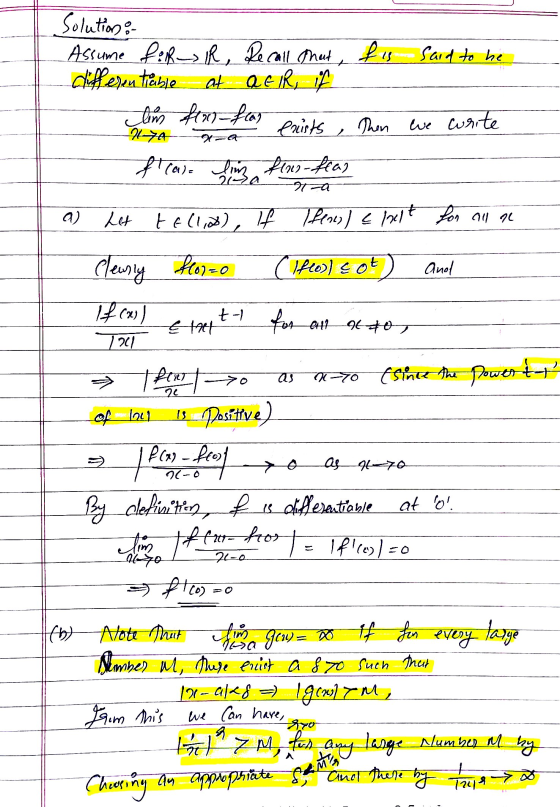
Exercise 7.9. Assume f:R → R. (a) Let t € (1,0). Prove that if |f(x) =...
1) Let f:R-->R be defined by f(x) = |x+2|. Prove or Disprove: f is differentiable at...
1) Let f:R-->R be defined by f(x) = |x+2|. Prove or Disprove: f is differentiable at -2 f is differentiable at 1 2) Prove the product rule. Hint: Use f(x)g(x)− f(c)g(c) = f(x)g(x)−g(c))+f(x)− f(c))g(c). 3) Prove the quotient rule. Hint: You can do this directly, but it may be easier to find the derivative of 1/x and then use the chain rule and the product rule. 4) For n∈Z, prove that xn is differentiable and find the derivative, unless, of course, n...
7. Consider the function f:R + R defined by f(x) = x < 0, 3 >...
 7. Consider the function f:R + R defined by f(x) = x < 0, 3 > 0. e-1/x2, Prove that f is differentiable of all orders and that f(n)(0) = 0 for all n e N. Conclude that f does not have a convergent power series expansion En Anx" for x near the origin. [We will see later in this class that this is impossible for holomorphic functions, namely being (complex) differentiable implies that there is always a convergent power...
1. Let f:R → R be the function defined as: 32 0 if x is rational...
 1. Let f:R → R be the function defined as: 32 0 if x is rational if x is irrational Prove that lim -70 f(x) = 0. Prove that limc f(x) does not exist for every real number c + 0. 2. Let f:R + R be a continuous function such that f(0) = 0 and f(2) = 0. Prove that there exists a real number c such that f(c+1) = f(c). 3 Let f. (a,b) R be a function...
A function f:R HR is said to be strictly increasing if f(x1) < f(12) whenever I]...
 A function f:R HR is said to be strictly increasing if f(x1) < f(12) whenever I] < 12. Prove: If a differentiable function f is strictly increasing, then f'(x) > 0. Then give counterexamples to show that the following statements are false, in general. (i) If a differentiable function f is strictly increasing, then f'(2) >0 for all 1. (ii) If f'(x) > 0 for all x, then f is strictly increasing -
*14. Let A be an n x n matrix. Define f:R" R by f(x) = Ax.x...
 *14. Let A be an n x n matrix. Define f:R" R by f(x) = Ax.x = x'AX. (a) Show that f is differentiable and Df (a)h = Aah + Ah a. (b) Deduce that when A is symmetric, Df(a)h = 2Aa . h. 15. Let a € R", 8 >0, and suppose f: B(a, 8) - R is differentiable at a. Suppose f(a) f(x)
Exercise 1. Let f : R R be differentiable on la, b, where a, b R...
 Exercise 1. Let f : R R be differentiable on la, b, where a, b R and a < b, and let f be continuous on [a, b]. Show that for every e> 0 there exists a 6 > 0 such that the inequality f(x)- f(c) T-C holds for all c, x E [a, 히 satisfying 0 < |c-x| < δ
(6) Let fel ), where is Lebesgue measure on R. Define F:R → R by F(x)...
 (6) Let fel ), where is Lebesgue measure on R. Define F:R → R by F(x) = f' f(t) dx. (a) Prove that F is a continuous function. (b) Prove that F is uniformly continuous on R. (Note that R is not compact.)
7.Let A be ann x n real symmetric invertible matrix, let B Rt and C E R. Define f:R R by 2 a. Giv...
 I need help with a, b, and c.
7.Let A be ann x n real symmetric invertible matrix, let B Rt and C E R. Define f:R R by 2 a. Give f (a) c. Give f"(x) d. Prove that if A is positive definite and u is the critical point of f, then f(u) < f(x) for all x E Rn where x Prove that if A is negative definite and u is the critical point of f, then...
I need help with a, b, and c.
7.Let A be ann x n real symmetric invertible matrix, let B Rt and C E R. Define f:R R by 2 a. Give f (a) c. Give f"(x) d. Prove that if A is positive definite and u is the critical point of f, then f(u) < f(x) for all x E Rn where x Prove that if A is negative definite and u is the critical point of f, then...
Let f:R->S be a homomorphism of rings and let K=(r in R]f(r)=0}. Prove that Khas the...
 Let f:R->S be a homomorphism of rings and let K=(r in R]f(r)=0}. Prove that Khas the absorption property O If rand s are in K then f(r)=f(s)=0 so f(rs)=f(r)f(s)=0 x 0=0 O If ris in R and s is in K then f(s)=0 so f(rs)=f(r)f(s)=f(r) x 0=0 Olf rand s are in R then f(r)=f(s)=0 so f(rs)=f(r)f(s)=0 x 0=0 O If ris in R and s is in K then f(r)=f(s)=0 so f(rs)=f(r)f(s)=0 x 0=0
7.Let A be ann x n real symmetric invertible matrix, let B Rt and C E R. Define f:R R by 2 a. Giv...
 a through e is considered one question.
7.Let A be ann x n real symmetric invertible matrix, let B Rt and C E R. Define f:R R by 2 a. Give f (a) c. Give f"(x) d. Prove that if A is positive definite and u is the critical point of f, then f(u) < f(x) for all x E Rn where x Prove that if A is negative definite and u is the critical point of f, then f(u)...
a through e is considered one question.
7.Let A be ann x n real symmetric invertible matrix, let B Rt and C E R. Define f:R R by 2 a. Give f (a) c. Give f"(x) d. Prove that if A is positive definite and u is the critical point of f, then f(u) < f(x) for all x E Rn where x Prove that if A is negative definite and u is the critical point of f, then f(u)...
 7. Consider the function f:R + R defined by f(x) = x < 0, 3 > 0. e-1/x2, Prove that f is differentiable of all orders and that f(n)(0) = 0 for all n e N. Conclude that f does not have a convergent power series expansion En Anx" for x near the origin. [We will see later in this class that this is impossible for holomorphic functions, namely being (complex) differentiable implies that there is always a convergent power...
 1. Let f:R → R be the function defined as: 32 0 if x is rational if x is irrational Prove that lim -70 f(x) = 0. Prove that limc f(x) does not exist for every real number c + 0. 2. Let f:R + R be a continuous function such that f(0) = 0 and f(2) = 0. Prove that there exists a real number c such that f(c+1) = f(c). 3 Let f. (a,b) R be a function...
 A function f:R HR is said to be strictly increasing if f(x1) < f(12) whenever I] < 12. Prove: If a differentiable function f is strictly increasing, then f'(x) > 0. Then give counterexamples to show that the following statements are false, in general. (i) If a differentiable function f is strictly increasing, then f'(2) >0 for all 1. (ii) If f'(x) > 0 for all x, then f is strictly increasing -
 *14. Let A be an n x n matrix. Define f:R" R by f(x) = Ax.x = x'AX. (a) Show that f is differentiable and Df (a)h = Aah + Ah a. (b) Deduce that when A is symmetric, Df(a)h = 2Aa . h. 15. Let a € R", 8 >0, and suppose f: B(a, 8) - R is differentiable at a. Suppose f(a) f(x)
 Exercise 1. Let f : R R be differentiable on la, b, where a, b R and a < b, and let f be continuous on [a, b]. Show that for every e> 0 there exists a 6 > 0 such that the inequality f(x)- f(c) T-C holds for all c, x E [a, 히 satisfying 0 < |c-x| < δ
 (6) Let fel ), where is Lebesgue measure on R. Define F:R → R by F(x) = f' f(t) dx. (a) Prove that F is a continuous function. (b) Prove that F is uniformly continuous on R. (Note that R is not compact.)
 I need help with a, b, and c.
7.Let A be ann x n real symmetric invertible matrix, let B Rt and C E R. Define f:R R by 2 a. Give f (a) c. Give f"(x) d. Prove that if A is positive definite and u is the critical point of f, then f(u) < f(x) for all x E Rn where x Prove that if A is negative definite and u is the critical point of f, then...
I need help with a, b, and c.
7.Let A be ann x n real symmetric invertible matrix, let B Rt and C E R. Define f:R R by 2 a. Give f (a) c. Give f"(x) d. Prove that if A is positive definite and u is the critical point of f, then f(u) < f(x) for all x E Rn where x Prove that if A is negative definite and u is the critical point of f, then...
 Let f:R->S be a homomorphism of rings and let K=(r in R]f(r)=0}. Prove that Khas the absorption property O If rand s are in K then f(r)=f(s)=0 so f(rs)=f(r)f(s)=0 x 0=0 O If ris in R and s is in K then f(s)=0 so f(rs)=f(r)f(s)=f(r) x 0=0 Olf rand s are in R then f(r)=f(s)=0 so f(rs)=f(r)f(s)=0 x 0=0 O If ris in R and s is in K then f(r)=f(s)=0 so f(rs)=f(r)f(s)=0 x 0=0
 a through e is considered one question.
7.Let A be ann x n real symmetric invertible matrix, let B Rt and C E R. Define f:R R by 2 a. Give f (a) c. Give f"(x) d. Prove that if A is positive definite and u is the critical point of f, then f(u) < f(x) for all x E Rn where x Prove that if A is negative definite and u is the critical point of f, then f(u)...
a through e is considered one question.
7.Let A be ann x n real symmetric invertible matrix, let B Rt and C E R. Define f:R R by 2 a. Give f (a) c. Give f"(x) d. Prove that if A is positive definite and u is the critical point of f, then f(u) < f(x) for all x E Rn where x Prove that if A is negative definite and u is the critical point of f, then f(u)...
Most questions answered within 3 hours.
-
Where is the error in this code sequence?
String s1 = "Hello";
String s2 = "ello";...
asked 11 months ago -
Financial data for Joel de Paris, Inc., for last year
follow:
Joel de Paris, Inc.
Balance...
asked 11 months ago -
Consider this reaction:
Al2(SO4)3 (aq)+ BaCl3
(aq) Al2Cl6 (aq)- +
3BaSO4(s) . What is the...
asked 11 months ago -
Suppose that Savneet is considering increasing her
recent random sample from 20 car rentals to 40...
asked 11 months ago -
Trucks arrive at an unloading terminal at an average rate of 120
per hour.
Trucks arrive...
asked 11 months ago -
Why are methanol and ethanol completely soluble in water while
octanol is not very little soluble....
asked 11 months ago -
A facilities manager at a university reads in a research report
that the mean amount of...
asked 11 months ago -
When the CuSO4 is rehydrated by adding water to the anhydrous
compound, is this an endothermic...
asked 11 months ago -
A ray of sunlight is passing from diamond into crown glass; the
angle of incidence is...
asked 11 months ago -
A block of mass 0.249 kg is placed on top of a light, vertical
spring of...
asked 11 months ago -
how do the kidneys compensate in the presences of acidosis
a) trigger hyperventilate
b) reserve acid...
asked 11 months ago -
Question 501 pts
The rental rate of capital to the firm increases. Which of the
following...
asked 11 months ago