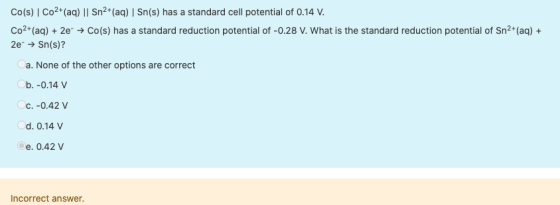
Could someone please explain to me how we get to this answer?
I know (Ecell = Ecathode − Eanode)
Homework Answers
Request Answer!
We need at least 10 more requests to produce the answer.
0 / 10 have requested this problem solution
The more requests, the faster the answer.
Add Answer to:
Could someone please explain to me how we get to this
answer?
I know (Ecell =...
An electrochemical cell based on the following reaction has astandard cell voltage (Eocell) of 0.48 V...
An electrochemical cell based on the following reaction has astandard cell voltage (Eocell) of 0.48 V Sn (s) + Cu2+ (aq) ---> Sn2+ (aq) + Cu (s) What is the standard reduction potential of tin? Sn2+ (aq) +2e- ---> Sn(s) a. -0.14 V b. 0.14 V c. -0.82 V d. 0.82 V e. none of the above
Can someone please help me? I keep getting stuck, I don’t know how to get log...
 Can
someone please help me? I keep getting stuck, I don’t know how to
get log on the other side of the equation. I can easily follow
another tutorial, but I can’t figure out the ending and what step I
need to do to get it! This was previously answered by someone else
and was wrong. I need to know HOW to work it out please!
Given the measured cell potential, Ecel, is-0.3555 V at 25 C in the following...
Can
someone please help me? I keep getting stuck, I don’t know how to
get log on the other side of the equation. I can easily follow
another tutorial, but I can’t figure out the ending and what step I
need to do to get it! This was previously answered by someone else
and was wrong. I need to know HOW to work it out please!
Given the measured cell potential, Ecel, is-0.3555 V at 25 C in the following...
How would a decrease in pH affect the non-standard potential (Ecell) of the reaction in: Co(s)...
How would a decrease in pH affect the non-standard potential (Ecell) of the reaction in: Co(s) + 2H+(aq) ⟶ H2(g) + Co2+(aq) E°cell = 0.28 V
Consider the concentration cell Sn(s) | Sn2+(aq, a(Sn2+)A) || Sn2+(aq, a(Sn2+)C) | Sn(s) The subscripts A...
Consider the concentration cell Sn(s) | Sn2+(aq, a(Sn2+)A) || Sn2+(aq, a(Sn2+)C) | Sn(s) The subscripts A and C in the activities a(Sn2+)A and a(Sn2+)C of the Sn2+(aq) ionic species refer, respectively, to the anodic and cathodic solutions. The standard reduction potential for the half reaction Sn2+(s) + 2e- ===> Sn(s) is E0(Sn2+/Sn) = -0.14 V. What is the anode/cathode ratio of the activities of the Sn2+(aq) ion a(Sn2+)C / a(Sn2+)A if the electromotive force of the cell is E =...
For the cell shown, the measured cell potential, Ecell, is -0.3629 V at 25 °C. Pt(s)...
 For the cell shown, the measured cell potential, Ecell, is -0.3629 V at 25 °C. Pt(s) | H,(g, 0.707 atm) | H+ (aq, ? M) || Cd2+ (aq, 1.00 M)| Cd(s) The balanced reduction half-reactions for the cell, and their respective standard reduction potential values, Eº, are 2 H+ (aq) + 2e - H (9) E° = 0.00 V Cd2+ (aq) + 2e — Cd(s) E' = -0.403 V Calculate the H+ concentration. M = 0.031 Incorrect
For the cell shown, the measured cell potential, Ecell, is -0.3687 V at 25 °C. Pt(s)...
 For the cell shown, the measured cell potential, Ecell, is -0.3687 V at 25 °C. Pt(s) | H, (8,0.873 atm) | H+ (aq, ? M) || Cd2+ (aq, 1.00 M) | Cd(s) The balanced reduction half-reactions for the cell, and their respective standard reduction potential values, Eº, are 2 H+ (aq) + 2e → H, (g) E° = 0.00 v Cd2+ (aq) + 2e- Cd(s) E° = -0.403 V Calculate the H+ concentration. [H+) = .0588 M Incorrect
ALEKS data table may not include the value, if not please just include the E value and I will go ...
 ALEKS data table may not include the value, if not please just
include the E value and I will go through the table and leave the
answer in the comments
A certain half-reaction has a standard reduction potential Ered- provide at least 0.50 V of electrical power. The cell will operate under standard conditions. Note for advanced students: assume the engineer requires this half-reaction to happen at the anode of the cell 0.53 V. An engineer proposes using this half-reaction...
ALEKS data table may not include the value, if not please just
include the E value and I will go through the table and leave the
answer in the comments
A certain half-reaction has a standard reduction potential Ered- provide at least 0.50 V of electrical power. The cell will operate under standard conditions. Note for advanced students: assume the engineer requires this half-reaction to happen at the anode of the cell 0.53 V. An engineer proposes using this half-reaction...
The standard reduction potential of the Ag Ag electrode is +0.80 V and the standard potential...
 The standard reduction potential of the Ag Ag electrode is +0.80 V and the standard potential of the cell Fe(s) Fe3+(aq) || Ag" (aq) Ag(s) is +0.84 V. What is the standard reduction potential of the Fe3+1Fe electrode? +1.64 V +0.04 V O-1.64v -0.04 v -0.12 V Question 10 (1 point) In the following cell, A is a standard Co2+1Co electrode connected to a standard hydrogen electrode. If the voltmeter reading is -0.28 V, which half-reaction occurs in the left-hand...
QUESTION 4 Using the table below and the Nearnst Equation E-E° (0.0592/n)logQ Find the voltage of...
 QUESTION 4 Using the table below and the Nearnst Equation E-E° (0.0592/n)logQ Find the voltage of the cell: Cu2+(aq) + Ni(s) ? Cu(s) + Ni2+(aq) at 25° C if the concentrations of the soluble species are [Cu2+1-0.050 M and [Ni]- 1.40 M Reduction Reaction Sn2++ 2e-? Sn Cu2+ + 2e- ?Cu" Reduction Potential, Ecell 0.14 Volts 0.34 Volts 0.25 Volts +0.77 Volts Fe3+ + e-? Fe2+ 0.50 V 0.54 V 0.62 V 0.66 V
Hi can someone help me with these questions, Thank you: Question 8 (1 point) The standard...
 Hi can someone help me with these questions, Thank you:
Question 8 (1 point) The standard potential of the cell Ni(s) Ni2+(aq) || Cl(aq) AgCl(s) Ag(s) is +0.45 V at 25°C. If the standard reduction potential of the AgCl|Ag|Ci couple is +0.22 V, calculate the standard reduction potential of the Ni2+INi couple. -0.45 V +0.23 V -0.67 v +0.67 v 0 -0.23 V Question 6 (1 point) The standard reduction potential of the Br2/Brand Sna/Sn couples are +1.07 and -0.14...
Hi can someone help me with these questions, Thank you:
Question 8 (1 point) The standard potential of the cell Ni(s) Ni2+(aq) || Cl(aq) AgCl(s) Ag(s) is +0.45 V at 25°C. If the standard reduction potential of the AgCl|Ag|Ci couple is +0.22 V, calculate the standard reduction potential of the Ni2+INi couple. -0.45 V +0.23 V -0.67 v +0.67 v 0 -0.23 V Question 6 (1 point) The standard reduction potential of the Br2/Brand Sna/Sn couples are +1.07 and -0.14...
 Can
someone please help me? I keep getting stuck, I don’t know how to
get log on the other side of the equation. I can easily follow
another tutorial, but I can’t figure out the ending and what step I
need to do to get it! This was previously answered by someone else
and was wrong. I need to know HOW to work it out please!
Given the measured cell potential, Ecel, is-0.3555 V at 25 C in the following...
Can
someone please help me? I keep getting stuck, I don’t know how to
get log on the other side of the equation. I can easily follow
another tutorial, but I can’t figure out the ending and what step I
need to do to get it! This was previously answered by someone else
and was wrong. I need to know HOW to work it out please!
Given the measured cell potential, Ecel, is-0.3555 V at 25 C in the following...
 For the cell shown, the measured cell potential, Ecell, is -0.3629 V at 25 °C. Pt(s) | H,(g, 0.707 atm) | H+ (aq, ? M) || Cd2+ (aq, 1.00 M)| Cd(s) The balanced reduction half-reactions for the cell, and their respective standard reduction potential values, Eº, are 2 H+ (aq) + 2e - H (9) E° = 0.00 V Cd2+ (aq) + 2e — Cd(s) E' = -0.403 V Calculate the H+ concentration. M = 0.031 Incorrect
 For the cell shown, the measured cell potential, Ecell, is -0.3687 V at 25 °C. Pt(s) | H, (8,0.873 atm) | H+ (aq, ? M) || Cd2+ (aq, 1.00 M) | Cd(s) The balanced reduction half-reactions for the cell, and their respective standard reduction potential values, Eº, are 2 H+ (aq) + 2e → H, (g) E° = 0.00 v Cd2+ (aq) + 2e- Cd(s) E° = -0.403 V Calculate the H+ concentration. [H+) = .0588 M Incorrect
 ALEKS data table may not include the value, if not please just
include the E value and I will go through the table and leave the
answer in the comments
A certain half-reaction has a standard reduction potential Ered- provide at least 0.50 V of electrical power. The cell will operate under standard conditions. Note for advanced students: assume the engineer requires this half-reaction to happen at the anode of the cell 0.53 V. An engineer proposes using this half-reaction...
ALEKS data table may not include the value, if not please just
include the E value and I will go through the table and leave the
answer in the comments
A certain half-reaction has a standard reduction potential Ered- provide at least 0.50 V of electrical power. The cell will operate under standard conditions. Note for advanced students: assume the engineer requires this half-reaction to happen at the anode of the cell 0.53 V. An engineer proposes using this half-reaction...
 The standard reduction potential of the Ag Ag electrode is +0.80 V and the standard potential of the cell Fe(s) Fe3+(aq) || Ag" (aq) Ag(s) is +0.84 V. What is the standard reduction potential of the Fe3+1Fe electrode? +1.64 V +0.04 V O-1.64v -0.04 v -0.12 V Question 10 (1 point) In the following cell, A is a standard Co2+1Co electrode connected to a standard hydrogen electrode. If the voltmeter reading is -0.28 V, which half-reaction occurs in the left-hand...
 QUESTION 4 Using the table below and the Nearnst Equation E-E° (0.0592/n)logQ Find the voltage of the cell: Cu2+(aq) + Ni(s) ? Cu(s) + Ni2+(aq) at 25° C if the concentrations of the soluble species are [Cu2+1-0.050 M and [Ni]- 1.40 M Reduction Reaction Sn2++ 2e-? Sn Cu2+ + 2e- ?Cu" Reduction Potential, Ecell 0.14 Volts 0.34 Volts 0.25 Volts +0.77 Volts Fe3+ + e-? Fe2+ 0.50 V 0.54 V 0.62 V 0.66 V
 Hi can someone help me with these questions, Thank you:
Question 8 (1 point) The standard potential of the cell Ni(s) Ni2+(aq) || Cl(aq) AgCl(s) Ag(s) is +0.45 V at 25°C. If the standard reduction potential of the AgCl|Ag|Ci couple is +0.22 V, calculate the standard reduction potential of the Ni2+INi couple. -0.45 V +0.23 V -0.67 v +0.67 v 0 -0.23 V Question 6 (1 point) The standard reduction potential of the Br2/Brand Sna/Sn couples are +1.07 and -0.14...
Hi can someone help me with these questions, Thank you:
Question 8 (1 point) The standard potential of the cell Ni(s) Ni2+(aq) || Cl(aq) AgCl(s) Ag(s) is +0.45 V at 25°C. If the standard reduction potential of the AgCl|Ag|Ci couple is +0.22 V, calculate the standard reduction potential of the Ni2+INi couple. -0.45 V +0.23 V -0.67 v +0.67 v 0 -0.23 V Question 6 (1 point) The standard reduction potential of the Br2/Brand Sna/Sn couples are +1.07 and -0.14...
Most questions answered within 3 hours.
-
Where is the error in this code sequence?
String s1 = "Hello";
String s2 = "ello";...
asked 10 months ago -
Financial data for Joel de Paris, Inc., for last year
follow:
Joel de Paris, Inc.
Balance...
asked 10 months ago -
Consider this reaction:
Al2(SO4)3 (aq)+ BaCl3
(aq) Al2Cl6 (aq)- +
3BaSO4(s) . What is the...
asked 10 months ago -
Suppose that Savneet is considering increasing her
recent random sample from 20 car rentals to 40...
asked 10 months ago -
Trucks arrive at an unloading terminal at an average rate of 120
per hour.
Trucks arrive...
asked 10 months ago -
Why are methanol and ethanol completely soluble in water while
octanol is not very little soluble....
asked 10 months ago -
A facilities manager at a university reads in a research report
that the mean amount of...
asked 10 months ago -
When the CuSO4 is rehydrated by adding water to the anhydrous
compound, is this an endothermic...
asked 10 months ago -
A ray of sunlight is passing from diamond into crown glass; the
angle of incidence is...
asked 10 months ago -
A block of mass 0.249 kg is placed on top of a light, vertical
spring of...
asked 10 months ago -
how do the kidneys compensate in the presences of acidosis
a) trigger hyperventilate
b) reserve acid...
asked 10 months ago -
Question 501 pts
The rental rate of capital to the firm increases. Which of the
following...
asked 10 months ago