
Homework Answers
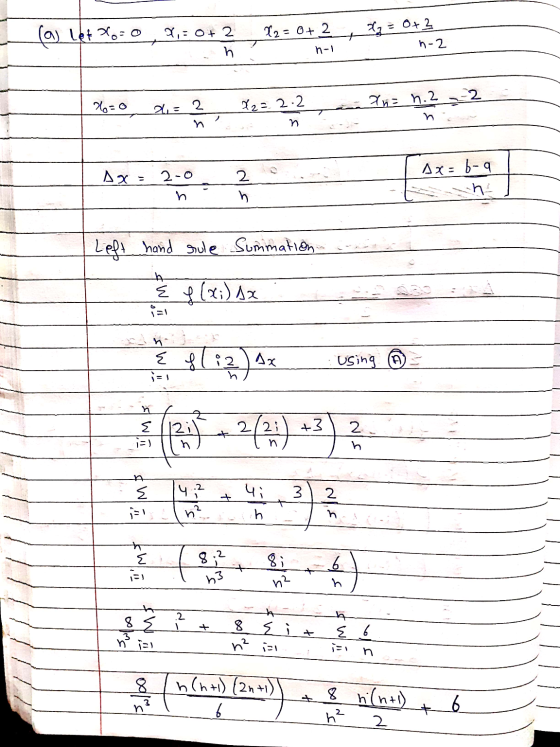
![... [x] - [ i, C 2.2 10, [x, x] - [ , 아) C, 2] - [아름, 으+ [2, 73 [ 아 쪽 Date: D 어 3.2 국 Page Na :](http://img.homeworklib.com/questions/3b991a10-ee2b-11ea-bec4-7b428495f974.png?x-oss-process=image/resize,w_560)
Add Answer to:
5. The Area of a Plane Region. (15 points) a. Find the left Riemann sum for...
Estimate the area of the region bounded by the graph of f(x)-x + 2 and the x-axis on [0,4] in the following ways a. Divide [0,4] into n = 4 subintervals and approximate the area of the region using...
 Estimate the area of the region bounded by the graph of f(x)-x + 2 and the x-axis on [0,4] in the following ways a. Divide [0,4] into n = 4 subintervals and approximate the area of the region using a left Riemann sum. Illustrate the solution geometrically. b. Divide [0,4] into n = 4 subintervals and approximate the area of the region using a midpoint Riemann sum· illustrate the solution geometrically. C. Divide [04] into n = 4 subintervals and...
by middle Riemann sum please~ not right and left ~Thank you 4-2 on the interval [-1,2],...
 by
middle Riemann sum please~ not right and left ~Thank you
4-2 on the interval [-1,2], and approximate [12] 1. (a) Sketch the graph of f(x) the area between the graph and the z-axis on [-1,2] by the left Riemann sum Ls using partitioning of the interval into 3 subintervals of equal length. b) For the same f(z) 4-12, write in sigma notation the formula for the left Riemann sum Ln with partitioning of the interval [-1,2 into n subintervals...
by
middle Riemann sum please~ not right and left ~Thank you
4-2 on the interval [-1,2], and approximate [12] 1. (a) Sketch the graph of f(x) the area between the graph and the z-axis on [-1,2] by the left Riemann sum Ls using partitioning of the interval into 3 subintervals of equal length. b) For the same f(z) 4-12, write in sigma notation the formula for the left Riemann sum Ln with partitioning of the interval [-1,2 into n subintervals...
Please show full workings for both parts of the answer because I keep getting the answer wrong. Thumbs up will be given...
 Please show full workings for both parts of the answer because I
keep getting the answer wrong. Thumbs up will be given to the
workings with correct answers!
7. Set up (do not solve) a definite integral that would give the area of the region under the graph of y = In x, above the x-axis, between the vertical lines x = 1 and x = e. Sketch the graph. You don't need to express with the Riemann sum definition...
Please show full workings for both parts of the answer because I
keep getting the answer wrong. Thumbs up will be given to the
workings with correct answers!
7. Set up (do not solve) a definite integral that would give the area of the region under the graph of y = In x, above the x-axis, between the vertical lines x = 1 and x = e. Sketch the graph. You don't need to express with the Riemann sum definition...
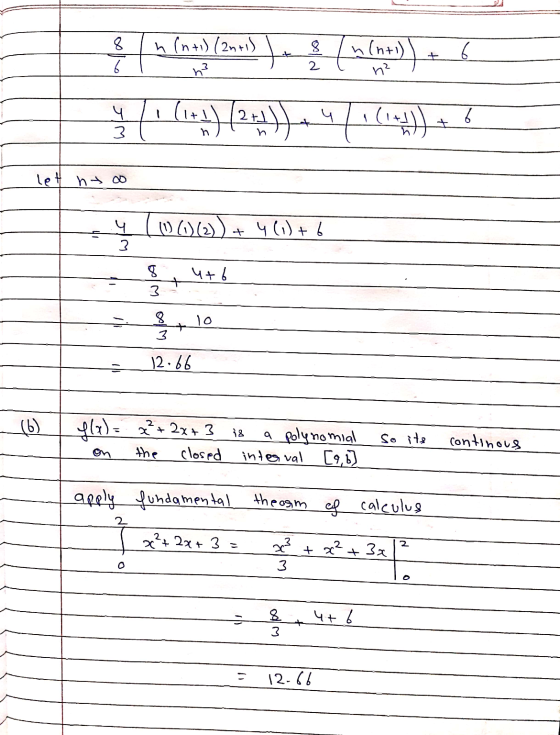
(a) Write s} (x2 – 3x)dx as a limit of a Riemann sums. (b) Evaluate this...
 (a) Write s} (x2 – 3x)dx as a limit of a Riemann sums. (b) Evaluate this limit exactly using sum properties: n(n+1) and n(n + 1)(2n + 1) 6 2 (c) Use the Fundamental Theorem of Calculus to confirm the result in (b)
22 (1 point) a) The rectangles in the graph below illustrate a left endpoint Riemann sum...
 22 (1 point) a) The rectangles in the graph below illustrate a left endpoint Riemann sum for f(x) on the interval (2,6]. 9 The value of this Riemann sum is and this Riemann sum is an underestimate of the area of the region enclosed by y = f(x), the x-axis, and the vertical lines x = 2 and x = 6. y 8 7 6 5 4 3 2 1 X 1 2 3 4 5 6 7 8 Left...
and the r-axis. 5. Consider the region S bounded by r 1, r = 5, y (a) Use four rectangles and a Riemann sum to appr...
 and the r-axis. 5. Consider the region S bounded by r 1, r = 5, y (a) Use four rectangles and a Riemann sum to approximate the area of the region S. Sketch the region S and the rectangles and indicate your rectangles overestimate or underestimate the area of S. (b) Find an expression for the area of the region S as a limit. Do not evaluate the limit.
and the r-axis. 5. Consider the region S bounded by r...
and the r-axis. 5. Consider the region S bounded by r 1, r = 5, y (a) Use four rectangles and a Riemann sum to approximate the area of the region S. Sketch the region S and the rectangles and indicate your rectangles overestimate or underestimate the area of S. (b) Find an expression for the area of the region S as a limit. Do not evaluate the limit.
and the r-axis. 5. Consider the region S bounded by r...
3. (10 pts) Find the area of the region bounded between y = xe-*?, , y...
 3. (10 pts) Find the area of the region bounded between y = xe-*?, , y = x + 1, x = 2 and the y-axis. Note that the graph of the region is provided below. You can leave your answer in terms of e. y=x+1 x2 X-0 0 0.5 1. 0 dy Use the Fundamental Theorem of Calculus to find dx for y = = L* sin (t2)dt.
5. (12 pts.) Consider the region bounded by f(x) 4-2x and the x-axis on interval [-1,...
 5. (12 pts.) Consider the region bounded by f(x) 4-2x and the x-axis on interval [-1, 4] Follow the steps to state the right Riemann Sum of the function f with n equal-length subintervals on [-, 4] (5 pts.) a. Xk= f(xa) (Substitute x into f and simplify.) Complete the right Riemann Sum (do not evaluate or simplify): -2 b. (1 pt.) lim R calculates NET AREA or TOTAL AREA. (Circle your choice.) Using the graph, shade the region bounded...
11. (10 points) Using a Riemann sum with n= 6 subintervals, find the overestimate (i.e. upper...
 11. (10 points) Using a Riemann sum with n= 6 subintervals, find the overestimate (i.e. upper Riemann sum) of the area of the region bounded above by the function f(x) = 2 - 3*+1 and below by the x-axis on the interval (0,3). You may give your answer in exact form or in decimal form correct to two decimal places.
1. (13 points) Use the limit of a Riemann Sum (i.e. sigma notation and the appropriate...
 1. (13 points) Use the limit of a Riemann Sum (i.e. sigma notation and the appropriate summation formulas) to evaluate the net-signed area between the graph of f(0) = 23 – 3 and the interval (0, 2). Let 27 be the right endpoint of the k-th subinterval (where all subintervals have equal width). Give your answer as a single integer or frac- tion, whichever is appropriate. Using any technique other than a limit of a Riemann Sum will earn no...
 Estimate the area of the region bounded by the graph of f(x)-x + 2 and the x-axis on [0,4] in the following ways a. Divide [0,4] into n = 4 subintervals and approximate the area of the region using a left Riemann sum. Illustrate the solution geometrically. b. Divide [0,4] into n = 4 subintervals and approximate the area of the region using a midpoint Riemann sum· illustrate the solution geometrically. C. Divide [04] into n = 4 subintervals and...
 by
middle Riemann sum please~ not right and left ~Thank you
4-2 on the interval [-1,2], and approximate [12] 1. (a) Sketch the graph of f(x) the area between the graph and the z-axis on [-1,2] by the left Riemann sum Ls using partitioning of the interval into 3 subintervals of equal length. b) For the same f(z) 4-12, write in sigma notation the formula for the left Riemann sum Ln with partitioning of the interval [-1,2 into n subintervals...
by
middle Riemann sum please~ not right and left ~Thank you
4-2 on the interval [-1,2], and approximate [12] 1. (a) Sketch the graph of f(x) the area between the graph and the z-axis on [-1,2] by the left Riemann sum Ls using partitioning of the interval into 3 subintervals of equal length. b) For the same f(z) 4-12, write in sigma notation the formula for the left Riemann sum Ln with partitioning of the interval [-1,2 into n subintervals...
 Please show full workings for both parts of the answer because I
keep getting the answer wrong. Thumbs up will be given to the
workings with correct answers!
7. Set up (do not solve) a definite integral that would give the area of the region under the graph of y = In x, above the x-axis, between the vertical lines x = 1 and x = e. Sketch the graph. You don't need to express with the Riemann sum definition...
Please show full workings for both parts of the answer because I
keep getting the answer wrong. Thumbs up will be given to the
workings with correct answers!
7. Set up (do not solve) a definite integral that would give the area of the region under the graph of y = In x, above the x-axis, between the vertical lines x = 1 and x = e. Sketch the graph. You don't need to express with the Riemann sum definition...
 (a) Write s} (x2 – 3x)dx as a limit of a Riemann sums. (b) Evaluate this limit exactly using sum properties: n(n+1) and n(n + 1)(2n + 1) 6 2 (c) Use the Fundamental Theorem of Calculus to confirm the result in (b)
 22 (1 point) a) The rectangles in the graph below illustrate a left endpoint Riemann sum for f(x) on the interval (2,6]. 9 The value of this Riemann sum is and this Riemann sum is an underestimate of the area of the region enclosed by y = f(x), the x-axis, and the vertical lines x = 2 and x = 6. y 8 7 6 5 4 3 2 1 X 1 2 3 4 5 6 7 8 Left...
 and the r-axis. 5. Consider the region S bounded by r 1, r = 5, y (a) Use four rectangles and a Riemann sum to approximate the area of the region S. Sketch the region S and the rectangles and indicate your rectangles overestimate or underestimate the area of S. (b) Find an expression for the area of the region S as a limit. Do not evaluate the limit.
and the r-axis. 5. Consider the region S bounded by r...
and the r-axis. 5. Consider the region S bounded by r 1, r = 5, y (a) Use four rectangles and a Riemann sum to approximate the area of the region S. Sketch the region S and the rectangles and indicate your rectangles overestimate or underestimate the area of S. (b) Find an expression for the area of the region S as a limit. Do not evaluate the limit.
and the r-axis. 5. Consider the region S bounded by r...
 3. (10 pts) Find the area of the region bounded between y = xe-*?, , y = x + 1, x = 2 and the y-axis. Note that the graph of the region is provided below. You can leave your answer in terms of e. y=x+1 x2 X-0 0 0.5 1. 0 dy Use the Fundamental Theorem of Calculus to find dx for y = = L* sin (t2)dt.
 5. (12 pts.) Consider the region bounded by f(x) 4-2x and the x-axis on interval [-1, 4] Follow the steps to state the right Riemann Sum of the function f with n equal-length subintervals on [-, 4] (5 pts.) a. Xk= f(xa) (Substitute x into f and simplify.) Complete the right Riemann Sum (do not evaluate or simplify): -2 b. (1 pt.) lim R calculates NET AREA or TOTAL AREA. (Circle your choice.) Using the graph, shade the region bounded...
 11. (10 points) Using a Riemann sum with n= 6 subintervals, find the overestimate (i.e. upper Riemann sum) of the area of the region bounded above by the function f(x) = 2 - 3*+1 and below by the x-axis on the interval (0,3). You may give your answer in exact form or in decimal form correct to two decimal places.
 1. (13 points) Use the limit of a Riemann Sum (i.e. sigma notation and the appropriate summation formulas) to evaluate the net-signed area between the graph of f(0) = 23 – 3 and the interval (0, 2). Let 27 be the right endpoint of the k-th subinterval (where all subintervals have equal width). Give your answer as a single integer or frac- tion, whichever is appropriate. Using any technique other than a limit of a Riemann Sum will earn no...
Most questions answered within 3 hours.
-
Where is the error in this code sequence?
String s1 = "Hello";
String s2 = "ello";...
asked 11 months ago -
Financial data for Joel de Paris, Inc., for last year
follow:
Joel de Paris, Inc.
Balance...
asked 11 months ago -
Consider this reaction:
Al2(SO4)3 (aq)+ BaCl3
(aq) Al2Cl6 (aq)- +
3BaSO4(s) . What is the...
asked 11 months ago -
Suppose that Savneet is considering increasing her
recent random sample from 20 car rentals to 40...
asked 11 months ago -
Trucks arrive at an unloading terminal at an average rate of 120
per hour.
Trucks arrive...
asked 11 months ago -
Why are methanol and ethanol completely soluble in water while
octanol is not very little soluble....
asked 11 months ago -
A facilities manager at a university reads in a research report
that the mean amount of...
asked 11 months ago -
When the CuSO4 is rehydrated by adding water to the anhydrous
compound, is this an endothermic...
asked 11 months ago -
A ray of sunlight is passing from diamond into crown glass; the
angle of incidence is...
asked 11 months ago -
A block of mass 0.249 kg is placed on top of a light, vertical
spring of...
asked 11 months ago -
how do the kidneys compensate in the presences of acidosis
a) trigger hyperventilate
b) reserve acid...
asked 11 months ago -
Question 501 pts
The rental rate of capital to the firm increases. Which of the
following...
asked 11 months ago