Question 1 1. (10 marks) Suppose that schooling (s) is the only variable that affects earnings....
Question 1
1. (10 marks) Suppose that schooling (s) is the only variable that affects earnings. The following equations describe the weekly salaries of tall and short workers: Wtall = 700 + 100s Wshort = 400 + 80s
On average, tall workers have 15 years of schooling and short workers have 12 years of schooling.
a) (4 marks) What is the short-tall wage differential in the labour market?
b) (6 marks) Use the Oaxaca decomposition approach to calculate how much of this wage differential could be due to discrimination.
Question 2
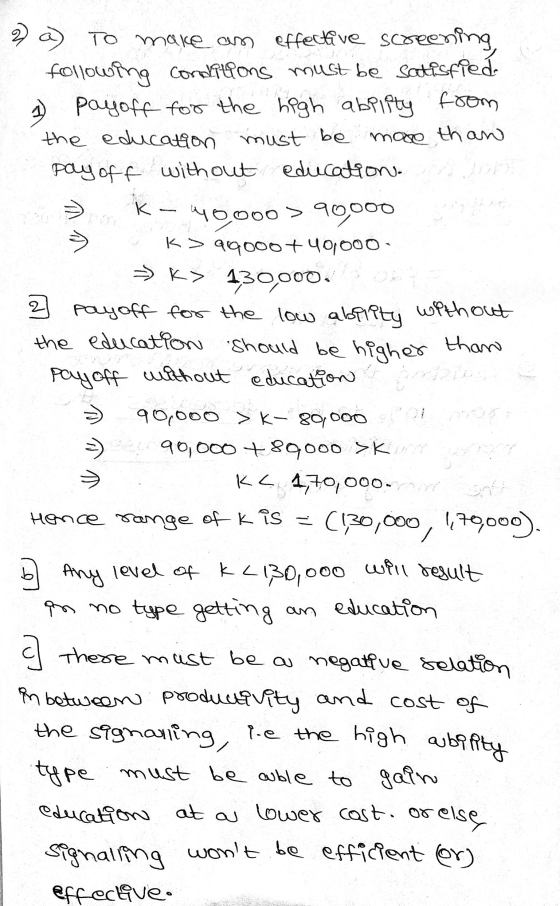
2. (10 marks) Suppose there are two types of persons, high-ability and low-ability. A particular degree costs, in terms of both monetary and psychic costs, a high-ability person $40,000 and costs a lowability person $80,000. Firms wish to use education as a screening device where they intend to pay $90,000 (life-time earnings) to workers without a diploma and $K to those with a diploma.
a) In what range must K be to make this an effective screening device?
b) What level of K would result in either type not getting an education?
c) Comment on the required relationship between productivity and costs for signalling to work and thus have value?
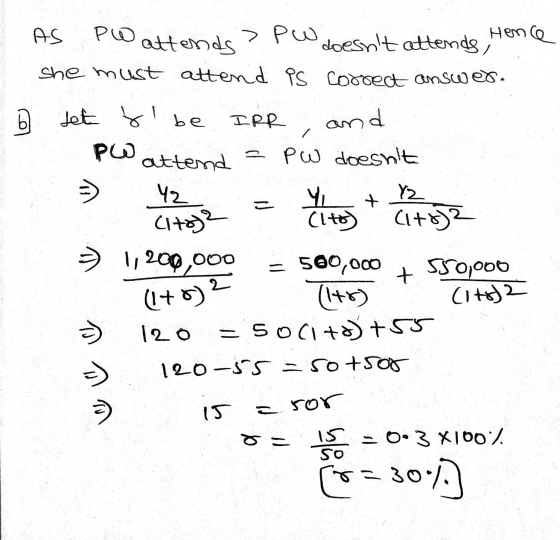
3. (10 marks) Consider an eighteen-year-old high school student that is about to graduate. She lives for two periods. If she decides to attend university, she has zero earnings in Period 1 and she earns $1,200,000 in Period 2. However, if she decides NOT to attend university, she earns $500,0000 in Period 1 and $550,000 in Period 2. Suppose university is free (i.e. no tuition) and the discount rate is 0.05 to discount the earnings in Period 2.
a) Should she attend university? Show your work.
b) Based on the information above, what is the internal rate of return?
Homework Answers
****EVENTHOUGH HOMEWORKLIB POLICY IS TO ANSWER FIRST QUESTION ONLY, I HAVE ANSWERED ALL FOR SAKE OF YOU, SO PLEASE GIVE POSITIVE RATING TO MY ANSWER, THANK YOU*****


Add Answer to:
Question 1
1. (10 marks) Suppose that schooling (s) is the only variable
that affects earnings....
Suppose years of schooling, s, is the only variable that affects earnings. The equations for the...
Suppose years of schooling, s, is the only variable that affects earnings. The equations for the weekly salaries (W) of male (m) and female (f) workers are given by: Wm = 340 + 150sm [αm +βm(Sm)] Wf = 317 + 119sf [αf +βf(Sf)] On average, men have 14 years of schooling and women have 13 years of schooling. The Oaxaca decomposition formula is given as follows: ΔW = (αm – αf) + (βm – βf)Sf + βm(Sm – Sf) Where,...
I. Suppose years of schooling, s, and years of experience both affect earnings. The equations for...
 I. Suppose years of schooling, s, and years of experience both affect earnings. The equations for the weekly salaries of white and black workers are given by: w 400100s, 50e, W 300 50s,+10e, On average, white workers have 16 years of schooling, black workers have 12 years of schooling and both workers have 20 years of experience. a. What are average earnings of white workers? Black workers? What is the average wage differential? b. What wage would the black workers...
(12 points) Suppose there are two types of people: high-ability and low-ability. The schooling required to...
(12 points) Suppose there are two types of people: high-ability and low-ability. The schooling required to obtain a particular diploma costs a high-ability person $8,000 per year, and it costs a low-ability person $10,001 per year. Firms wish to use this diploma as a signal of an individual’s ability. The firms intend to pay workers such that the present value of lifetime earnings for a worker without the diploma is $250,000, and the present value of lifetime earnings for a...
4. (6 points) Suppose there are two types of persons: high-ability and low-ability. A particular diploma...
 4. (6 points) Suppose there are two types of persons: high-ability and low-ability. A particular diploma costs a high-ability person $30,000 and costs a low-ability person $40,000. Firms wish to use education as a screening device where they intend to pay $60,000 to workers without a diploma and SK to those with a diploma. In what range must K be to make this an effective screening device?
Problem 1 (2.5 marks). Suppose there are only two time periods, today (period 1) and tomorrow...
 Problem 1 (2.5 marks). Suppose there are only two time periods, today (period 1) and tomorrow (period 2), and only one consumption good, let's call it food. Assume that food is a perfectly divisible good. Let ci and c2 denote the amount of food consumed today and tomorrow, respectively. Note that here we use subscripts to denote time periods. The price of food today is equal to Pi = P, but as the rate of inflation is > 0, the...
Q1 Which of the following are included and which are excluded in calculating this year's GDP....
 Q1 Which of the following are included and which are excluded in calculating this year's GDP. Explain in each instance. a. A monthly scholarship cheque received by an economics student b. The purchase of an almost new tractor by farmer Kojo C. The cashing in of a savings bond d. An increase in business inventories e. Tim Horton's purchases a corner grocery store f. Fearless Qweenie Kong, a stuntwoman, purchases a life insurance policy for a billion dollars ($) g....
 I. Suppose years of schooling, s, and years of experience both affect earnings. The equations for the weekly salaries of white and black workers are given by: w 400100s, 50e, W 300 50s,+10e, On average, white workers have 16 years of schooling, black workers have 12 years of schooling and both workers have 20 years of experience. a. What are average earnings of white workers? Black workers? What is the average wage differential? b. What wage would the black workers...
 4. (6 points) Suppose there are two types of persons: high-ability and low-ability. A particular diploma costs a high-ability person $30,000 and costs a low-ability person $40,000. Firms wish to use education as a screening device where they intend to pay $60,000 to workers without a diploma and SK to those with a diploma. In what range must K be to make this an effective screening device?
 Problem 1 (2.5 marks). Suppose there are only two time periods, today (period 1) and tomorrow (period 2), and only one consumption good, let's call it food. Assume that food is a perfectly divisible good. Let ci and c2 denote the amount of food consumed today and tomorrow, respectively. Note that here we use subscripts to denote time periods. The price of food today is equal to Pi = P, but as the rate of inflation is > 0, the...
 Q1 Which of the following are included and which are excluded in calculating this year's GDP. Explain in each instance. a. A monthly scholarship cheque received by an economics student b. The purchase of an almost new tractor by farmer Kojo C. The cashing in of a savings bond d. An increase in business inventories e. Tim Horton's purchases a corner grocery store f. Fearless Qweenie Kong, a stuntwoman, purchases a life insurance policy for a billion dollars ($) g....
Most questions answered within 3 hours.
-
Where is the error in this code sequence?
String s1 = "Hello";
String s2 = "ello";...
asked 10 months ago -
Financial data for Joel de Paris, Inc., for last year
follow:
Joel de Paris, Inc.
Balance...
asked 10 months ago -
Consider this reaction:
Al2(SO4)3 (aq)+ BaCl3
(aq) Al2Cl6 (aq)- +
3BaSO4(s) . What is the...
asked 10 months ago -
Suppose that Savneet is considering increasing her
recent random sample from 20 car rentals to 40...
asked 10 months ago -
Trucks arrive at an unloading terminal at an average rate of 120
per hour.
Trucks arrive...
asked 10 months ago -
Why are methanol and ethanol completely soluble in water while
octanol is not very little soluble....
asked 10 months ago -
A facilities manager at a university reads in a research report
that the mean amount of...
asked 10 months ago -
When the CuSO4 is rehydrated by adding water to the anhydrous
compound, is this an endothermic...
asked 10 months ago -
A ray of sunlight is passing from diamond into crown glass; the
angle of incidence is...
asked 10 months ago -
A block of mass 0.249 kg is placed on top of a light, vertical
spring of...
asked 10 months ago -
how do the kidneys compensate in the presences of acidosis
a) trigger hyperventilate
b) reserve acid...
asked 10 months ago -
Question 501 pts
The rental rate of capital to the firm increases. Which of the
following...
asked 10 months ago