
Homework Answers
Request Answer!
We need at least 10 more requests to produce the answer.
0 / 10 have requested this problem solution
The more requests, the faster the answer.
Add Answer to:
CoH5OH(aq) + CN-(aq) + + HCN(aq) + C6H50-(aq) The equilibrium constant for this reaction is less...
The following reactions all have K < 1. 1) CN-(aq) + C6H5OH (aq) ---> HCN (aq)...
The following reactions all have K < 1. 1) CN-(aq) + C6H5OH (aq) ---> HCN (aq) + C6H5O-(aq) 2) ClO-(aq) + C6H5OH (aq) ---> C6H5O-(aq) + HClO (aq) 3) HCN (aq) + ClO-(aq) ---> HClO (aq) + CN-(aq) Arrange the substances based on their relative BASE strength. Clear All C6H5O- ClO- HCN HClO C6H5OH CN- strongest base intermediate base weakest base not a Bronsted-Lowry base The following reactions all have K > 1. 1) HCOO-(aq) + HNO2(aq) ---> HCOOH (aq)...
6. For the reaction HCN (9) + H200) = H* (aq) + CN- (aq) how would...
 6. For the reaction HCN (9) + H200) = H* (aq) + CN- (aq) how would decreasing (CN) shift the equilibrium? 7. For the reaction HCN (g) + H20 (1) = H30+ (aq) + CN (aq) how would adding H30- shift the equilibrium? 242
The following reactions all have K>1. 1) HF (aq) + CN (aq) F (aq) + HCN...
 The following reactions all have K>1. 1) HF (aq) + CN (aq) F (aq) + HCN (aq) 2) HNO2 (aq) + CN* (aq)_HCN (aq) + NO2 (aq) 3) HF (aq) + NO2 (aq)_F (aq) + HNO2 (aq) Arrange the substances based on their relative base strength. Clear All HCN strongest base CN intermediate base NO2 weakest base not a Bronsted-Lowry HNO2 base HF
The following reactions all have K<1. 1) CN- (aq) + CH3OH(aq) = HCN (aq) + CH30"...
 The following reactions all have K<1. 1) CN- (aq) + CH3OH(aq) = HCN (aq) + CH30" (aq) 2) CIO" (aq) + CH2OH(aq) = CH 0(aq) + HCIO (aq) 3) HCN (aq) + CIO" (aq) = HCIO (aq) + CN- (aq) Arrange the substances based on their relative BASE strength. Clear All HCN CHOH strongest base CN intermediate base HCIO weakest base CIO not a Bronsted-Lowry base CH,0"
The following reactions all have K < 1. 1) C9H7O4-(aq) + HCN (aq) -HC9H7O4(aq) + CN-(aq)...
The following reactions all have K < 1. 1) C9H7O4-(aq) + HCN (aq) -HC9H7O4(aq) + CN-(aq) 2) NO2-(aq) + HCN (aq) - CN-(aq) + HNO2(aq) 3) HC9H7O4(aq) + NO2-(aq) -HNO2(aq) + C9H7O4-(aq) Arrange the substances based on their relative acid strength. Clear All HNO2 C9H7O4- HC9H7O4 HCN NO2- CN- strongest acid intermediate acid weakest acid not a Bronsted-Lowry acid
Consider the reaction below. Which species are conjugate acid/base pairs? HSO3-(aq)+HCN(aq)H2SO3(aq)+CN-(aq)
 Consider the reaction below. Which species are conjugate
acid/base pairs?
HSO3-(aq)+HCN(aq)H2SO3(aq)+CN-(aq)
Consider the reaction below. Which species are conjugate
acid/base pairs?
HSO3-(aq)+HCN(aq)H2SO3(aq)+CN-(aq)
The following reactions all have K<1. 1) CIO" (aq) + HCN (aq) 2 HCIO (aq) +...
 The following reactions all have K<1. 1) CIO" (aq) + HCN (aq) 2 HCIO (aq) + CN" (aq) 2) CH,COO" (aq) + HCN (aq) CN" (aq) + CH,COOH (aq) 3) HCIO (aq) + CH3C00" (aq) 2 CH2COOH (aq) + CIO" (aq) Arrange the substances based on their relative BASE strength. Clear All CH,COOH CH3COO strongest base HCN intermediate base weakest base HCIO not a Bronsted-Lowry base
What is the net direction of the acid-base reactions? HCN(aq) +F (aq) = CN- (aq) +...
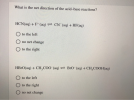 What is the net direction of the acid-base reactions? HCN(aq) +F (aq) = CN- (aq) + HF(aq) O to the left O no net change O to the right HBrO(aq) + CH, COO (aq) = BrO (aq) + CH, COOH(aq) to the left O to the right no net change
A chemical engineer is studying the following reaction: HCN(0g)+NH (aq) +CN (aq)+NH (aq) At the temperature...
 A chemical engineer is studying the following reaction: HCN(0g)+NH (aq) +CN (aq)+NH (aq) At the temperature the engineer picks, the equilibrium constant K, for this reaction is 0.75 The engineer charges ("fills") four reaction vessels with hydrogen cyanide and ammonia, and lets the reaction begin. He then measures the composition of the mixture inside each vessel from time to time. His first set of measurements are shown in the table below Predict the changes in the compositions the engineer should...
13. Which are the Bronsted BASES in the following reaction?.njanela H-PO: (aq) + CN (aq) →HPO/?"(aq) + HCN (aq) a)...
 13. Which are the Bronsted BASES in the following reaction?.njanela H-PO: (aq) + CN (aq) →HPO/?"(aq) + HCN (aq) a) H PO, and HPO.2 b) H PO, and HCN c) CN and HPO d) CN and HCN Helou HCl A Br HI 14. Put the following acids in order in terms of increasing acid strength and explain why. Which of the following is NOT -conjugate acid-base pair a) HI< HBr< HCI<HF. The size of the halide is decreasing and the...
 6. For the reaction HCN (9) + H200) = H* (aq) + CN- (aq) how would decreasing (CN) shift the equilibrium? 7. For the reaction HCN (g) + H20 (1) = H30+ (aq) + CN (aq) how would adding H30- shift the equilibrium? 242
 The following reactions all have K>1. 1) HF (aq) + CN (aq) F (aq) + HCN (aq) 2) HNO2 (aq) + CN* (aq)_HCN (aq) + NO2 (aq) 3) HF (aq) + NO2 (aq)_F (aq) + HNO2 (aq) Arrange the substances based on their relative base strength. Clear All HCN strongest base CN intermediate base NO2 weakest base not a Bronsted-Lowry HNO2 base HF
 The following reactions all have K<1. 1) CN- (aq) + CH3OH(aq) = HCN (aq) + CH30" (aq) 2) CIO" (aq) + CH2OH(aq) = CH 0(aq) + HCIO (aq) 3) HCN (aq) + CIO" (aq) = HCIO (aq) + CN- (aq) Arrange the substances based on their relative BASE strength. Clear All HCN CHOH strongest base CN intermediate base HCIO weakest base CIO not a Bronsted-Lowry base CH,0"
 Consider the reaction below. Which species are conjugate
acid/base pairs?
HSO3-(aq)+HCN(aq)H2SO3(aq)+CN-(aq)
Consider the reaction below. Which species are conjugate
acid/base pairs?
HSO3-(aq)+HCN(aq)H2SO3(aq)+CN-(aq)
 The following reactions all have K<1. 1) CIO" (aq) + HCN (aq) 2 HCIO (aq) + CN" (aq) 2) CH,COO" (aq) + HCN (aq) CN" (aq) + CH,COOH (aq) 3) HCIO (aq) + CH3C00" (aq) 2 CH2COOH (aq) + CIO" (aq) Arrange the substances based on their relative BASE strength. Clear All CH,COOH CH3COO strongest base HCN intermediate base weakest base HCIO not a Bronsted-Lowry base
 What is the net direction of the acid-base reactions? HCN(aq) +F (aq) = CN- (aq) + HF(aq) O to the left O no net change O to the right HBrO(aq) + CH, COO (aq) = BrO (aq) + CH, COOH(aq) to the left O to the right no net change
 A chemical engineer is studying the following reaction: HCN(0g)+NH (aq) +CN (aq)+NH (aq) At the temperature the engineer picks, the equilibrium constant K, for this reaction is 0.75 The engineer charges ("fills") four reaction vessels with hydrogen cyanide and ammonia, and lets the reaction begin. He then measures the composition of the mixture inside each vessel from time to time. His first set of measurements are shown in the table below Predict the changes in the compositions the engineer should...
 13. Which are the Bronsted BASES in the following reaction?.njanela H-PO: (aq) + CN (aq) →HPO/?"(aq) + HCN (aq) a) H PO, and HPO.2 b) H PO, and HCN c) CN and HPO d) CN and HCN Helou HCl A Br HI 14. Put the following acids in order in terms of increasing acid strength and explain why. Which of the following is NOT -conjugate acid-base pair a) HI< HBr< HCI<HF. The size of the halide is decreasing and the...
Most questions answered within 3 hours.
-
Where is the error in this code sequence?
String s1 = "Hello";
String s2 = "ello";...
asked 11 months ago -
Financial data for Joel de Paris, Inc., for last year
follow:
Joel de Paris, Inc.
Balance...
asked 11 months ago -
Consider this reaction:
Al2(SO4)3 (aq)+ BaCl3
(aq) Al2Cl6 (aq)- +
3BaSO4(s) . What is the...
asked 11 months ago -
Suppose that Savneet is considering increasing her
recent random sample from 20 car rentals to 40...
asked 11 months ago -
Trucks arrive at an unloading terminal at an average rate of 120
per hour.
Trucks arrive...
asked 11 months ago -
Why are methanol and ethanol completely soluble in water while
octanol is not very little soluble....
asked 11 months ago -
A facilities manager at a university reads in a research report
that the mean amount of...
asked 11 months ago -
When the CuSO4 is rehydrated by adding water to the anhydrous
compound, is this an endothermic...
asked 11 months ago -
A ray of sunlight is passing from diamond into crown glass; the
angle of incidence is...
asked 11 months ago -
A block of mass 0.249 kg is placed on top of a light, vertical
spring of...
asked 11 months ago -
how do the kidneys compensate in the presences of acidosis
a) trigger hyperventilate
b) reserve acid...
asked 11 months ago -
Question 501 pts
The rental rate of capital to the firm increases. Which of the
following...
asked 11 months ago