Problem 5a (10 points): In class, you have derived the response of a first-order system to...
Problem 5a (10 points): In class, you have derived the response of a first-order system to a unit-step input. Given a first-order system of the form G(s) = K / ( 1 + T s), where T is the time-constant, and K is the constant, find
i) The time-response to a unit-ramp input r(t) = t.
ii) The steady-state error for error measured as e(t) = r(t) - c(t). (Hint: the steady-state error is measured as t tends to infinity).
Homework Answers
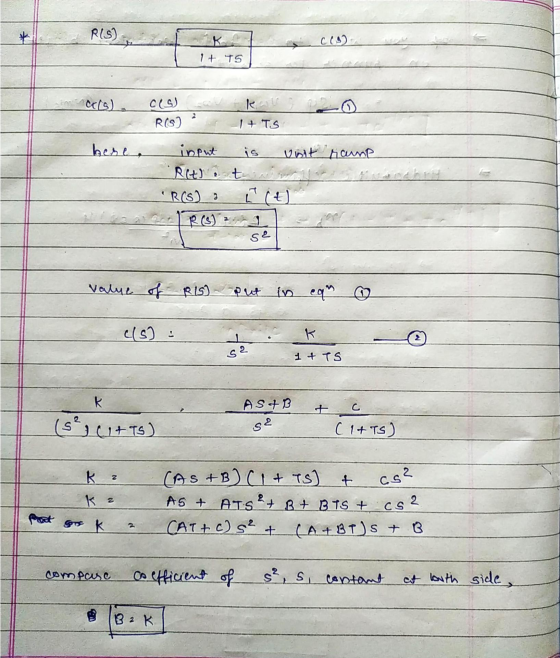
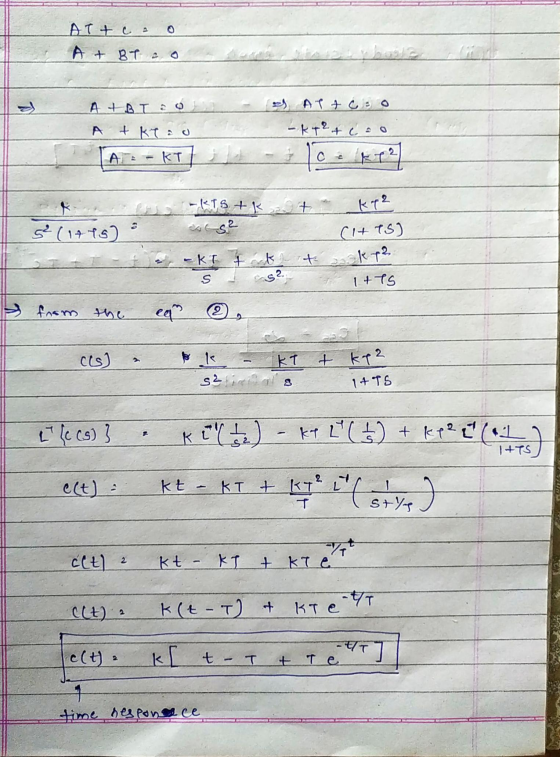
 I
tried to give answer as simple as possible.
I
tried to give answer as simple as possible.
Hope You'll get it.
Have a nice day..!!
Thank You.!!
Add Answer to:
Problem 5a (10 points): In class, you have
derived the response of a first-order system to...
2). Solve the following first order system response to the ramp function (2t) as described in the...
 2). Solve the following first order system response to the ramp function (2t) as described in the equation below. (The initial condition is zero). Derive an expression for the steady state error. At what time does it reach 98% of its value? Plot a graph containing the input and system response. 4x + 2x = 21
2). Solve the following first order system response to the ramp function (2t) as described in the equation below. (The initial condition is zero)....
2). Solve the following first order system response to the ramp function (2t) as described in the equation below. (The initial condition is zero). Derive an expression for the steady state error. At what time does it reach 98% of its value? Plot a graph containing the input and system response. 4x + 2x = 21
2). Solve the following first order system response to the ramp function (2t) as described in the equation below. (The initial condition is zero)....
Problem 1: Steady-state error analvsis (a) A block diagram of a feedback control system is given ...
 The Class Name is: MAE 318 System Dynamics and Control I
Problem 1: Steady-state error analvsis (a) A block diagram of a feedback control system is given below. Assuming that the tunable constant Khas a value that makes this closed-loop system stable, find the steady-state error of the closed-loop system for (a a step reference input with amplitude R, r(t)- R u(t) (ii) a ramp reference input with slope R, r(t) = Rt-us(t) R(s) Y(s) (s+2)(s +5) (b) A block...
The Class Name is: MAE 318 System Dynamics and Control I
Problem 1: Steady-state error analvsis (a) A block diagram of a feedback control system is given below. Assuming that the tunable constant Khas a value that makes this closed-loop system stable, find the steady-state error of the closed-loop system for (a a step reference input with amplitude R, r(t)- R u(t) (ii) a ramp reference input with slope R, r(t) = Rt-us(t) R(s) Y(s) (s+2)(s +5) (b) A block...
R(S) C(s) G(s) Figure P3 G(S) K(s2 – 2s + 2) s(s + 1)(8 +2) Problem...
 R(S) C(s) G(s) Figure P3 G(S) K(s2 – 2s + 2) s(s + 1)(8 +2) Problem 4) (25 points) Consider the same unity feedback control system given in Figure P3 and do the following: a. Determine the system type (type 0, type 1, type 2, etc.) and justify it. (05 points) b. Suppose that 10% maximum overshoot is required as a transient response specification. Find the steady-state error for this P-controlled system, where K = 0.24 for a unit step...
help Consider the closed-loop system in Figure E5.19. where Gs)G 3s and H(s) -K (a) Determine...
 help
Consider the closed-loop system in Figure E5.19. where Gs)G 3s and H(s) -K (a) Determine the closed-loop transfer function T(s) Y(s)/R(s). (b) Determine the steady-state error of the closed-loop system response to a unit ramp input, R(s) 1/s (c) Select a value for Ka so that the steady-state error of the system response to a unit step input, R(s)1/s, is zero.
help
Consider the closed-loop system in Figure E5.19. where Gs)G 3s and H(s) -K (a) Determine the closed-loop transfer function T(s) Y(s)/R(s). (b) Determine the steady-state error of the closed-loop system response to a unit ramp input, R(s) 1/s (c) Select a value for Ka so that the steady-state error of the system response to a unit step input, R(s)1/s, is zero.
1. [25%] Consider the closed-loop system shown where it is desired to stabilize the system with...
 1. [25%] Consider the closed-loop system shown where it is desired to stabilize the system with feedback where the control law is a form of a PID controller. Design using the Root Locus Method such that the: a. percent overshoot is less than 10% for a unit step b. settling time is less than 4 seconds, c. steady-state absolute error (not percent error) due to a unit ramp input (r=t) is less than 1. d. Note: The actuator u(t) saturates...
Please show calculations by HAND and NOT MATLAB. The answers are here to help. Thank you Note : Ts= 4/&*wn (&=damping ratio) Skill-Assessment Exercise 9.3 PROBLEM: A unity feedback system wit...
 Please show calculations by HAND and NOT MATLAB. The answers are
here to help. Thank you
Note : Ts= 4/&*wn (&=damping ratio)
Skill-Assessment Exercise 9.3 PROBLEM: A unity feedback system with forward transfer function 6) s(s + is operating with a closed-loop step response that has 20% overshoot. Do the following: a. Evaluate the settling time. b. Evaluate the steady-state error for a unit ramp input. c. Design a lag-lead compensator to decrease the settling time by 2 times and...
Please show calculations by HAND and NOT MATLAB. The answers are
here to help. Thank you
Note : Ts= 4/&*wn (&=damping ratio)
Skill-Assessment Exercise 9.3 PROBLEM: A unity feedback system with forward transfer function 6) s(s + is operating with a closed-loop step response that has 20% overshoot. Do the following: a. Evaluate the settling time. b. Evaluate the steady-state error for a unit ramp input. c. Design a lag-lead compensator to decrease the settling time by 2 times and...
Dear lecturers, this is crucial. Please write the solution if you are sure. Thanks for your...
 Dear lecturers, this is crucial. Please write the solution if
you are sure. Thanks for your effort! I will give thumbs up at
first sight!
R(s) C(s) G(s) Figure P3 where G(S) = K(S2 – 2s + 2) S(S + 1) (3 + 2) Problem 4) (25 points) Consider the same unity feedback control system given in Figure P3 and do the following. a. Determine the system type (type 0, type 1, type 2, etc.) and justify it. (05 points)...
Dear lecturers, this is crucial. Please write the solution if
you are sure. Thanks for your effort! I will give thumbs up at
first sight!
R(s) C(s) G(s) Figure P3 where G(S) = K(S2 – 2s + 2) S(S + 1) (3 + 2) Problem 4) (25 points) Consider the same unity feedback control system given in Figure P3 and do the following. a. Determine the system type (type 0, type 1, type 2, etc.) and justify it. (05 points)...
Find the steady state error constants and the steady-state error response for the digital control system...
 Find the steady state error constants and the steady-state error response for the digital control system shown below, if the inputs are: a. Unit Step, u(t) b. Unit Ramp, t u(t) c. Unit Parabola, 0.5t2u(t) 2. R(s) + C(s) s(s 2) T=0.1
Lag Compensator Design Using Root-Locus 2. Consider the unity feedback system in Figure 1 for G(s...
 Lag Compensator Design Using Root-Locus 2. Consider the unity feedback system in Figure 1 for G(s)- s(s+3(s6) Design a lag compensation to meet the following specifications The step response settling time is to be less than 5 sec. . The step response overshoot is to be less than 17% . The steady-state error to a unit ramp input must not exceed 10%. Dynamic specifications (overshoot and settling time) can be met using proportional feedback, but a lag compensator is needed...
Determine the gain K, to obtain a steady state error of 0.10: *Hint, What type is the transfer fu...
 Determine the gain K, to obtain a steady state error of
0.10:
*Hint, What type is the transfer function?
**Assume the input is a unit input (i.e. step, ramp, or
parabola)
Determine the gain K, to obtain a steady state error of 0.10: "Hint, What type is the transfer function? "Assume the input is a unit input (i.e. step, ramp, or parabola) R(s) C(s) t- s2+12s+32 s2+5s+6
Determine the gain K, to obtain a steady state error of 0.10: "Hint,...
Determine the gain K, to obtain a steady state error of
0.10:
*Hint, What type is the transfer function?
**Assume the input is a unit input (i.e. step, ramp, or
parabola)
Determine the gain K, to obtain a steady state error of 0.10: "Hint, What type is the transfer function? "Assume the input is a unit input (i.e. step, ramp, or parabola) R(s) C(s) t- s2+12s+32 s2+5s+6
Determine the gain K, to obtain a steady state error of 0.10: "Hint,...
 2). Solve the following first order system response to the ramp function (2t) as described in the equation below. (The initial condition is zero). Derive an expression for the steady state error. At what time does it reach 98% of its value? Plot a graph containing the input and system response. 4x + 2x = 21
2). Solve the following first order system response to the ramp function (2t) as described in the equation below. (The initial condition is zero)....
2). Solve the following first order system response to the ramp function (2t) as described in the equation below. (The initial condition is zero). Derive an expression for the steady state error. At what time does it reach 98% of its value? Plot a graph containing the input and system response. 4x + 2x = 21
2). Solve the following first order system response to the ramp function (2t) as described in the equation below. (The initial condition is zero)....
 The Class Name is: MAE 318 System Dynamics and Control I
Problem 1: Steady-state error analvsis (a) A block diagram of a feedback control system is given below. Assuming that the tunable constant Khas a value that makes this closed-loop system stable, find the steady-state error of the closed-loop system for (a a step reference input with amplitude R, r(t)- R u(t) (ii) a ramp reference input with slope R, r(t) = Rt-us(t) R(s) Y(s) (s+2)(s +5) (b) A block...
The Class Name is: MAE 318 System Dynamics and Control I
Problem 1: Steady-state error analvsis (a) A block diagram of a feedback control system is given below. Assuming that the tunable constant Khas a value that makes this closed-loop system stable, find the steady-state error of the closed-loop system for (a a step reference input with amplitude R, r(t)- R u(t) (ii) a ramp reference input with slope R, r(t) = Rt-us(t) R(s) Y(s) (s+2)(s +5) (b) A block...
 R(S) C(s) G(s) Figure P3 G(S) K(s2 – 2s + 2) s(s + 1)(8 +2) Problem 4) (25 points) Consider the same unity feedback control system given in Figure P3 and do the following: a. Determine the system type (type 0, type 1, type 2, etc.) and justify it. (05 points) b. Suppose that 10% maximum overshoot is required as a transient response specification. Find the steady-state error for this P-controlled system, where K = 0.24 for a unit step...
 help
Consider the closed-loop system in Figure E5.19. where Gs)G 3s and H(s) -K (a) Determine the closed-loop transfer function T(s) Y(s)/R(s). (b) Determine the steady-state error of the closed-loop system response to a unit ramp input, R(s) 1/s (c) Select a value for Ka so that the steady-state error of the system response to a unit step input, R(s)1/s, is zero.
help
Consider the closed-loop system in Figure E5.19. where Gs)G 3s and H(s) -K (a) Determine the closed-loop transfer function T(s) Y(s)/R(s). (b) Determine the steady-state error of the closed-loop system response to a unit ramp input, R(s) 1/s (c) Select a value for Ka so that the steady-state error of the system response to a unit step input, R(s)1/s, is zero.
 1. [25%] Consider the closed-loop system shown where it is desired to stabilize the system with feedback where the control law is a form of a PID controller. Design using the Root Locus Method such that the: a. percent overshoot is less than 10% for a unit step b. settling time is less than 4 seconds, c. steady-state absolute error (not percent error) due to a unit ramp input (r=t) is less than 1. d. Note: The actuator u(t) saturates...
 Please show calculations by HAND and NOT MATLAB. The answers are
here to help. Thank you
Note : Ts= 4/&*wn (&=damping ratio)
Skill-Assessment Exercise 9.3 PROBLEM: A unity feedback system with forward transfer function 6) s(s + is operating with a closed-loop step response that has 20% overshoot. Do the following: a. Evaluate the settling time. b. Evaluate the steady-state error for a unit ramp input. c. Design a lag-lead compensator to decrease the settling time by 2 times and...
Please show calculations by HAND and NOT MATLAB. The answers are
here to help. Thank you
Note : Ts= 4/&*wn (&=damping ratio)
Skill-Assessment Exercise 9.3 PROBLEM: A unity feedback system with forward transfer function 6) s(s + is operating with a closed-loop step response that has 20% overshoot. Do the following: a. Evaluate the settling time. b. Evaluate the steady-state error for a unit ramp input. c. Design a lag-lead compensator to decrease the settling time by 2 times and...
 Dear lecturers, this is crucial. Please write the solution if
you are sure. Thanks for your effort! I will give thumbs up at
first sight!
R(s) C(s) G(s) Figure P3 where G(S) = K(S2 – 2s + 2) S(S + 1) (3 + 2) Problem 4) (25 points) Consider the same unity feedback control system given in Figure P3 and do the following. a. Determine the system type (type 0, type 1, type 2, etc.) and justify it. (05 points)...
Dear lecturers, this is crucial. Please write the solution if
you are sure. Thanks for your effort! I will give thumbs up at
first sight!
R(s) C(s) G(s) Figure P3 where G(S) = K(S2 – 2s + 2) S(S + 1) (3 + 2) Problem 4) (25 points) Consider the same unity feedback control system given in Figure P3 and do the following. a. Determine the system type (type 0, type 1, type 2, etc.) and justify it. (05 points)...
 Find the steady state error constants and the steady-state error response for the digital control system shown below, if the inputs are: a. Unit Step, u(t) b. Unit Ramp, t u(t) c. Unit Parabola, 0.5t2u(t) 2. R(s) + C(s) s(s 2) T=0.1
 Lag Compensator Design Using Root-Locus 2. Consider the unity feedback system in Figure 1 for G(s)- s(s+3(s6) Design a lag compensation to meet the following specifications The step response settling time is to be less than 5 sec. . The step response overshoot is to be less than 17% . The steady-state error to a unit ramp input must not exceed 10%. Dynamic specifications (overshoot and settling time) can be met using proportional feedback, but a lag compensator is needed...
 Determine the gain K, to obtain a steady state error of
0.10:
*Hint, What type is the transfer function?
**Assume the input is a unit input (i.e. step, ramp, or
parabola)
Determine the gain K, to obtain a steady state error of 0.10: "Hint, What type is the transfer function? "Assume the input is a unit input (i.e. step, ramp, or parabola) R(s) C(s) t- s2+12s+32 s2+5s+6
Determine the gain K, to obtain a steady state error of 0.10: "Hint,...
Determine the gain K, to obtain a steady state error of
0.10:
*Hint, What type is the transfer function?
**Assume the input is a unit input (i.e. step, ramp, or
parabola)
Determine the gain K, to obtain a steady state error of 0.10: "Hint, What type is the transfer function? "Assume the input is a unit input (i.e. step, ramp, or parabola) R(s) C(s) t- s2+12s+32 s2+5s+6
Determine the gain K, to obtain a steady state error of 0.10: "Hint,...
Most questions answered within 3 hours.
-
Where is the error in this code sequence?
String s1 = "Hello";
String s2 = "ello";...
asked 11 months ago -
Financial data for Joel de Paris, Inc., for last year
follow:
Joel de Paris, Inc.
Balance...
asked 11 months ago -
Consider this reaction:
Al2(SO4)3 (aq)+ BaCl3
(aq) Al2Cl6 (aq)- +
3BaSO4(s) . What is the...
asked 11 months ago -
Suppose that Savneet is considering increasing her
recent random sample from 20 car rentals to 40...
asked 11 months ago -
Trucks arrive at an unloading terminal at an average rate of 120
per hour.
Trucks arrive...
asked 11 months ago -
Why are methanol and ethanol completely soluble in water while
octanol is not very little soluble....
asked 11 months ago -
A facilities manager at a university reads in a research report
that the mean amount of...
asked 11 months ago -
When the CuSO4 is rehydrated by adding water to the anhydrous
compound, is this an endothermic...
asked 11 months ago -
A ray of sunlight is passing from diamond into crown glass; the
angle of incidence is...
asked 11 months ago -
A block of mass 0.249 kg is placed on top of a light, vertical
spring of...
asked 11 months ago -
how do the kidneys compensate in the presences of acidosis
a) trigger hyperventilate
b) reserve acid...
asked 11 months ago -
Question 501 pts
The rental rate of capital to the firm increases. Which of the
following...
asked 11 months ago