
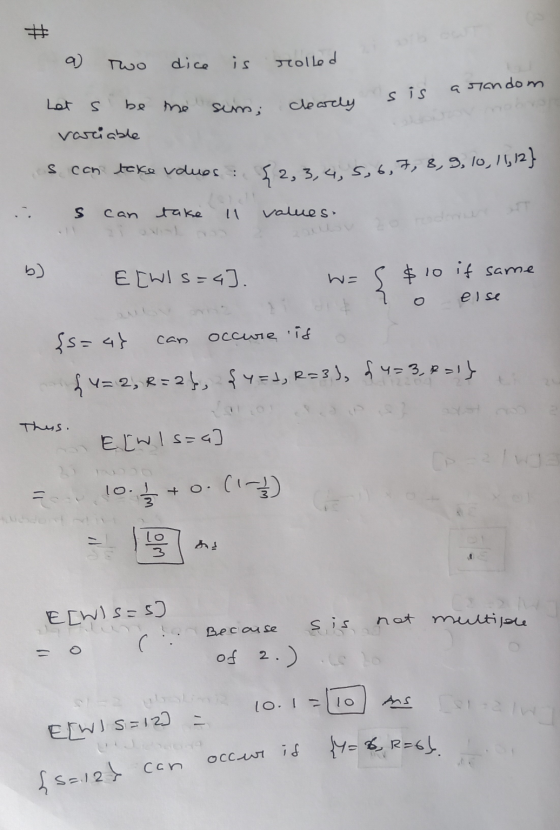
![b) Compute E[W S = 4], E[W|S = 5] and E[W S = 12). Can you explain on why you obtain these numerical values, particularly E[W](http://img.homeworklib.com/questions/cb41a690-ef1b-11ea-bb89-412dd9006fc7.png?x-oss-process=image/resize,w_560)
Homework Answers
Add Answer to:
Conditional Expectation A player plays a game. A pair of fair dice is rolled, the outcome...
. In the carnival game Under-or-Over-Seven, a pair of fair dice is rolled once, and the...
. In the carnival game Under-or-Over-Seven, a pair of fair dice is rolled once, and the resulting sum determines whether the player wins or loses his or her bet. For example, the player can bet $1 that the sum will be under 7—that is, 2, 3, 4, 5, or 6. For this bet, the player wins $1 if the result is under 7 and loses $1 if the outcome equals or is greater than 7. Similarly, the player can bet...
6.32 In the game of Chuck-a-luck, three dice are rolled. The player selects a number between...
 6.32 In the game of Chuck-a-luck, three dice are rolled. The player selects a number between 1 and 6. If the player's number comes up on exactly one die, the player wins $1. If the player's number comes up on exactly two dice, the player wins $2. If the player's number comes up on all three dice, the player wins $3. If the player's number does not come up, the player loses $1. Let X denote the player's win or...
the carnival game Under-or-Over-Seven, a pair of fair dice is rolled once, and the resulting sum...
the carnival game Under-or-Over-Seven, a pair of fair dice is rolled once, and the resulting sum determines whether the player wins or loses his or her bet. For example, the player can bet $1 that the sum will be under 7—that is, 2, 3, 4, 5, or 6. For this bet, the player wins $1 if the result is under 7 and loses $1 if the outcome equals or is greater than 7. Similarly, the player can bet $1 that...
In the carnival game Under-or-Over-Seven, a pair of fair dice is rolled once, and the resulting...
In the carnival game Under-or-Over-Seven, a pair of fair dice is rolled once, and the resulting sum determines whether the player wins or loses his or her bet. For example, using method one, the player can bet $2.00 that the sum will be under 7, that is, 2, 3, 4, 5, or 6. For this bet, the player wins $2.00 if the result is under 7 and loses $2.00 if the outcome equals or is greater than 7. Similarly, using...
Conditional Probability Two fair dice are rolled: (a) Express the sample space S in set builder...
 Conditional Probability Two fair dice are rolled: (a) Express the sample space S in set builder notation and the probability P "At least one of the dice rolls a four." Write all possible outcomes of A (b) Consider the event A (c) What is the probability that at least one die rolls a four? (d) What is the conditional probability that the first die rolls a four given that the sum of the dice is six? (e) What is the...
Problem #3: 5 fair 12-sided dice are rolled. (a) [3 marks] Find the conditional probability that...
 Problem #3: 5 fair 12-sided dice are rolled. (a) [3 marks] Find the conditional probability that at least one die lands on 3 given that all 5 dice land on different numbers. 6) [2 marks] True or False: If X is the maximum of the 5 numbers from one roll, and Y is the minimum of the 5 numbers from one roll, then X and Y are independent random variables.
Question 3 (15 pts). A gambler plays a game in which a fair 6-sided die will be rolled. He is all...
 Question 3 (15 pts). A gambler plays a game in which a fair 6-sided die will be rolled. He is allowed to bet on two sets of outcomes: A (1,2,3) and B (2,4,5,6). If he bets on A then he wins $1 if one of the numbers in A is rolled and otherwise he loses $1 -let X be the amount won by betting on A (so P(X-1)-P(X1)If he bets on B then he wins $0.50 if a number in...
Example Consider the following dice game. A pair of standard ( fair ) dice are repeatedly...
Example Consider the following dice game. A pair of standard ( fair ) dice are repeatedly rolled. If a ’ 7 ’ comes up before an ’ 11 ’ , then the player wins, otherwise the player loses. Let W be the event that the player wins. Find P(W). To say the dice are fair is equivalent to assuming that Laplace’s rule holds and the 36 possible outcomes for a throw of the dice are equally likely. For convenience, an...
Bob plays a game in which he rolls a pair of fair 6-sided dice once. He...
Bob plays a game in which he rolls a pair of fair 6-sided dice once. He adds the number of dots on both dice to create a sum. He loses $1 if he rolls a sum less than 5 doesn’t win or lose anything if he rolls a sum that is higher than 4, but less than 8 wins $1 if he rolls a sum that’s higher than 7 but less than 12 wins $2 if he rolls a sum...
Game consists of: • It costs $2 for the player to enter • Each round, the...
Game consists of: • It costs $2 for the player to enter • Each round, the player announces a single number: {1, 2, 3, 4, 5, 6} • Two fair six-sided dices are rolled • For each die that shows the number announced, the player wins $1. For example, the player pays $2 to enter the game and announces the number 2. If the outcome of the roll is 3, 2, 2, then the player gets back $2. However, if...
 6.32 In the game of Chuck-a-luck, three dice are rolled. The player selects a number between 1 and 6. If the player's number comes up on exactly one die, the player wins $1. If the player's number comes up on exactly two dice, the player wins $2. If the player's number comes up on all three dice, the player wins $3. If the player's number does not come up, the player loses $1. Let X denote the player's win or...
 Conditional Probability Two fair dice are rolled: (a) Express the sample space S in set builder notation and the probability P "At least one of the dice rolls a four." Write all possible outcomes of A (b) Consider the event A (c) What is the probability that at least one die rolls a four? (d) What is the conditional probability that the first die rolls a four given that the sum of the dice is six? (e) What is the...
 Problem #3: 5 fair 12-sided dice are rolled. (a) [3 marks] Find the conditional probability that at least one die lands on 3 given that all 5 dice land on different numbers. 6) [2 marks] True or False: If X is the maximum of the 5 numbers from one roll, and Y is the minimum of the 5 numbers from one roll, then X and Y are independent random variables.
 Question 3 (15 pts). A gambler plays a game in which a fair 6-sided die will be rolled. He is allowed to bet on two sets of outcomes: A (1,2,3) and B (2,4,5,6). If he bets on A then he wins $1 if one of the numbers in A is rolled and otherwise he loses $1 -let X be the amount won by betting on A (so P(X-1)-P(X1)If he bets on B then he wins $0.50 if a number in...
Most questions answered within 3 hours.
-
Where is the error in this code sequence?
String s1 = "Hello";
String s2 = "ello";...
asked 10 months ago -
Financial data for Joel de Paris, Inc., for last year
follow:
Joel de Paris, Inc.
Balance...
asked 10 months ago -
Consider this reaction:
Al2(SO4)3 (aq)+ BaCl3
(aq) Al2Cl6 (aq)- +
3BaSO4(s) . What is the...
asked 10 months ago -
Suppose that Savneet is considering increasing her
recent random sample from 20 car rentals to 40...
asked 10 months ago -
Trucks arrive at an unloading terminal at an average rate of 120
per hour.
Trucks arrive...
asked 10 months ago -
Why are methanol and ethanol completely soluble in water while
octanol is not very little soluble....
asked 10 months ago -
A facilities manager at a university reads in a research report
that the mean amount of...
asked 10 months ago -
When the CuSO4 is rehydrated by adding water to the anhydrous
compound, is this an endothermic...
asked 10 months ago -
A ray of sunlight is passing from diamond into crown glass; the
angle of incidence is...
asked 10 months ago -
A block of mass 0.249 kg is placed on top of a light, vertical
spring of...
asked 10 months ago -
how do the kidneys compensate in the presences of acidosis
a) trigger hyperventilate
b) reserve acid...
asked 10 months ago -
Question 501 pts
The rental rate of capital to the firm increases. Which of the
following...
asked 10 months ago