Why are many ionic compounds not soluble in water? A. They are non-polar and do not...
Why are many ionic compounds not soluble in water?
A. They are non-polar and do not mix well with H2O
B. They have metals that are much denser than water
C. They have high charge density which makes stronger ionic bonds that water can’t break
D. They have weak ionic bonds that cause them to precipitate
E. The higher pressure of water causes solids to precipitate
Homework Answers
Request Answer!
We need at least 10 more requests to produce the answer.
0 / 10 have requested this problem solution
The more requests, the faster the answer.
Add Answer to:
Why are many ionic compounds not soluble in water?
A. They are non-polar and do not...
Why are many ionic compounds not soluble in water? They are non-polar and do not mix...
Why are many ionic compounds not soluble in water? They are non-polar and do not mix well with H2O They have metals that are much denser than water They have high charge density which makes stronger ionic bonds that water can’t break They have weak ionic bonds that cause them to precipitate The higher pressure of water causes solids to precipitate
19. Identify the ions present in a crystal of Na2SO4. A. Nat, S2 , and O2...
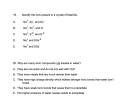 19. Identify the ions present in a crystal of Na2SO4. A. Nat, S2 , and O2 B. Na+, szt, and Na, s-2, and 0-2 C. D. Na+ and S04-2 E. Na+ and S04 20. Why are many ionic compounds not soluble in water? A. They are non-polar and do not mix well with H2O B. They have metals that are much denser than water C. They have high charge density which makes stronger ionic bonds that water can't break D....
19. Identify the ions present in a crystal of Na2SO4. A. B C Na*, S2", and...
 19. Identify the ions present in a crystal of Na2SO4. A. B C Na*, S2", and O2 Na, S2, and o Na*, s2, and 0-2 Na and S04-2 Na* and S04 D. E. I 20. Why are many ionic compounds not soluble in water? A. They are non-polar and do not mix well with H20 B. They have metals that are much denser than water C. They have high charge density which makes stronger ionic bonds that water can't break...
SOLUTIONS 22. Non-polar compounds are soluble in ionic compounds b) electrolytes c) polar solvents d) non-polar...
 SOLUTIONS 22. Non-polar compounds are soluble in ionic compounds b) electrolytes c) polar solvents d) non-polar solvents 23. Which of the following would increase the solubility of gaseous O2 in water? (there is more than correct answer, mark them all!) Decreasing the temperature of the solution Increasing the temperature of the solution Decreasing the pressure of the solution Increasing the pressure of the solution 24. Which of the following describes an unsaturated solution? A solution that has less than the...
Organic compounds are always polar and dissolve in water True False Question 2 1 pts Inorganic...
 Organic compounds are always polar and dissolve in water True False Question 2 1 pts Inorganic salts are usually polar and soluble in water O True False Question 3 1 pts What kind of bonds do we usually find in organic hydrocarbons? non polar covalent bonds polar covalent bonds polar ionic bonds coordinated bonds
7. If an ionic bond is stronger than a dipole-dipole interaction, how can water dissolve an...
7. If an ionic bond is stronger than a dipole-dipole interaction, how can water dissolve an ionic compound? None of these The ion-dipole interactions of a bunch of water molecules gang up on the strong ionic bond and pull it into the solution. The ions never overcome their interatomic attraction and therefore are not soluble. The ionic bond is weakened by the ion-dipole interactions and ionic repulsion ejects the ions from the crystal. The ion-dipole...
I performed an experiment recently, and found potassium nitrate (KNO3) to be soluble in water but...
I performed an experiment recently, and found potassium nitrate (KNO3) to be soluble in water but not hexane; and to have a red/green light color and insensity and a strong conductor (conductivity). But potassium nitrate I found is non-polar, I thought non-polar molecules didn't dissolve in water and are generally weak conductors? please explain how this is possible, thank you. NOTE: I know KNO3 is ionic, and most ionic bonds are polar; so, I'm confused as to how it is...
question 9.5) can someone please explain to me why CaCO3 is soluble in water and not...
 question 9.5)
can someone please explain to me why CaCO3 is soluble in water
and not carbon tetrachloride (CCl4)? thank you ?!
9.35 9.50 9.379.39 9.67 9.41 9.43 9.459.479.499.55 9.57 9.1 Identify the solute and the solvent in each solution composed of the following: a. 10.0 g of NaCl and 100.0 g of H, O b. 50.0 mL of ethanol, C, H, O, and 10.0 mL of H, O c. 0.20 L of O, and 0.80 L of N2 9.5...
question 9.5)
can someone please explain to me why CaCO3 is soluble in water
and not carbon tetrachloride (CCl4)? thank you ?!
9.35 9.50 9.379.39 9.67 9.41 9.43 9.459.479.499.55 9.57 9.1 Identify the solute and the solvent in each solution composed of the following: a. 10.0 g of NaCl and 100.0 g of H, O b. 50.0 mL of ethanol, C, H, O, and 10.0 mL of H, O c. 0.20 L of O, and 0.80 L of N2 9.5...
2. Why do ionic substances with higher lattice energies tend to be less soluble in water...
 2. Why do ionic substances with higher lattice energies tend to be less soluble in water than substances with lower lattice energies? 3. Which would you expect to have the larger hydration energy, SO or CIOA? Explain. 4. Ethyl alcohol, CH CH2OH, is miscible with water at 20°C, but pentyl alcohol, CH3CH2CH2CH2CH2OH, is soluble in water only to the extent of 2.7 g/100 ml. Explain.
6) All of the following compounds are soluble in water EXCEPT: B) NaCl. C) NH40 A) Paz. D) FeCl3 Eco, 7) If you had...
 6) All of the following compounds are soluble in water EXCEPT: B) NaCl. C) NH40 A) Paz. D) FeCl3 Eco, 7) If you had an aqueous mixture that contained As, K, and Pb * cations, how many diff solids could precipitate if a chloride solution was added? y different A) 1 B) 2 C) 3 D) 4 E) no solids will precipitate 8) Considering the following precipitation reaction: Pb(NO3)2(aq) + 2Kl(aq) -- Pbly(s) +2KNO3(aq) Which ion would NOT be present...
 19. Identify the ions present in a crystal of Na2SO4. A. Nat, S2 , and O2 B. Na+, szt, and Na, s-2, and 0-2 C. D. Na+ and S04-2 E. Na+ and S04 20. Why are many ionic compounds not soluble in water? A. They are non-polar and do not mix well with H2O B. They have metals that are much denser than water C. They have high charge density which makes stronger ionic bonds that water can't break D....
 19. Identify the ions present in a crystal of Na2SO4. A. B C Na*, S2", and O2 Na, S2, and o Na*, s2, and 0-2 Na and S04-2 Na* and S04 D. E. I 20. Why are many ionic compounds not soluble in water? A. They are non-polar and do not mix well with H20 B. They have metals that are much denser than water C. They have high charge density which makes stronger ionic bonds that water can't break...
 SOLUTIONS 22. Non-polar compounds are soluble in ionic compounds b) electrolytes c) polar solvents d) non-polar solvents 23. Which of the following would increase the solubility of gaseous O2 in water? (there is more than correct answer, mark them all!) Decreasing the temperature of the solution Increasing the temperature of the solution Decreasing the pressure of the solution Increasing the pressure of the solution 24. Which of the following describes an unsaturated solution? A solution that has less than the...
 Organic compounds are always polar and dissolve in water True False Question 2 1 pts Inorganic salts are usually polar and soluble in water O True False Question 3 1 pts What kind of bonds do we usually find in organic hydrocarbons? non polar covalent bonds polar covalent bonds polar ionic bonds coordinated bonds
 question 9.5)
can someone please explain to me why CaCO3 is soluble in water
and not carbon tetrachloride (CCl4)? thank you ?!
9.35 9.50 9.379.39 9.67 9.41 9.43 9.459.479.499.55 9.57 9.1 Identify the solute and the solvent in each solution composed of the following: a. 10.0 g of NaCl and 100.0 g of H, O b. 50.0 mL of ethanol, C, H, O, and 10.0 mL of H, O c. 0.20 L of O, and 0.80 L of N2 9.5...
question 9.5)
can someone please explain to me why CaCO3 is soluble in water
and not carbon tetrachloride (CCl4)? thank you ?!
9.35 9.50 9.379.39 9.67 9.41 9.43 9.459.479.499.55 9.57 9.1 Identify the solute and the solvent in each solution composed of the following: a. 10.0 g of NaCl and 100.0 g of H, O b. 50.0 mL of ethanol, C, H, O, and 10.0 mL of H, O c. 0.20 L of O, and 0.80 L of N2 9.5...
 2. Why do ionic substances with higher lattice energies tend to be less soluble in water than substances with lower lattice energies? 3. Which would you expect to have the larger hydration energy, SO or CIOA? Explain. 4. Ethyl alcohol, CH CH2OH, is miscible with water at 20°C, but pentyl alcohol, CH3CH2CH2CH2CH2OH, is soluble in water only to the extent of 2.7 g/100 ml. Explain.
 6) All of the following compounds are soluble in water EXCEPT: B) NaCl. C) NH40 A) Paz. D) FeCl3 Eco, 7) If you had an aqueous mixture that contained As, K, and Pb * cations, how many diff solids could precipitate if a chloride solution was added? y different A) 1 B) 2 C) 3 D) 4 E) no solids will precipitate 8) Considering the following precipitation reaction: Pb(NO3)2(aq) + 2Kl(aq) -- Pbly(s) +2KNO3(aq) Which ion would NOT be present...
Most questions answered within 3 hours.
-
Where is the error in this code sequence?
String s1 = "Hello";
String s2 = "ello";...
asked 11 months ago -
Financial data for Joel de Paris, Inc., for last year
follow:
Joel de Paris, Inc.
Balance...
asked 11 months ago -
Consider this reaction:
Al2(SO4)3 (aq)+ BaCl3
(aq) Al2Cl6 (aq)- +
3BaSO4(s) . What is the...
asked 11 months ago -
Suppose that Savneet is considering increasing her
recent random sample from 20 car rentals to 40...
asked 11 months ago -
Trucks arrive at an unloading terminal at an average rate of 120
per hour.
Trucks arrive...
asked 11 months ago -
Why are methanol and ethanol completely soluble in water while
octanol is not very little soluble....
asked 11 months ago -
A facilities manager at a university reads in a research report
that the mean amount of...
asked 11 months ago -
When the CuSO4 is rehydrated by adding water to the anhydrous
compound, is this an endothermic...
asked 11 months ago -
A ray of sunlight is passing from diamond into crown glass; the
angle of incidence is...
asked 11 months ago -
A block of mass 0.249 kg is placed on top of a light, vertical
spring of...
asked 11 months ago -
how do the kidneys compensate in the presences of acidosis
a) trigger hyperventilate
b) reserve acid...
asked 11 months ago -
Question 501 pts
The rental rate of capital to the firm increases. Which of the
following...
asked 11 months ago