the reaction, acetaldehyde + NADH + H+ --> ethanol + NAD+, occurs during? 1. aerobic catabolism...
the reaction, acetaldehyde + NADH + H+ --> ethanol + NAD+, occurs during?
1. aerobic catabolism of glucose
2.preparation phase of glycolysis
3. anaerobic catabolism of glucose in muscle cells
4. anaerobic catabolism of glucose in yeast
Homework Answers
Request Answer!
We need at least 10 more requests to produce the answer.
0 / 10 have requested this problem solution
The more requests, the faster the answer.
Add Answer to:
the reaction, acetaldehyde + NADH + H+ --> ethanol + NAD+,
occurs during?
1. aerobic catabolism...
A) In this reaction, Acetaldehyde + NADH + H+ --> ethanol + NAD+ 1. Acetaldehyde is...
A) In this reaction, Acetaldehyde + NADH + H+ --> ethanol + NAD+ 1. Acetaldehyde is the reducing agent 2. Acetaldehyde is the oxidizing agent 3. NAD+ is oxidized 4. NADH is the oxidizing agent B) In ATP synthase complex, the F0 portion: 1. serves as proton channel 2. goes through conformational change to release ATP 3. oversees transport of ATP from mitochondria of eukaryotic cells 4. pumps proton against concentration gradient
Alcohol dehydrogenase detoxifies ethanol in two steps. First, ethanol is oxidized to acetaldehyde, which is coupled...
 Alcohol dehydrogenase detoxifies ethanol in two steps. First, ethanol is oxidized to acetaldehyde, which is coupled with the reduction of NAD' to NADH. Second, acetaldehyde is oxidized to acetate, which process also produces an NADH molecule. Under anaerobic conditions, muscle cells needing extra energy couple the reduction of pyruvate to lactate with the oxidation of NADH to NAD*. The NAD is then shuttled to the anaerobic glycolysis reactions which produce a small amount of ATP. One common side effect of...
A suspension of yeast cells is being grown under anaerobic conditions such that glucose is degraded...
A suspension of yeast cells is being grown under anaerobic conditions such that glucose is degraded to ethanol and carbon dioxide. Adding an inhibitor of alcohol dehydrogenase to the yeast cell suspension results in rapid cell death. Why? a.) Without alcohol dehydrogenase, the acetaldehyde concentration increases to levels that are toxic to the yeast cells. b.) NADH generated during glycolysis cannot be recycled back to NAD+, thus anaerobic ATP production through glycolysis cannot be maintained. c.) Pyruvate is no longer...
gets reduced 20. glucose + ATP > glucose-6 phosphate +ADP In the above reaction, - A....
 gets reduced 20. glucose + ATP > glucose-6 phosphate +ADP In the above reaction, - A. ADPIATP B. ATP/glucose C. glucose/glucose-6 phosphate D. glucose6-phosphate/glucose E. glucose/ATP 21. Which of the following is a net product of glycolysis? A. ATP B. NAD+ C. pyruvate D. CO2 E. A&C 22. Substrate-level phosphorylation occurs in the process of A. Oxidative phosphorylation B. electron transport chain C. glycolysis D. ATP-synthase function E. C&D 23. What should your hypothesis be for "Do yeast produce ethanol...
- Attempt 1 ar Respiration and fermentation summary ③ 3 ott Part C - Fermentation -...
 - Attempt 1 ar Respiration and fermentation summary ③ 3 ott Part C - Fermentation - ATP production in the absence of oxygen Under anaerobic conditions (a lack of oxygen), glycolysis continues in most cells deste the fact that oxidative phosphorylation stops and its production of NAD (which is needed as an input to glycolysis) also stops. The diagram Vlustrates the process of fermentation which is used by many cols in the absence of oxygen In fermentation, the NADH produced...
The body can break down alcohol through the following reaction: ethanol + NAD +→ acetadehyde +...
 The body can break down alcohol through the following reaction:
ethanol + NAD +→ acetadehyde + NADH + H+ Calculate Delta G* for
this reaction at 25C.
The standard reduction potentials are:
ethanol →acetaldehyde + 2H+ + 2e- E = -0.197V
NAD+ + H+ + 2e- → NADH E= -0.320V
1. The body can break down alcohol through the following reaction: ethanol + NAD* acetadehyde + NADH+H* Calculate AGº for this reaction at 25°C. The standard reduction potentials are: ethanol...
The body can break down alcohol through the following reaction:
ethanol + NAD +→ acetadehyde + NADH + H+ Calculate Delta G* for
this reaction at 25C.
The standard reduction potentials are:
ethanol →acetaldehyde + 2H+ + 2e- E = -0.197V
NAD+ + H+ + 2e- → NADH E= -0.320V
1. The body can break down alcohol through the following reaction: ethanol + NAD* acetadehyde + NADH+H* Calculate AGº for this reaction at 25°C. The standard reduction potentials are: ethanol...
which is true? 1. catabolism of glucose is endergonic 2. glycolysis is aerobic and produced ATP...
which is true? 1. catabolism of glucose is endergonic 2. glycolysis is aerobic and produced ATP by oxidative phosphorlyation 3. phosphofructokinases can exist in different permutations 4. during cellular respiration, glucose is reduced to CO2, and either O2 or organic molecule is oxidized An abundance of which increases activity of pyruvate dehydrogenase? 1. ADP 2.NADH 3. lipoic acid 4. TPP
In which of the following metabolic conversions is ATP "consumed" during glycolysis? During glycolysis, the steps...
 In which of the following metabolic conversions is ATP "consumed" during glycolysis? During glycolysis, the steps between glucose and formation of the triose phosphates In skeletal muscle cells, the NADH that is produced by glycolysis under anaerobic conditions (vigorous exercise) is regenerated to NAD^+ by the conversion of:
The conversion of ethanol to acetaldehyde within the liver is a zeroth-order reaction: CH3CH2OH NAD Ht CH3C(O)H +NADH...
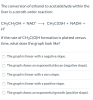 The conversion of ethanol to acetaldehyde within the liver is a zeroth-order reaction: CH3CH2OH NAD Ht CH3C(O)H +NADH + If the rate of CH3C(O)H formation is plotted versus time, what does the graph look like? OThe graph is linear with a negative slope. OThe graph shows an exponential decay (negative slope) OThe graph is linear with a zero slope. OThe graph is linear with a positive slope. OThe graph shows an exponential growth (positive slope). The hydrolysis of sucrose (C12H22011)...
NADH --> NAD+ + 2e- + H+ Question options: demonstrates that NADH can reduce to other...
NADH --> NAD+ + 2e- + H+ Question options: demonstrates that NADH can reduce to other molecules is the equation for the reduction of NADH is the equation for the oxidation of NADH demonstrates that NADH can donate e- to other molecules Glycolysis results in Question options: the synthesis of ATP via substrate-level phosphorylation the complete oxidation of glucose the reduction of electron carriers the sythesis of ATP via oxidative phosphorylation Pyruvate oxidation (which happens twice for every molecule of...
 Alcohol dehydrogenase detoxifies ethanol in two steps. First, ethanol is oxidized to acetaldehyde, which is coupled with the reduction of NAD' to NADH. Second, acetaldehyde is oxidized to acetate, which process also produces an NADH molecule. Under anaerobic conditions, muscle cells needing extra energy couple the reduction of pyruvate to lactate with the oxidation of NADH to NAD*. The NAD is then shuttled to the anaerobic glycolysis reactions which produce a small amount of ATP. One common side effect of...
 gets reduced 20. glucose + ATP > glucose-6 phosphate +ADP In the above reaction, - A. ADPIATP B. ATP/glucose C. glucose/glucose-6 phosphate D. glucose6-phosphate/glucose E. glucose/ATP 21. Which of the following is a net product of glycolysis? A. ATP B. NAD+ C. pyruvate D. CO2 E. A&C 22. Substrate-level phosphorylation occurs in the process of A. Oxidative phosphorylation B. electron transport chain C. glycolysis D. ATP-synthase function E. C&D 23. What should your hypothesis be for "Do yeast produce ethanol...
 - Attempt 1 ar Respiration and fermentation summary ③ 3 ott Part C - Fermentation - ATP production in the absence of oxygen Under anaerobic conditions (a lack of oxygen), glycolysis continues in most cells deste the fact that oxidative phosphorylation stops and its production of NAD (which is needed as an input to glycolysis) also stops. The diagram Vlustrates the process of fermentation which is used by many cols in the absence of oxygen In fermentation, the NADH produced...
 The body can break down alcohol through the following reaction:
ethanol + NAD +→ acetadehyde + NADH + H+ Calculate Delta G* for
this reaction at 25C.
The standard reduction potentials are:
ethanol →acetaldehyde + 2H+ + 2e- E = -0.197V
NAD+ + H+ + 2e- → NADH E= -0.320V
1. The body can break down alcohol through the following reaction: ethanol + NAD* acetadehyde + NADH+H* Calculate AGº for this reaction at 25°C. The standard reduction potentials are: ethanol...
The body can break down alcohol through the following reaction:
ethanol + NAD +→ acetadehyde + NADH + H+ Calculate Delta G* for
this reaction at 25C.
The standard reduction potentials are:
ethanol →acetaldehyde + 2H+ + 2e- E = -0.197V
NAD+ + H+ + 2e- → NADH E= -0.320V
1. The body can break down alcohol through the following reaction: ethanol + NAD* acetadehyde + NADH+H* Calculate AGº for this reaction at 25°C. The standard reduction potentials are: ethanol...
 In which of the following metabolic conversions is ATP "consumed" during glycolysis? During glycolysis, the steps between glucose and formation of the triose phosphates In skeletal muscle cells, the NADH that is produced by glycolysis under anaerobic conditions (vigorous exercise) is regenerated to NAD^+ by the conversion of:
 The conversion of ethanol to acetaldehyde within the liver is a zeroth-order reaction: CH3CH2OH NAD Ht CH3C(O)H +NADH + If the rate of CH3C(O)H formation is plotted versus time, what does the graph look like? OThe graph is linear with a negative slope. OThe graph shows an exponential decay (negative slope) OThe graph is linear with a zero slope. OThe graph is linear with a positive slope. OThe graph shows an exponential growth (positive slope). The hydrolysis of sucrose (C12H22011)...
Most questions answered within 3 hours.
-
Where is the error in this code sequence?
String s1 = "Hello";
String s2 = "ello";...
asked 10 months ago -
Financial data for Joel de Paris, Inc., for last year
follow:
Joel de Paris, Inc.
Balance...
asked 10 months ago -
Consider this reaction:
Al2(SO4)3 (aq)+ BaCl3
(aq) Al2Cl6 (aq)- +
3BaSO4(s) . What is the...
asked 10 months ago -
Suppose that Savneet is considering increasing her
recent random sample from 20 car rentals to 40...
asked 10 months ago -
Trucks arrive at an unloading terminal at an average rate of 120
per hour.
Trucks arrive...
asked 10 months ago -
Why are methanol and ethanol completely soluble in water while
octanol is not very little soluble....
asked 10 months ago -
A facilities manager at a university reads in a research report
that the mean amount of...
asked 10 months ago -
When the CuSO4 is rehydrated by adding water to the anhydrous
compound, is this an endothermic...
asked 10 months ago -
A ray of sunlight is passing from diamond into crown glass; the
angle of incidence is...
asked 10 months ago -
A block of mass 0.249 kg is placed on top of a light, vertical
spring of...
asked 10 months ago -
how do the kidneys compensate in the presences of acidosis
a) trigger hyperventilate
b) reserve acid...
asked 10 months ago -
Question 501 pts
The rental rate of capital to the firm increases. Which of the
following...
asked 10 months ago