1.Explain why it does not make sense to evaluate log( − 3 ) . 2.Why is...
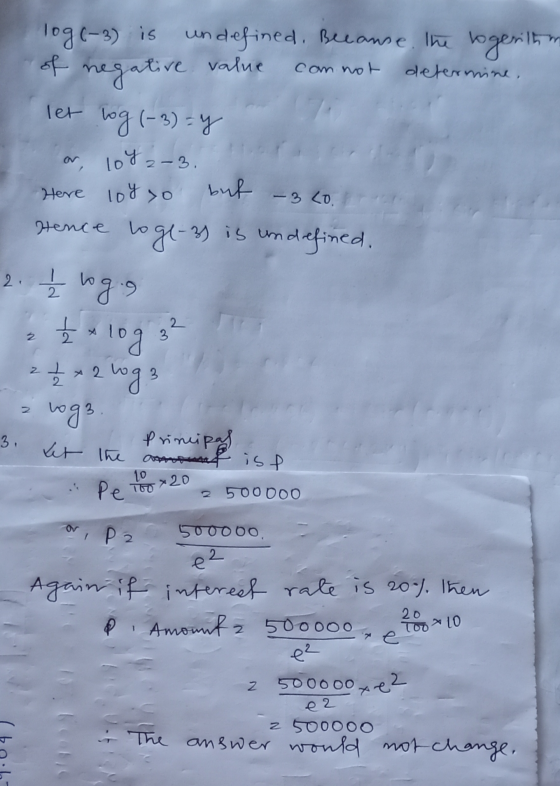
1.Explain why it does not make sense to evaluate log( − 3 ) .
2.Why is log 3 = 1/2 ⋅ log 9?
3.In the WebAssign for this section homework you calculated the amount of money you would need to invest at 10% compounded continuously to have $500,000 in 20 years. Would the answer change if the money were invested at 20% compounded continuously for 10 years? Why or why not?
Homework Answers
Add Answer to:
1.Explain why it does not make sense to evaluate log( − 3 )
.
2.Why is...
1.plain why it does not make sense to evaluate log ( − 3 ) . 2.What...
1.plain why it does not make sense to evaluate log ( − 3 ) . 2.What steps must be done to permit changing y = − log x into exponential form?
Thank you for the help! 10. Solve: 20102-'=5 (b) 3- 272 (a) 11. Solve: log, (x+...
 Thank you for the help!
10. Solve: 20102-'=5 (b) 3- 272 (a) 11. Solve: log, (x+ 4)+log, (r -4)-logs 20 12. Karen wants to invest $10,000 in a CD account. One plan offers 5.15% compounded monthly. Another offers 5% compounded continuously. a. Calculate the future value of the plan that offers 5.15% compounded monthly for, 17 b. Calculate the future value of the plan that offers 5% compounded continuously fort 1? Which plan eans more interest? How much more? c.If...
Thank you for the help!
10. Solve: 20102-'=5 (b) 3- 272 (a) 11. Solve: log, (x+ 4)+log, (r -4)-logs 20 12. Karen wants to invest $10,000 in a CD account. One plan offers 5.15% compounded monthly. Another offers 5% compounded continuously. a. Calculate the future value of the plan that offers 5.15% compounded monthly for, 17 b. Calculate the future value of the plan that offers 5% compounded continuously fort 1? Which plan eans more interest? How much more? c.If...
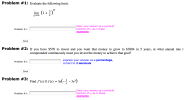
Please answer all three questions. Problem #1: Evaluate the following limit. Problem #1: Enter your answer...
 Please answer all three questions.
Problem #1: Evaluate the following limit. Problem #1: Enter your answer as a symbolic function of t, as in these examples Save Problem #2: If you have $570 to invest and you want that money to grow to $3804 in 5 years, at what annual rate r compounded continuously must you invest the money to achieve that goal? Problem #2: express your answer as a percentage, correct to 2 decimals Save Problem #3: Find f'(x)...
Please answer all three questions.
Problem #1: Evaluate the following limit. Problem #1: Enter your answer as a symbolic function of t, as in these examples Save Problem #2: If you have $570 to invest and you want that money to grow to $3804 in 5 years, at what annual rate r compounded continuously must you invest the money to achieve that goal? Problem #2: express your answer as a percentage, correct to 2 decimals Save Problem #3: Find f'(x)...
Compounded Continuously 1. How much money will be in the account after 5 years if $2030...
 Compounded Continuously 1. How much money will be in the account after 5 years if $2030 is deposited at 4% compounded continuously? 2. Determine the amount of interest earned in 5 years if $2030 is deposited at 4% compounded continuously? 3. Inflation is running at 0.8% per month when you deposit $3000 in an account earning 6% compounded continuously. In constant dollars, how much will you have 2 years from now? 4. Find the present value of $12,075 if money...
LOGARITHMIC AND EXPONENTIAL FUNCTIONS. (ANSWER BASED ON CHAPTER OBJECTIVES: Define an exponential function. Evaluate an exponential...
LOGARITHMIC AND EXPONENTIAL FUNCTIONS. (ANSWER BASED ON CHAPTER OBJECTIVES: Define an exponential function. Evaluate an exponential expression using the properties of exponents. Simplify an exponential expression using the properties of exponents. Solve an exponential equation. Find the derivative of exponential functions. Define a logarithmic function. Evaluate a logarithmic expression using the properties of logarithms. Simplify a logarithmic expression using the properties of logarithms. Solve a logarithmic equation. Find the derivative of logarithmic functions.) The two graphs attached show the relationship...
You are advising a co-worker on saving for retirement. The co-worker gives you two possible scenarios: Scenario 1: Suppo...
You are advising a co-worker on saving for retirement. The co-worker gives you two possible scenarios: Scenario 1: Suppose you invest $170 a month for 6 years into an account earning 10% compounded monthly. After 6 years, you leave the money, without making additional deposits, in the account for another 22 years. How much will you have in the end? Scenario 2: Suppose instead you didn't invest anything for the first 6 years, then deposited $170 a month for 22...
1) The amount of money earned by an investment of principal P with an (annual) interest...
1) The amount of money earned by an investment of principal P with an (annual) interest rate of r with interest compute continuously is given by P ert where t is the investment in years. In the following, all amounts are invested in accounts where interest is compounded continuously. (a) (15 pts) Assume that Alice invests $50000 at an interest rate of 5%. Create a table that lists her income for t = 1, 2, . . . 5 (b)...
Please I need aclarify answers with details in all the questions. Thank you 1. Newborn baby...
 Please I need aclarify answers with details in all the
questions. Thank you
1. Newborn baby Gregory, born today, has doting grandparents who education. They calculate that he will need S25,000 per year for 4 years beginning at age 18. In addition, they'd like to give him a lump sum of S50,000 at age 22 so he can buy a car for his graduation. They want to make 18 equal annual payments into a 10% interest-paying account (starting today and...
Please I need aclarify answers with details in all the
questions. Thank you
1. Newborn baby Gregory, born today, has doting grandparents who education. They calculate that he will need S25,000 per year for 4 years beginning at age 18. In addition, they'd like to give him a lump sum of S50,000 at age 22 so he can buy a car for his graduation. They want to make 18 equal annual payments into a 10% interest-paying account (starting today and...
1. Suppose you accumulated $500,000, perhaps from many years of saving. You put the money in...
1. Suppose you accumulated $500,000, perhaps from many years of saving. You put the money in a savings plan earning 6% compounded monthly. If you want to withdraw $4,000 at the beginning of each month, how long before the savings plan is exhausted? 2. Suppose you accumulated $500,000, perhaps from many years of saving. You put the money in a savings plan earning 6% compounded monthly. If you want the plan to last 40 years, how much can you withdraw...
1 Due Date: October 31, 2019 PGE 411 Homewok-3 3. It is desired to make an...
1 Due Date: October 31, 2019 PGE 411 Homewok-3 3. It is desired to make an initial lump sum investment that will provide for a withdrawal of $500 at the end of year 1, $600 at the end of year 2, and amounts increasing $100 per year to a final $2400 at the end of year 20. How great an initial investment will be required if it earns 12% compounded annually? 4. It is desired to invest a lump sum...
 Thank you for the help!
10. Solve: 20102-'=5 (b) 3- 272 (a) 11. Solve: log, (x+ 4)+log, (r -4)-logs 20 12. Karen wants to invest $10,000 in a CD account. One plan offers 5.15% compounded monthly. Another offers 5% compounded continuously. a. Calculate the future value of the plan that offers 5.15% compounded monthly for, 17 b. Calculate the future value of the plan that offers 5% compounded continuously fort 1? Which plan eans more interest? How much more? c.If...
Thank you for the help!
10. Solve: 20102-'=5 (b) 3- 272 (a) 11. Solve: log, (x+ 4)+log, (r -4)-logs 20 12. Karen wants to invest $10,000 in a CD account. One plan offers 5.15% compounded monthly. Another offers 5% compounded continuously. a. Calculate the future value of the plan that offers 5.15% compounded monthly for, 17 b. Calculate the future value of the plan that offers 5% compounded continuously fort 1? Which plan eans more interest? How much more? c.If...
 Please answer all three questions.
Problem #1: Evaluate the following limit. Problem #1: Enter your answer as a symbolic function of t, as in these examples Save Problem #2: If you have $570 to invest and you want that money to grow to $3804 in 5 years, at what annual rate r compounded continuously must you invest the money to achieve that goal? Problem #2: express your answer as a percentage, correct to 2 decimals Save Problem #3: Find f'(x)...
Please answer all three questions.
Problem #1: Evaluate the following limit. Problem #1: Enter your answer as a symbolic function of t, as in these examples Save Problem #2: If you have $570 to invest and you want that money to grow to $3804 in 5 years, at what annual rate r compounded continuously must you invest the money to achieve that goal? Problem #2: express your answer as a percentage, correct to 2 decimals Save Problem #3: Find f'(x)...
 Compounded Continuously 1. How much money will be in the account after 5 years if $2030 is deposited at 4% compounded continuously? 2. Determine the amount of interest earned in 5 years if $2030 is deposited at 4% compounded continuously? 3. Inflation is running at 0.8% per month when you deposit $3000 in an account earning 6% compounded continuously. In constant dollars, how much will you have 2 years from now? 4. Find the present value of $12,075 if money...
 Please I need aclarify answers with details in all the
questions. Thank you
1. Newborn baby Gregory, born today, has doting grandparents who education. They calculate that he will need S25,000 per year for 4 years beginning at age 18. In addition, they'd like to give him a lump sum of S50,000 at age 22 so he can buy a car for his graduation. They want to make 18 equal annual payments into a 10% interest-paying account (starting today and...
Please I need aclarify answers with details in all the
questions. Thank you
1. Newborn baby Gregory, born today, has doting grandparents who education. They calculate that he will need S25,000 per year for 4 years beginning at age 18. In addition, they'd like to give him a lump sum of S50,000 at age 22 so he can buy a car for his graduation. They want to make 18 equal annual payments into a 10% interest-paying account (starting today and...
Most questions answered within 3 hours.
-
Where is the error in this code sequence?
String s1 = "Hello";
String s2 = "ello";...
asked 10 months ago -
Financial data for Joel de Paris, Inc., for last year
follow:
Joel de Paris, Inc.
Balance...
asked 10 months ago -
Consider this reaction:
Al2(SO4)3 (aq)+ BaCl3
(aq) Al2Cl6 (aq)- +
3BaSO4(s) . What is the...
asked 10 months ago -
Suppose that Savneet is considering increasing her
recent random sample from 20 car rentals to 40...
asked 10 months ago -
Trucks arrive at an unloading terminal at an average rate of 120
per hour.
Trucks arrive...
asked 10 months ago -
Why are methanol and ethanol completely soluble in water while
octanol is not very little soluble....
asked 10 months ago -
A facilities manager at a university reads in a research report
that the mean amount of...
asked 10 months ago -
When the CuSO4 is rehydrated by adding water to the anhydrous
compound, is this an endothermic...
asked 10 months ago -
A ray of sunlight is passing from diamond into crown glass; the
angle of incidence is...
asked 10 months ago -
A block of mass 0.249 kg is placed on top of a light, vertical
spring of...
asked 10 months ago -
how do the kidneys compensate in the presences of acidosis
a) trigger hyperventilate
b) reserve acid...
asked 10 months ago -
Question 501 pts
The rental rate of capital to the firm increases. Which of the
following...
asked 10 months ago