![Question 30 < For the reaction 3 A + 4 B → 2 C + 4 D, what is the magnitude of the rate of change for [D] when [C] is increas](http://img.homeworklib.com/questions/52656a40-f053-11ea-81fe-03bd25474439.png?x-oss-process=image/resize,w_560)
Homework Answers
![Rate of increase of [C] 2 M/s From reaction stoichiometry, 4* Rate of increase of [D] = 2* Rate of increase of [C] Rate of in](http://img.homeworklib.com/questions/be837720-f053-11ea-9702-efd2fc1a3597.png?x-oss-process=image/resize,w_560)
< Question 4 of 12 > Attempt 3 - Consider a general reaction enzyme A(aq) B(aq)...
 < Question 4 of 12 > Attempt 3 - Consider a general reaction enzyme A(aq) B(aq) The AG® of the reaction is - 7.100 kJ. mol-'. Calculate the equilibrium constant for the reaction at 25°C. Kg = 1.003 What is AG for the reaction at body temperature (37.0 °C) if the concentration of A is 1.8 M and the concentration of B is 0.80 M? J. mol-' AG = 0.621 he
For the reaction 2 A + 4 B → 2C + 4D, what is the absolute...
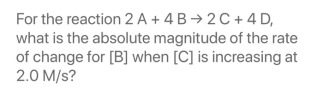 For the reaction 2 A + 4 B → 2C + 4D, what is the absolute magnitude of the rate of change for [B] when [C] is increasing at 2.0 M/s?
Score: < Question 2 of 3 > For the reaction 2 NH,(g) = 3H2(g) + N...
 Score: < Question 2 of 3 > For the reaction 2 NH,(g) = 3H2(g) + N (8) the equilibrium concentrations were found to be [NH,] = 0.250 M, [H.] = 0.310 M, and [N] = 0.800 equilibrium constant for this reaction?
For the reaction CHs (a) 3 H2 (a) <=---> CgH,2 (a) + heat Determine which of the following will shift the equ...
 For the reaction CHs (a) 3 H2 (a) <=---> CgH,2 (a) + heat Determine which of the following will shift the equilibrium to the left a) adding a catalyst b) decreasing the temperature c) increasing the pressure by decreasing the volume of the container d) increasing the concentration of H2 e) increasing the concentration of CeHe f) decreasing the concentration of C H12 g) more than one correct response h) no correct response O0000O
For the reaction 2 A(aq) <---> B(aq) + C(aq), the standard Gibbs free enthalpy change is...
 For the reaction 2 A(aq) <---> B(aq) + C(aq), the standard
Gibbs free enthalpy change is 1.47 kJ at 25oC. The initial
concentration of A(aq) is 0.567 M, the initial concentration of
B(aq) is 0.303 M, and the initial concentration of C(aq) is 0.219
M. What would be the concentration of A(aq) (in mol/L) once we
attain equilibrium (we are still at 25oC)?
Question 2 : For the reaction 2 A(aq) <---> B(aq) + C(aq), the standard Gibbs free enthalpy...
For the reaction 2 A(aq) <---> B(aq) + C(aq), the standard
Gibbs free enthalpy change is 1.47 kJ at 25oC. The initial
concentration of A(aq) is 0.567 M, the initial concentration of
B(aq) is 0.303 M, and the initial concentration of C(aq) is 0.219
M. What would be the concentration of A(aq) (in mol/L) once we
attain equilibrium (we are still at 25oC)?
Question 2 : For the reaction 2 A(aq) <---> B(aq) + C(aq), the standard Gibbs free enthalpy...
Indicate whether the actions below will shift the following reaction: RIGHT, LEFT or NO CHANGE. Heat...
 Indicate whether the actions below will shift the following reaction: RIGHT, LEFT or NO CHANGE. Heat + NH4CO2NHz(s) <=> 2 NH3(g) + CO2(g) Increasing the quantity of NH4CO2NH2(s) Removing CO2(g) Increasing the volume of the container Increasing the temperature Adding a catalyst right left no change
< Question 3 of 11 > Consider the reaction. PCI,(g) =PCI,(g) + CI,(g) K = 0.0420...
 < Question 3 of 11 > Consider the reaction. PCI,(g) =PCI,(g) + CI,(g) K = 0.0420 The concentrations of the products at equilibrium are [PC13) = 0.130 M and [Cl] = 0.140 M. What is the reactant, PCls, at equilibrium? (PCI) = C [PC1s] = M
< 2. Determine the exact value of sec 23 b. 2 V3 2. c. d. NI...
 < 2. Determine the exact value of sec 23 b. 2 V3 2. c. d. NI 3 2
Question 2 of 23. Answers A&B please. <Chapter 10 Homework s Solution... C Exercise 10.12 ching...
 Question 2 of 23. Answers A&B please.
<Chapter 10 Homework s Solution... C Exercise 10.12 ching Increase... Constants | Periodic Table Assume all temperatures to be exact, and neglect significant figures for small changes in dimension. 472 1: 950
Question 2 of 23. Answers A&B please.
<Chapter 10 Homework s Solution... C Exercise 10.12 ching Increase... Constants | Periodic Table Assume all temperatures to be exact, and neglect significant figures for small changes in dimension. 472 1: 950
Source code for the next questions 1. <DOCTYPE html> 2. <html lang-"en"> 3. </head> 4. <Script>...
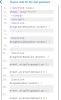 Source code for the next questions 1. <DOCTYPE html> 2. <html lang-"en"> 3. </head> 4. <Script> 5. function dragLeaveHandler (event) 8. function dragEnterHandler (event) 10. 11. function dragOverHandler (event) event.stopPropagation ); event.preventDefault ) 12. 13. 14. 15. function dropHandler (event) event.stopPropagation ); event.preventDefault ) 16
 < Question 4 of 12 > Attempt 3 - Consider a general reaction enzyme A(aq) B(aq) The AG® of the reaction is - 7.100 kJ. mol-'. Calculate the equilibrium constant for the reaction at 25°C. Kg = 1.003 What is AG for the reaction at body temperature (37.0 °C) if the concentration of A is 1.8 M and the concentration of B is 0.80 M? J. mol-' AG = 0.621 he
 For the reaction 2 A + 4 B → 2C + 4D, what is the absolute magnitude of the rate of change for [B] when [C] is increasing at 2.0 M/s?
 Score: < Question 2 of 3 > For the reaction 2 NH,(g) = 3H2(g) + N (8) the equilibrium concentrations were found to be [NH,] = 0.250 M, [H.] = 0.310 M, and [N] = 0.800 equilibrium constant for this reaction?
 For the reaction CHs (a) 3 H2 (a) <=---> CgH,2 (a) + heat Determine which of the following will shift the equilibrium to the left a) adding a catalyst b) decreasing the temperature c) increasing the pressure by decreasing the volume of the container d) increasing the concentration of H2 e) increasing the concentration of CeHe f) decreasing the concentration of C H12 g) more than one correct response h) no correct response O0000O
 For the reaction 2 A(aq) <---> B(aq) + C(aq), the standard
Gibbs free enthalpy change is 1.47 kJ at 25oC. The initial
concentration of A(aq) is 0.567 M, the initial concentration of
B(aq) is 0.303 M, and the initial concentration of C(aq) is 0.219
M. What would be the concentration of A(aq) (in mol/L) once we
attain equilibrium (we are still at 25oC)?
Question 2 : For the reaction 2 A(aq) <---> B(aq) + C(aq), the standard Gibbs free enthalpy...
For the reaction 2 A(aq) <---> B(aq) + C(aq), the standard
Gibbs free enthalpy change is 1.47 kJ at 25oC. The initial
concentration of A(aq) is 0.567 M, the initial concentration of
B(aq) is 0.303 M, and the initial concentration of C(aq) is 0.219
M. What would be the concentration of A(aq) (in mol/L) once we
attain equilibrium (we are still at 25oC)?
Question 2 : For the reaction 2 A(aq) <---> B(aq) + C(aq), the standard Gibbs free enthalpy...
 Indicate whether the actions below will shift the following reaction: RIGHT, LEFT or NO CHANGE. Heat + NH4CO2NHz(s) <=> 2 NH3(g) + CO2(g) Increasing the quantity of NH4CO2NH2(s) Removing CO2(g) Increasing the volume of the container Increasing the temperature Adding a catalyst right left no change
 < Question 3 of 11 > Consider the reaction. PCI,(g) =PCI,(g) + CI,(g) K = 0.0420 The concentrations of the products at equilibrium are [PC13) = 0.130 M and [Cl] = 0.140 M. What is the reactant, PCls, at equilibrium? (PCI) = C [PC1s] = M
 < 2. Determine the exact value of sec 23 b. 2 V3 2. c. d. NI 3 2
 Question 2 of 23. Answers A&B please.
<Chapter 10 Homework s Solution... C Exercise 10.12 ching Increase... Constants | Periodic Table Assume all temperatures to be exact, and neglect significant figures for small changes in dimension. 472 1: 950
Question 2 of 23. Answers A&B please.
<Chapter 10 Homework s Solution... C Exercise 10.12 ching Increase... Constants | Periodic Table Assume all temperatures to be exact, and neglect significant figures for small changes in dimension. 472 1: 950
 Source code for the next questions 1. <DOCTYPE html> 2. <html lang-"en"> 3. </head> 4. <Script> 5. function dragLeaveHandler (event) 8. function dragEnterHandler (event) 10. 11. function dragOverHandler (event) event.stopPropagation ); event.preventDefault ) 12. 13. 14. 15. function dropHandler (event) event.stopPropagation ); event.preventDefault ) 16
Most questions answered within 3 hours.
-
Where is the error in this code sequence?
String s1 = "Hello";
String s2 = "ello";...
asked 10 months ago -
Financial data for Joel de Paris, Inc., for last year
follow:
Joel de Paris, Inc.
Balance...
asked 10 months ago -
Consider this reaction:
Al2(SO4)3 (aq)+ BaCl3
(aq) Al2Cl6 (aq)- +
3BaSO4(s) . What is the...
asked 10 months ago -
Suppose that Savneet is considering increasing her
recent random sample from 20 car rentals to 40...
asked 10 months ago -
Trucks arrive at an unloading terminal at an average rate of 120
per hour.
Trucks arrive...
asked 10 months ago -
Why are methanol and ethanol completely soluble in water while
octanol is not very little soluble....
asked 10 months ago -
A facilities manager at a university reads in a research report
that the mean amount of...
asked 10 months ago -
When the CuSO4 is rehydrated by adding water to the anhydrous
compound, is this an endothermic...
asked 10 months ago -
A ray of sunlight is passing from diamond into crown glass; the
angle of incidence is...
asked 10 months ago -
A block of mass 0.249 kg is placed on top of a light, vertical
spring of...
asked 10 months ago -
how do the kidneys compensate in the presences of acidosis
a) trigger hyperventilate
b) reserve acid...
asked 10 months ago -
Question 501 pts
The rental rate of capital to the firm increases. Which of the
following...
asked 10 months ago