
Homework Answers
PLEASE UPVOTE IF YOU LIKE....THANKS
Add Answer to:
In the Rutherford model of the hydrogen atom, a proton (mass M, charge ) is the...
In the Rutherford model of the hydrogen atom, a proton (mass M, charge ) is the...
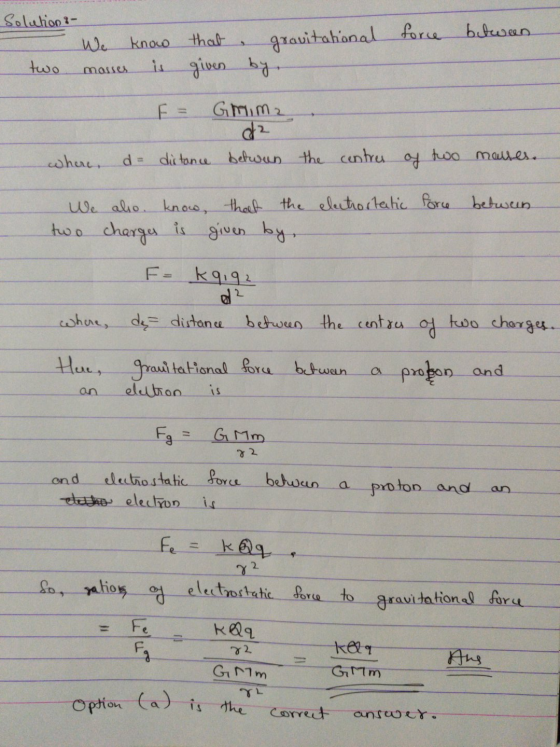
 In the Rutherford model of the hydrogen atom, a proton (mass M, charge ) is the nucleus and an electron (mass m, charge g) moves around the proton in a circle of radius r. Let k denote the Coulomb force constant (1/472) and the universal gravitational constant. The ratio of the electrostatic force to the gravitational force between electron and proton is: Select one: O a. GMm/kQq O b. kQqGM2 O c. kg/GM O d. GOq/k Mon O e. kMme
In the Rutherford model of the hydrogen atom, a proton (mass M, charge Q) is the...
 In the Rutherford model of the hydrogen atom, a proton (mass M, charge Q) is the nucleus and an electron (mass m, charge q) moves around the proton in a circle of radius r. Let k denote the Coulomb force constant (1/4peo) and G the universal gravitational constant. The ratio of the electrostatic force to the gravitational force between electron and proton is: Select one: a. kMm/ GQq b.kQq/GMm c. GQq/kMm d. kQq/GMmr2 e. GMm/kQq
Question 3 Not yet answered Points out of 5.00 P Flag question In the Rutherford model...
 Question 3 Not yet answered Points out of 5.00 P Flag question In the Rutherford model of the hydrogen atom, a proton (mass M, charge ) is the nucleus and an electron (mass m, charge ) moves around the proton in a circle of radius r. Let k denote the Coulomb force constant (1/4peo) and the universal gravitational constant. The ratio of the electrostatic force to the gravitational force between electron and proton is: Select one: a. GQq/kMm O b....
2 Atomic Physics The Rutherford model of an atom asserts that electrons move in circular or...
 2 Atomic Physics The Rutherford model of an atom asserts that electrons move in circular or elliptical orbits about the nucleus They are held in orbit by the Coulomb force. In hydrogen a single electron moves in a circular orbit around a single proton. The radius of a hydrogen atom is 5.3. 10-1 m a) What is the Coulomb force between the proton and the electron? (b) What is the speed of the electron?
5) (2090) The electron is bound to the proton in a hydrogen atom due to the...
 5) (2090) The electron is bound to the proton in a hydrogen atom due to the Coulomb force. Now assume that electric charge did not exist and the electron was bound to the proton by the gravitational force to form a hydrogen atom, please derive the corresponding expressions for (a) (8%) the Bohr radius ao and (b) (7%) energy En, (c) (5%) Compute the smallest frequency of the Balmer series. (G-6.67x10 N mKg')
In the Bohr model of the Hydrogen atom, a single electron orbits around a single proton...
In the Bohr model of the Hydrogen atom, a single electron orbits around a single proton (which constitutes the nucleus). The mass of the electron (9.11x10⁻³¹ kg) is much less than the proton (1.67x10⁻²⁷ kg), so the proton remains stationary while the electron moves around it. If the electron is 6.6x10⁻¹¹ m away from the proton, calculate the magnitude of the electric force (in N) exerted by the proton on the electron. b) [Continued ...] In the Bohr model, an...
1.The nucleus of a hydrogen atom is a single proton, which has a radius of about...
1.The nucleus of a hydrogen atom is a single proton, which has a radius of about 1.6 10-15 m. The single electron in a hydrogen atom normally orbits the nucleus at a distance of 5.2 10-11 m. What is the ratio of the density of the hydrogen nucleus to the density of the complete hydrogen atom? 2.In a Rutherford scattering experiment a target nucleus has a diameter of 2.70 10-14 m. The incoming particle has a mass of 6.64 10-27...
E18M.6 The Rutherford model of the hydrogen atom (pro- posed by Ernst Rutherford in roughly 1910) imagines the electron as orbiting the proton in a circle (a) Use Newton's second law, Coulomb&...
 E18M.6 The Rutherford model of the hydrogen atom (pro- posed by Ernst Rutherford in roughly 1910) imagines the electron as orbiting the proton in a circle (a) Use Newton's second law, Coulomb's law, and what you know about acceleration in circular motion to show that the electron's acceleration in a circular orbit of radius r is ã/(4me,mr) and its orbital kinetic energy is K-72/ (8πεο r), where e is the proton's charge and m is the electron's mass. (b) Show...
Say you have a point charge of one Coulomb and a hydrogen atom some distance away....
Say you have a point charge of one Coulomb and a hydrogen atom some distance away. Within what distance would the difference of forces on the proton and electron from the Coulomb charge exceed the attraction between the proton and electron that holds the hydrogen atom together. Treat the hydrogen atom as a proton and electron 0.53 × 10⁻¹⁰ m (a.k.a., one Bohr radius) apart
Considering hydrogen atom as a electron (mass Me and charge -e) circulates at a proton (...
Considering hydrogen atom as a electron (mass Me and charge -e) circulates at a proton ( mass Mp and charge +e) doing a circular motion with radius r, therefore the total energy of electron=_____, and the magnetic field of circular motion by electron that acts on the proton=______.
 In the Rutherford model of the hydrogen atom, a proton (mass M, charge ) is the nucleus and an electron (mass m, charge g) moves around the proton in a circle of radius r. Let k denote the Coulomb force constant (1/472) and the universal gravitational constant. The ratio of the electrostatic force to the gravitational force between electron and proton is: Select one: O a. GMm/kQq O b. kQqGM2 O c. kg/GM O d. GOq/k Mon O e. kMme
 In the Rutherford model of the hydrogen atom, a proton (mass M, charge Q) is the nucleus and an electron (mass m, charge q) moves around the proton in a circle of radius r. Let k denote the Coulomb force constant (1/4peo) and G the universal gravitational constant. The ratio of the electrostatic force to the gravitational force between electron and proton is: Select one: a. kMm/ GQq b.kQq/GMm c. GQq/kMm d. kQq/GMmr2 e. GMm/kQq
 Question 3 Not yet answered Points out of 5.00 P Flag question In the Rutherford model of the hydrogen atom, a proton (mass M, charge ) is the nucleus and an electron (mass m, charge ) moves around the proton in a circle of radius r. Let k denote the Coulomb force constant (1/4peo) and the universal gravitational constant. The ratio of the electrostatic force to the gravitational force between electron and proton is: Select one: a. GQq/kMm O b....
 2 Atomic Physics The Rutherford model of an atom asserts that electrons move in circular or elliptical orbits about the nucleus They are held in orbit by the Coulomb force. In hydrogen a single electron moves in a circular orbit around a single proton. The radius of a hydrogen atom is 5.3. 10-1 m a) What is the Coulomb force between the proton and the electron? (b) What is the speed of the electron?
 5) (2090) The electron is bound to the proton in a hydrogen atom due to the Coulomb force. Now assume that electric charge did not exist and the electron was bound to the proton by the gravitational force to form a hydrogen atom, please derive the corresponding expressions for (a) (8%) the Bohr radius ao and (b) (7%) energy En, (c) (5%) Compute the smallest frequency of the Balmer series. (G-6.67x10 N mKg')
 E18M.6 The Rutherford model of the hydrogen atom (pro- posed by Ernst Rutherford in roughly 1910) imagines the electron as orbiting the proton in a circle (a) Use Newton's second law, Coulomb's law, and what you know about acceleration in circular motion to show that the electron's acceleration in a circular orbit of radius r is ã/(4me,mr) and its orbital kinetic energy is K-72/ (8πεο r), where e is the proton's charge and m is the electron's mass. (b) Show...
Most questions answered within 3 hours.
-
Where is the error in this code sequence?
String s1 = "Hello";
String s2 = "ello";...
asked 11 months ago -
Financial data for Joel de Paris, Inc., for last year
follow:
Joel de Paris, Inc.
Balance...
asked 11 months ago -
Consider this reaction:
Al2(SO4)3 (aq)+ BaCl3
(aq) Al2Cl6 (aq)- +
3BaSO4(s) . What is the...
asked 11 months ago -
Suppose that Savneet is considering increasing her
recent random sample from 20 car rentals to 40...
asked 11 months ago -
Trucks arrive at an unloading terminal at an average rate of 120
per hour.
Trucks arrive...
asked 11 months ago -
Why are methanol and ethanol completely soluble in water while
octanol is not very little soluble....
asked 11 months ago -
A facilities manager at a university reads in a research report
that the mean amount of...
asked 11 months ago -
When the CuSO4 is rehydrated by adding water to the anhydrous
compound, is this an endothermic...
asked 11 months ago -
A ray of sunlight is passing from diamond into crown glass; the
angle of incidence is...
asked 11 months ago -
A block of mass 0.249 kg is placed on top of a light, vertical
spring of...
asked 11 months ago -
how do the kidneys compensate in the presences of acidosis
a) trigger hyperventilate
b) reserve acid...
asked 11 months ago -
Question 501 pts
The rental rate of capital to the firm increases. Which of the
following...
asked 11 months ago