
Homework Answers
Add Answer to:
dont understand
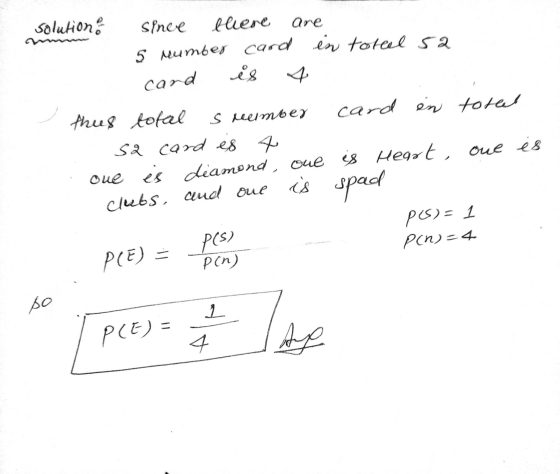
An experiment consists of drawing 1 card from a standard 52-card deck. Let E...
We are drawing two cards without replacement from a standard 52-card deck. Find the probability that...
We are drawing two cards without replacement from a standard 52-card deck. Find the probability that we draw at least one black cardblack card. The probability is (Type an integer or a simplified fraction.)
We are drawing two cards without replacement from a standard 52-card deck. Find the probability that...
 We are drawing two cards without replacement from a standard 52-card deck. Find the probability that we draw at least one ten. The probability is (Type an integer or a simplified fraction.)
A standard deck of cards contains 52 cards. One card is selected from the deck (a)...
 A standard deck of cards contains 52 cards. One card is selected from the deck (a) Compute the probability of randomly selecting a ten or nine. (b) Compute the probability of randomly selecting a ten or nine or two. (c) Compute the probability of randomly selecting an ace or heart 2 a. P(ten or nine) (Type an integer or a simplified fraction.) 13 b. P(ten or nine or two)- | (Type an integer or a simplified fraction.) c. Place or...
A standard deck of cards contains 52 cards. One card is selected from the deck. (a)...
 A standard deck of cards contains 52 cards. One card is selected from the deck. (a) Compute the probability of randomly selecting a club or spade. (b) Compute the probability of randomly selecting a club or spade or heart. (c) Compute the probability of randomly selecting a four or heart. a. P(club or spade) = (Type an integer or a simplified fraction.) b. P(club or spade or heart) = ((Type an integer or a simplified fraction.) c. P(four or heart) = ...
A single card is drawn from a standard 52-card deck. Let R be the event that...
 A single card is drawn from a standard 52-card deck. Let R be the event that the card drawn is a red, and let F be the event that the card drawn is a face card. Find the indicated probability P(R'OF)
A random experiment consists of drawing a card from an ordinary deck of 52 playing cards....
A random experiment consists of drawing a card from an ordinary deck of 52 playing cards. Let the probability set function P assign a probability of 1 52 to each of the 52 possible outcomes. Let C1 denote the collection of the red cards (hearts and diamonds) and let C2 denote the collection of the 4 kings plus the 4 aces. Compute P(C1), P(C2), P(C1 ∩C2), and P(C1 ∪C2).
A standard 52-card deck has four 13-card suits: diamonds, hearts, 13-card suit contains cards numbered f...
 A standard 52-card deck has four 13-card suits: diamonds, hearts, 13-card suit contains cards numbered f probability of drawing a black king of hearts clubs, and spades. The diamonds and hearts are red, and the clubs and spades are black Each from 2 to 10, a jack, a queen, a king, and an ace. An experiment consists of drawing 1 card from the standard deck. Find the The probability of choosing a black king of hearts is ype an integer...
Draw a single card from a standard 52 card deck, and let the events be: A={the...
 Draw a single card from a standard 52 card deck, and let the events be: A={the card drawn is a spade } and B = {the card drawn is a face card (K, Qor J)}. What is the conditional probability of the event AB, P( AB), that is the probability of the event A given that the event B has occurred? (Write the probability as a decimal number and round your answer to TWO decimal places.)
A single card is drawn from a standard 52 card deck. Find the conditional probability that...
 A single card is drawn from a standard 52 card deck. Find the conditional probability that the card is a heart, given that it is an ace. The probability that the card drawn is a heart, given that it is an ace is (Type an integer or a fraction)
Consider the random experiment in which one card is drawn from a standard deck of 52....
Consider the random experiment in which one card is drawn from a standard deck of 52. Let RED be the event that a red card (hearts or diamonds) is drawn, BLACK be the event that a black card (clubs or spades) is drawn, EVEN means an even numbered card is drawn (2, 4, 6, 8 or 10); ODD means an odd numbered card is drawn (3, 5, 7 or 9 - aces not included); COURT means a court card (jack,...
 We are drawing two cards without replacement from a standard 52-card deck. Find the probability that we draw at least one ten. The probability is (Type an integer or a simplified fraction.)
 A standard deck of cards contains 52 cards. One card is selected from the deck (a) Compute the probability of randomly selecting a ten or nine. (b) Compute the probability of randomly selecting a ten or nine or two. (c) Compute the probability of randomly selecting an ace or heart 2 a. P(ten or nine) (Type an integer or a simplified fraction.) 13 b. P(ten or nine or two)- | (Type an integer or a simplified fraction.) c. Place or...
 A standard deck of cards contains 52 cards. One card is selected from the deck. (a) Compute the probability of randomly selecting a club or spade. (b) Compute the probability of randomly selecting a club or spade or heart. (c) Compute the probability of randomly selecting a four or heart. a. P(club or spade) = (Type an integer or a simplified fraction.) b. P(club or spade or heart) = ((Type an integer or a simplified fraction.) c. P(four or heart) = ...
 A single card is drawn from a standard 52-card deck. Let R be the event that the card drawn is a red, and let F be the event that the card drawn is a face card. Find the indicated probability P(R'OF)
 A standard 52-card deck has four 13-card suits: diamonds, hearts, 13-card suit contains cards numbered f probability of drawing a black king of hearts clubs, and spades. The diamonds and hearts are red, and the clubs and spades are black Each from 2 to 10, a jack, a queen, a king, and an ace. An experiment consists of drawing 1 card from the standard deck. Find the The probability of choosing a black king of hearts is ype an integer...
 Draw a single card from a standard 52 card deck, and let the events be: A={the card drawn is a spade } and B = {the card drawn is a face card (K, Qor J)}. What is the conditional probability of the event AB, P( AB), that is the probability of the event A given that the event B has occurred? (Write the probability as a decimal number and round your answer to TWO decimal places.)
 A single card is drawn from a standard 52 card deck. Find the conditional probability that the card is a heart, given that it is an ace. The probability that the card drawn is a heart, given that it is an ace is (Type an integer or a fraction)
Most questions answered within 3 hours.
-
Where is the error in this code sequence?
String s1 = "Hello";
String s2 = "ello";...
asked 10 months ago -
Financial data for Joel de Paris, Inc., for last year
follow:
Joel de Paris, Inc.
Balance...
asked 10 months ago -
Consider this reaction:
Al2(SO4)3 (aq)+ BaCl3
(aq) Al2Cl6 (aq)- +
3BaSO4(s) . What is the...
asked 10 months ago -
Suppose that Savneet is considering increasing her
recent random sample from 20 car rentals to 40...
asked 10 months ago -
Trucks arrive at an unloading terminal at an average rate of 120
per hour.
Trucks arrive...
asked 10 months ago -
Why are methanol and ethanol completely soluble in water while
octanol is not very little soluble....
asked 10 months ago -
A facilities manager at a university reads in a research report
that the mean amount of...
asked 10 months ago -
When the CuSO4 is rehydrated by adding water to the anhydrous
compound, is this an endothermic...
asked 10 months ago -
A ray of sunlight is passing from diamond into crown glass; the
angle of incidence is...
asked 10 months ago -
A block of mass 0.249 kg is placed on top of a light, vertical
spring of...
asked 10 months ago -
how do the kidneys compensate in the presences of acidosis
a) trigger hyperventilate
b) reserve acid...
asked 10 months ago -
Question 501 pts
The rental rate of capital to the firm increases. Which of the
following...
asked 10 months ago