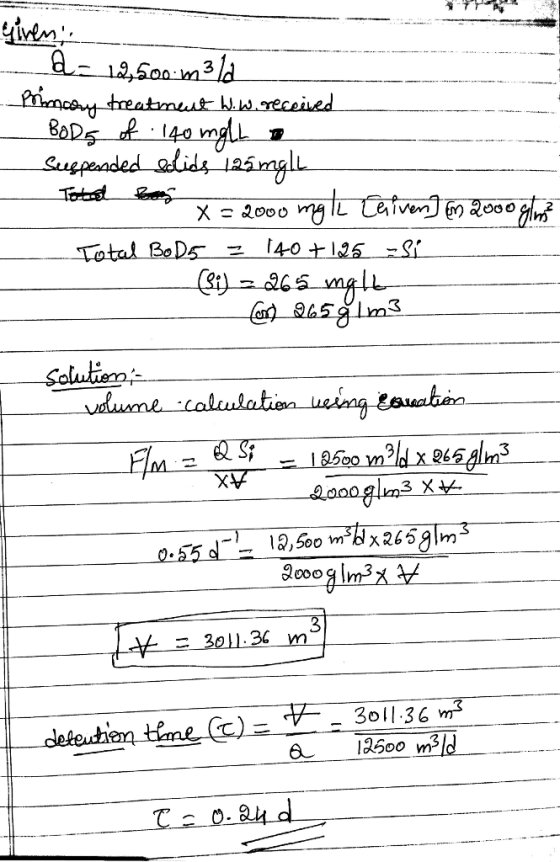
A Tapered aeration-system is used to treat 12,500 m3/d of municipal wastewater. The wastewater has received...
A Tapered aeration-system is used to treat 12,500
m3/d of municipal wastewater. The wastewater has
received primary treatment and has a BOD 5 of 140 mg/l
and a suspended solids of 125 mg/l. The system is to be operated in
the following way: (a) Soluble BOD 5 in effluent
5 mg/l (b) Average
solids concentration in the reactor= 2000 mg/l (c) Mean cell-
retention time= 10 d. The biological constants have been determined
by pilot-plant analysis and are: Y= 0.55 Kg biomass/ Kg BOD
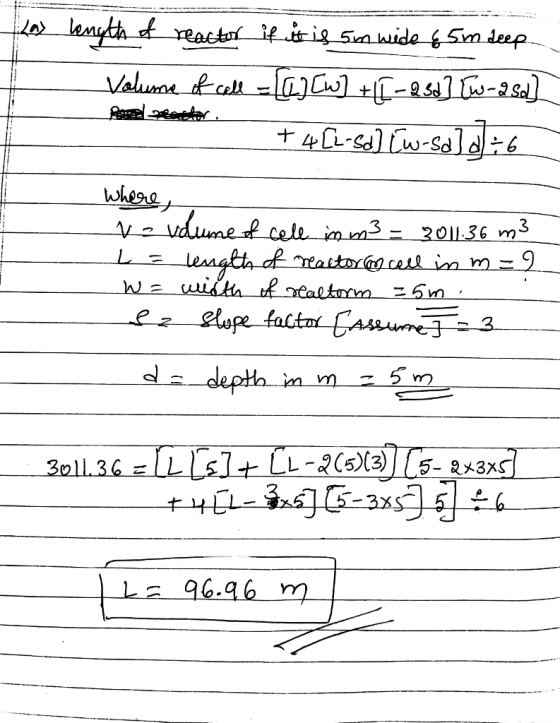
utilized and k 0= 0.55 /d. (a) Determine the length of
the reactor if it is 5 m wide and 5 m deep. (b) Assume an effluent
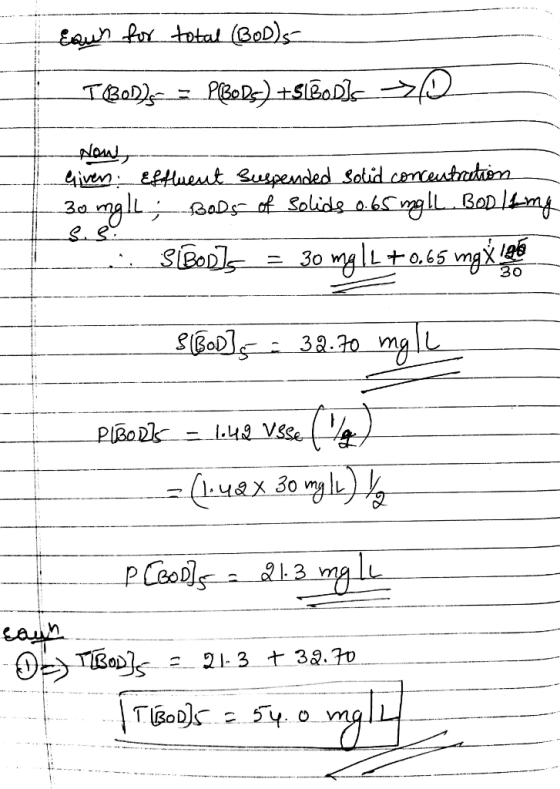
suspended- solids concentration of 30 mg/l; the BOD 5 of the solids
is 0.65 mg BOD/ 1.0 mg SS. Determine the total BOD in the
effluent.
Homework Answers
Add Answer to:
A Tapered aeration-system is used to treat 12,500
m3/d of municipal wastewater. The wastewater has
received...
Plug-Flow reactor
A Tapered aeration-system is used to treat 12,500 m3/d of municipal wastewater. The wastewater has received primary treatment and has a BOD 5 of 140 mg/l and a suspended solids of 125 mg/l. The system is to be operated in the following way: (a) Soluble BOD 5 in effluent 5 mg/l (b) Average solids concentration in the reactor= 2000 mg/l (c) Mean cell- retention time= 10 d. The biological constants have been determined by pilot-plant analysis and are: Y= 0.55 Kg biomass/ Kg BOD utilized...
(30 points) A completely mixed activated sludge system comprised of an aerated reactor and a secondary clarifier with sludge return is going to treat 15,000 m/d of industrial wastewater. Th...
 (30 points) A completely mixed activated sludge system comprised of an aerated reactor and a secondary clarifier with sludge return is going to treat 15,000 m/d of industrial wastewater. The primary effluent going to the reactor has a BODs of 1,100 mg/L that must be reduced to 150 mg/L prior to discharge to a municipal sewer. The pilot study was conducted and generated the following results: 3. Mean cell residence time- 5 day, MLSS concentration in the reactor 7.200 mg/L...
A complete-mix activated sludge system is used to treat municipal wastewater after primary sedime...
 A complete-mix activated sludge system is used to treat municipal wastewater after primary sedimentation at 20 °C with MLVSS concentration of 2000 g/m3. The discharge standard for soluble BOD, concentration in the effluent is 0.5 g/m. The characteristics of the primary influent are: flow Q -2000 m'/d, soluble BOD -200 g/m3, Using these data and the kinetic coefficients in following, determine 1. Theoretical solids retention time (SRT) in unit of days 2. Pk vss in unit of kg VSS/d 3....
A completely mixed activated sludge plant is designed to treat 10,000 m3/d of an industrial wastewater....
 A completely mixed activated sludge plant is designed to treat
10,000 m3/d of an industrial wastewater. The wastewater has a BOD5
of 1200 mg/L. Pilot plant data indicates that a reactor volume of
6090 m3 with an MLSS concentration of 5000 mg/L should produce 83%
BOD5 removal. The value for Y is determined to be 0.7 kg/kg and the
value of kd is found to be 0.03 d–1. Under ow solids concentra-
tion is 12,000 mg/L. The ow diagram is...
A completely mixed activated sludge plant is designed to treat
10,000 m3/d of an industrial wastewater. The wastewater has a BOD5
of 1200 mg/L. Pilot plant data indicates that a reactor volume of
6090 m3 with an MLSS concentration of 5000 mg/L should produce 83%
BOD5 removal. The value for Y is determined to be 0.7 kg/kg and the
value of kd is found to be 0.03 d–1. Under ow solids concentra-
tion is 12,000 mg/L. The ow diagram is...
6.8 a. Using the variable-order kinetic information from Example 6.8 for a municipal wastewater, ...
 6.8 a. Using the variable-order kinetic information from Example 6.8 for a municipal wastewater, determine the effluent BODs concentration for a complete-mix activated sludge facility operated at a five-day solids residence time. b. For a wastewater flow rate of 2 million gallons per day with character- istics of a typical wastewater from Table 6.1, determine the discharge rate of biomass (Ibs/day). in the lagooll lall x biomass Rearranging Eq.(6.37) V X HRT EXAMPLE 6.8 Determine the required volume of an...
3. Determine the aeration tank volume (mgd), excess biomass in the waste sludge (kg/d), and the BOD f a completely mixed activated-sludge process by assuming the following: k 4.0 day r-0.55 lb vS...
 3. Determine the aeration tank volume (mgd), excess biomass in the waste sludge (kg/d), and the BOD f a completely mixed activated-sludge process by assuming the following: k 4.0 day r-0.55 lb vSS/1b BOD, K, 80 mg/l, ks-0.05 day', wastewater flow rate 2.5 mgd, soluble effluent BOD- 15 mgl, soluble influent BOD - 170 mgl, and MLVSS-2200 mg/l, and mean cell residence time -6 days. (15 pts)
3. Determine the aeration tank volume (mgd), excess biomass in the waste sludge...
3. Determine the aeration tank volume (mgd), excess biomass in the waste sludge (kg/d), and the BOD f a completely mixed activated-sludge process by assuming the following: k 4.0 day r-0.55 lb vSS/1b BOD, K, 80 mg/l, ks-0.05 day', wastewater flow rate 2.5 mgd, soluble effluent BOD- 15 mgl, soluble influent BOD - 170 mgl, and MLVSS-2200 mg/l, and mean cell residence time -6 days. (15 pts)
3. Determine the aeration tank volume (mgd), excess biomass in the waste sludge...
A wastewater treatment plant, which serves a population of 300,000 people, receives an average daily volume...
 A wastewater treatment plant, which serves a population of 300,000 people, receives an average daily volume of 24 million gallons per day (MGD) at an average influent 5-day biochemical oxygen demand concentration of 200 mgBODs/L and an average influent total suspended solids concentration of 220 mgTSS/L. The plant operates a primary sedimentation process that remove 65% of the incoming TSS and 35% of the incoming BOD %. This process is followed by a secondary treatment process before discharge to the...
2. [20] A small town has been directed to upgrade its primary wastewater treatment plant to...
 2. [20] A small town has been directed to upgrade its primary wastewater treatment plant to a secondary plant that can meet an effluent standard of 25.0 mg/L BODs and 30.0 mg/L suspended solids. They have selected a completely mixed activated sludge system. The following data are available from the existing primary plant. Existing plant effluent characteristics Flow = 0.2000 m 3/s soluble BODs-80 mg/L Assume that the BOD5 of the suspended solids may be estimated as equal to 50%...
Q Search The following information is given for an activated sludge system design: Flowrate Influent BOD...
 Q Search The following information is given for an activated sludge system design: Flowrate Influent BOD Effluent BOD Unit m'/d mg/L mg/L Value 10,000 150 SRT Synthesis yield, Y, g VSS/g bCOD Wastewater 1 Wastewater 2 Wastewater 3 Cell debris yield, f, 0.40 0.50 0.30 0.15 0.08 g VSS/g VSS Endogenous decay, b, gVSS/g VsSd mg/L nbVSS Temperature Note: Wastewater 1, 2, or 3 to be selected by instructor 10 Determine (a) the aeration tank oxygen requirements in kg/d, (b)...
A wastewater flow of 18,000 m3/day is to be treated in a completely mixed activated sludge...
 A wastewater flow of 18,000 m3/day is to be treated in a completely mixed activated sludge system at a concentration of 3000 mg/L MLSS (mixed liquor suspended solids). The secondary clarifier is designed to thicken the sludge to 12,000 mg/L. Assuming a growth yield coefficient of 0.5 Kg/Kg, an influent BOD of 100 mg/L with a residence time of 8 days, determine the following: a) The volume of the reactor b) The mass of the solids and the wet volume...
 (30 points) A completely mixed activated sludge system comprised of an aerated reactor and a secondary clarifier with sludge return is going to treat 15,000 m/d of industrial wastewater. The primary effluent going to the reactor has a BODs of 1,100 mg/L that must be reduced to 150 mg/L prior to discharge to a municipal sewer. The pilot study was conducted and generated the following results: 3. Mean cell residence time- 5 day, MLSS concentration in the reactor 7.200 mg/L...
 A complete-mix activated sludge system is used to treat municipal wastewater after primary sedimentation at 20 °C with MLVSS concentration of 2000 g/m3. The discharge standard for soluble BOD, concentration in the effluent is 0.5 g/m. The characteristics of the primary influent are: flow Q -2000 m'/d, soluble BOD -200 g/m3, Using these data and the kinetic coefficients in following, determine 1. Theoretical solids retention time (SRT) in unit of days 2. Pk vss in unit of kg VSS/d 3....
 A completely mixed activated sludge plant is designed to treat
10,000 m3/d of an industrial wastewater. The wastewater has a BOD5
of 1200 mg/L. Pilot plant data indicates that a reactor volume of
6090 m3 with an MLSS concentration of 5000 mg/L should produce 83%
BOD5 removal. The value for Y is determined to be 0.7 kg/kg and the
value of kd is found to be 0.03 d–1. Under ow solids concentra-
tion is 12,000 mg/L. The ow diagram is...
A completely mixed activated sludge plant is designed to treat
10,000 m3/d of an industrial wastewater. The wastewater has a BOD5
of 1200 mg/L. Pilot plant data indicates that a reactor volume of
6090 m3 with an MLSS concentration of 5000 mg/L should produce 83%
BOD5 removal. The value for Y is determined to be 0.7 kg/kg and the
value of kd is found to be 0.03 d–1. Under ow solids concentra-
tion is 12,000 mg/L. The ow diagram is...
 6.8 a. Using the variable-order kinetic information from Example 6.8 for a municipal wastewater, determine the effluent BODs concentration for a complete-mix activated sludge facility operated at a five-day solids residence time. b. For a wastewater flow rate of 2 million gallons per day with character- istics of a typical wastewater from Table 6.1, determine the discharge rate of biomass (Ibs/day). in the lagooll lall x biomass Rearranging Eq.(6.37) V X HRT EXAMPLE 6.8 Determine the required volume of an...
 3. Determine the aeration tank volume (mgd), excess biomass in the waste sludge (kg/d), and the BOD f a completely mixed activated-sludge process by assuming the following: k 4.0 day r-0.55 lb vSS/1b BOD, K, 80 mg/l, ks-0.05 day', wastewater flow rate 2.5 mgd, soluble effluent BOD- 15 mgl, soluble influent BOD - 170 mgl, and MLVSS-2200 mg/l, and mean cell residence time -6 days. (15 pts)
3. Determine the aeration tank volume (mgd), excess biomass in the waste sludge...
3. Determine the aeration tank volume (mgd), excess biomass in the waste sludge (kg/d), and the BOD f a completely mixed activated-sludge process by assuming the following: k 4.0 day r-0.55 lb vSS/1b BOD, K, 80 mg/l, ks-0.05 day', wastewater flow rate 2.5 mgd, soluble effluent BOD- 15 mgl, soluble influent BOD - 170 mgl, and MLVSS-2200 mg/l, and mean cell residence time -6 days. (15 pts)
3. Determine the aeration tank volume (mgd), excess biomass in the waste sludge...
 A wastewater treatment plant, which serves a population of 300,000 people, receives an average daily volume of 24 million gallons per day (MGD) at an average influent 5-day biochemical oxygen demand concentration of 200 mgBODs/L and an average influent total suspended solids concentration of 220 mgTSS/L. The plant operates a primary sedimentation process that remove 65% of the incoming TSS and 35% of the incoming BOD %. This process is followed by a secondary treatment process before discharge to the...
 2. [20] A small town has been directed to upgrade its primary wastewater treatment plant to a secondary plant that can meet an effluent standard of 25.0 mg/L BODs and 30.0 mg/L suspended solids. They have selected a completely mixed activated sludge system. The following data are available from the existing primary plant. Existing plant effluent characteristics Flow = 0.2000 m 3/s soluble BODs-80 mg/L Assume that the BOD5 of the suspended solids may be estimated as equal to 50%...
 Q Search The following information is given for an activated sludge system design: Flowrate Influent BOD Effluent BOD Unit m'/d mg/L mg/L Value 10,000 150 SRT Synthesis yield, Y, g VSS/g bCOD Wastewater 1 Wastewater 2 Wastewater 3 Cell debris yield, f, 0.40 0.50 0.30 0.15 0.08 g VSS/g VSS Endogenous decay, b, gVSS/g VsSd mg/L nbVSS Temperature Note: Wastewater 1, 2, or 3 to be selected by instructor 10 Determine (a) the aeration tank oxygen requirements in kg/d, (b)...
 A wastewater flow of 18,000 m3/day is to be treated in a completely mixed activated sludge system at a concentration of 3000 mg/L MLSS (mixed liquor suspended solids). The secondary clarifier is designed to thicken the sludge to 12,000 mg/L. Assuming a growth yield coefficient of 0.5 Kg/Kg, an influent BOD of 100 mg/L with a residence time of 8 days, determine the following: a) The volume of the reactor b) The mass of the solids and the wet volume...
Most questions answered within 3 hours.
-
Where is the error in this code sequence?
String s1 = "Hello";
String s2 = "ello";...
asked 11 months ago -
Financial data for Joel de Paris, Inc., for last year
follow:
Joel de Paris, Inc.
Balance...
asked 11 months ago -
Consider this reaction:
Al2(SO4)3 (aq)+ BaCl3
(aq) Al2Cl6 (aq)- +
3BaSO4(s) . What is the...
asked 11 months ago -
Suppose that Savneet is considering increasing her
recent random sample from 20 car rentals to 40...
asked 11 months ago -
Trucks arrive at an unloading terminal at an average rate of 120
per hour.
Trucks arrive...
asked 11 months ago -
Why are methanol and ethanol completely soluble in water while
octanol is not very little soluble....
asked 11 months ago -
A facilities manager at a university reads in a research report
that the mean amount of...
asked 11 months ago -
When the CuSO4 is rehydrated by adding water to the anhydrous
compound, is this an endothermic...
asked 11 months ago -
A ray of sunlight is passing from diamond into crown glass; the
angle of incidence is...
asked 11 months ago -
A block of mass 0.249 kg is placed on top of a light, vertical
spring of...
asked 11 months ago -
how do the kidneys compensate in the presences of acidosis
a) trigger hyperventilate
b) reserve acid...
asked 11 months ago -
Question 501 pts
The rental rate of capital to the firm increases. Which of the
following...
asked 11 months ago