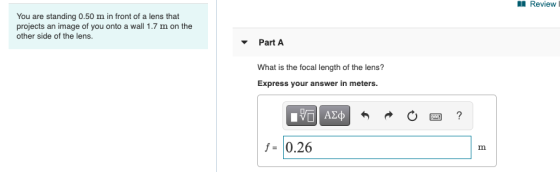
My answer is wrong. Please help.
Homework Answers
Given the object distance u is 0.50m in front of the lens and the image distance v is 1.7m on the other side of the lens. By sign convention u = -0.50m and v = +1.7m. If f is the focal length of the lens, by lens formula
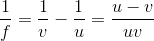

So the focal length of the lens is 0.39m.
Add Answer to:
My answer is wrong. Please help.
B Review You are standing 0.50 m in front of...
You are standing in front of a Jens that projects an image of you onto a...
 You are standing in front of a Jens that projects an image of you onto a wall 1.80 m on the other side of the lens. This image is three times your height: (a) How far are you from the lens? (b) Is your image erect or inverted? (c) What is the focal length of the lens? Is the lens converging or diverging? d) Draw a principal- ray diagram
Please help me with part B and C they are both wrong. The objective lens and...
 Please help me with part B and C they are both wrong.
The objective lens and the eyepiece of a microscope are 16.5 cm apart. The objective lens has a magnification of 62x and the eyepiece has a magnification of 10 %. Assume that the image of the objective lies very close to the focal point of the eyepiece. Part A Calculate the overall magnification of the microscope. M = 620 X Submit Previous Answers Correct Part B Calculate the...
Please help me with part B and C they are both wrong.
The objective lens and the eyepiece of a microscope are 16.5 cm apart. The objective lens has a magnification of 62x and the eyepiece has a magnification of 10 %. Assume that the image of the objective lies very close to the focal point of the eyepiece. Part A Calculate the overall magnification of the microscope. M = 620 X Submit Previous Answers Correct Part B Calculate the...
2. A birthday candle is 2.0 m (Social distance) in front of a lens with a...
 2. A birthday candle is 2.0 m (Social distance) in front of a lens with a focal length of - 2.5 m. The candle is 0.50 m tall (so that it can be seen). Tell me all about the image of the candle, including: (A) How far is the image from the lens, and on which side of the lens is it on? (B) Is the image upright or inverted? (C) Is the image real or virtual? (D) How tall...
Problem 18.45 - Enhanced - with Feedback 12 of 20 Review Constants Periodic Table A 1.0...
 Problem 18.45 - Enhanced - with Feedback 12 of 20 Review Constants Periodic Table A 1.0 cm tall object is 70 cm in front of a converging lens that has a 20 cm focal length Part A Calculate the image position Express your answer with the appropriate units. Enter positive value if the image is on the other side from the lens and negative value if the image is on the same side as the object. НА + 2 Value...
PRE-LAB INVESTIGATION: Review the use of ray diagrams to help you to determine how and where...
 PRE-LAB INVESTIGATION: Review the use of ray diagrams to help you to determine how and where light from a particular point on an object converges to form an image. You can get a conceptual understanding of the process of image formation by a lens using the " Geometric Optics" Place the light source assembly 10 cm double convex lens and viewing on dynamics track as shown in figurel. Turn on the light source and rotate the light source wheel until...
am needing help, thank you!! Review | Constants A 3.0 cm tall object is 55 cm...
 am needing help, thank
you!!
Review | Constants A 3.0 cm tall object is 55 cm in front of a convex mirror that has a -20 cm focal length. Part A Calculate the image position. Input positive value if the image is on the same side from the mirror as an object and negative if the image is on the other side. Express your answer using two significant figures. nνα ΑΣφ cm Request Answer Submit Part B Calculate the image...
am needing help, thank
you!!
Review | Constants A 3.0 cm tall object is 55 cm in front of a convex mirror that has a -20 cm focal length. Part A Calculate the image position. Input positive value if the image is on the same side from the mirror as an object and negative if the image is on the other side. Express your answer using two significant figures. nνα ΑΣφ cm Request Answer Submit Part B Calculate the image...
need help. please answer #5 and 6 5. An object is placed 26.0 cm in front...
 need help. please answer #5 and 6
5. An object is placed 26.0 cm in front of convex lens of focal length 40.0 cm. What is the magnification of the image? 6. In a supermarket, a convex mirror of radius of curvature 5.20 m is used for surveillance. A 1.80 m tall shopper is 12.0 m from such a mirror. (a) Where is her image? (b) What is the size of her image?
need help. please answer #5 and 6
5. An object is placed 26.0 cm in front of convex lens of focal length 40.0 cm. What is the magnification of the image? 6. In a supermarket, a convex mirror of radius of curvature 5.20 m is used for surveillance. A 1.80 m tall shopper is 12.0 m from such a mirror. (a) Where is her image? (b) What is the size of her image?
Please help with part C and E Review IC Part A A 30-year-old optometry patient focuses...
 Please help with part C and E
Review IC Part A A 30-year-old optometry patient focuses on a 6.50 cm-tall photograph at his near point. (See the table below.) We can model his eye as a sphere 2.50 cm in diameter, with a thin lens at the front and the retina at the rear. Receding of near point with age: Age (years) Near point (cm) 10 7 10 What is the effective focal length of his eye when he focuses...
Please help with part C and E
Review IC Part A A 30-year-old optometry patient focuses on a 6.50 cm-tall photograph at his near point. (See the table below.) We can model his eye as a sphere 2.50 cm in diameter, with a thin lens at the front and the retina at the rear. Receding of near point with age: Age (years) Near point (cm) 10 7 10 What is the effective focal length of his eye when he focuses...
Please HELP!!! I will rate good for good answers! A diverging lens with a focal length...
 Please HELP!!! I will rate good for good
answers!
A diverging lens with a focal length of -15 cm is placed 16 cm to the right of a converging lens with a focal length of 18 cm . An object is placed 33 cm to the left of the converging lens. Part A Where will the final image be located? to the left of the diverging lens to the right of the diverging lens Submit Previous Answers Correct Part B...
Please HELP!!! I will rate good for good
answers!
A diverging lens with a focal length of -15 cm is placed 16 cm to the right of a converging lens with a focal length of 18 cm . An object is placed 33 cm to the left of the converging lens. Part A Where will the final image be located? to the left of the diverging lens to the right of the diverging lens Submit Previous Answers Correct Part B...
Review Constants Part A An underwater camera has a lens of focal length 35.0 mm and...
 Review Constants Part A An underwater camera has a lens of focal length 35.0 mm and a maximum aperture of f/2.80. The film it uses has an emulsion that is sensitive to light of frequency 6.10x10¹⁴ Hz . If the photographer takes a picture of an object 3.10 m in front of the camera with the lens wide open. What is the width of the smallest resolvable detail on the subject if the object is a fish underwater with the...
 You are standing in front of a Jens that projects an image of you onto a wall 1.80 m on the other side of the lens. This image is three times your height: (a) How far are you from the lens? (b) Is your image erect or inverted? (c) What is the focal length of the lens? Is the lens converging or diverging? d) Draw a principal- ray diagram
 Please help me with part B and C they are both wrong.
The objective lens and the eyepiece of a microscope are 16.5 cm apart. The objective lens has a magnification of 62x and the eyepiece has a magnification of 10 %. Assume that the image of the objective lies very close to the focal point of the eyepiece. Part A Calculate the overall magnification of the microscope. M = 620 X Submit Previous Answers Correct Part B Calculate the...
Please help me with part B and C they are both wrong.
The objective lens and the eyepiece of a microscope are 16.5 cm apart. The objective lens has a magnification of 62x and the eyepiece has a magnification of 10 %. Assume that the image of the objective lies very close to the focal point of the eyepiece. Part A Calculate the overall magnification of the microscope. M = 620 X Submit Previous Answers Correct Part B Calculate the...
 2. A birthday candle is 2.0 m (Social distance) in front of a lens with a focal length of - 2.5 m. The candle is 0.50 m tall (so that it can be seen). Tell me all about the image of the candle, including: (A) How far is the image from the lens, and on which side of the lens is it on? (B) Is the image upright or inverted? (C) Is the image real or virtual? (D) How tall...
 Problem 18.45 - Enhanced - with Feedback 12 of 20 Review Constants Periodic Table A 1.0 cm tall object is 70 cm in front of a converging lens that has a 20 cm focal length Part A Calculate the image position Express your answer with the appropriate units. Enter positive value if the image is on the other side from the lens and negative value if the image is on the same side as the object. НА + 2 Value...
 PRE-LAB INVESTIGATION: Review the use of ray diagrams to help you to determine how and where light from a particular point on an object converges to form an image. You can get a conceptual understanding of the process of image formation by a lens using the " Geometric Optics" Place the light source assembly 10 cm double convex lens and viewing on dynamics track as shown in figurel. Turn on the light source and rotate the light source wheel until...
 am needing help, thank
you!!
Review | Constants A 3.0 cm tall object is 55 cm in front of a convex mirror that has a -20 cm focal length. Part A Calculate the image position. Input positive value if the image is on the same side from the mirror as an object and negative if the image is on the other side. Express your answer using two significant figures. nνα ΑΣφ cm Request Answer Submit Part B Calculate the image...
am needing help, thank
you!!
Review | Constants A 3.0 cm tall object is 55 cm in front of a convex mirror that has a -20 cm focal length. Part A Calculate the image position. Input positive value if the image is on the same side from the mirror as an object and negative if the image is on the other side. Express your answer using two significant figures. nνα ΑΣφ cm Request Answer Submit Part B Calculate the image...
 need help. please answer #5 and 6
5. An object is placed 26.0 cm in front of convex lens of focal length 40.0 cm. What is the magnification of the image? 6. In a supermarket, a convex mirror of radius of curvature 5.20 m is used for surveillance. A 1.80 m tall shopper is 12.0 m from such a mirror. (a) Where is her image? (b) What is the size of her image?
need help. please answer #5 and 6
5. An object is placed 26.0 cm in front of convex lens of focal length 40.0 cm. What is the magnification of the image? 6. In a supermarket, a convex mirror of radius of curvature 5.20 m is used for surveillance. A 1.80 m tall shopper is 12.0 m from such a mirror. (a) Where is her image? (b) What is the size of her image?
 Please help with part C and E
Review IC Part A A 30-year-old optometry patient focuses on a 6.50 cm-tall photograph at his near point. (See the table below.) We can model his eye as a sphere 2.50 cm in diameter, with a thin lens at the front and the retina at the rear. Receding of near point with age: Age (years) Near point (cm) 10 7 10 What is the effective focal length of his eye when he focuses...
Please help with part C and E
Review IC Part A A 30-year-old optometry patient focuses on a 6.50 cm-tall photograph at his near point. (See the table below.) We can model his eye as a sphere 2.50 cm in diameter, with a thin lens at the front and the retina at the rear. Receding of near point with age: Age (years) Near point (cm) 10 7 10 What is the effective focal length of his eye when he focuses...
 Please HELP!!! I will rate good for good
answers!
A diverging lens with a focal length of -15 cm is placed 16 cm to the right of a converging lens with a focal length of 18 cm . An object is placed 33 cm to the left of the converging lens. Part A Where will the final image be located? to the left of the diverging lens to the right of the diverging lens Submit Previous Answers Correct Part B...
Please HELP!!! I will rate good for good
answers!
A diverging lens with a focal length of -15 cm is placed 16 cm to the right of a converging lens with a focal length of 18 cm . An object is placed 33 cm to the left of the converging lens. Part A Where will the final image be located? to the left of the diverging lens to the right of the diverging lens Submit Previous Answers Correct Part B...
 Review Constants Part A An underwater camera has a lens of focal length 35.0 mm and a maximum aperture of f/2.80. The film it uses has an emulsion that is sensitive to light of frequency 6.10x10¹⁴ Hz . If the photographer takes a picture of an object 3.10 m in front of the camera with the lens wide open. What is the width of the smallest resolvable detail on the subject if the object is a fish underwater with the...
Most questions answered within 3 hours.
-
Where is the error in this code sequence?
String s1 = "Hello";
String s2 = "ello";...
asked 11 months ago -
Financial data for Joel de Paris, Inc., for last year
follow:
Joel de Paris, Inc.
Balance...
asked 11 months ago -
Consider this reaction:
Al2(SO4)3 (aq)+ BaCl3
(aq) Al2Cl6 (aq)- +
3BaSO4(s) . What is the...
asked 11 months ago -
Suppose that Savneet is considering increasing her
recent random sample from 20 car rentals to 40...
asked 11 months ago -
Trucks arrive at an unloading terminal at an average rate of 120
per hour.
Trucks arrive...
asked 11 months ago -
Why are methanol and ethanol completely soluble in water while
octanol is not very little soluble....
asked 11 months ago -
A facilities manager at a university reads in a research report
that the mean amount of...
asked 11 months ago -
When the CuSO4 is rehydrated by adding water to the anhydrous
compound, is this an endothermic...
asked 11 months ago -
A ray of sunlight is passing from diamond into crown glass; the
angle of incidence is...
asked 11 months ago -
A block of mass 0.249 kg is placed on top of a light, vertical
spring of...
asked 11 months ago -
how do the kidneys compensate in the presences of acidosis
a) trigger hyperventilate
b) reserve acid...
asked 11 months ago -
Question 501 pts
The rental rate of capital to the firm increases. Which of the
following...
asked 11 months ago