
Homework Answers
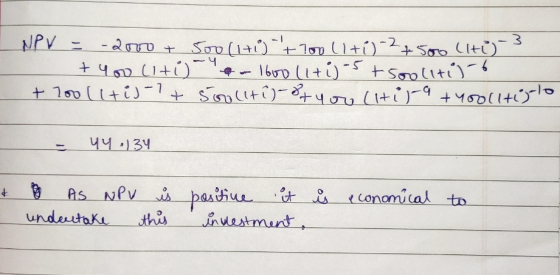
I= 0.08
I use net present value method as its easy to decide on the basis of NPV whether to undertake the investment or not.
please upvote if i'm able to help you it means a lot
thank you
Add Answer to:
Is the investment shown in the following picture economically feasible at an interest rate of 8%?...
"Determine the interest rate (i) that makes the pairs of cash flows shown economically equivalent. Calculate...
 "Determine the interest rate (i) that makes the pairs of cash flows shown economically equivalent. Calculate the Present Worth of the second cash flow series at an 18% annual interest rate using only one formula and then check the answer using another method of calculation." $1380 S1380 $1380 S1380 S1380 $1380 $1380 4 Years 1=? S2500 $1875 S1406 S1055 $791 $593 445 2 4 舀 . Years
(iii) Projects A and B are competing for funds. With an original investment of €1,000 and...
 (iii) Projects A and B are competing for funds. With an original
investment of €1,000 and returns given in Table Q3, determine using
appropriate project financing evaluation techniques whether the
company should choose projects A or B? Provide calculations to
justify your recommendation. Use 10% discount rate in your
calculations.
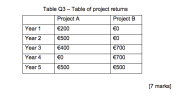
Table Q3 - Table of project returns Project A Project B Year 1 €200 €O Year 2 €500 Year 3 €400 €700 Year 4 €0 €700 Year 5 €500 €500...
(iii) Projects A and B are competing for funds. With an original
investment of €1,000 and returns given in Table Q3, determine using
appropriate project financing evaluation techniques whether the
company should choose projects A or B? Provide calculations to
justify your recommendation. Use 10% discount rate in your
calculations.
Table Q3 - Table of project returns Project A Project B Year 1 €200 €O Year 2 €500 Year 3 €400 €700 Year 4 €0 €700 Year 5 €500 €500...
The YTM on a bond is the interest rate you earn on your investment if interest...
 The YTM on a bond is the interest rate you earn on your investment if interest rates don't change. If you actually sell the bond before it matures, your realized return is known as the holding period yield (HPY). a. Suppose that today you buy an annual coupon bond with a coupon rate of 8.3 percent for $785. The bond has 8 years to maturity and a par value of $1,000. What rate of return do you expect to earn...
The YTM on a bond is the interest rate you earn on your investment if interest...
The YTM on a bond is the interest rate you earn on your investment if interest rates don’t change. If you actually sell the bond before it matures, your realized return is known as the holding period yield (HPY). a. Suppose that today you buy a bond with an annual coupon rate of 8 percent for $1,030. The bond has 17 years to maturity. What rate of return do you expect to earn on your investment? Assume a par value...
The YTM on a bond is the interest rate you earn on your investment if interest...
 The YTM on a bond is the interest rate you earn on your investment if interest rates don't change. If you actually sell the bond before it matures, your realized return is known as the holding period yield (HPY). a. Suppose that today you buy an annual coupon bond with a coupon rate of 8.1 percent for $905. The bond has 8 years to maturity and a par value of $1,000. What rate of return do you expect to earn...
The YTM on a bond is the interest rate you earn on your investment if interest...
The YTM on a bond is the interest rate you earn on your investment if interest rates don’t change. If you actually sell the bond before it matures, your realized return is known as the holding period yield (HPY). a. Suppose that today you buy a bond with an annual coupon rate of 8 percent for $1,100. The bond has 15 years to maturity. A.) What rate of return do you expect to earn on your investment? Assume a par...
You make the following five end-of-year deposits into your investment account that earns 9% annual interest:...
You make the following five end-of-year deposits into your investment account that earns 9% annual interest: $600 in year 1, $700 in year 2, $500 in year 3, $300 in year 4, and $400 in year 5. Note that the first cash flow of $600 which occurs at the end of year 1 earns interest for four years.What is the balance in your investment account at the end of year 5? Round to the nearest dollar amount.
6) You are trying to decide from three investment opportunities with the following end-of-year CFs. Which...
 6) You are trying to decide from three investment opportunities with the following end-of-year CFs. Which investment would you choose assuming a 10% discount rate? Remember to show what each investment is worth to you today, to explain your choice. End of Year 400 400 400 400 500 400 400 400 400 600 6 600
The YTM on a bond is the interest rate you earn on your investment if interest...
 The YTM on a bond is the interest rate you earn on your investment if interest rates don't change. If you actually sell the bond before it matures, your realized return is known as the holding period yield (HPY). a. Suppose that today you buy a bond with an annual coupon rate of 11 percent for $1,060. The bond has 20 years to maturity. What rate of return do you expect to earn on your investment? Assume a par value...
The YTM on a bond is the interest rate you earn on your investment if interest...
 The YTM on a bond is the interest rate you earn on your investment if interest rates don't change. If you actually sell the bond before it matures, your realized return is known as the holding period yield (HPY). a. Suppose that today you buy a bond with an annual coupon rate of 7 percent for $1,160. The bond has 15 years to maturity. What rate of return do you expect to earn on your investment? Assume a par value...
 "Determine the interest rate (i) that makes the pairs of cash flows shown economically equivalent. Calculate the Present Worth of the second cash flow series at an 18% annual interest rate using only one formula and then check the answer using another method of calculation." $1380 S1380 $1380 S1380 S1380 $1380 $1380 4 Years 1=? S2500 $1875 S1406 S1055 $791 $593 445 2 4 舀 . Years
 (iii) Projects A and B are competing for funds. With an original
investment of €1,000 and returns given in Table Q3, determine using
appropriate project financing evaluation techniques whether the
company should choose projects A or B? Provide calculations to
justify your recommendation. Use 10% discount rate in your
calculations.
Table Q3 - Table of project returns Project A Project B Year 1 €200 €O Year 2 €500 Year 3 €400 €700 Year 4 €0 €700 Year 5 €500 €500...
(iii) Projects A and B are competing for funds. With an original
investment of €1,000 and returns given in Table Q3, determine using
appropriate project financing evaluation techniques whether the
company should choose projects A or B? Provide calculations to
justify your recommendation. Use 10% discount rate in your
calculations.
Table Q3 - Table of project returns Project A Project B Year 1 €200 €O Year 2 €500 Year 3 €400 €700 Year 4 €0 €700 Year 5 €500 €500...
 The YTM on a bond is the interest rate you earn on your investment if interest rates don't change. If you actually sell the bond before it matures, your realized return is known as the holding period yield (HPY). a. Suppose that today you buy an annual coupon bond with a coupon rate of 8.3 percent for $785. The bond has 8 years to maturity and a par value of $1,000. What rate of return do you expect to earn...
 The YTM on a bond is the interest rate you earn on your investment if interest rates don't change. If you actually sell the bond before it matures, your realized return is known as the holding period yield (HPY). a. Suppose that today you buy an annual coupon bond with a coupon rate of 8.1 percent for $905. The bond has 8 years to maturity and a par value of $1,000. What rate of return do you expect to earn...
 6) You are trying to decide from three investment opportunities with the following end-of-year CFs. Which investment would you choose assuming a 10% discount rate? Remember to show what each investment is worth to you today, to explain your choice. End of Year 400 400 400 400 500 400 400 400 400 600 6 600
 The YTM on a bond is the interest rate you earn on your investment if interest rates don't change. If you actually sell the bond before it matures, your realized return is known as the holding period yield (HPY). a. Suppose that today you buy a bond with an annual coupon rate of 11 percent for $1,060. The bond has 20 years to maturity. What rate of return do you expect to earn on your investment? Assume a par value...
 The YTM on a bond is the interest rate you earn on your investment if interest rates don't change. If you actually sell the bond before it matures, your realized return is known as the holding period yield (HPY). a. Suppose that today you buy a bond with an annual coupon rate of 7 percent for $1,160. The bond has 15 years to maturity. What rate of return do you expect to earn on your investment? Assume a par value...
Most questions answered within 3 hours.
-
Where is the error in this code sequence?
String s1 = "Hello";
String s2 = "ello";...
asked 11 months ago -
Financial data for Joel de Paris, Inc., for last year
follow:
Joel de Paris, Inc.
Balance...
asked 11 months ago -
Consider this reaction:
Al2(SO4)3 (aq)+ BaCl3
(aq) Al2Cl6 (aq)- +
3BaSO4(s) . What is the...
asked 11 months ago -
Suppose that Savneet is considering increasing her
recent random sample from 20 car rentals to 40...
asked 11 months ago -
Trucks arrive at an unloading terminal at an average rate of 120
per hour.
Trucks arrive...
asked 11 months ago -
Why are methanol and ethanol completely soluble in water while
octanol is not very little soluble....
asked 11 months ago -
A facilities manager at a university reads in a research report
that the mean amount of...
asked 11 months ago -
When the CuSO4 is rehydrated by adding water to the anhydrous
compound, is this an endothermic...
asked 11 months ago -
A ray of sunlight is passing from diamond into crown glass; the
angle of incidence is...
asked 11 months ago -
A block of mass 0.249 kg is placed on top of a light, vertical
spring of...
asked 11 months ago -
how do the kidneys compensate in the presences of acidosis
a) trigger hyperventilate
b) reserve acid...
asked 11 months ago -
Question 501 pts
The rental rate of capital to the firm increases. Which of the
following...
asked 11 months ago