
Homework Answers
Add Answer to:
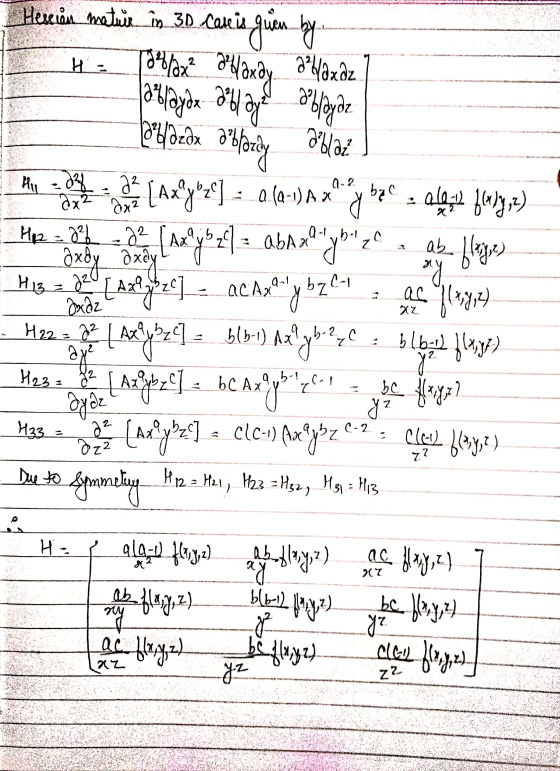
Consider the function, f(x, y, z)= Ax“yºzº. The objective is to find the Hessian matrix of...
By examining the Hessian matrix, show that if f(x, y, z) has a local minimum at...
By examining the Hessian matrix, show that if f(x, y, z) has a local minimum at (x0, y0, z0), then g(x, y, z) = −f(x, y, z) must have a local maximum at that point. Likewise, show that if f has a local maximum, then g must have a local minimum at that point.
Consider the following nonlinear program: min s.t. - (a) Express the objective function of the above problem in the standard quadratic function form: (b) Find the gradient and the Hessian of...
Consider the following nonlinear program: min s.t. - (a) Express the objective function of the above problem in the standard quadratic function form: (b) Find the gradient and the Hessian of f(x). (c) If possible, solve the minimisation problem and give reasons why the solution you found is a global minimum rather than just a local minimum. Otherwise, demonstrate that the problem is unbounded. f (x: y) = (x + 2y)2-2x-y We were unable to transcribe this imageWe were unable...
4. Consider the following function in R" f(Fi, n)=-1) k-1 Find the critical point of this...
 4. Consider the following function in R" f(Fi, n)=-1) k-1 Find the critical point of this function and show whether it is a local minimum, a local maximum, or neither 5. By examining the Hessian matrix, show that if f(x,y, ) has a local minimum at then g(z, y,) -f(x,y, ) must have a local maximum at that point. Likewise, show that if f has a local maximum, then g must have a local minimum at that point. (ro, yo,...
Consider the following utility function of 3 goods, x, y and z: U(x,y,z)=ax+by+cz; x,y,z≥0 and a,...
Consider the following utility function of 3 goods, x, y and z: U(x,y,z)=ax+by+cz; x,y,z≥0 and a, b, c are constants. The prices of good x and y is denoted by pX and pY respectively. The income is denoted by m. Good z is provided by the government free of cost but the quantity of good z provided by the government depends on the consumption of good x and y chosen by the consumer. For example, if in equilibrium, the consumer...
Problem 1 Let gi(x, y, z)-y, 92(x, y, z)z and f(x, y, z) is a differential function We introduce ...
 Problem 1 Let gi(x, y, z)-y, 92(x, y, z)z and f(x, y, z) is a differential function We introduce F(x, y, z, A, )-f(x, y, z) - Xgi(x, y, z) - Hg2(x, y, 2). ·Show that the Lagrange system for the critical points off with constraints gi (x, y, z) = 92(x,y, z)0: F(zo, yo, 20, λο, μο)-(0, 0, 0, 0, 0) is equivalent to the one-dimensional critical point equation: df dr(ro, 0, 0) = 0, 30 = 20 =...
2.1 Compute the gradient V f(x) and Hessian V2 f (x) of the Rosenbrock function f(x)...
 2.1 Compute the gradient V f(x) and Hessian V2 f (x) of the Rosenbrock function f(x) 100(x2-x?)2 +(1-x1)2. (2.22) CHAPTER 2. FUNDAMENTALS OF UNCONSTRAINED OPTIMIZATION 28 (1, 1) matrix at that point is positive definite. Show that x* is the only local minimizer of this function, and that the Hessian
Solve the following problem using Lagrange multiplier method: Maximize f(x,y,z) = 4y-2z subject to the constraints...
 Solve the following problem using Lagrange multiplier method: Maximize f(x,y,z) = 4y-2z subject to the constraints 2x-y-z 2 x2+y2- 1 1. (1) (2) (Note: You need not check the Hessian matrix, just find the maximum by evaluating the values of f(x,y,z) at the potential solution points) Also, using sensitivity analysis, find the change in the maximum value of the function, f, if the above constraints are changed to: (3) (4) 2x -0.9y-z 2 x2+ y2- 0.9.
Solve the following problem...
Solve the following problem using Lagrange multiplier method: Maximize f(x,y,z) = 4y-2z subject to the constraints 2x-y-z 2 x2+y2- 1 1. (1) (2) (Note: You need not check the Hessian matrix, just find the maximum by evaluating the values of f(x,y,z) at the potential solution points) Also, using sensitivity analysis, find the change in the maximum value of the function, f, if the above constraints are changed to: (3) (4) 2x -0.9y-z 2 x2+ y2- 0.9.
Solve the following problem...
Solve the following problem using Lagrange multiplier method: Maximize f(x,y,z) = 4y-2z subject to the constraints...
 Solve the following problem using Lagrange multiplier method: Maximize f(x,y,z) = 4y-2z subject to the constraints 2x-y-z 2 x2+ y2- 1 (1) (2) (Note: You need not check the Hessian matrix, just find the maximum by evaluating the values of f(x,y,z) at the potential solution points) Also, using sensitivity analysis, find the change in the maximum value of the function, f, if the above constraints are changed to: (3) (4) 2x-0.9y-z =2 x2+y2- 0.9
Solve the following problem using Lagrange...
Solve the following problem using Lagrange multiplier method: Maximize f(x,y,z) = 4y-2z subject to the constraints 2x-y-z 2 x2+ y2- 1 (1) (2) (Note: You need not check the Hessian matrix, just find the maximum by evaluating the values of f(x,y,z) at the potential solution points) Also, using sensitivity analysis, find the change in the maximum value of the function, f, if the above constraints are changed to: (3) (4) 2x-0.9y-z =2 x2+y2- 0.9
Solve the following problem using Lagrange...
Consider the function S Ax? f(x) = - { x < 3 17 - Ax x3...
 Consider the function S Ax? f(x) = - { x < 3 17 - Ax x3 Find a value of A so that the function is continuous at x = 3. - 12/17 17/12 12/17 17/3 - 17/12
3. In the following, consider z as a function of x and y, i.e., z =...
 3. In the following, consider z as a function of x and y, i.e., z = z(x, y) and use az az implicit differentiation to find the partial derivatives and ax ay (a) x2 + y2 + z2 = 3xyz (b) yz = ln(x + z)
 4. Consider the following function in R" f(Fi, n)=-1) k-1 Find the critical point of this function and show whether it is a local minimum, a local maximum, or neither 5. By examining the Hessian matrix, show that if f(x,y, ) has a local minimum at then g(z, y,) -f(x,y, ) must have a local maximum at that point. Likewise, show that if f has a local maximum, then g must have a local minimum at that point. (ro, yo,...
 Problem 1 Let gi(x, y, z)-y, 92(x, y, z)z and f(x, y, z) is a differential function We introduce F(x, y, z, A, )-f(x, y, z) - Xgi(x, y, z) - Hg2(x, y, 2). ·Show that the Lagrange system for the critical points off with constraints gi (x, y, z) = 92(x,y, z)0: F(zo, yo, 20, λο, μο)-(0, 0, 0, 0, 0) is equivalent to the one-dimensional critical point equation: df dr(ro, 0, 0) = 0, 30 = 20 =...
 2.1 Compute the gradient V f(x) and Hessian V2 f (x) of the Rosenbrock function f(x) 100(x2-x?)2 +(1-x1)2. (2.22) CHAPTER 2. FUNDAMENTALS OF UNCONSTRAINED OPTIMIZATION 28 (1, 1) matrix at that point is positive definite. Show that x* is the only local minimizer of this function, and that the Hessian
 Solve the following problem using Lagrange multiplier method: Maximize f(x,y,z) = 4y-2z subject to the constraints 2x-y-z 2 x2+y2- 1 1. (1) (2) (Note: You need not check the Hessian matrix, just find the maximum by evaluating the values of f(x,y,z) at the potential solution points) Also, using sensitivity analysis, find the change in the maximum value of the function, f, if the above constraints are changed to: (3) (4) 2x -0.9y-z 2 x2+ y2- 0.9.
Solve the following problem...
Solve the following problem using Lagrange multiplier method: Maximize f(x,y,z) = 4y-2z subject to the constraints 2x-y-z 2 x2+y2- 1 1. (1) (2) (Note: You need not check the Hessian matrix, just find the maximum by evaluating the values of f(x,y,z) at the potential solution points) Also, using sensitivity analysis, find the change in the maximum value of the function, f, if the above constraints are changed to: (3) (4) 2x -0.9y-z 2 x2+ y2- 0.9.
Solve the following problem...
 Solve the following problem using Lagrange multiplier method: Maximize f(x,y,z) = 4y-2z subject to the constraints 2x-y-z 2 x2+ y2- 1 (1) (2) (Note: You need not check the Hessian matrix, just find the maximum by evaluating the values of f(x,y,z) at the potential solution points) Also, using sensitivity analysis, find the change in the maximum value of the function, f, if the above constraints are changed to: (3) (4) 2x-0.9y-z =2 x2+y2- 0.9
Solve the following problem using Lagrange...
Solve the following problem using Lagrange multiplier method: Maximize f(x,y,z) = 4y-2z subject to the constraints 2x-y-z 2 x2+ y2- 1 (1) (2) (Note: You need not check the Hessian matrix, just find the maximum by evaluating the values of f(x,y,z) at the potential solution points) Also, using sensitivity analysis, find the change in the maximum value of the function, f, if the above constraints are changed to: (3) (4) 2x-0.9y-z =2 x2+y2- 0.9
Solve the following problem using Lagrange...
 Consider the function S Ax? f(x) = - { x < 3 17 - Ax x3 Find a value of A so that the function is continuous at x = 3. - 12/17 17/12 12/17 17/3 - 17/12
 3. In the following, consider z as a function of x and y, i.e., z = z(x, y) and use az az implicit differentiation to find the partial derivatives and ax ay (a) x2 + y2 + z2 = 3xyz (b) yz = ln(x + z)
Most questions answered within 3 hours.
-
Where is the error in this code sequence?
String s1 = "Hello";
String s2 = "ello";...
asked 10 months ago -
Financial data for Joel de Paris, Inc., for last year
follow:
Joel de Paris, Inc.
Balance...
asked 10 months ago -
Consider this reaction:
Al2(SO4)3 (aq)+ BaCl3
(aq) Al2Cl6 (aq)- +
3BaSO4(s) . What is the...
asked 10 months ago -
Suppose that Savneet is considering increasing her
recent random sample from 20 car rentals to 40...
asked 10 months ago -
Trucks arrive at an unloading terminal at an average rate of 120
per hour.
Trucks arrive...
asked 10 months ago -
Why are methanol and ethanol completely soluble in water while
octanol is not very little soluble....
asked 10 months ago -
A facilities manager at a university reads in a research report
that the mean amount of...
asked 10 months ago -
When the CuSO4 is rehydrated by adding water to the anhydrous
compound, is this an endothermic...
asked 10 months ago -
A ray of sunlight is passing from diamond into crown glass; the
angle of incidence is...
asked 10 months ago -
A block of mass 0.249 kg is placed on top of a light, vertical
spring of...
asked 10 months ago -
how do the kidneys compensate in the presences of acidosis
a) trigger hyperventilate
b) reserve acid...
asked 10 months ago -
Question 501 pts
The rental rate of capital to the firm increases. Which of the
following...
asked 10 months ago