
Homework Answers
Add Answer to:
please help...add sketch
Water flows steadily through a curved duct that turns the flow through angle...
Water flows steadily through a curved duct that turns the flow through angle @= 135º, as...
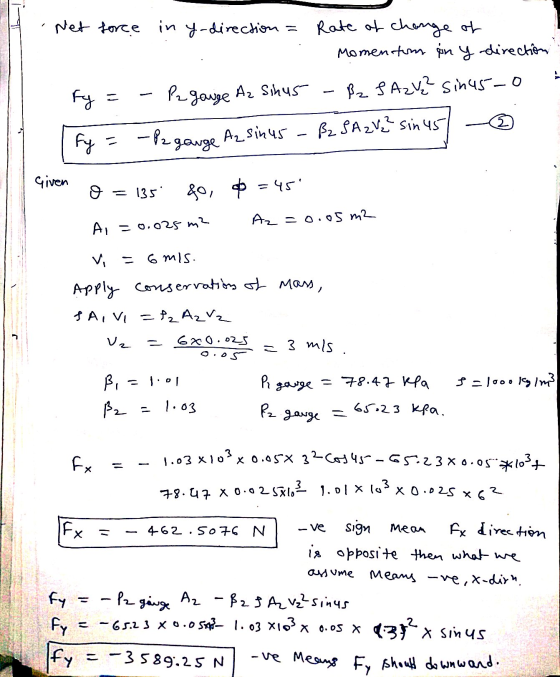
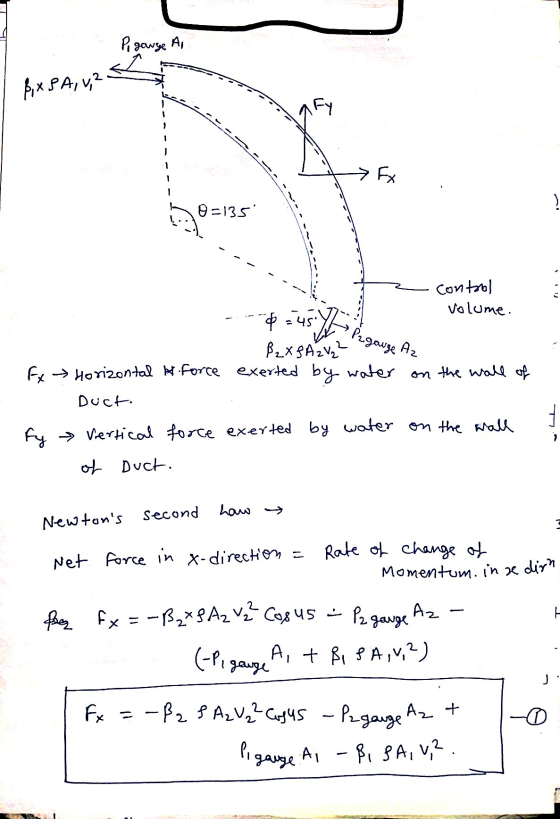
 Water flows steadily through a curved duct that turns the flow through angle @= 135º, as shown in Fig. 3. The cross-sectional area of the duct changes from A1 = 0.025 m² at the inlet to A2 = 0.05 m’ at the outlet. The average velocity at the duct inlet is V1 = 6 m/s. The momentum flux correction factor may be taken as B1 = 1.01 at the duct inlet and B2 = 1.03 at the its outlet. The...
asap please, will rate! 3. Water flows steadily through a curved duct that turns the flow...
 asap please, will rate!
3. Water flows steadily through a curved duct that turns the flow through angle 0= 135º, as shown in Fig. 3. The cross-sectional area of the duct changes from Aj 0.025 m² at the inlet to A2 = 0.05 m² at the outlet. The average velocity at the duct inlet is V1 = 6 m/s. The momentum flux correction factor may be taken as Bi= 1.01 at the duct inlet and B2 = 1.03 at the...
asap please, will rate!
3. Water flows steadily through a curved duct that turns the flow through angle 0= 135º, as shown in Fig. 3. The cross-sectional area of the duct changes from Aj 0.025 m² at the inlet to A2 = 0.05 m² at the outlet. The average velocity at the duct inlet is V1 = 6 m/s. The momentum flux correction factor may be taken as Bi= 1.01 at the duct inlet and B2 = 1.03 at the...
Water flows steadily through a curved duct that turns the flow through angle = 135 degrees,...
 Water flows steadily through a curved duct that turns the flow
through angle = 135 degrees, as shown in Fig. 3. The
cross-sectional area of the duct changes from A1 = 0.025 m2 at the
inlet to A2 = 0.05 m2 at the outlet. The average velocity at the
duct inlet is V1 = 6 m/s. The momentum flux correction factor may
be taken as 1 = 1.01 at the duct inlet and 2 = 1.03 at the its
outlet....
Water flows steadily through a curved duct that turns the flow
through angle = 135 degrees, as shown in Fig. 3. The
cross-sectional area of the duct changes from A1 = 0.025 m2 at the
inlet to A2 = 0.05 m2 at the outlet. The average velocity at the
duct inlet is V1 = 6 m/s. The momentum flux correction factor may
be taken as 1 = 1.01 at the duct inlet and 2 = 1.03 at the its
outlet....
Question 2 (a) An incompressible fluid of density ρ and viscosity μ flows through a curved...
 Question 2 (a) An incompressible fluid of density ρ and viscosity μ flows through a curved duct that turns the flow through angle θ. (ii) (iii) (i) Write an expression for the horizontal force F of the fluid on the walls of the duct in 4 marks) terms of the given variables (ignore the gravity); Calculate the force Fx, when: θ = 135°, ρ = 9982 kg/m , μ=1.003x10⁻³ kg/m.s., Al = 0.025 m2, A2-0.05 m, Vi-6 m/s, Plaage-78.47 kPa,...
Water (density = 1000 kg/m3) flows through a duct that makes a 180 degree U-shaped bend...
Water (density = 1000 kg/m3) flows through a duct that makes a 180 degree U-shaped bend (see below). Assume that the fluid is incompressible through the duct and the velocity at the inlet is V1 = 24 m/s. Assume that the momentum-flux correction factor at both inlet (point 1) and outlet (point 2) is 2.1. The gage pressures are P1 = 120 kPa at the inlet and P2 = 248 kPa at the outlet of the bend. The inlet is...
4. CO2 flows steadily through the duct shown from 350 kPa, 60°C, and 120 m/s at...
 4. CO2 flows steadily through the duct shown from 350 kPa, 60°C, and 120 m/s at the inlet state to M -1.3 at the outlet, where local isentropic stagnation conditions are known to be 385 kPa and 350 K. Compute the local isentropic stagnation pressure and temperature at the inlet and the static pressure and temperature at the duct outlet. Flow Inlet Outlet
will give thumbs up for correct answer!! 1. Water flows steadily through an inclined nozzle, as...
 will give thumbs up for correct
answer!!
1. Water flows steadily through an inclined nozzle, as shown in the figure below. The operating conditions of the nozzle inlet and outlet are given in the figure. Determine the pressure required at the nozzle inlet. (Pwater = 1000 kg/m²). K -2m P = ? Vi= some rozm P = 3 kia = 0.05m 300 122=0.5m
will give thumbs up for correct
answer!!
1. Water flows steadily through an inclined nozzle, as shown in the figure below. The operating conditions of the nozzle inlet and outlet are given in the figure. Determine the pressure required at the nozzle inlet. (Pwater = 1000 kg/m²). K -2m P = ? Vi= some rozm P = 3 kia = 0.05m 300 122=0.5m
please help...add sketch Underground water is to be pumped by a 78 percent efficient 5-kW submerged...
 please help...add sketch
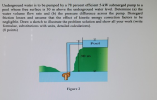
Underground water is to be pumped by a 78 percent efficient 5-kW submerged pump to a pool whose free surface is 30 m above the underground water level. Determine (a) the water volume flow rate and (b) the pressure difference across the pump. Disregard friction losses and assume that the effect of kinetic energy correction factors to be negligible. Draw a sketch to illustrate the problem solution and show all your work (write formulae, substitutions with units,...
please help...add sketch
Underground water is to be pumped by a 78 percent efficient 5-kW submerged pump to a pool whose free surface is 30 m above the underground water level. Determine (a) the water volume flow rate and (b) the pressure difference across the pump. Disregard friction losses and assume that the effect of kinetic energy correction factors to be negligible. Draw a sketch to illustrate the problem solution and show all your work (write formulae, substitutions with units,...
4. (10 points) Water flows steadily through a reducing elbow before being released to atmosphere, as...
 4. (10 points) Water flows steadily through a reducing elbow before being released to atmosphere, as shown in the figure below. The average velocity at the inlet is U - 1 m/s. The diameter at the outlet D2 = 0.1 m is less than the diameter at the inlet D = 0.15 m, such that the flow accelerates through the elbow. The elbow is smooth and short, such that the effect of friction is negligible. The elbow is in horizontal...
Water (p = 1,000 kg/m?) flows steadily through a 90° elbow and exits as a free...
 Water (p = 1,000 kg/m?) flows steadily through a 90° elbow and exits as a free jet through a nozzle, as shown below. The measured upstream gage pressure is 800 kPa. Neglect body forces and viscous effects, and disregard the height of the elbow/nozzle combination. The water velocity at any cross section is assumed to be uniform. However, the water velocity inside the elbow is not negligible compared to that in the nozzle. Consider the following: Determine the velocities V,...
 Water flows steadily through a curved duct that turns the flow through angle @= 135º, as shown in Fig. 3. The cross-sectional area of the duct changes from A1 = 0.025 m² at the inlet to A2 = 0.05 m’ at the outlet. The average velocity at the duct inlet is V1 = 6 m/s. The momentum flux correction factor may be taken as B1 = 1.01 at the duct inlet and B2 = 1.03 at the its outlet. The...
 asap please, will rate!
3. Water flows steadily through a curved duct that turns the flow through angle 0= 135º, as shown in Fig. 3. The cross-sectional area of the duct changes from Aj 0.025 m² at the inlet to A2 = 0.05 m² at the outlet. The average velocity at the duct inlet is V1 = 6 m/s. The momentum flux correction factor may be taken as Bi= 1.01 at the duct inlet and B2 = 1.03 at the...
asap please, will rate!
3. Water flows steadily through a curved duct that turns the flow through angle 0= 135º, as shown in Fig. 3. The cross-sectional area of the duct changes from Aj 0.025 m² at the inlet to A2 = 0.05 m² at the outlet. The average velocity at the duct inlet is V1 = 6 m/s. The momentum flux correction factor may be taken as Bi= 1.01 at the duct inlet and B2 = 1.03 at the...
 Water flows steadily through a curved duct that turns the flow
through angle = 135 degrees, as shown in Fig. 3. The
cross-sectional area of the duct changes from A1 = 0.025 m2 at the
inlet to A2 = 0.05 m2 at the outlet. The average velocity at the
duct inlet is V1 = 6 m/s. The momentum flux correction factor may
be taken as 1 = 1.01 at the duct inlet and 2 = 1.03 at the its
outlet....
Water flows steadily through a curved duct that turns the flow
through angle = 135 degrees, as shown in Fig. 3. The
cross-sectional area of the duct changes from A1 = 0.025 m2 at the
inlet to A2 = 0.05 m2 at the outlet. The average velocity at the
duct inlet is V1 = 6 m/s. The momentum flux correction factor may
be taken as 1 = 1.01 at the duct inlet and 2 = 1.03 at the its
outlet....
 Question 2 (a) An incompressible fluid of density ρ and viscosity μ flows through a curved duct that turns the flow through angle θ. (ii) (iii) (i) Write an expression for the horizontal force F of the fluid on the walls of the duct in 4 marks) terms of the given variables (ignore the gravity); Calculate the force Fx, when: θ = 135°, ρ = 9982 kg/m , μ=1.003x10⁻³ kg/m.s., Al = 0.025 m2, A2-0.05 m, Vi-6 m/s, Plaage-78.47 kPa,...
 4. CO2 flows steadily through the duct shown from 350 kPa, 60°C, and 120 m/s at the inlet state to M -1.3 at the outlet, where local isentropic stagnation conditions are known to be 385 kPa and 350 K. Compute the local isentropic stagnation pressure and temperature at the inlet and the static pressure and temperature at the duct outlet. Flow Inlet Outlet
 will give thumbs up for correct
answer!!
1. Water flows steadily through an inclined nozzle, as shown in the figure below. The operating conditions of the nozzle inlet and outlet are given in the figure. Determine the pressure required at the nozzle inlet. (Pwater = 1000 kg/m²). K -2m P = ? Vi= some rozm P = 3 kia = 0.05m 300 122=0.5m
will give thumbs up for correct
answer!!
1. Water flows steadily through an inclined nozzle, as shown in the figure below. The operating conditions of the nozzle inlet and outlet are given in the figure. Determine the pressure required at the nozzle inlet. (Pwater = 1000 kg/m²). K -2m P = ? Vi= some rozm P = 3 kia = 0.05m 300 122=0.5m
 please help...add sketch
Underground water is to be pumped by a 78 percent efficient 5-kW submerged pump to a pool whose free surface is 30 m above the underground water level. Determine (a) the water volume flow rate and (b) the pressure difference across the pump. Disregard friction losses and assume that the effect of kinetic energy correction factors to be negligible. Draw a sketch to illustrate the problem solution and show all your work (write formulae, substitutions with units,...
please help...add sketch
Underground water is to be pumped by a 78 percent efficient 5-kW submerged pump to a pool whose free surface is 30 m above the underground water level. Determine (a) the water volume flow rate and (b) the pressure difference across the pump. Disregard friction losses and assume that the effect of kinetic energy correction factors to be negligible. Draw a sketch to illustrate the problem solution and show all your work (write formulae, substitutions with units,...
 4. (10 points) Water flows steadily through a reducing elbow before being released to atmosphere, as shown in the figure below. The average velocity at the inlet is U - 1 m/s. The diameter at the outlet D2 = 0.1 m is less than the diameter at the inlet D = 0.15 m, such that the flow accelerates through the elbow. The elbow is smooth and short, such that the effect of friction is negligible. The elbow is in horizontal...
 Water (p = 1,000 kg/m?) flows steadily through a 90° elbow and exits as a free jet through a nozzle, as shown below. The measured upstream gage pressure is 800 kPa. Neglect body forces and viscous effects, and disregard the height of the elbow/nozzle combination. The water velocity at any cross section is assumed to be uniform. However, the water velocity inside the elbow is not negligible compared to that in the nozzle. Consider the following: Determine the velocities V,...
Most questions answered within 3 hours.
-
Where is the error in this code sequence?
String s1 = "Hello";
String s2 = "ello";...
asked 11 months ago -
Financial data for Joel de Paris, Inc., for last year
follow:
Joel de Paris, Inc.
Balance...
asked 11 months ago -
Consider this reaction:
Al2(SO4)3 (aq)+ BaCl3
(aq) Al2Cl6 (aq)- +
3BaSO4(s) . What is the...
asked 11 months ago -
Suppose that Savneet is considering increasing her
recent random sample from 20 car rentals to 40...
asked 11 months ago -
Trucks arrive at an unloading terminal at an average rate of 120
per hour.
Trucks arrive...
asked 11 months ago -
Why are methanol and ethanol completely soluble in water while
octanol is not very little soluble....
asked 11 months ago -
A facilities manager at a university reads in a research report
that the mean amount of...
asked 11 months ago -
When the CuSO4 is rehydrated by adding water to the anhydrous
compound, is this an endothermic...
asked 11 months ago -
A ray of sunlight is passing from diamond into crown glass; the
angle of incidence is...
asked 11 months ago -
A block of mass 0.249 kg is placed on top of a light, vertical
spring of...
asked 11 months ago -
how do the kidneys compensate in the presences of acidosis
a) trigger hyperventilate
b) reserve acid...
asked 11 months ago -
Question 501 pts
The rental rate of capital to the firm increases. Which of the
following...
asked 11 months ago