
Homework Answers
Add Answer to:
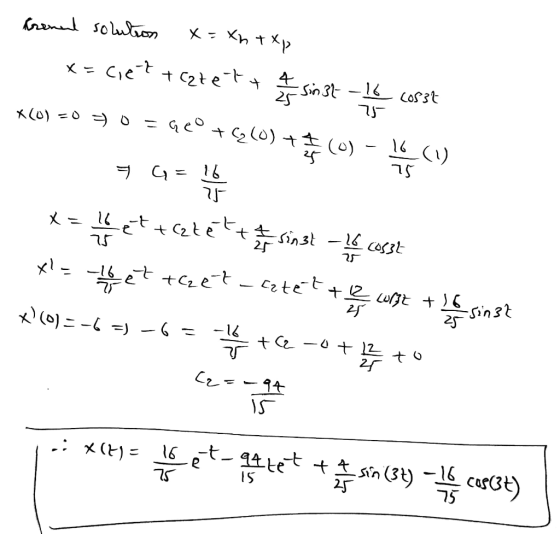
5) Given the following, solve the differential equation for a mass on a spring. A 96...
Given the following, solve the differential equation for a mass on a spring. A 96 pound...
Given the following, solve the differential equation for a mass on a spring. A 96 pound weight hangs from a spring. The damping coefficient is 6 slugs/second and the spring constant is 3 pounds/foot. There is an applied force of 8cos3t pounds. The weight starts from the equilibrium position with an upward velocity of 6 feet/second. (In other words, x(0) = 0 and x'(0) = -6)
6. A 32-pound object stretches a spring 8 feet to reach equilibrium. The object is then...
 6. A 32-pound object stretches a spring 8 feet to reach equilibrium. The object is then pulled to a point that is I foot below the equilibrium position and released from with an upward velocity of 6 feet per second Assume a damping force of 5. What is the position of the object when it attains its maximum displacement above the equilibrium position? Express your answer to 4 decimal places
A force of 15 pounds stretches a spring by 3 feet. Assuming the spring exhibits a...
A force of 15 pounds stretches a spring by 3 feet. Assuming the spring exhibits a damping force numerically equivalent to its instantaneous velocity, determine the equation of motion if the spring is released from the equilibrium position with an upward velocity of 3 feet-per-second.
I need the correct u(t). Ibs stretches a spring 4 inches what is the spring constant?...
 I need the correct u(t).
Ibs stretches a spring 4 inches what is the spring constant? If the mass has a velocity of 6 ft/sec and this results in a viscous resistance of 117 lbs what is the damping coefficient? If a mass weighing Assume 32lb = 1 slug Preview slugs a. What is the mass of the object? 15 lb sec b. What is the damping coefficient? c19s . What is the spring constant? k = 144 ft n...
I need the correct u(t).
Ibs stretches a spring 4 inches what is the spring constant? If the mass has a velocity of 6 ft/sec and this results in a viscous resistance of 117 lbs what is the damping coefficient? If a mass weighing Assume 32lb = 1 slug Preview slugs a. What is the mass of the object? 15 lb sec b. What is the damping coefficient? c19s . What is the spring constant? k = 144 ft n...
A 32 pound weight is attached to the lower end of a coiled spring suspended from the ceiling. The...
A 32 pound weight is attached to the lower end of a coiled spring suspended from the ceiling. The spring constant for the spring is 9. At time t = 0, the weight is positioned Sqrt(3) feet below equilibrium and given an upward velocity of 3 feet per second. Determine the equation of motion of the weight as a function of time. Find the amplitude of the motion. Find the period of the motion. Find the phase angle. Determine the...
1. A mass weighing 8 pounds is attached to a 4 foot long spring and stretches it to 8 feet long. ...
 1. A mass weighing 8 pounds is attached to a 4 foot long spring and stretches it to 8 feet long. The medium offers a damping force equal to 0.5 times the instantaneous velocity. Find the equation of motion if the mass is released from rest at a position 18 inches above the equilibrium.
1. A mass weighing 8 pounds is attached to a 4 foot long spring and stretches it to 8 feet long. The medium offers a damping...
1. A mass weighing 8 pounds is attached to a 4 foot long spring and stretches it to 8 feet long. The medium offers a damping force equal to 0.5 times the instantaneous velocity. Find the equation of motion if the mass is released from rest at a position 18 inches above the equilibrium.
1. A mass weighing 8 pounds is attached to a 4 foot long spring and stretches it to 8 feet long. The medium offers a damping...
1. A force of 2 pounds stretches a spring 1 foot. A mass weighing 3.2 pounds...
 1. A force of 2 pounds stretches a spring 1 foot. A mass weighing 3.2 pounds is attached to the spring, and the system is then immersed in a medium that offers a damping force that is equal to 0.4 times the instantaneous velocity. (a) Find the equation of motion if the mass is initially released from rest from a point 1 foot above the equilibrium position. (Use the convention that displacements measured below the equilibrium position are positive.) (b)...
Solve it with matlab 25.16 The motion of a damped spring-mass system (Fig. P25.16) is described...
 Solve it with matlab
25.16 The motion of a damped spring-mass system (Fig. P25.16) is described by the following ordinary differential equation: d’x dx ++ kx = 0 m dr dt where x = displacement from equilibrium position (m), t = time (s), m 20-kg mass, and c = the damping coefficient (N · s/m). The damping coefficient c takes on three values of 5 (under- damped), 40 (critically damped), and 200 (overdamped). The spring constant k = 20 N/m....
Solve it with matlab
25.16 The motion of a damped spring-mass system (Fig. P25.16) is described by the following ordinary differential equation: d’x dx ++ kx = 0 m dr dt where x = displacement from equilibrium position (m), t = time (s), m 20-kg mass, and c = the damping coefficient (N · s/m). The damping coefficient c takes on three values of 5 (under- damped), 40 (critically damped), and 200 (overdamped). The spring constant k = 20 N/m....
5. (20 points) A mass weighing 8 pounds stretches a spring 1.6 feet. The entire system...
 5. (20 points) A mass weighing 8 pounds stretches a spring 1.6 feet. The entire system is placed in a medium that offers a damping force numerically equivalent to twice the instantaneous velocity. The mass is initially released from a point 1/2 foot above the equilibrium point with a downward velocity of 5 ft/sec. (a) (6 points) Write the differential equation for the mass/spring system and identify the initial conditions. 7 5. (b) (12 points) Solve the IVP in part...
Differential Equation problem We know that a force of 2.8 Newtons is required to stretch a certain spring 0.7 meters beyond its natural length. A 1.44-kg mass is attached to this spring and allowed t...
 Differential Equation problem
We know that a force of 2.8 Newtons is required to stretch a certain spring 0.7 meters beyond its natural length. A 1.44-kg mass is attached to this spring and allowed to come to equilibrium. The mass-spring system is then set in motion by applying a push in the upward direction that gives the mass an initial velocity of 1.04 meters per second. Let y(t) represent the displacement of the mass above the equilibrium position t seconds...
Differential Equation problem
We know that a force of 2.8 Newtons is required to stretch a certain spring 0.7 meters beyond its natural length. A 1.44-kg mass is attached to this spring and allowed to come to equilibrium. The mass-spring system is then set in motion by applying a push in the upward direction that gives the mass an initial velocity of 1.04 meters per second. Let y(t) represent the displacement of the mass above the equilibrium position t seconds...
 6. A 32-pound object stretches a spring 8 feet to reach equilibrium. The object is then pulled to a point that is I foot below the equilibrium position and released from with an upward velocity of 6 feet per second Assume a damping force of 5. What is the position of the object when it attains its maximum displacement above the equilibrium position? Express your answer to 4 decimal places
 I need the correct u(t).
Ibs stretches a spring 4 inches what is the spring constant? If the mass has a velocity of 6 ft/sec and this results in a viscous resistance of 117 lbs what is the damping coefficient? If a mass weighing Assume 32lb = 1 slug Preview slugs a. What is the mass of the object? 15 lb sec b. What is the damping coefficient? c19s . What is the spring constant? k = 144 ft n...
I need the correct u(t).
Ibs stretches a spring 4 inches what is the spring constant? If the mass has a velocity of 6 ft/sec and this results in a viscous resistance of 117 lbs what is the damping coefficient? If a mass weighing Assume 32lb = 1 slug Preview slugs a. What is the mass of the object? 15 lb sec b. What is the damping coefficient? c19s . What is the spring constant? k = 144 ft n...
 1. A mass weighing 8 pounds is attached to a 4 foot long spring and stretches it to 8 feet long. The medium offers a damping force equal to 0.5 times the instantaneous velocity. Find the equation of motion if the mass is released from rest at a position 18 inches above the equilibrium.
1. A mass weighing 8 pounds is attached to a 4 foot long spring and stretches it to 8 feet long. The medium offers a damping...
1. A mass weighing 8 pounds is attached to a 4 foot long spring and stretches it to 8 feet long. The medium offers a damping force equal to 0.5 times the instantaneous velocity. Find the equation of motion if the mass is released from rest at a position 18 inches above the equilibrium.
1. A mass weighing 8 pounds is attached to a 4 foot long spring and stretches it to 8 feet long. The medium offers a damping...
 1. A force of 2 pounds stretches a spring 1 foot. A mass weighing 3.2 pounds is attached to the spring, and the system is then immersed in a medium that offers a damping force that is equal to 0.4 times the instantaneous velocity. (a) Find the equation of motion if the mass is initially released from rest from a point 1 foot above the equilibrium position. (Use the convention that displacements measured below the equilibrium position are positive.) (b)...
 Solve it with matlab
25.16 The motion of a damped spring-mass system (Fig. P25.16) is described by the following ordinary differential equation: d’x dx ++ kx = 0 m dr dt where x = displacement from equilibrium position (m), t = time (s), m 20-kg mass, and c = the damping coefficient (N · s/m). The damping coefficient c takes on three values of 5 (under- damped), 40 (critically damped), and 200 (overdamped). The spring constant k = 20 N/m....
Solve it with matlab
25.16 The motion of a damped spring-mass system (Fig. P25.16) is described by the following ordinary differential equation: d’x dx ++ kx = 0 m dr dt where x = displacement from equilibrium position (m), t = time (s), m 20-kg mass, and c = the damping coefficient (N · s/m). The damping coefficient c takes on three values of 5 (under- damped), 40 (critically damped), and 200 (overdamped). The spring constant k = 20 N/m....
 5. (20 points) A mass weighing 8 pounds stretches a spring 1.6 feet. The entire system is placed in a medium that offers a damping force numerically equivalent to twice the instantaneous velocity. The mass is initially released from a point 1/2 foot above the equilibrium point with a downward velocity of 5 ft/sec. (a) (6 points) Write the differential equation for the mass/spring system and identify the initial conditions. 7 5. (b) (12 points) Solve the IVP in part...
 Differential Equation problem
We know that a force of 2.8 Newtons is required to stretch a certain spring 0.7 meters beyond its natural length. A 1.44-kg mass is attached to this spring and allowed to come to equilibrium. The mass-spring system is then set in motion by applying a push in the upward direction that gives the mass an initial velocity of 1.04 meters per second. Let y(t) represent the displacement of the mass above the equilibrium position t seconds...
Differential Equation problem
We know that a force of 2.8 Newtons is required to stretch a certain spring 0.7 meters beyond its natural length. A 1.44-kg mass is attached to this spring and allowed to come to equilibrium. The mass-spring system is then set in motion by applying a push in the upward direction that gives the mass an initial velocity of 1.04 meters per second. Let y(t) represent the displacement of the mass above the equilibrium position t seconds...
Most questions answered within 3 hours.
-
Where is the error in this code sequence?
String s1 = "Hello";
String s2 = "ello";...
asked 10 months ago -
Financial data for Joel de Paris, Inc., for last year
follow:
Joel de Paris, Inc.
Balance...
asked 10 months ago -
Consider this reaction:
Al2(SO4)3 (aq)+ BaCl3
(aq) Al2Cl6 (aq)- +
3BaSO4(s) . What is the...
asked 10 months ago -
Suppose that Savneet is considering increasing her
recent random sample from 20 car rentals to 40...
asked 10 months ago -
Trucks arrive at an unloading terminal at an average rate of 120
per hour.
Trucks arrive...
asked 10 months ago -
Why are methanol and ethanol completely soluble in water while
octanol is not very little soluble....
asked 10 months ago -
A facilities manager at a university reads in a research report
that the mean amount of...
asked 10 months ago -
When the CuSO4 is rehydrated by adding water to the anhydrous
compound, is this an endothermic...
asked 10 months ago -
A ray of sunlight is passing from diamond into crown glass; the
angle of incidence is...
asked 10 months ago -
A block of mass 0.249 kg is placed on top of a light, vertical
spring of...
asked 10 months ago -
how do the kidneys compensate in the presences of acidosis
a) trigger hyperventilate
b) reserve acid...
asked 10 months ago -
Question 501 pts
The rental rate of capital to the firm increases. Which of the
following...
asked 10 months ago