


Homework Answers
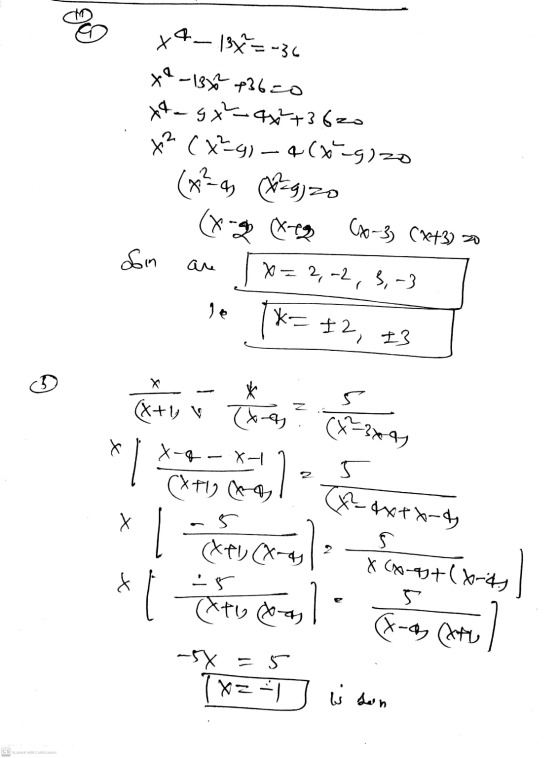
 as per HomeworkLib policy I have solved first
two question
as per HomeworkLib policy I have solved first
two question
Add Answer to:
Show all work from this point forward for full marks. 11. Solve the following & a)...
Please show all your work for credit. a). Use the Remainder Theorem and synthetic division to...
 Please show all your work for credit. a). Use the Remainder Theorem and synthetic division to find the function value. Verify your answer using another method b) Use the Remainder Theorem and synthetic drvision to find the function value. Verify your answer using another method f(x) 4x-3x 2x -4, (2) a) Using the facto(+5x+2), find the remaining factorte) off (x) +6x +3x- 10 and winte the polynomial in fully factored form. ) Using the factors (3x + 2) and (x...
Answer ALL questions. (20 marks) 1. Find the quotient and remainder by using long division. (6x...
 Answer ALL questions. (20 marks) 1. Find the quotient and remainder by using long division. (6x + 4x* + 3) + (1 + 2x) 2. Given that P(x) = ax2 + 5x - 1 and Q(x) = bx + 4. If P(x). Q(x) = 3x2 + 17x2 + 19x - 4, find the values of a and b. 3. The function H(x) = x3 + ax? – bx + 5 gives a remainder of 11 when divided by x +...
Part A-Multiple Choice K/U-20 marks] 1. If the leading coefficient of an odd-degree polynomial function is...
 Part A-Multiple Choice K/U-20 marks] 1. If the leading coefficient of an odd-degree polynomial function is positive, then the function extends from the third quadrant to the first quadrant; that is, as * , y -co and as →-co, y → b. * →-co, y → and as x 0, y →-60 * →-co, y →-co and as x 0, y → d. X-CO, y -co and as x, y →-00 a. c. c. c. 6 2. Which polynomial function...
4. Solve the following equation using integration by parts. (10 Marks) | 22 x2 In(x) dx...
 4. Solve the following equation using integration by parts. (10 Marks) | 22 x2 In(x) dx 5. Calculate the shaded area between the curve and the x-axis as shown below. (5 Marks) y = x2 - 6x
4. [25 points) Solve each of the following definite and indefinite integrals. Show all of your...
 4. [25 points) Solve each of the following definite and indefinite integrals. Show all of your work for full credit. For definite integrals, leave numerical answers in exact form (without rounding). Please double-check to make sure you copy the problems correctly, as minor typos could change the difficulty of these substantially. a. 1(413 – 1/3 + 1)dt b. Syndx c. S x cos(3x) dx d. S 6x sin(3x) dx e. 2y In y dy
Show all steps clearly, to receive full marks for your solutions. 10. For each of the...
 Show all steps clearly, to receive full marks for your solutions. 10. For each of the following, identify the base function and describe the transformation(s): Fle) = P(x + 1) f(x) = -4(3x)* + 5 (8 marks) 11. 12. Describe the transformations that must be applied to the graph of the base function (3) to obtain the transformed function. Write the transformed equation in simplified form. f(x) = x, y=71-5 (x - 1)) + 1 (10 marks) State the base...
Show all steps clearly, to receive full marks for your solutions. 10. For each of the...
 Show all steps clearly, to receive full marks for your solutions. 10. For each of the following, identify the base function and describe the transformation(s): F(x+1) f(x) = -4(3x)" + 5 (8 marks) 11. Describe the transformations that must be applied to the graph of the base function fee) to obtain the transformed function. Write the transformed equation in simplified form. $12)=x, y21-- 1)) + 1 (10 marks) State the base function that corresponds to the transformed lunction = -21...
Lidl US pietes une sidemem vers the question. Use common or natural logarithms to solve the...
 Lidl US pietes une sidemem vers the question. Use common or natural logarithms to solve the exponential equation symbolically. 1 1) A) 1 In 27 + 2 3 In 3 B) = X = - In 3 In 27 + 18 In 3 C) X=- In 27 6 D) - In 27 3 In 3 - 2 Solve the logarithmic equation symbolically. 2) In x + In x4 = 5 A) x + x4 - 05 2) B) x =...
Section A: Show all your work. [AR1: 5 x 2 Marks] A1. Solve the following system...
 Section A: Show all your work. [AR1: 5 x 2 Marks] A1. Solve the following system of equations Algebraically (Substitution). -7x - 2y = -10 6x + y = 15 A2. Solve the following system of equations Algebraically (Elimination). x - 2y = 15 2x + 3y = 2 A3. Solve the following system of equations Algebraically (Any Method). [AR1: 2 Mark] y = -x-7 Page 116
Please show how to solve this. ord -Exam2 FallzuT4verzaprn.docx SHOW WORK TO GET FULL CREDIT Problem...
 Please show how to solve
this.
ord -Exam2 FallzuT4verzaprn.docx SHOW WORK TO GET FULL CREDIT Problem 7) Suppose that a certain random variable, X, has the following cumulative distribution function: 0 x <1 0.7 1x < 4 127 i)Determine P(X>1) (6 points) ii)Determine P(4 sXs 6) (6 points)
Please show how to solve
this.
ord -Exam2 FallzuT4verzaprn.docx SHOW WORK TO GET FULL CREDIT Problem 7) Suppose that a certain random variable, X, has the following cumulative distribution function: 0 x <1 0.7 1x < 4 127 i)Determine P(X>1) (6 points) ii)Determine P(4 sXs 6) (6 points)
 Please show all your work for credit. a). Use the Remainder Theorem and synthetic division to find the function value. Verify your answer using another method b) Use the Remainder Theorem and synthetic drvision to find the function value. Verify your answer using another method f(x) 4x-3x 2x -4, (2) a) Using the facto(+5x+2), find the remaining factorte) off (x) +6x +3x- 10 and winte the polynomial in fully factored form. ) Using the factors (3x + 2) and (x...
 Answer ALL questions. (20 marks) 1. Find the quotient and remainder by using long division. (6x + 4x* + 3) + (1 + 2x) 2. Given that P(x) = ax2 + 5x - 1 and Q(x) = bx + 4. If P(x). Q(x) = 3x2 + 17x2 + 19x - 4, find the values of a and b. 3. The function H(x) = x3 + ax? – bx + 5 gives a remainder of 11 when divided by x +...
 Part A-Multiple Choice K/U-20 marks] 1. If the leading coefficient of an odd-degree polynomial function is positive, then the function extends from the third quadrant to the first quadrant; that is, as * , y -co and as →-co, y → b. * →-co, y → and as x 0, y →-60 * →-co, y →-co and as x 0, y → d. X-CO, y -co and as x, y →-00 a. c. c. c. 6 2. Which polynomial function...
 4. Solve the following equation using integration by parts. (10 Marks) | 22 x2 In(x) dx 5. Calculate the shaded area between the curve and the x-axis as shown below. (5 Marks) y = x2 - 6x
 4. [25 points) Solve each of the following definite and indefinite integrals. Show all of your work for full credit. For definite integrals, leave numerical answers in exact form (without rounding). Please double-check to make sure you copy the problems correctly, as minor typos could change the difficulty of these substantially. a. 1(413 – 1/3 + 1)dt b. Syndx c. S x cos(3x) dx d. S 6x sin(3x) dx e. 2y In y dy
 Show all steps clearly, to receive full marks for your solutions. 10. For each of the following, identify the base function and describe the transformation(s): Fle) = P(x + 1) f(x) = -4(3x)* + 5 (8 marks) 11. 12. Describe the transformations that must be applied to the graph of the base function (3) to obtain the transformed function. Write the transformed equation in simplified form. f(x) = x, y=71-5 (x - 1)) + 1 (10 marks) State the base...
 Show all steps clearly, to receive full marks for your solutions. 10. For each of the following, identify the base function and describe the transformation(s): F(x+1) f(x) = -4(3x)" + 5 (8 marks) 11. Describe the transformations that must be applied to the graph of the base function fee) to obtain the transformed function. Write the transformed equation in simplified form. $12)=x, y21-- 1)) + 1 (10 marks) State the base function that corresponds to the transformed lunction = -21...
 Lidl US pietes une sidemem vers the question. Use common or natural logarithms to solve the exponential equation symbolically. 1 1) A) 1 In 27 + 2 3 In 3 B) = X = - In 3 In 27 + 18 In 3 C) X=- In 27 6 D) - In 27 3 In 3 - 2 Solve the logarithmic equation symbolically. 2) In x + In x4 = 5 A) x + x4 - 05 2) B) x =...
 Section A: Show all your work. [AR1: 5 x 2 Marks] A1. Solve the following system of equations Algebraically (Substitution). -7x - 2y = -10 6x + y = 15 A2. Solve the following system of equations Algebraically (Elimination). x - 2y = 15 2x + 3y = 2 A3. Solve the following system of equations Algebraically (Any Method). [AR1: 2 Mark] y = -x-7 Page 116
 Please show how to solve
this.
ord -Exam2 FallzuT4verzaprn.docx SHOW WORK TO GET FULL CREDIT Problem 7) Suppose that a certain random variable, X, has the following cumulative distribution function: 0 x <1 0.7 1x < 4 127 i)Determine P(X>1) (6 points) ii)Determine P(4 sXs 6) (6 points)
Please show how to solve
this.
ord -Exam2 FallzuT4verzaprn.docx SHOW WORK TO GET FULL CREDIT Problem 7) Suppose that a certain random variable, X, has the following cumulative distribution function: 0 x <1 0.7 1x < 4 127 i)Determine P(X>1) (6 points) ii)Determine P(4 sXs 6) (6 points)
Most questions answered within 3 hours.
-
Where is the error in this code sequence?
String s1 = "Hello";
String s2 = "ello";...
asked 10 months ago -
Financial data for Joel de Paris, Inc., for last year
follow:
Joel de Paris, Inc.
Balance...
asked 10 months ago -
Consider this reaction:
Al2(SO4)3 (aq)+ BaCl3
(aq) Al2Cl6 (aq)- +
3BaSO4(s) . What is the...
asked 10 months ago -
Suppose that Savneet is considering increasing her
recent random sample from 20 car rentals to 40...
asked 10 months ago -
Trucks arrive at an unloading terminal at an average rate of 120
per hour.
Trucks arrive...
asked 10 months ago -
Why are methanol and ethanol completely soluble in water while
octanol is not very little soluble....
asked 10 months ago -
A facilities manager at a university reads in a research report
that the mean amount of...
asked 10 months ago -
When the CuSO4 is rehydrated by adding water to the anhydrous
compound, is this an endothermic...
asked 10 months ago -
A ray of sunlight is passing from diamond into crown glass; the
angle of incidence is...
asked 10 months ago -
A block of mass 0.249 kg is placed on top of a light, vertical
spring of...
asked 10 months ago -
how do the kidneys compensate in the presences of acidosis
a) trigger hyperventilate
b) reserve acid...
asked 10 months ago -
Question 501 pts
The rental rate of capital to the firm increases. Which of the
following...
asked 10 months ago