

Homework Answers
Request Answer!
We need at least 10 more requests to produce the answer.
0 / 10 have requested this problem solution
The more requests, the faster the answer.
Add Answer to:
I
would like the answer for two questions. question 29 and question
46
All of the...
When a 3.08 g sample of liquid octane (C8H18) is burned in a bomb calorimeter, the...
When a 3.08 g sample of liquid octane (C8H18) is burned in a bomb calorimeter, the temperature of the calorimeter rises by 26.9 oC. The heat capacity of the calorimeter, measured in a separate experiment, is 6.22 kJ/∘C . The calorimeter also contains 3.00 kg of water, specific heat capacity of 4.18 J/g°C. Determine the heat of combustion of octane in units of kJ/mol octane.
1a) Consider the reaction: C12H22O11(s)+12O2(g)→12CO2(g)+11H2O(l) in which 10.0 g of sucrose, C12H22O11, was burned in a...
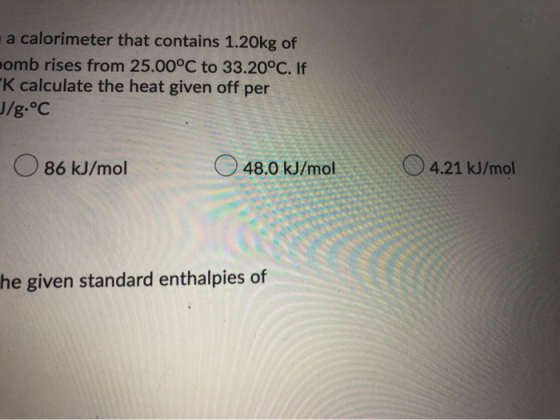
1a) Consider the reaction: C12H22O11(s)+12O2(g)→12CO2(g)+11H2O(l) in which 10.0 g of sucrose, C12H22O11, was burned in a bomb calorimeter with a heat capacity of 7.50 kJ/∘C. The temperature increase inside the calorimeter was found to be 22.0 ∘C. What is the heat of this reaction per mole of sucrose? 1b) One tablespoon of peanut butter has a mass of 17.0 g. It is combusted in a calorimeter whose heat capacity is 110 kJ/°C. The temperature of the calorimeter rises from 21.6...
The temperature rises from 25.00°C to 29.00°C in a bomb calorimeter when 3.50 g of sucrose undergoes combustion in a bo...
The temperature rises from 25.00°C to 29.00°C in a bomb calorimeter when 3.50 g of sucrose undergoes combustion in a bomb calorimeter. Calculate ΔErxn for the combustion of sucrose in kJ/mol sucrose. The heat capacity of the calorimeter is 4.90 kJ/°C. The molar mass of sugar is 342.3 g/mol
The temperature rises from 25.00°C to 29.00°C in a bomb calorimeter when 3.50 g of sucrose undergoes combustion in a bo...
The temperature rises from 25.00°C to 29.00°C in a bomb calorimeter when 3.50 g of sucrose undergoes combustion in a bomb calorimeter. Calculate ΔErxn for the combustion of sucrose in kJ/mol sucrose. The heat capacity of the calorimeter is 4.90 kJ/°C. The molar mass of sugar is 342.3 g/mol
Answer both questions please and thank you!!! QUESTION 3 0.5 points If nitrogen gas has a...
 Answer both questions please and thank you!!!
QUESTION 3 0.5 points If nitrogen gas has a density of 1.14 g/L, and an unknown gas has a density of 3.41 g/L at the same temperature and pressure, what is the ratio of the rate of effusion of the known gas to the rate of effusion of nitrogen? rate effusion unknown rate effusion N2 ? QUESTION 4 0.5 points The combustion reaction for octane burning in oxygen is: 2 C8H18 () 25...
Answer both questions please and thank you!!!
QUESTION 3 0.5 points If nitrogen gas has a density of 1.14 g/L, and an unknown gas has a density of 3.41 g/L at the same temperature and pressure, what is the ratio of the rate of effusion of the known gas to the rate of effusion of nitrogen? rate effusion unknown rate effusion N2 ? QUESTION 4 0.5 points The combustion reaction for octane burning in oxygen is: 2 C8H18 () 25...
QUESTION 4 The combustion reaction for octane burning in oxygen is: 2 C8H18 ()25 O2(g)- 16...
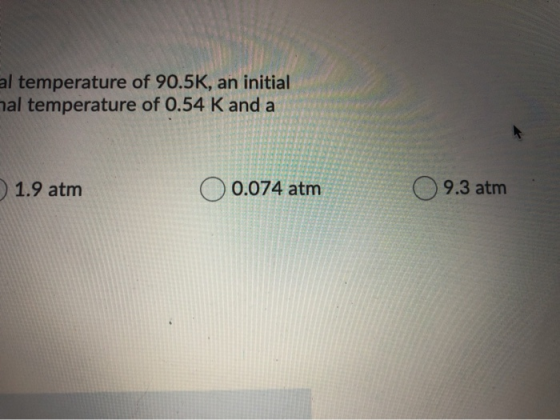
 QUESTION 4 The combustion reaction for octane burning in oxygen is: 2 C8H18 ()25 O2(g)- 16 CO2(g) +18 H20(g) AH = -10869 kJ Suppose an oxygen bomb calorimeter is loaded with oxygen gas and excess octane. The oxygen gas has a volume of 480.0 mL, pressure of 8.28 atm, and an initial temperature of 22.1 °C The calorimeter has a heat capacity of 1.75 kJ/ °C Assuming the oxygen reacts completely, what is the final temperature of the calorimeter?
QUESTION 4 The combustion reaction for octane burning in oxygen is 2 C3H18 (1) + 25...
 QUESTION 4 The combustion reaction for octane burning in oxygen is 2 C3H18 (1) + 25 O2(g) - 16 CO2(g) +18 H20() AH = -10869 kJ. Suppose an oxygen bomb calorimeter is loaded with oxygen gas and excess octane. The oxygen gas has a volume of 480.0 mL, pressure of 8.38 atm, and an initial temperature of 22.1 "C The calorimeter has a heat capacity of 1.75 kJ/ "C Assuming the oxygen reacts completely, what is the final temperature of...
When a 3.80-g sample of liquid octane (C8H18) is burned in a bomb calorimeter, the temperature...
When a 3.80-g sample of liquid octane (C8H18) is burned in a bomb calorimeter, the temperature of the calorimeter rises by 26.5 ∘C. The heat capacity of the calorimeter, measured in a separate experiment, is 6.21 kJ/∘C . You may want to reference (Page 265) Section 6.5 while completing this problem. Part A Determine ΔE for octane combustion in units of kJ/mol octane. Express your answer using three significant figures.
12 Question (1 point) 421 g of octane, CH18 reacts with excess oxygen in a bomb...
 12 Question (1 point) 421 g of octane, CH18 reacts with excess oxygen in a bomb calorimeter. The heat capacity of the calorimeter is 6.97 kJ/°C and the temperature increases by 50.0°C 1st attempt See Periodic Table See Hint How much heat. in units of /mol. was absorbed by the bomb calorimeter? kJ/mol
QUESTION 3 0.5 points Save Answer If nitrogen gas has a density of 1.14 g/L, and...
 QUESTION 3 0.5 points Save Answer If nitrogen gas has a density of 1.14 g/L, and an unknown gas has a density of 5.67 g/L at the same temp and pressure, what is the ratio of the rate of effusion of the known gas to the rate of effusion of nitrogen? rate effusion unknown - 2 rate effusion N2 QUESTION 4 0.5 points Save Answer The combustion reaction for octane burning in oxygen is: 2 C8H18 (1) + 25 O2(g)...
 Answer both questions please and thank you!!!
QUESTION 3 0.5 points If nitrogen gas has a density of 1.14 g/L, and an unknown gas has a density of 3.41 g/L at the same temperature and pressure, what is the ratio of the rate of effusion of the known gas to the rate of effusion of nitrogen? rate effusion unknown rate effusion N2 ? QUESTION 4 0.5 points The combustion reaction for octane burning in oxygen is: 2 C8H18 () 25...
Answer both questions please and thank you!!!
QUESTION 3 0.5 points If nitrogen gas has a density of 1.14 g/L, and an unknown gas has a density of 3.41 g/L at the same temperature and pressure, what is the ratio of the rate of effusion of the known gas to the rate of effusion of nitrogen? rate effusion unknown rate effusion N2 ? QUESTION 4 0.5 points The combustion reaction for octane burning in oxygen is: 2 C8H18 () 25...
 QUESTION 4 The combustion reaction for octane burning in oxygen is: 2 C8H18 ()25 O2(g)- 16 CO2(g) +18 H20(g) AH = -10869 kJ Suppose an oxygen bomb calorimeter is loaded with oxygen gas and excess octane. The oxygen gas has a volume of 480.0 mL, pressure of 8.28 atm, and an initial temperature of 22.1 °C The calorimeter has a heat capacity of 1.75 kJ/ °C Assuming the oxygen reacts completely, what is the final temperature of the calorimeter?
 QUESTION 4 The combustion reaction for octane burning in oxygen is 2 C3H18 (1) + 25 O2(g) - 16 CO2(g) +18 H20() AH = -10869 kJ. Suppose an oxygen bomb calorimeter is loaded with oxygen gas and excess octane. The oxygen gas has a volume of 480.0 mL, pressure of 8.38 atm, and an initial temperature of 22.1 "C The calorimeter has a heat capacity of 1.75 kJ/ "C Assuming the oxygen reacts completely, what is the final temperature of...
 12 Question (1 point) 421 g of octane, CH18 reacts with excess oxygen in a bomb calorimeter. The heat capacity of the calorimeter is 6.97 kJ/°C and the temperature increases by 50.0°C 1st attempt See Periodic Table See Hint How much heat. in units of /mol. was absorbed by the bomb calorimeter? kJ/mol
 QUESTION 3 0.5 points Save Answer If nitrogen gas has a density of 1.14 g/L, and an unknown gas has a density of 5.67 g/L at the same temp and pressure, what is the ratio of the rate of effusion of the known gas to the rate of effusion of nitrogen? rate effusion unknown - 2 rate effusion N2 QUESTION 4 0.5 points Save Answer The combustion reaction for octane burning in oxygen is: 2 C8H18 (1) + 25 O2(g)...
Most questions answered within 3 hours.
-
Where is the error in this code sequence?
String s1 = "Hello";
String s2 = "ello";...
asked 10 months ago -
Financial data for Joel de Paris, Inc., for last year
follow:
Joel de Paris, Inc.
Balance...
asked 10 months ago -
Consider this reaction:
Al2(SO4)3 (aq)+ BaCl3
(aq) Al2Cl6 (aq)- +
3BaSO4(s) . What is the...
asked 10 months ago -
Suppose that Savneet is considering increasing her
recent random sample from 20 car rentals to 40...
asked 10 months ago -
Trucks arrive at an unloading terminal at an average rate of 120
per hour.
Trucks arrive...
asked 10 months ago -
Why are methanol and ethanol completely soluble in water while
octanol is not very little soluble....
asked 10 months ago -
A facilities manager at a university reads in a research report
that the mean amount of...
asked 10 months ago -
When the CuSO4 is rehydrated by adding water to the anhydrous
compound, is this an endothermic...
asked 10 months ago -
A ray of sunlight is passing from diamond into crown glass; the
angle of incidence is...
asked 10 months ago -
A block of mass 0.249 kg is placed on top of a light, vertical
spring of...
asked 10 months ago -
how do the kidneys compensate in the presences of acidosis
a) trigger hyperventilate
b) reserve acid...
asked 10 months ago -
Question 501 pts
The rental rate of capital to the firm increases. Which of the
following...
asked 10 months ago