
Homework Answers
The heat transfer due to radiation from a surface
a). Increases linearly with surface temperature
- False, The equation of heat transfer per unit
area from a surface of temperature T is given as  where
where  is the Stefan-Boltzmann's constant. So it can be clearly
interpreted that relation between heat transfer and surface
temperature is not linear. Heat transfer is proportional to the
fourth power of surface temperature.
is the Stefan-Boltzmann's constant. So it can be clearly
interpreted that relation between heat transfer and surface
temperature is not linear. Heat transfer is proportional to the
fourth power of surface temperature.
b). Decreases as surface temperature decreases.
- Correct, As mentioned above, Heat transfer rate is directly proportional to the fourth power of surface temperature. If Surface temperature increases, the rate of heat transfer will increase and vice versa.
c). Varies with square of the surface temperature.
-False,
Heat transfer rate is directly proportional to fourth power of
surface temperature(T).
d). Varies with 4th power of surface temperature.
-Correct,
This equation is based on the Stefan-Boltzmann law according to
which the radiant energy emitted per unit time per unit area of a
black surface is directly proportional to fourth power of its
absolute temperature.
e). Depends on material but not on temperature.
-False,
The amount of heat transfered depends on both material and
temperature. For a non-black body, the equation of heat transfer is
 , where
  is the emissivity of the material. As the material varies,
emissivity varies. This means that heat transfer depends on both
material and surface temperature.
is the emissivity of the material. As the material varies,
emissivity varies. This means that heat transfer depends on both
material and surface temperature.
Add Answer to:
4. Circle all statement(s) that are correct. The heat transfer due to radiation from a surface...
thumbs up for correct answers( please answer all multiple choice questions) 4, Radiation heat transfer is...
 thumbs up for correct answers( please answer all multiple choice
questions)
4, Radiation heat transfer is characterized by A) energy transport as a result of bulk fluid motion A) thermal energy transfer as vibrational energy in the lattice structure of the material ) movement of discrete packets of energy as electromagnetic waves D) circulation of fluid motion by buoyancy effects 15. Consider a 0.2m diameter, 1.8 rm long horizontal cylinder in a room at 20°C . If the outer surface...
thumbs up for correct answers( please answer all multiple choice
questions)
4, Radiation heat transfer is characterized by A) energy transport as a result of bulk fluid motion A) thermal energy transfer as vibrational energy in the lattice structure of the material ) movement of discrete packets of energy as electromagnetic waves D) circulation of fluid motion by buoyancy effects 15. Consider a 0.2m diameter, 1.8 rm long horizontal cylinder in a room at 20°C . If the outer surface...
Heat Transfer QUESTIONS A black surface emits energy at the same rate in every direction. True...
 Heat Transfer
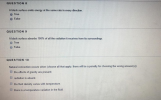
QUESTIONS A black surface emits energy at the same rate in every direction. True False QUESTION 9 A black surface absorbs 100% of all the radiation it receives from its surroundings True False QUESTION 10 Natural convection occurs when choose all that apply, there will be a penalty for choosing the wrong answer(s) the effects of gravity are present. radiation is absent. the fluid density varies with temperature there is a temperature variation in the fluid.
Heat Transfer
QUESTIONS A black surface emits energy at the same rate in every direction. True False QUESTION 9 A black surface absorbs 100% of all the radiation it receives from its surroundings True False QUESTION 10 Natural convection occurs when choose all that apply, there will be a penalty for choosing the wrong answer(s) the effects of gravity are present. radiation is absent. the fluid density varies with temperature there is a temperature variation in the fluid.
The rate of heat transfer by emitted radiation is determined by the Stefan-Boltzmann law of radiation...
 The rate of heat transfer by emitted radiation is determined by the Stefan-Boltzmann law of radiation = ceAT4 t where a 5.67x10⁸ J/(s m2. K4) is the Stefan-Boltzmann constant, A is the surface area of the object, and T is its absolute temperature in kelvin. The symbol e stands for the emissivity of the object, which is a measure of how well it radiates. An ideal jet-black (or black body) radiator has e 1, whereas a perfect reflector has e...
Which of the following are true about radiation of heat? Mark all that apply. The rate...
 Which of the following are true about radiation of heat? Mark all that apply. The rate of energy transfer is proportional to the surface area of the object Radiation occurs when mass at one temperature transfers to a different location Radiation can transfer heat through empty space (vacuum) Radiation is a result of the collisions between molecules in two different objects at two different temperatures Which of the following characteristics describe good thermal conductors? Mark all that apply. High thermal...
it’s heat transfer class.. quick answer and clear steps please 3. For a four-surface system, all surfaces are diffuse and gray. All surfaces have the same size of square 2 m2 and the emissivities...
 it’s heat transfer class.. quick answer and clear steps
please
3. For a four-surface system, all surfaces are diffuse and gray. All surfaces have the same size of square 2 m2 and the emissivities are 0.7,0.5, 0.7 and 0.8 for surface 1-4, respectively. The temperature of these surfaces are 500K, 400K, 500K and 700K for surface 1-4 respectively. (30+10 PTS) (a) Build the entire resistance system. (b) What are the view factors between surface 1 to 2 and 2 to...
it’s heat transfer class.. quick answer and clear steps
please
3. For a four-surface system, all surfaces are diffuse and gray. All surfaces have the same size of square 2 m2 and the emissivities are 0.7,0.5, 0.7 and 0.8 for surface 1-4, respectively. The temperature of these surfaces are 500K, 400K, 500K and 700K for surface 1-4 respectively. (30+10 PTS) (a) Build the entire resistance system. (b) What are the view factors between surface 1 to 2 and 2 to...
please solve these questions (a) Calculate the rate of heat transfer by radiation from a car...
 please solve these questions
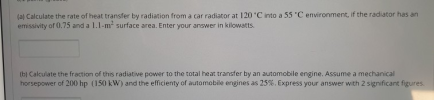
(a) Calculate the rate of heat transfer by radiation from a car radiator at 120 °C into a 55 °C environment, if the radiator has an emissivity of 0.75 and a 1.1-m surface area. Enter your answer in kilowatts. (b) Calculate the fraction of this radiative power to the total heat transfer by an automobile engine. Assume a mechanical horsepower of 200 hp (150 kW) and the efficienty of automobile engines as 25 %. Express your...
please solve these questions
(a) Calculate the rate of heat transfer by radiation from a car radiator at 120 °C into a 55 °C environment, if the radiator has an emissivity of 0.75 and a 1.1-m surface area. Enter your answer in kilowatts. (b) Calculate the fraction of this radiative power to the total heat transfer by an automobile engine. Assume a mechanical horsepower of 200 hp (150 kW) and the efficienty of automobile engines as 25 %. Express your...
Radiation heat transfer: Two perfectly black surfaces (each with emissivity ε = 1.0) are constructed such...
Radiation heat transfer: Two perfectly black surfaces (each with emissivity ε = 1.0) are constructed such that all the radiant energy leaving a surface at 800 °C (1073 K) reaches the other surface. The temperature of the other surface, with area A = 2 m2, is maintained at 250 °C (523 K). Using the formula Q = ε σ A (THot4 – TCold4) calculate the heat transfer (in kW) of the surface maintained at 800 °C. The Stefan-Boltzmann constant, σ...
Heat Transfer (20) Radiation is emitted from a small opening (A 10 m2) of a furnace in which surface temperature is constant to be 2000K. The inner surface of the furnace is diffuse and gray (E-0.5)....
 Heat Transfer
(20) Radiation is emitted from a small opening (A 10 m2) of a furnace in which surface temperature is constant to be 2000K. The inner surface of the furnace is diffuse and gray (E-0.5). A portion of this radiation is intercepted by three detectors that are 0.5m from the aperture as shown below. The area of three detectors is the same as 10 m2 The area of the opening of the furnace and detectors can be considered as...
Heat Transfer
(20) Radiation is emitted from a small opening (A 10 m2) of a furnace in which surface temperature is constant to be 2000K. The inner surface of the furnace is diffuse and gray (E-0.5). A portion of this radiation is intercepted by three detectors that are 0.5m from the aperture as shown below. The area of three detectors is the same as 10 m2 The area of the opening of the furnace and detectors can be considered as...
what are the fundamental assumptions needed to apply heat transfer, radiation circuit analysis theory? DI Question...
 what are the fundamental assumptions needed to apply heat
transfer, radiation circuit analysis theory?
DI Question 3 8 pts Select any of the assumptions listed below that are always required when developing a radiation network analysis. O Highly reflective surfaces Non-participating medium Opaque surfaces O Insulated surfaces O Gray surfaces DI Question 4 8 pts The figure below is the sp blackbody (solid line) at 500 K, and for a real surface (dashed line) at the same temperature as the...
what are the fundamental assumptions needed to apply heat
transfer, radiation circuit analysis theory?
DI Question 3 8 pts Select any of the assumptions listed below that are always required when developing a radiation network analysis. O Highly reflective surfaces Non-participating medium Opaque surfaces O Insulated surfaces O Gray surfaces DI Question 4 8 pts The figure below is the sp blackbody (solid line) at 500 K, and for a real surface (dashed line) at the same temperature as the...
During air cooling of oranges, grapefruit, and tangelos, the heat transfer coefficient for combined convection, radiation,...
 During air cooling of oranges, grapefruit, and tangelos, the heat transfer coefficient for combined convection, radiation, and evaporation for air velocities of 0.11<V< 0.33 m/s is determined experimentally and is expressed as h = 5.05 KairRe131D, where the diameter Dis 0.1 m. Oranges are cooled by refrigerated air at 5°C and 1 atm at a velocity of 0.3 m/s. Given: The thermal conductivity of the orange is given to be k = 0.50 W/m°C. The thermal conductivity and the kinematic...
 thumbs up for correct answers( please answer all multiple choice
questions)
4, Radiation heat transfer is characterized by A) energy transport as a result of bulk fluid motion A) thermal energy transfer as vibrational energy in the lattice structure of the material ) movement of discrete packets of energy as electromagnetic waves D) circulation of fluid motion by buoyancy effects 15. Consider a 0.2m diameter, 1.8 rm long horizontal cylinder in a room at 20°C . If the outer surface...
thumbs up for correct answers( please answer all multiple choice
questions)
4, Radiation heat transfer is characterized by A) energy transport as a result of bulk fluid motion A) thermal energy transfer as vibrational energy in the lattice structure of the material ) movement of discrete packets of energy as electromagnetic waves D) circulation of fluid motion by buoyancy effects 15. Consider a 0.2m diameter, 1.8 rm long horizontal cylinder in a room at 20°C . If the outer surface...
 Heat Transfer
QUESTIONS A black surface emits energy at the same rate in every direction. True False QUESTION 9 A black surface absorbs 100% of all the radiation it receives from its surroundings True False QUESTION 10 Natural convection occurs when choose all that apply, there will be a penalty for choosing the wrong answer(s) the effects of gravity are present. radiation is absent. the fluid density varies with temperature there is a temperature variation in the fluid.
Heat Transfer
QUESTIONS A black surface emits energy at the same rate in every direction. True False QUESTION 9 A black surface absorbs 100% of all the radiation it receives from its surroundings True False QUESTION 10 Natural convection occurs when choose all that apply, there will be a penalty for choosing the wrong answer(s) the effects of gravity are present. radiation is absent. the fluid density varies with temperature there is a temperature variation in the fluid.
 The rate of heat transfer by emitted radiation is determined by the Stefan-Boltzmann law of radiation = ceAT4 t where a 5.67x10⁸ J/(s m2. K4) is the Stefan-Boltzmann constant, A is the surface area of the object, and T is its absolute temperature in kelvin. The symbol e stands for the emissivity of the object, which is a measure of how well it radiates. An ideal jet-black (or black body) radiator has e 1, whereas a perfect reflector has e...
 Which of the following are true about radiation of heat? Mark all that apply. The rate of energy transfer is proportional to the surface area of the object Radiation occurs when mass at one temperature transfers to a different location Radiation can transfer heat through empty space (vacuum) Radiation is a result of the collisions between molecules in two different objects at two different temperatures Which of the following characteristics describe good thermal conductors? Mark all that apply. High thermal...
 it’s heat transfer class.. quick answer and clear steps
please
3. For a four-surface system, all surfaces are diffuse and gray. All surfaces have the same size of square 2 m2 and the emissivities are 0.7,0.5, 0.7 and 0.8 for surface 1-4, respectively. The temperature of these surfaces are 500K, 400K, 500K and 700K for surface 1-4 respectively. (30+10 PTS) (a) Build the entire resistance system. (b) What are the view factors between surface 1 to 2 and 2 to...
it’s heat transfer class.. quick answer and clear steps
please
3. For a four-surface system, all surfaces are diffuse and gray. All surfaces have the same size of square 2 m2 and the emissivities are 0.7,0.5, 0.7 and 0.8 for surface 1-4, respectively. The temperature of these surfaces are 500K, 400K, 500K and 700K for surface 1-4 respectively. (30+10 PTS) (a) Build the entire resistance system. (b) What are the view factors between surface 1 to 2 and 2 to...
 please solve these questions
(a) Calculate the rate of heat transfer by radiation from a car radiator at 120 °C into a 55 °C environment, if the radiator has an emissivity of 0.75 and a 1.1-m surface area. Enter your answer in kilowatts. (b) Calculate the fraction of this radiative power to the total heat transfer by an automobile engine. Assume a mechanical horsepower of 200 hp (150 kW) and the efficienty of automobile engines as 25 %. Express your...
please solve these questions
(a) Calculate the rate of heat transfer by radiation from a car radiator at 120 °C into a 55 °C environment, if the radiator has an emissivity of 0.75 and a 1.1-m surface area. Enter your answer in kilowatts. (b) Calculate the fraction of this radiative power to the total heat transfer by an automobile engine. Assume a mechanical horsepower of 200 hp (150 kW) and the efficienty of automobile engines as 25 %. Express your...
 Heat Transfer
(20) Radiation is emitted from a small opening (A 10 m2) of a furnace in which surface temperature is constant to be 2000K. The inner surface of the furnace is diffuse and gray (E-0.5). A portion of this radiation is intercepted by three detectors that are 0.5m from the aperture as shown below. The area of three detectors is the same as 10 m2 The area of the opening of the furnace and detectors can be considered as...
Heat Transfer
(20) Radiation is emitted from a small opening (A 10 m2) of a furnace in which surface temperature is constant to be 2000K. The inner surface of the furnace is diffuse and gray (E-0.5). A portion of this radiation is intercepted by three detectors that are 0.5m from the aperture as shown below. The area of three detectors is the same as 10 m2 The area of the opening of the furnace and detectors can be considered as...
 what are the fundamental assumptions needed to apply heat
transfer, radiation circuit analysis theory?
DI Question 3 8 pts Select any of the assumptions listed below that are always required when developing a radiation network analysis. O Highly reflective surfaces Non-participating medium Opaque surfaces O Insulated surfaces O Gray surfaces DI Question 4 8 pts The figure below is the sp blackbody (solid line) at 500 K, and for a real surface (dashed line) at the same temperature as the...
what are the fundamental assumptions needed to apply heat
transfer, radiation circuit analysis theory?
DI Question 3 8 pts Select any of the assumptions listed below that are always required when developing a radiation network analysis. O Highly reflective surfaces Non-participating medium Opaque surfaces O Insulated surfaces O Gray surfaces DI Question 4 8 pts The figure below is the sp blackbody (solid line) at 500 K, and for a real surface (dashed line) at the same temperature as the...
 During air cooling of oranges, grapefruit, and tangelos, the heat transfer coefficient for combined convection, radiation, and evaporation for air velocities of 0.11<V< 0.33 m/s is determined experimentally and is expressed as h = 5.05 KairRe131D, where the diameter Dis 0.1 m. Oranges are cooled by refrigerated air at 5°C and 1 atm at a velocity of 0.3 m/s. Given: The thermal conductivity of the orange is given to be k = 0.50 W/m°C. The thermal conductivity and the kinematic...
Most questions answered within 3 hours.
-
Where is the error in this code sequence?
String s1 = "Hello";
String s2 = "ello";...
asked 10 months ago -
Financial data for Joel de Paris, Inc., for last year
follow:
Joel de Paris, Inc.
Balance...
asked 10 months ago -
Consider this reaction:
Al2(SO4)3 (aq)+ BaCl3
(aq) Al2Cl6 (aq)- +
3BaSO4(s) . What is the...
asked 10 months ago -
Suppose that Savneet is considering increasing her
recent random sample from 20 car rentals to 40...
asked 10 months ago -
Trucks arrive at an unloading terminal at an average rate of 120
per hour.
Trucks arrive...
asked 10 months ago -
Why are methanol and ethanol completely soluble in water while
octanol is not very little soluble....
asked 10 months ago -
A facilities manager at a university reads in a research report
that the mean amount of...
asked 10 months ago -
When the CuSO4 is rehydrated by adding water to the anhydrous
compound, is this an endothermic...
asked 10 months ago -
A ray of sunlight is passing from diamond into crown glass; the
angle of incidence is...
asked 10 months ago -
A block of mass 0.249 kg is placed on top of a light, vertical
spring of...
asked 10 months ago -
how do the kidneys compensate in the presences of acidosis
a) trigger hyperventilate
b) reserve acid...
asked 10 months ago -
Question 501 pts
The rental rate of capital to the firm increases. Which of the
following...
asked 10 months ago