
Homework Answers
Add Answer to:
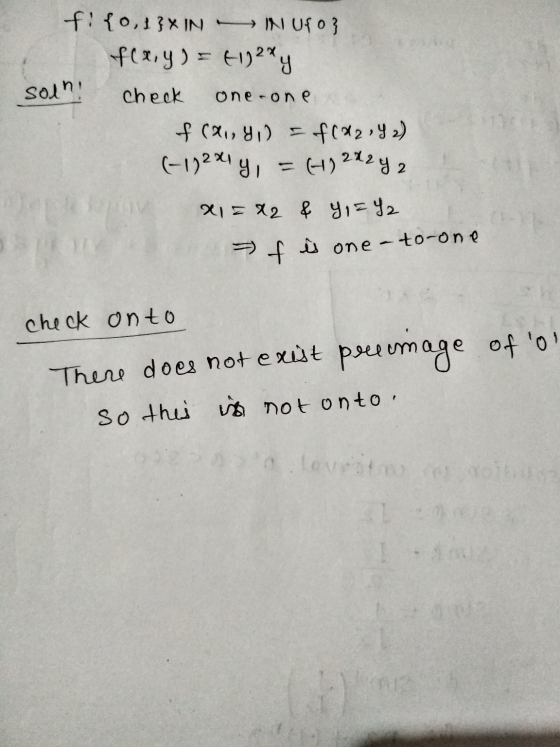
Consider the function f : {0,1} » N → NU{0} defined as f(x,y) = (-1)22 y....
Let X = {0, 1, 2} and Y = {0,1,2}. Now we define f={(0,1),(1,0),(2,1)] Please enter...
 Let X = {0, 1, 2} and Y = {0,1,2}. Now we define f={(0,1),(1,0),(2,1)] Please enter your answer as a sum of the following numbers (they are not mutually exclusive): • 1 ifff is a function f : X Y • 2 ifff is a function and it is also injective • 4ifff is a function and it is also surjective This means that your answer can be 0 (not a function), 1 (a function but neither injective or surjective)....
Fix an integer N>1, and consider the function f:[0,1]R defined as follows: if XE[0,1] and there...
 Fix an integer N>1, and consider the function f:[0,1]R defined as follows: if XE[0,1] and there is an integer n with 1<n<N such that nxez, choose n with this property as small as possible, and set f(x) := 1/n^2; otherwise set f(x):=0. Show that f is 0 integrable, and S f.
real analysis II. Consider the function f:[0,1] - R defined by f(x) 0 if x E...
 real analysis
II. Consider the function f:[0,1] - R defined by f(x) 0 if x E [0,1]\ Q and f(x) = 1/q if x = p/q in lowest terms. 1. Prove that f is discontinuous at every x E Qn [0,1]. 2. Prove that f is continuous at every x e [0,1] \ Q.
II. Consider the function f:[0,1] - R defined by f(x) 0 if x E [0,1]\ Q and f(x) = 1/q if x = p/q in lowest...
real analysis
II. Consider the function f:[0,1] - R defined by f(x) 0 if x E [0,1]\ Q and f(x) = 1/q if x = p/q in lowest terms. 1. Prove that f is discontinuous at every x E Qn [0,1]. 2. Prove that f is continuous at every x e [0,1] \ Q.
II. Consider the function f:[0,1] - R defined by f(x) 0 if x E [0,1]\ Q and f(x) = 1/q if x = p/q in lowest...
Answer the questions in the space provided below. 1. The definition of a function f: X...
 Answer the questions in the space provided below. 1. The definition of a function f: X + Y is as a certain subset of the product X x Y. Let f: N + N be the function defined by the equation f(n) = n2. For each pair (x, y) listed below, determine whether or not (x,y) ef. a) (2,4) b) (5, 23) c) (1,1) d) (-3,9) 2. For each function defined below, state whether it is injective (one-to-one) and whether...
1 Fix an integer N > 1, and consider the function f : [0,1] - R...
 1 Fix an integer N > 1, and consider the function f : [0,1] - R defined as follows: if 2 € (0,1) and there is an integer n with 1 <n<N such that nx € Z, choose n with this property as small as possible, and set f(x) := otherwise set f(x):= 0. Show that f is integrable, and compute Sf. (Hint: a problem from Homework Set 7 may be very useful for 0 this!)
Let f : R2-R2 be a function defin ed by f(x,y) (3+ z +y,) (a) Determine if f is injective. Explai...
 Let f : R2-R2 be a function defin ed by f(x,y) (3+ z +y,) (a) Determine if f is injective. Explain why. (b) Determine if f is surjective. Explain why
Let f : R2-R2 be a function defin ed by f(x,y) (3+ z +y,) (a) Determine if f is injective. Explain why. (b) Determine if f is surjective. Explain why
Let f : R2-R2 be a function defin ed by f(x,y) (3+ z +y,) (a) Determine if f is injective. Explain why. (b) Determine if f is surjective. Explain why
5. Let A = P(R). Define f : R → A by the formula f(x) =...
 5. Let A = P(R). Define f : R → A by the formula f(x) = {y E RIy2 < x). (a) Find f(2). (b) Is f injective, surjective, both (bijective), or neither? Z given by f(u)n+l, ifn is even n - 3, if n is odd 6. Consider the function f : Z → Z given by f(n) = (a) Is f injective? Prove your answer. (b) Is f surjective? Prove your answer
2. Show that the function f:N→Q defined by f(n) = is injective but not surjective.
 2. Show that the function f:N→Q defined by f(n) = is injective but not surjective.
1. Consider the function y f(x) defined by Supposing that you are given x, write an...
 1. Consider the function y f(x) defined by Supposing that you are given x, write an R expression for y using if state- ments Add your expression for y to the following program, then run it to plot the function f. # input x,values <-seq(-2, 2, by 0.1) # for each x calculate y n <- length(x.values) y.values <- rep(0, n) for (i in 1 :n) x <- x. values[i] # your expression for y goes here y.values ij <-...
1. Consider the function y f(x) defined by Supposing that you are given x, write an...
 1. Consider the function y f(x) defined by Supposing that you are given x, write an R expression for y using if state- ments Add your expression for y to the following program, then run it to plot the function f. # input x,values <-seq(-2, 2, by 0.1) # for each x calculate y n <- length(x.values) y.values <- rep(0, n) for (i in 1 :n) x <- x. values[i] # your expression for y goes here y.values ij <-...
 Let X = {0, 1, 2} and Y = {0,1,2}. Now we define f={(0,1),(1,0),(2,1)] Please enter your answer as a sum of the following numbers (they are not mutually exclusive): • 1 ifff is a function f : X Y • 2 ifff is a function and it is also injective • 4ifff is a function and it is also surjective This means that your answer can be 0 (not a function), 1 (a function but neither injective or surjective)....
 Fix an integer N>1, and consider the function f:[0,1]R defined as follows: if XE[0,1] and there is an integer n with 1<n<N such that nxez, choose n with this property as small as possible, and set f(x) := 1/n^2; otherwise set f(x):=0. Show that f is 0 integrable, and S f.
 real analysis
II. Consider the function f:[0,1] - R defined by f(x) 0 if x E [0,1]\ Q and f(x) = 1/q if x = p/q in lowest terms. 1. Prove that f is discontinuous at every x E Qn [0,1]. 2. Prove that f is continuous at every x e [0,1] \ Q.
II. Consider the function f:[0,1] - R defined by f(x) 0 if x E [0,1]\ Q and f(x) = 1/q if x = p/q in lowest...
real analysis
II. Consider the function f:[0,1] - R defined by f(x) 0 if x E [0,1]\ Q and f(x) = 1/q if x = p/q in lowest terms. 1. Prove that f is discontinuous at every x E Qn [0,1]. 2. Prove that f is continuous at every x e [0,1] \ Q.
II. Consider the function f:[0,1] - R defined by f(x) 0 if x E [0,1]\ Q and f(x) = 1/q if x = p/q in lowest...
 Answer the questions in the space provided below. 1. The definition of a function f: X + Y is as a certain subset of the product X x Y. Let f: N + N be the function defined by the equation f(n) = n2. For each pair (x, y) listed below, determine whether or not (x,y) ef. a) (2,4) b) (5, 23) c) (1,1) d) (-3,9) 2. For each function defined below, state whether it is injective (one-to-one) and whether...
 1 Fix an integer N > 1, and consider the function f : [0,1] - R defined as follows: if 2 € (0,1) and there is an integer n with 1 <n<N such that nx € Z, choose n with this property as small as possible, and set f(x) := otherwise set f(x):= 0. Show that f is integrable, and compute Sf. (Hint: a problem from Homework Set 7 may be very useful for 0 this!)
 Let f : R2-R2 be a function defin ed by f(x,y) (3+ z +y,) (a) Determine if f is injective. Explain why. (b) Determine if f is surjective. Explain why
Let f : R2-R2 be a function defin ed by f(x,y) (3+ z +y,) (a) Determine if f is injective. Explain why. (b) Determine if f is surjective. Explain why
Let f : R2-R2 be a function defin ed by f(x,y) (3+ z +y,) (a) Determine if f is injective. Explain why. (b) Determine if f is surjective. Explain why
 5. Let A = P(R). Define f : R → A by the formula f(x) = {y E RIy2 < x). (a) Find f(2). (b) Is f injective, surjective, both (bijective), or neither? Z given by f(u)n+l, ifn is even n - 3, if n is odd 6. Consider the function f : Z → Z given by f(n) = (a) Is f injective? Prove your answer. (b) Is f surjective? Prove your answer
 2. Show that the function f:N→Q defined by f(n) = is injective but not surjective.
 1. Consider the function y f(x) defined by Supposing that you are given x, write an R expression for y using if state- ments Add your expression for y to the following program, then run it to plot the function f. # input x,values <-seq(-2, 2, by 0.1) # for each x calculate y n <- length(x.values) y.values <- rep(0, n) for (i in 1 :n) x <- x. values[i] # your expression for y goes here y.values ij <-...
 1. Consider the function y f(x) defined by Supposing that you are given x, write an R expression for y using if state- ments Add your expression for y to the following program, then run it to plot the function f. # input x,values <-seq(-2, 2, by 0.1) # for each x calculate y n <- length(x.values) y.values <- rep(0, n) for (i in 1 :n) x <- x. values[i] # your expression for y goes here y.values ij <-...
Most questions answered within 3 hours.
-
Where is the error in this code sequence?
String s1 = "Hello";
String s2 = "ello";...
asked 10 months ago -
Financial data for Joel de Paris, Inc., for last year
follow:
Joel de Paris, Inc.
Balance...
asked 10 months ago -
Consider this reaction:
Al2(SO4)3 (aq)+ BaCl3
(aq) Al2Cl6 (aq)- +
3BaSO4(s) . What is the...
asked 10 months ago -
Suppose that Savneet is considering increasing her
recent random sample from 20 car rentals to 40...
asked 10 months ago -
Trucks arrive at an unloading terminal at an average rate of 120
per hour.
Trucks arrive...
asked 10 months ago -
Why are methanol and ethanol completely soluble in water while
octanol is not very little soluble....
asked 10 months ago -
A facilities manager at a university reads in a research report
that the mean amount of...
asked 10 months ago -
When the CuSO4 is rehydrated by adding water to the anhydrous
compound, is this an endothermic...
asked 10 months ago -
A ray of sunlight is passing from diamond into crown glass; the
angle of incidence is...
asked 10 months ago -
A block of mass 0.249 kg is placed on top of a light, vertical
spring of...
asked 10 months ago -
how do the kidneys compensate in the presences of acidosis
a) trigger hyperventilate
b) reserve acid...
asked 10 months ago -
Question 501 pts
The rental rate of capital to the firm increases. Which of the
following...
asked 10 months ago