
Homework Answers
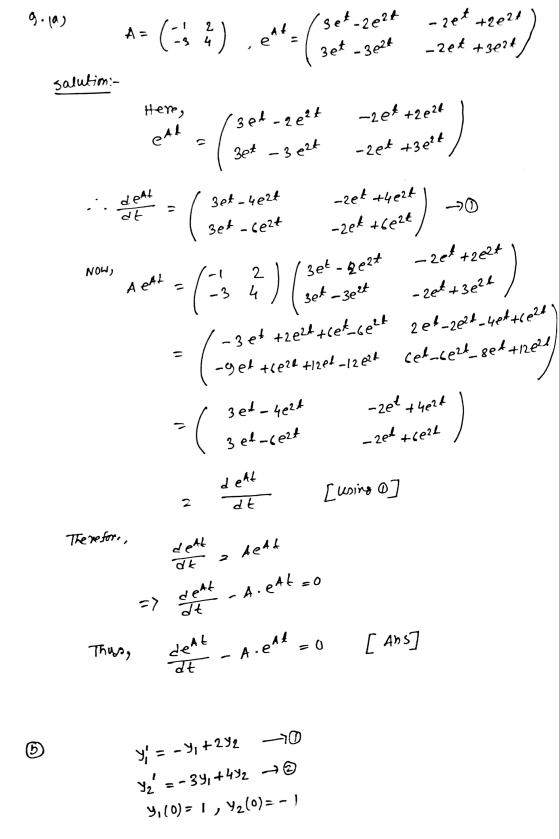
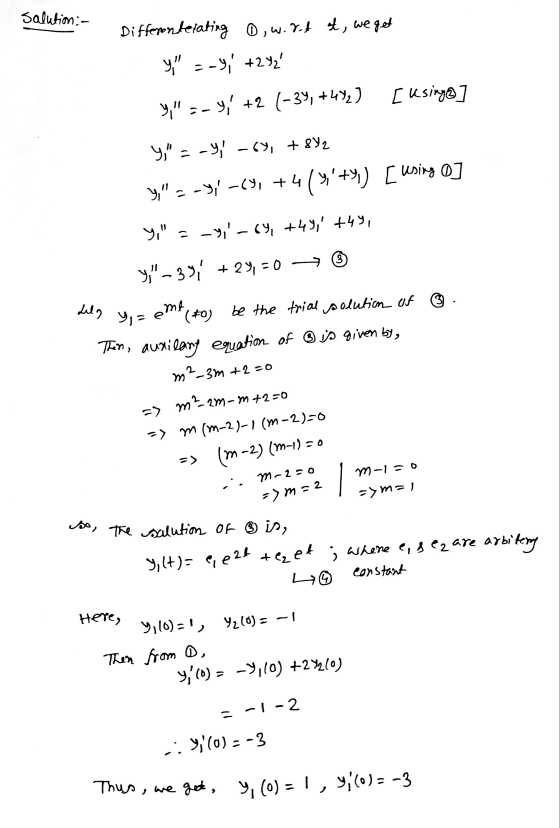
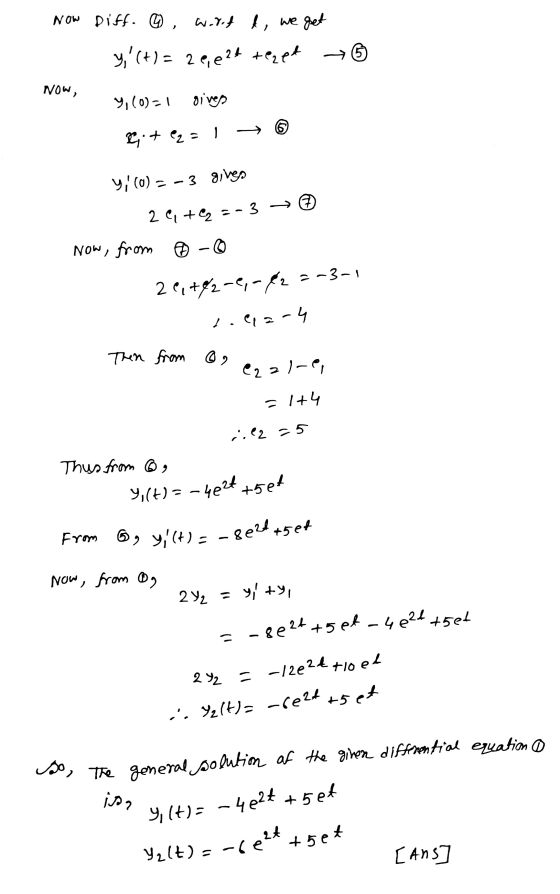
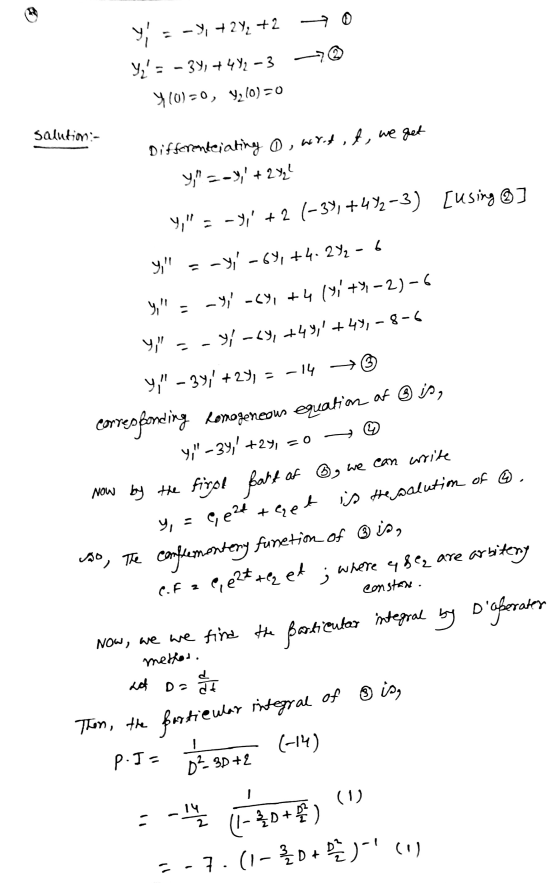
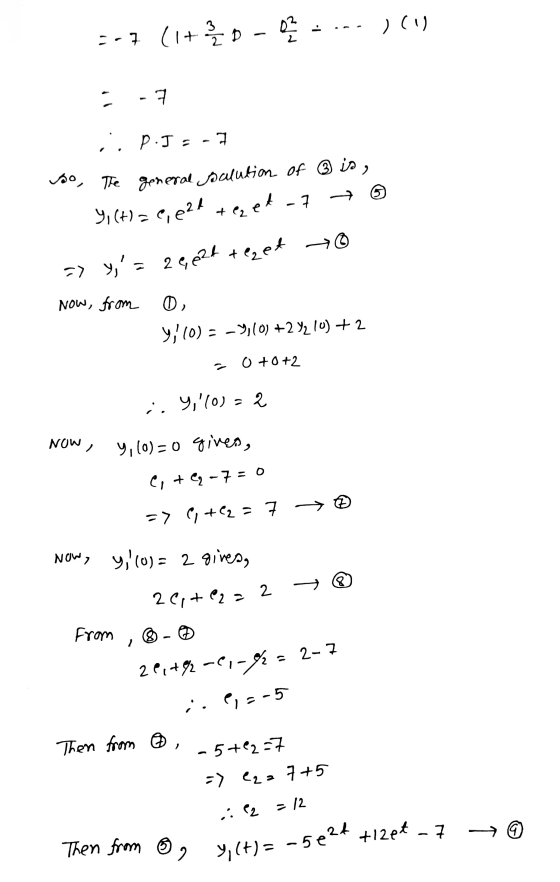
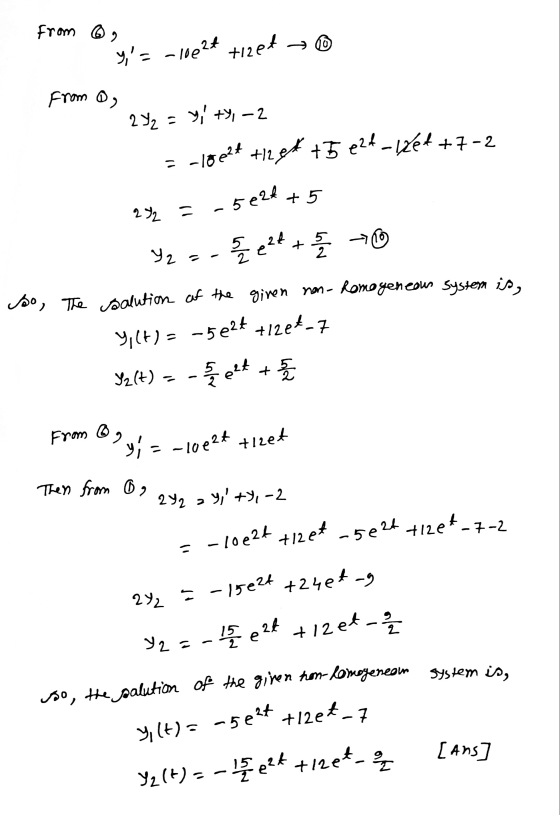
Please answer all parts with full & clear solutions so I can understand :) 2. Consider...
 Please answer all parts with full & clear solutions so I can
understand :)
2. Consider the following system of ordinary differential equations, 3 y1 (t) 4у (t) dy1 (t)/dt dy2 (t)/dt 4y2(t), 3 y2(t) with initial conditions yı(0) = 1, y2(0) = 0. (a) Write down the system of ordinary differential equations in matrix-vector form. You should also give the initial conditions in vector form. [2] [6] (b) Find exp(At), where A is the matrix you found in (a)....
Please answer all parts with full & clear solutions so I can
understand :)
2. Consider the following system of ordinary differential equations, 3 y1 (t) 4у (t) dy1 (t)/dt dy2 (t)/dt 4y2(t), 3 y2(t) with initial conditions yı(0) = 1, y2(0) = 0. (a) Write down the system of ordinary differential equations in matrix-vector form. You should also give the initial conditions in vector form. [2] [6] (b) Find exp(At), where A is the matrix you found in (a)....
2. (3+4+4+4 pts) In this problem, we discuss a method of solving SOL equations known as...
 2. (3+4+4+4 pts) In this problem, we discuss a method of solving SOL equations known as Reduction of Order. Given an equation y" +p(a)y' +9(2)y = 0, and assuming yi is a solution, Reduction of Order asks: does there exist a second, linearly-independent solution y2 of the form y2 = u(x)41 for some function u(x)? See Section 3.2, Exercise 36 for reference). We'll now use this to solve the following problem. (a) Consider the SOL differential equation sin(x)y" — 2...
Consider the differential equation: -9ty" – 6t(t – 3)y' + 6(t – 3)y=0, t> 0. a....
 Consider the differential equation: -9ty" – 6t(t – 3)y' + 6(t – 3)y=0, t> 0. a. Given that yı(t) = 3t is a solution, apply the reduction of order method to find another solution y2 for which yı and y2 form a fundamental solution set. i. Starting with yi, solve for w in yıw' + (2y + p(t)yı)w = 0 so that w(1) = -3. w(t) = ii. Now solve for u where u = w so that u(1) =...
d'yi dạy1 Yi = 0.5 Consider the following Ordinary Differential Equation (ODE) for function yı (2)...
 d'yi dạy1 Yi = 0.5 Consider the following Ordinary Differential Equation (ODE) for function yı (2) on interval [0, 1] dyi +(-4.9) * + 7.9 * +(-4.2) * yı(x) = -0.2 - 1.0-2 dx3 d.x2 dc with the following initial conditions at point x = 0: dy1 dạyi = 2.48 = 6.912 dc d.2 Introducting notations dyi dy2 day1 Y2 = y3 = da dc d.x2 convert the ODE to the system of three first-order ODEs for functions yi, y2,...
5. Consider the system of differential equations yi = y1 + 2y2, y = -41/2 +...
 5. Consider the system of differential equations yi = y1 + 2y2, y = -41/2 + y2 with initial conditions yi(0) = 1, y2(0= 0. This has exact solution yı(t) = exp(t) cos(t), yz(t) = - exp(t) sin(t)/2. (a) Apply Euler's method with h=1/4 and find the global truncation error by comparing with the exact solution over the interval [0, 1]. (b) Apply the RK4 method with h=1 and find the global truncation error by comparing with the exact solution...
Consider the linear system dc dt = 5x + 2.3333333333333y, x(0) = 4 dy dt =...
 Consider the linear system dc dt = 5x + 2.3333333333333y, x(0) = 4 dy dt = – 2y, y(0) = - 3 If the associated matrix has the form M= с Find the entries. a = Preview Preview b= C= Preview d= Preview Find the trace and determinant of M. Preview tr(M) = det(M) = Preview Find the eigenvalues 11, 12 of M, where li > 12. 21 = Preview 12 = Preview Let vi = [1, yı] be an...
Find the solution y of the initial value problem 3"(t) = 2 (3(t). y(1) = 0,...
 Find the solution y of the initial value problem 3"(t) = 2 (3(t). y(1) = 0, y' (1) = 1. +3 g(t) = M Solve the initial value problem g(t) g” (t) + 50g (+)? = 0, y(0) = 1, y'(0) = 7. g(t) = Σ Use the reduction order method to find a second solution ya to the differential equation ty" + 12ty' +28 y = 0. knowing that the function yı(t) = + 4 is solution to that...
3. (5 pts) Ulse the method of undetermined coeffcients to find the solution to the system in prob...
 heres the previous problem. need number 3 done.
3. (5 pts) Ulse the method of undetermined coeffcients to find the solution to the system in problem 2 with initial condition given by y1(0)-0, y2(0)- yi(0) -0, v2(0) 0 2. (10 pts) Use the method of variation of parameters to find the general solution of the systam y' - Ay+g(0) where A is the matrix 1 2, and g(t) 0 A-2 1
3. (5 pts) Ulse the method of undetermined coeffcients...
heres the previous problem. need number 3 done.
3. (5 pts) Ulse the method of undetermined coeffcients to find the solution to the system in problem 2 with initial condition given by y1(0)-0, y2(0)- yi(0) -0, v2(0) 0 2. (10 pts) Use the method of variation of parameters to find the general solution of the systam y' - Ay+g(0) where A is the matrix 1 2, and g(t) 0 A-2 1
3. (5 pts) Ulse the method of undetermined coeffcients...
Consider the linear system dc = 4x + 1.6666666666667y, x(0) = 3 dt dy dt =...
 Consider the linear system dc = 4x + 1.6666666666667y, x(0) = 3 dt dy dt = - ly, g(0) = - 2 If the associated matrix has the form M= [aa] Find the entries. a = Preview b= Preview C= Preview d = Preview Find the trace and determinant of M. Preview tr(M) = det(M) = Preview Find the eigenvalues 11, 12 of M, where 11 > 12. Preview 21 = 12 = Preview Let v1 = (1, yı] be...
dy: 2 Consider the following Ordinary Differential Equation (ODE) for function yı(z) on interval [0, 1]...
 dy: 2 Consider the following Ordinary Differential Equation (ODE) for function yı(z) on interval [0, 1] +(-10,3) dayi dy + 28.06 + (-16.368) + y(x) = 1.272.0.52 with the following initial conditions at point a = 0; dy 91 = 4.572 = 30.6248 = 185.2223 dar Introducting notations dyi dy2 dy dar dar dir? convert the ODE to the system of three first-order ODEs for functions y1, y2, y3 in the form: dy dar fi (1, y1, ya, y) dy2...
 Please answer all parts with full & clear solutions so I can
understand :)
2. Consider the following system of ordinary differential equations, 3 y1 (t) 4у (t) dy1 (t)/dt dy2 (t)/dt 4y2(t), 3 y2(t) with initial conditions yı(0) = 1, y2(0) = 0. (a) Write down the system of ordinary differential equations in matrix-vector form. You should also give the initial conditions in vector form. [2] [6] (b) Find exp(At), where A is the matrix you found in (a)....
Please answer all parts with full & clear solutions so I can
understand :)
2. Consider the following system of ordinary differential equations, 3 y1 (t) 4у (t) dy1 (t)/dt dy2 (t)/dt 4y2(t), 3 y2(t) with initial conditions yı(0) = 1, y2(0) = 0. (a) Write down the system of ordinary differential equations in matrix-vector form. You should also give the initial conditions in vector form. [2] [6] (b) Find exp(At), where A is the matrix you found in (a)....
 2. (3+4+4+4 pts) In this problem, we discuss a method of solving SOL equations known as Reduction of Order. Given an equation y" +p(a)y' +9(2)y = 0, and assuming yi is a solution, Reduction of Order asks: does there exist a second, linearly-independent solution y2 of the form y2 = u(x)41 for some function u(x)? See Section 3.2, Exercise 36 for reference). We'll now use this to solve the following problem. (a) Consider the SOL differential equation sin(x)y" — 2...
 Consider the differential equation: -9ty" – 6t(t – 3)y' + 6(t – 3)y=0, t> 0. a. Given that yı(t) = 3t is a solution, apply the reduction of order method to find another solution y2 for which yı and y2 form a fundamental solution set. i. Starting with yi, solve for w in yıw' + (2y + p(t)yı)w = 0 so that w(1) = -3. w(t) = ii. Now solve for u where u = w so that u(1) =...
 d'yi dạy1 Yi = 0.5 Consider the following Ordinary Differential Equation (ODE) for function yı (2) on interval [0, 1] dyi +(-4.9) * + 7.9 * +(-4.2) * yı(x) = -0.2 - 1.0-2 dx3 d.x2 dc with the following initial conditions at point x = 0: dy1 dạyi = 2.48 = 6.912 dc d.2 Introducting notations dyi dy2 day1 Y2 = y3 = da dc d.x2 convert the ODE to the system of three first-order ODEs for functions yi, y2,...
 5. Consider the system of differential equations yi = y1 + 2y2, y = -41/2 + y2 with initial conditions yi(0) = 1, y2(0= 0. This has exact solution yı(t) = exp(t) cos(t), yz(t) = - exp(t) sin(t)/2. (a) Apply Euler's method with h=1/4 and find the global truncation error by comparing with the exact solution over the interval [0, 1]. (b) Apply the RK4 method with h=1 and find the global truncation error by comparing with the exact solution...
 Consider the linear system dc dt = 5x + 2.3333333333333y, x(0) = 4 dy dt = – 2y, y(0) = - 3 If the associated matrix has the form M= с Find the entries. a = Preview Preview b= C= Preview d= Preview Find the trace and determinant of M. Preview tr(M) = det(M) = Preview Find the eigenvalues 11, 12 of M, where li > 12. 21 = Preview 12 = Preview Let vi = [1, yı] be an...
 Find the solution y of the initial value problem 3"(t) = 2 (3(t). y(1) = 0, y' (1) = 1. +3 g(t) = M Solve the initial value problem g(t) g” (t) + 50g (+)? = 0, y(0) = 1, y'(0) = 7. g(t) = Σ Use the reduction order method to find a second solution ya to the differential equation ty" + 12ty' +28 y = 0. knowing that the function yı(t) = + 4 is solution to that...
 heres the previous problem. need number 3 done.
3. (5 pts) Ulse the method of undetermined coeffcients to find the solution to the system in problem 2 with initial condition given by y1(0)-0, y2(0)- yi(0) -0, v2(0) 0 2. (10 pts) Use the method of variation of parameters to find the general solution of the systam y' - Ay+g(0) where A is the matrix 1 2, and g(t) 0 A-2 1
3. (5 pts) Ulse the method of undetermined coeffcients...
heres the previous problem. need number 3 done.
3. (5 pts) Ulse the method of undetermined coeffcients to find the solution to the system in problem 2 with initial condition given by y1(0)-0, y2(0)- yi(0) -0, v2(0) 0 2. (10 pts) Use the method of variation of parameters to find the general solution of the systam y' - Ay+g(0) where A is the matrix 1 2, and g(t) 0 A-2 1
3. (5 pts) Ulse the method of undetermined coeffcients...
 Consider the linear system dc = 4x + 1.6666666666667y, x(0) = 3 dt dy dt = - ly, g(0) = - 2 If the associated matrix has the form M= [aa] Find the entries. a = Preview b= Preview C= Preview d = Preview Find the trace and determinant of M. Preview tr(M) = det(M) = Preview Find the eigenvalues 11, 12 of M, where 11 > 12. Preview 21 = 12 = Preview Let v1 = (1, yı] be...
 dy: 2 Consider the following Ordinary Differential Equation (ODE) for function yı(z) on interval [0, 1] +(-10,3) dayi dy + 28.06 + (-16.368) + y(x) = 1.272.0.52 with the following initial conditions at point a = 0; dy 91 = 4.572 = 30.6248 = 185.2223 dar Introducting notations dyi dy2 dy dar dar dir? convert the ODE to the system of three first-order ODEs for functions y1, y2, y3 in the form: dy dar fi (1, y1, ya, y) dy2...
Most questions answered within 3 hours.
-
Where is the error in this code sequence?
String s1 = "Hello";
String s2 = "ello";...
asked 10 months ago -
Financial data for Joel de Paris, Inc., for last year
follow:
Joel de Paris, Inc.
Balance...
asked 10 months ago -
Consider this reaction:
Al2(SO4)3 (aq)+ BaCl3
(aq) Al2Cl6 (aq)- +
3BaSO4(s) . What is the...
asked 10 months ago -
Suppose that Savneet is considering increasing her
recent random sample from 20 car rentals to 40...
asked 10 months ago -
Trucks arrive at an unloading terminal at an average rate of 120
per hour.
Trucks arrive...
asked 10 months ago -
Why are methanol and ethanol completely soluble in water while
octanol is not very little soluble....
asked 10 months ago -
A facilities manager at a university reads in a research report
that the mean amount of...
asked 10 months ago -
When the CuSO4 is rehydrated by adding water to the anhydrous
compound, is this an endothermic...
asked 10 months ago -
A ray of sunlight is passing from diamond into crown glass; the
angle of incidence is...
asked 10 months ago -
A block of mass 0.249 kg is placed on top of a light, vertical
spring of...
asked 10 months ago -
how do the kidneys compensate in the presences of acidosis
a) trigger hyperventilate
b) reserve acid...
asked 10 months ago -
Question 501 pts
The rental rate of capital to the firm increases. Which of the
following...
asked 10 months ago