Questions 8-11
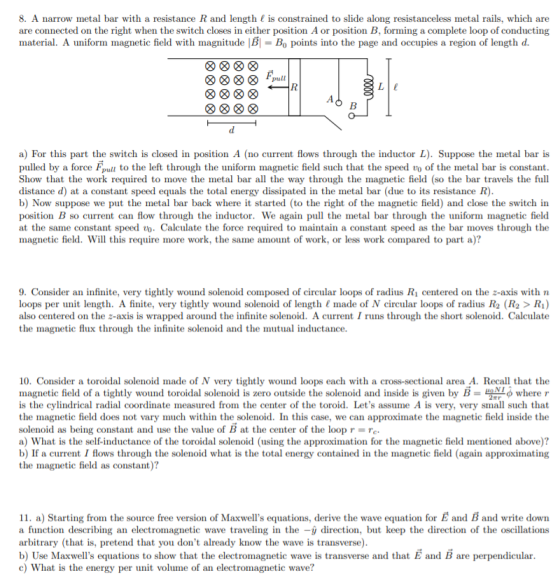
8. A narrow metal bar with a resistance R and length l is constrained to slide along resistanceless metal rails, which are are connected on the right when the switch closes in either position A or position B, forming a complete loop of conducting material. A uniform magnetic field with magnitude |B| = Bo points into the page and occupies a region of length d. Ē pull R 0000 Le Ad ♡♡ B d a) For this part the switch is closed in position A (no current flows through the inductor L). Suppose the metal bar is pulled by a force Fpull to the left through the uniform magnetic field such that the speed vo of the metal bar is constant. Show that the work required to move the metal bar all the way through the magnetic field (so the bar travels the full distance d) at a constant speed equals the total energy dissipated in the metal bar (due to its resistance R). b) Now suppose we put the metal bar back where it started to the right of the magnetic field) and close the switch in position B so current can flow through the inductor. We again pull the metal bar through the uniform magnetic field at the same constant speed vo. Calculate the force required to maintain a constant speed as the bar moves through the magnetic field. Will this require more work, the same amount of work, or less work compared to part a)?
Homework Answers
From Faraday's law of electromagnetic induction ,
we know that EMF (e ) induced in a moving conuctor in a
magnetic field is given by , e = -d / dt
/ dt
= magnetic flux which is equal to BA
where B = magnetic field , and A = area of the loop under magnetic field
The negative sign shows that the induced EMF (e) always opposes the net flux change.
( meaning that if the flux is increasing , then induced emf will ten to decrease the flux and vice versa)
Now,

Taking the rod moved to a distance = x from initial point
Now Area closed by loop inide magnetic filed increase by , dA = l*x
[ where l = length of rod
x = length moved horizontally ]
now , d
/dt = d( BA)/dt
EMF (e) = B*[ dA/dt ] ( as B= B0 = constant )
e = B*l [ dx/dt] ( as l = length is constant)
e = B0lv0 ( v0 = velocity of rod )
Now as the conductor is moving with contant velocity which means that the net force acting on the rod should be zero. so definitely a force of same magnitude will act in the opposite direction due to induced emf
[ Femf = force induced to the emf and acts in the right direction ]
as we know [ Force acting on a conductor rod moving in a magnetic field , F=I*L*B ]
Fpull = Femf = I*L*B ( I = current , L = length , B = magnetic field)
Now , In case a)
circuit is closed at A , containing only rod of resistance R.
As the force Fpull is pulling rod in the magnetic field therby increasing the net magnetic flux in the loop.
From ohm's law , I = V/R
current flowing in the circuit is , I = e/R
I = B0v0l/R
now the energy dissipated in the resistor , is equal to the heat energy dissipated in the resistor .
W ( energy dissipated in resistor R) = I2Rt
where I = current
R = resistance of resistor
t = time
now putting the values of I = B0v0l/R ,
we get , W1= (Bvl/R )2Rt
W1 = [(B0v0l)2*t]/R
so W1 = [(Bol)2*vo*(vo*t) ]/R
W1 = [(Bol)2*vo*d]/R
( distance covered by rod moving with constant velocity is , d = vo*t )
Now work done in moving rod will be , W2 = Fpull * d [ work done = Force applied * distance moved]
= Femf *d
= I*L*B*d => (Bvl/R)*l*B*d =>
W2 = [(B0l)2 *v0*d]/R --------(1)
so W1 = W2 , Hence proved.
b) in this case the loop is closed at B, so net resistance will be Rnet = R + jXL
XL = reactive resistance of inductor
so , Rnet = sqrt ( R2 + (XL)2) [ so Rnet > R ]
now in this case current will be , i = e/Rnet
[ e = same as previous one as it doesnt depend on the resistances in circuit]
Force required to move it with a constant velocty will be , F = i*l*B0
i = e/Rnet
i = B0v0l/Rnet
in this case the current induced will be less than the current induced in part a of the problem
Work done in moving the rod upto a distance of , d with constant velocity v0 , W = F*d
W = F * d
W = (i*l*B)*d
W = [(B0v0l*l*B0)*d] / Rnet
so W = [(B0l)2*v0*d]/Rnet
comparing it to the work done in case a of the problem , by equation (1) we get that
only the denominator is different , so here Rnet > R ( as calculated )
so Work done in case B will be less than the work done in case A
A conducting rod with length L, is to slide without friction on horizontal infinitely long metal...
 A conducting rod with length L, is to slide without friction on horizontal infinitely long metal rails connected through resistance R as show in Fig. uniform magnetic field B is directed out of the plane of the figure. What is the applied force F required to move the bar to the right with a constant speed At what rate is energy dissipated in the resistor R?
RS ws Inside 1. You have two parallel metal rails that are connected by a 32...
 RS ws Inside 1. You have two parallel metal rails that are connected by a 32 resistor as shown in the figure on the right. You slide a metal bar onto the rails so that the two rails, the bar, and the resistor make a complete circuit. The bar has a length of 0.16 m. You place this apparatus inside a uniform magnetic field with a strength of 0.57 T that points into the page. You pull the bar to...
There is a magnetic field B = 0.5 T constant entering the paper. The conductive bar...
There is a magnetic field B = 0.5 T constant entering the paper. The conductive bar is of length l = 0.2 m, and moves to the right on conductive rails with velocity v = 10 m / s on conductor rails. R symbolizes a resistance of 10 W. 20. The current in the circuit is ____ 21. The power dissipated in R is ____ 22. And to maintain the current, pull the bar with a force F of ____
A metal rod of length l = 19 cm moves at constant speed v on rails of negligible resistance that terminate in a resistor R = 0.2
 A metal rod of length l = 19 cm moves at constant speed v on rails of negligible resistance
that terminate in a resistor R = 0.2 ?, as shown in the figure above. A uniform and constant magnetic
field B = 1 T ia normal to the plane of the rails. The induced current is I =1 A and flows in the direction shown. Find :a) the speed v;m/sb) the external force needed to keep the rod moving at v.N to the right.
A metal rod of length l = 19 cm moves at constant speed v on rails of negligible resistance
that terminate in a resistor R = 0.2 ?, as shown in the figure above. A uniform and constant magnetic
field B = 1 T ia normal to the plane of the rails. The induced current is I =1 A and flows in the direction shown. Find :a) the speed v;m/sb) the external force needed to keep the rod moving at v.N to the right.
In the figure below, a metal bar sitting on two parallel conducting rails, connected to each other by a resistor, is pulled to the right at a constant speed.
 A vertical bar and two parallel horizontal rails lie in the
plane of the page. The parallel rails run from left to right, with
one a distance ℓ above the other. The left ends of the rails are
connected by a vertical wire containing a resistor R. The
vertical bar lies across the rails to the right of the wire. Force
vector Fapp points from the bar toward
the right.In the figure below, a metal bar sitting on two parallel...
A vertical bar and two parallel horizontal rails lie in the
plane of the page. The parallel rails run from left to right, with
one a distance ℓ above the other. The left ends of the rails are
connected by a vertical wire containing a resistor R. The
vertical bar lies across the rails to the right of the wire. Force
vector Fapp points from the bar toward
the right.In the figure below, a metal bar sitting on two parallel...
Please help with both problems. Im really lost on this chapter Group Problem 1. A conducting...
 Please help with both problems.
Im really lost on this chapter
Group Problem 1. A conducting bar with mass m and resistance R slides on frictionless conducting rails, separated by a distance 1 from each other, in a region that has a static uniform magnetic field B directed into the page (see figure below). An external agent is pushing the bar, maintaing its motion to the right with constant velocity ū. At time t = 0, the agent abruptly stops...
Please help with both problems.
Im really lost on this chapter
Group Problem 1. A conducting bar with mass m and resistance R slides on frictionless conducting rails, separated by a distance 1 from each other, in a region that has a static uniform magnetic field B directed into the page (see figure below). An external agent is pushing the bar, maintaing its motion to the right with constant velocity ū. At time t = 0, the agent abruptly stops...
Constants A conducting rod with length 0.213 m , mass 0.100 kg , and resistance 83.5...
Constants A conducting rod with length 0.213 m , mass 0.100 kg , and resistance 83.5 Ω moves without friction on metal rails as shown in the following figure(Figure 1). A uniform magnetic field with magnitude 1.50 T is directed into the plane of the figure. The rod is initially at rest, and then a constant force with magnitude 1.90 N and directed to the right is applied to the bar.How many seconds after the force is applied does the...
A conducting bar moves along frictionless conducting rails connected to a 4.00 omega resistor. The length...
 A conducting bar moves along frictionless conducting rails
connected to a 4.00 omega resistor. The length of the bar is 1.60m
and a uniform magnetic field of 2.20T is applied perpendicular to
the paper pointing outward as shown
a) What is the applied force required to move the bar to the
right with a constant speed of 6.00 m/s?
b) At what rate is energy dissipated in the 4.00 ohm
resistor?
A conducting bar moves along frictionless conducting rails connected...
A conducting bar moves along frictionless conducting rails
connected to a 4.00 omega resistor. The length of the bar is 1.60m
and a uniform magnetic field of 2.20T is applied perpendicular to
the paper pointing outward as shown
a) What is the applied force required to move the bar to the
right with a constant speed of 6.00 m/s?
b) At what rate is energy dissipated in the 4.00 ohm
resistor?
A conducting bar moves along frictionless conducting rails connected...
A pair of parallel conducting rails that are L = 22 cm apart lies at right...
 A pair of parallel conducting rails that are L = 22 cm apart lies at right angles to a uniform magnetic field of 0.7 T directed into the page, as shown in the figure below. A R = 172 resistor is connected across the rails. A conducting bar is moved to the right at 2 m/s across the rails. B into page R L 2 m/s ♡ ♡ ♡ 1) What is the current in the resistor? (Express your answer...
A 0.95 m long metal bar is pulled to the right at a steady 7.1 m/s perpendicular to a uniform
 Magnetic Flux: A 0.95 m long metal bar is pulled to the right at a steady 7.1 m/s perpendicular to a uniform, 2.20 T magnetic field. The bar rides on parallel metal rails connected through R= 144 Ω, as shown, so that the apparatus makes a complete circuit. You can ignore the resistance of the bar and the rails. What is the current in the wire and what direction does it flow (Clockwise or Counterclockwise)
 A conducting rod with length L, is to slide without friction on horizontal infinitely long metal rails connected through resistance R as show in Fig. uniform magnetic field B is directed out of the plane of the figure. What is the applied force F required to move the bar to the right with a constant speed At what rate is energy dissipated in the resistor R?
 RS ws Inside 1. You have two parallel metal rails that are connected by a 32 resistor as shown in the figure on the right. You slide a metal bar onto the rails so that the two rails, the bar, and the resistor make a complete circuit. The bar has a length of 0.16 m. You place this apparatus inside a uniform magnetic field with a strength of 0.57 T that points into the page. You pull the bar to...
 A metal rod of length l = 19 cm moves at constant speed v on rails of negligible resistance
that terminate in a resistor R = 0.2 ?, as shown in the figure above. A uniform and constant magnetic
field B = 1 T ia normal to the plane of the rails. The induced current is I =1 A and flows in the direction shown. Find :a) the speed v;m/sb) the external force needed to keep the rod moving at v.N to the right.
A metal rod of length l = 19 cm moves at constant speed v on rails of negligible resistance
that terminate in a resistor R = 0.2 ?, as shown in the figure above. A uniform and constant magnetic
field B = 1 T ia normal to the plane of the rails. The induced current is I =1 A and flows in the direction shown. Find :a) the speed v;m/sb) the external force needed to keep the rod moving at v.N to the right.
 A vertical bar and two parallel horizontal rails lie in the
plane of the page. The parallel rails run from left to right, with
one a distance ℓ above the other. The left ends of the rails are
connected by a vertical wire containing a resistor R. The
vertical bar lies across the rails to the right of the wire. Force
vector Fapp points from the bar toward
the right.In the figure below, a metal bar sitting on two parallel...
A vertical bar and two parallel horizontal rails lie in the
plane of the page. The parallel rails run from left to right, with
one a distance ℓ above the other. The left ends of the rails are
connected by a vertical wire containing a resistor R. The
vertical bar lies across the rails to the right of the wire. Force
vector Fapp points from the bar toward
the right.In the figure below, a metal bar sitting on two parallel...
 Please help with both problems.
Im really lost on this chapter
Group Problem 1. A conducting bar with mass m and resistance R slides on frictionless conducting rails, separated by a distance 1 from each other, in a region that has a static uniform magnetic field B directed into the page (see figure below). An external agent is pushing the bar, maintaing its motion to the right with constant velocity ū. At time t = 0, the agent abruptly stops...
Please help with both problems.
Im really lost on this chapter
Group Problem 1. A conducting bar with mass m and resistance R slides on frictionless conducting rails, separated by a distance 1 from each other, in a region that has a static uniform magnetic field B directed into the page (see figure below). An external agent is pushing the bar, maintaing its motion to the right with constant velocity ū. At time t = 0, the agent abruptly stops...
 A conducting bar moves along frictionless conducting rails
connected to a 4.00 omega resistor. The length of the bar is 1.60m
and a uniform magnetic field of 2.20T is applied perpendicular to
the paper pointing outward as shown
a) What is the applied force required to move the bar to the
right with a constant speed of 6.00 m/s?
b) At what rate is energy dissipated in the 4.00 ohm
resistor?
A conducting bar moves along frictionless conducting rails connected...
A conducting bar moves along frictionless conducting rails
connected to a 4.00 omega resistor. The length of the bar is 1.60m
and a uniform magnetic field of 2.20T is applied perpendicular to
the paper pointing outward as shown
a) What is the applied force required to move the bar to the
right with a constant speed of 6.00 m/s?
b) At what rate is energy dissipated in the 4.00 ohm
resistor?
A conducting bar moves along frictionless conducting rails connected...
 A pair of parallel conducting rails that are L = 22 cm apart lies at right angles to a uniform magnetic field of 0.7 T directed into the page, as shown in the figure below. A R = 172 resistor is connected across the rails. A conducting bar is moved to the right at 2 m/s across the rails. B into page R L 2 m/s ♡ ♡ ♡ 1) What is the current in the resistor? (Express your answer...
Most questions answered within 3 hours.
-
Where is the error in this code sequence?
String s1 = "Hello";
String s2 = "ello";...
asked 10 months ago -
Financial data for Joel de Paris, Inc., for last year
follow:
Joel de Paris, Inc.
Balance...
asked 10 months ago -
Consider this reaction:
Al2(SO4)3 (aq)+ BaCl3
(aq) Al2Cl6 (aq)- +
3BaSO4(s) . What is the...
asked 10 months ago -
Suppose that Savneet is considering increasing her
recent random sample from 20 car rentals to 40...
asked 10 months ago -
Trucks arrive at an unloading terminal at an average rate of 120
per hour.
Trucks arrive...
asked 10 months ago -
Why are methanol and ethanol completely soluble in water while
octanol is not very little soluble....
asked 10 months ago -
A facilities manager at a university reads in a research report
that the mean amount of...
asked 10 months ago -
When the CuSO4 is rehydrated by adding water to the anhydrous
compound, is this an endothermic...
asked 10 months ago -
A ray of sunlight is passing from diamond into crown glass; the
angle of incidence is...
asked 10 months ago -
A block of mass 0.249 kg is placed on top of a light, vertical
spring of...
asked 10 months ago -
how do the kidneys compensate in the presences of acidosis
a) trigger hyperventilate
b) reserve acid...
asked 10 months ago -
Question 501 pts
The rental rate of capital to the firm increases. Which of the
following...
asked 10 months ago