In each of the following problems, three sets are described. One of the sets is not...
In each of the following problems, three sets are described. One of the sets is not the same as the other two. In each case, find the set that is not like the others. (you do not need to prove, a very brief explanation is sufficient)
(a) A = {a + b | a ∈ N, b ∈ N}; B = {a − b | a ∈ N, b ∈ N}; C = N.
(b) A = {x^2 | x ∈ N}; B = {x^2 | x ∈ Z}; C = {x^2 | x ∈ R}.
(c) A = {4z + 2 | z ∈ Z}; B = {4z − 2 | z ∈ Z}; C = {2z + 4 | z ∈ Z}.
(d) A = {m | m ∈ Z ∧ m ≡ 4 (mod 3)};
B = {m | m ∈ Z ∧ m ≡ −4 (mod 3)};
C = {m | m ∈ Z ∧ m ≡ 14 (mod 3)}.
Homework Answers


Add Answer to:
In each of the following problems, three sets are described. One
of the sets is not...
For each of the following sets, prove that it is countable by showing that there is...
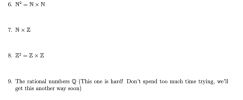 For each of the following sets, prove that it is countable by
showing that there is a bijection to that set from N.
6. N2 N x N 7. N x Z 8. Z2 Zx Z 9. The rational numbers Q (This one is hard! Don't spend too much time trying, we'll get this another way soon)
For each of the following sets, prove that it is countable by
showing that there is a bijection to that set from N.
6. N2 N x N 7. N x Z 8. Z2 Zx Z 9. The rational numbers Q (This one is hard! Don't spend too much time trying, we'll get this another way soon)
The 3-Dimensional Matching (3DM) decision problem takes as input three sets \(A, B\), and \(C\), each...
The 3-Dimensional Matching (3DM) decision problem takes as input three sets \(A, B\), and \(C\), each having size \(n\), along with a set \(S\) of triples of the form \((a, b, c)\) where \(a \in A, b \in B\), and \(c \in C\). We assume that \(|S|=m \geq n\). The problem is to decide if there exists a \(3 \mathrm{DM}\) matching, i.e. a subset of \(n\) triples from \(S\) for which each member of \(A \cup B \cup C\) belongs...
cept of a randon PROBLEMS 1.1-1. Specify the following sets by the rule method. A= (1,2,3),...
 cept of a randon PROBLEMS 1.1-1. Specify the following sets by the rule method. A= (1,2,3), B = (8, 10, 12. 14), C (1, 3, 5, 7,... 1.1-2. Use the tabular method to specify a class of sets for the sets of Problem 1.1-1. uncountable, or finite or infinite. A (1), B= (x= 1}, C ={0 < integers), D = (children in public school No. 5), E={girls in public school No. 5), F = {girls in class in public 1.1-3....
Problem 2 (Chinese Remaindering Theorem) [20 marks/ Let m and n be two relatively prime integers....
 Problem 2 (Chinese Remaindering Theorem) [20 marks/ Let m and n be two relatively prime integers. Let s,t E Z be such that sm+tn The Chinese Remaindering Theorem states that for every a, b E Z there exists c E Z such that r a mod m (Va E Z) b mod nmod mn (3) where a convenient c is given by 1. Prove that the above c satisfies both ca mod m and cb mod n 2. LetxEZ. Prove...
2, For each of these sets. A={3n : n E N), B = {r E R...
 2, For each of these sets. A={3n : n E N), B = {r E R : x2 < 7), and C = {x E R : x < 12), (i) Is the set bounded above? Prove your answer.] ( .] ii) Is the set bounded below? Prove your answer answer the following questions:
For each of the following sets, indicate whether it is a vector space. If so, point...
For each of the following sets, indicate whether it is a vector space. If so, point out a basis of it; otherwise, point out which vector-space property is violated. 1.The set V of vectors [2x, x2] with x R2. Addition and scalar multiplication are defined in the same way as on vectors. 2.The set V of vectors [x, y, z] R3 satisfying x + y + z = 3 and x − y + 2z = 6. Addition and scalar...
Question 3 ONLY Notes: This homework consists of 3 problems. Write your answers in full sentences....
 Question 3 ONLY
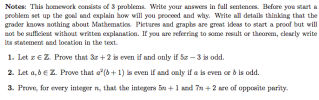
Notes: This homework consists of 3 problems. Write your answers in full sentences. Before you start a problem set up the goal and explain how will you proceed and why. Write all details thinking that the grader knows nothing about Mathematics. Pictures and graphs are great ideas to start a proof but will not be sufficient without written explanation. If you are referring to some result or theorem, clearly write its statement and location in the text....
Question 3 ONLY
Notes: This homework consists of 3 problems. Write your answers in full sentences. Before you start a problem set up the goal and explain how will you proceed and why. Write all details thinking that the grader knows nothing about Mathematics. Pictures and graphs are great ideas to start a proof but will not be sufficient without written explanation. If you are referring to some result or theorem, clearly write its statement and location in the text....
Consider a periodic signal x[n] = sin(0.1πn) + 13sin(0.3πn) + 15sin(0.5πn). For each of the following...
Consider a periodic signal x[n] = sin(0.1πn) + 13sin(0.3πn) + 15sin(0.5πn). For each of the following systems, determine if the system imparts (i) no distortion, (ii) magnitude distortion, and/or (iii) phase (or delay) distortion. In each case, graph the input and the steady state response for 0 ≤ n ≤ 60. (a) H(z) = 1/9(1 + 2z^(−1) + 3z^(−2) + 2z^(−3) + z^(−4)). (b) h[n] = {1(n=0),−1.1756,1} (c) H(z) = {1+1.778z^(−2)+3.1605z^(−4) }/{1+0.5625z^(−2)+0.3164z^(−4)}
c) Gallium d) Potassium e) 3, 1, 0, - 8. Name the element described: a) c)...
 c) Gallium d) Potassium e) 3, 1, 0, - 8. Name the element described: a) c) 3, 2, 2, 3 d) 4p e) 3, 1, 0, f) m-2, n = 4, m,- +1/2, 1 = 2 9. 10. Explain briefly why each set of the following is not a possible set of quantum numbers for an electron in an atom. In each case, change the incorrect value (or values) to make the set valid. a) n = 2,1-2, m.-0, m,-...
4. For the following sets determine the least upper bound (it is not necessary to prove...
 4. For the following sets determine the least upper bound (it is
not necessary
to prove that it is the least upper bound):
a.) M = [0; 1] [ (3; 4)
b.) M =
n5n + 1
4n ? 3
n 2 N
o
c.) M =
n n + 1
2n + 13
n 2 N
o
d.) M =
nXn
i=1
9
10i
n 2 N
o
e.) M =
n
xjx > 0 and x2 < 5g:...
4. For the following sets determine the least upper bound (it is
not necessary
to prove that it is the least upper bound):
a.) M = [0; 1] [ (3; 4)
b.) M =
n5n + 1
4n ? 3
n 2 N
o
c.) M =
n n + 1
2n + 13
n 2 N
o
d.) M =
nXn
i=1
9
10i
n 2 N
o
e.) M =
n
xjx > 0 and x2 < 5g:...
 For each of the following sets, prove that it is countable by
showing that there is a bijection to that set from N.
6. N2 N x N 7. N x Z 8. Z2 Zx Z 9. The rational numbers Q (This one is hard! Don't spend too much time trying, we'll get this another way soon)
For each of the following sets, prove that it is countable by
showing that there is a bijection to that set from N.
6. N2 N x N 7. N x Z 8. Z2 Zx Z 9. The rational numbers Q (This one is hard! Don't spend too much time trying, we'll get this another way soon)
 cept of a randon PROBLEMS 1.1-1. Specify the following sets by the rule method. A= (1,2,3), B = (8, 10, 12. 14), C (1, 3, 5, 7,... 1.1-2. Use the tabular method to specify a class of sets for the sets of Problem 1.1-1. uncountable, or finite or infinite. A (1), B= (x= 1}, C ={0 < integers), D = (children in public school No. 5), E={girls in public school No. 5), F = {girls in class in public 1.1-3....
 Problem 2 (Chinese Remaindering Theorem) [20 marks/ Let m and n be two relatively prime integers. Let s,t E Z be such that sm+tn The Chinese Remaindering Theorem states that for every a, b E Z there exists c E Z such that r a mod m (Va E Z) b mod nmod mn (3) where a convenient c is given by 1. Prove that the above c satisfies both ca mod m and cb mod n 2. LetxEZ. Prove...
 2, For each of these sets. A={3n : n E N), B = {r E R : x2 < 7), and C = {x E R : x < 12), (i) Is the set bounded above? Prove your answer.] ( .] ii) Is the set bounded below? Prove your answer answer the following questions:
 Question 3 ONLY
Notes: This homework consists of 3 problems. Write your answers in full sentences. Before you start a problem set up the goal and explain how will you proceed and why. Write all details thinking that the grader knows nothing about Mathematics. Pictures and graphs are great ideas to start a proof but will not be sufficient without written explanation. If you are referring to some result or theorem, clearly write its statement and location in the text....
Question 3 ONLY
Notes: This homework consists of 3 problems. Write your answers in full sentences. Before you start a problem set up the goal and explain how will you proceed and why. Write all details thinking that the grader knows nothing about Mathematics. Pictures and graphs are great ideas to start a proof but will not be sufficient without written explanation. If you are referring to some result or theorem, clearly write its statement and location in the text....
 c) Gallium d) Potassium e) 3, 1, 0, - 8. Name the element described: a) c) 3, 2, 2, 3 d) 4p e) 3, 1, 0, f) m-2, n = 4, m,- +1/2, 1 = 2 9. 10. Explain briefly why each set of the following is not a possible set of quantum numbers for an electron in an atom. In each case, change the incorrect value (or values) to make the set valid. a) n = 2,1-2, m.-0, m,-...
 4. For the following sets determine the least upper bound (it is
not necessary
to prove that it is the least upper bound):
a.) M = [0; 1] [ (3; 4)
b.) M =
n5n + 1
4n ? 3
n 2 N
o
c.) M =
n n + 1
2n + 13
n 2 N
o
d.) M =
nXn
i=1
9
10i
n 2 N
o
e.) M =
n
xjx > 0 and x2 < 5g:...
4. For the following sets determine the least upper bound (it is
not necessary
to prove that it is the least upper bound):
a.) M = [0; 1] [ (3; 4)
b.) M =
n5n + 1
4n ? 3
n 2 N
o
c.) M =
n n + 1
2n + 13
n 2 N
o
d.) M =
nXn
i=1
9
10i
n 2 N
o
e.) M =
n
xjx > 0 and x2 < 5g:...
Most questions answered within 3 hours.
-
Where is the error in this code sequence?
String s1 = "Hello";
String s2 = "ello";...
asked 10 months ago -
Financial data for Joel de Paris, Inc., for last year
follow:
Joel de Paris, Inc.
Balance...
asked 10 months ago -
Consider this reaction:
Al2(SO4)3 (aq)+ BaCl3
(aq) Al2Cl6 (aq)- +
3BaSO4(s) . What is the...
asked 10 months ago -
Suppose that Savneet is considering increasing her
recent random sample from 20 car rentals to 40...
asked 10 months ago -
Trucks arrive at an unloading terminal at an average rate of 120
per hour.
Trucks arrive...
asked 10 months ago -
Why are methanol and ethanol completely soluble in water while
octanol is not very little soluble....
asked 10 months ago -
A facilities manager at a university reads in a research report
that the mean amount of...
asked 10 months ago -
When the CuSO4 is rehydrated by adding water to the anhydrous
compound, is this an endothermic...
asked 10 months ago -
A ray of sunlight is passing from diamond into crown glass; the
angle of incidence is...
asked 10 months ago -
A block of mass 0.249 kg is placed on top of a light, vertical
spring of...
asked 10 months ago -
how do the kidneys compensate in the presences of acidosis
a) trigger hyperventilate
b) reserve acid...
asked 10 months ago -
Question 501 pts
The rental rate of capital to the firm increases. Which of the
following...
asked 10 months ago