
Homework Answers
Request Answer!
We need at least 10 more requests to produce the answer.
0 / 10 have requested this problem solution
The more requests, the faster the answer.
Add Answer to:
2.5 points In an experiment where the initial concentration of Fet was 0.00112 M and the...
If each species has an initial concentration of 2.5 M; please calculate Keq and the concentrations...
If each species has an initial concentration of 2.5 M; please calculate Keq and the concentrations at equilibrium for the following reaction at 578 degrees C. NOCl(g)<----> NO(g) + Cl2(g)
1. (2.5 2.5 5 points) Consider the real-valued passband signal zp(t) = xc(t)cos(27fet)-as(t) sin(27 fet) where,...
 1. (2.5 2.5 5 points) Consider the real-valued passband signal zp(t) = xc(t)cos(27fet)-as(t) sin(27 fet) where, as usual, xe(t) and xs(t) are real-valued baseband signals with (real) bandwidth W/2. Let Ee, Es, Ep represent respectively, the energies of xp(t), xc(t), x,(t) W, show that f re(t) cos(4 fet)dt = J ,(t) cos(47fet) = 0. (a) Assume that fe (b) Show that Ep = Ec/2+ Es/2. Hint: Use trigonometric identities on
Save Answer QUESTION 17 2.5 points What is the concentration of OCI in a 0.60 M...
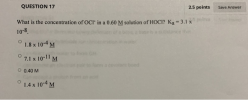 Save Answer QUESTION 17 2.5 points What is the concentration of OCI in a 0.60 M solution of HOCI? Ka - 3.1 x 10⁻⁸. ° 1.8 x 10⁻⁴ M ° 7.1 x 10⁻¹¹ M O 0.40 M ° 1.4 x 10⁻⁴ M
Experiment Initial [A] Initial [B] Initial [C] Initial Rate of Reaction 1 0.1 M 0.1 M...
Experiment Initial [A] Initial [B] Initial [C] Initial Rate of Reaction 1 0.1 M 0.1 M 0.2 M 4 x 10^(-4) M/min 2 0.3 M 0.2 M 0.2 M 1.2 x 10^(-3) M/min 3 0.1 M 0.3 M 0.2 M 4 x 10^(-4) M/min 4 0.3 M 0.4 M 0.6 M 3.6 x 10^(-3) The method of initial rates is used to determine the rate law for reactants A, B, and C. This data was obtained at 25 degrees C....
What is the final concentration of D at equilibrium if the initial concentrations are [A] =...
What is the final concentration of D at equilibrium if the initial concentrations are [A] = 1.00 M and [B] = 2.00 M ?The reversible chemical reaction A+B⇌C+D has the following equilibrium constant: Kc=[C][D][A][B]=5.3 Gaseous hydrogen iodide is placed in a closed container at 425∘C, where it partially decomposes to hydrogen and iodine: 2HI(g)⇌H2(g)+I2(g) At equilibrium it is found that [HI]= 3.55×10⁻³M, [H2]= 4.82×10⁻⁴M , and [I2]= 4.82×10⁻⁴M. What is the value of Kc at this temperature? b The reversible...
Problem 11 Consider the reaction: A (aq) + (aq) at 293 K where the initial concentration...
 Problem 11 Consider the reaction: A (aq) + (aq) at 293 K where the initial concentration of A = 1.00 M and the initial concentration of B = 0.000 M. At equilibrium it is found that the concentration of B -0.645 M. What is the maximum amount of work that can be done by this system when the concentration of A = 0.829 M?
5. A student does an experiment to determine the equili but at a higher temperature. ermine...
 5. A student does an experiment to determine the equili but at a higher temperature. ermine the equilibrium constant for the same reaction that you will study, Fe** (aq) + SCN (aq) FeSCN2+ (aq) The student prepares solution 1, by mixing 5. s Solution, by mixing 5.00 ml of 0.002 M Fe(NO2)2 solution with 5.00 mL of .00011M KSCN solution, heats the mixture, and finds that the equilibrium concentration of F and finds that the equilibrium concentration of FeSCN2+ in...
For this question, consider the reaction A-->B with a rate constant k=7.17x10^-4 m/s. A.)In one experiment,...
 For this question, consider the reaction A-->B with a rate
constant k=7.17x10^-4 m/s.
A.)In one experiment, the half life for A is determined to be
15.00 minutes. What was the initial concentration of A?
B.) In a different experiment, it takes 15.00 minutes for the
concentration of A to decrease by 28%. What was the initial
concentration of A in this trial?
ate dete ate law for this rance of pros Name: TA Name: Student ID: Section number: Aneta 10For...
For this question, consider the reaction A-->B with a rate
constant k=7.17x10^-4 m/s.
A.)In one experiment, the half life for A is determined to be
15.00 minutes. What was the initial concentration of A?
B.) In a different experiment, it takes 15.00 minutes for the
concentration of A to decrease by 28%. What was the initial
concentration of A in this trial?
ate dete ate law for this rance of pros Name: TA Name: Student ID: Section number: Aneta 10For...
Problem 1. [30 points) A metal block falls with initial speed v. = 2.5 m/s and...
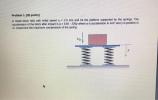 Problem 1. [30 points) A metal block falls with initial speed v. = 2.5 m/s and hit the platform supported by the springs. The acceleration of the block after impact is a = 9.81 - 220y where a is acceleration in m/sand y is position in m. Determine the maximum compression of the spring. VO y
5-10 The data below refer to the following reaction: 2NO(g) + Brz(g) 2NOBr(g) [NO] 2.5 [Brz] Concentration (M) Initial...
 5-10 The data below refer to the following reaction: 2NO(g) + Brz(g) 2NOBr(g) [NO] 2.5 [Brz] Concentration (M) Initial Equilibrium [NOBr] 5.0 1.0 2.0 Calculate Kc Ans: 0.12 5-11 The AG of atomic oxygen is 230.1 kJ/mol. Determine the equilibrium constant for the following reaction at standard thermodynamic conditions: O2(g) 52 0(g). A) 4.7 x 10-41 B) 2.3 x 10-61 C) 2.1 x 10-81 D) 2.1 x 1040 E) 4.5 x 1080
 1. (2.5 2.5 5 points) Consider the real-valued passband signal zp(t) = xc(t)cos(27fet)-as(t) sin(27 fet) where, as usual, xe(t) and xs(t) are real-valued baseband signals with (real) bandwidth W/2. Let Ee, Es, Ep represent respectively, the energies of xp(t), xc(t), x,(t) W, show that f re(t) cos(4 fet)dt = J ,(t) cos(47fet) = 0. (a) Assume that fe (b) Show that Ep = Ec/2+ Es/2. Hint: Use trigonometric identities on
 Save Answer QUESTION 17 2.5 points What is the concentration of OCI in a 0.60 M solution of HOCI? Ka - 3.1 x 10⁻⁸. ° 1.8 x 10⁻⁴ M ° 7.1 x 10⁻¹¹ M O 0.40 M ° 1.4 x 10⁻⁴ M
 Problem 11 Consider the reaction: A (aq) + (aq) at 293 K where the initial concentration of A = 1.00 M and the initial concentration of B = 0.000 M. At equilibrium it is found that the concentration of B -0.645 M. What is the maximum amount of work that can be done by this system when the concentration of A = 0.829 M?
 5. A student does an experiment to determine the equili but at a higher temperature. ermine the equilibrium constant for the same reaction that you will study, Fe** (aq) + SCN (aq) FeSCN2+ (aq) The student prepares solution 1, by mixing 5. s Solution, by mixing 5.00 ml of 0.002 M Fe(NO2)2 solution with 5.00 mL of .00011M KSCN solution, heats the mixture, and finds that the equilibrium concentration of F and finds that the equilibrium concentration of FeSCN2+ in...
 For this question, consider the reaction A-->B with a rate
constant k=7.17x10^-4 m/s.
A.)In one experiment, the half life for A is determined to be
15.00 minutes. What was the initial concentration of A?
B.) In a different experiment, it takes 15.00 minutes for the
concentration of A to decrease by 28%. What was the initial
concentration of A in this trial?
ate dete ate law for this rance of pros Name: TA Name: Student ID: Section number: Aneta 10For...
For this question, consider the reaction A-->B with a rate
constant k=7.17x10^-4 m/s.
A.)In one experiment, the half life for A is determined to be
15.00 minutes. What was the initial concentration of A?
B.) In a different experiment, it takes 15.00 minutes for the
concentration of A to decrease by 28%. What was the initial
concentration of A in this trial?
ate dete ate law for this rance of pros Name: TA Name: Student ID: Section number: Aneta 10For...
 Problem 1. [30 points) A metal block falls with initial speed v. = 2.5 m/s and hit the platform supported by the springs. The acceleration of the block after impact is a = 9.81 - 220y where a is acceleration in m/sand y is position in m. Determine the maximum compression of the spring. VO y
 5-10 The data below refer to the following reaction: 2NO(g) + Brz(g) 2NOBr(g) [NO] 2.5 [Brz] Concentration (M) Initial Equilibrium [NOBr] 5.0 1.0 2.0 Calculate Kc Ans: 0.12 5-11 The AG of atomic oxygen is 230.1 kJ/mol. Determine the equilibrium constant for the following reaction at standard thermodynamic conditions: O2(g) 52 0(g). A) 4.7 x 10-41 B) 2.3 x 10-61 C) 2.1 x 10-81 D) 2.1 x 1040 E) 4.5 x 1080
Most questions answered within 3 hours.
-
Where is the error in this code sequence?
String s1 = "Hello";
String s2 = "ello";...
asked 10 months ago -
Financial data for Joel de Paris, Inc., for last year
follow:
Joel de Paris, Inc.
Balance...
asked 10 months ago -
Consider this reaction:
Al2(SO4)3 (aq)+ BaCl3
(aq) Al2Cl6 (aq)- +
3BaSO4(s) . What is the...
asked 10 months ago -
Suppose that Savneet is considering increasing her
recent random sample from 20 car rentals to 40...
asked 10 months ago -
Trucks arrive at an unloading terminal at an average rate of 120
per hour.
Trucks arrive...
asked 10 months ago -
Why are methanol and ethanol completely soluble in water while
octanol is not very little soluble....
asked 10 months ago -
A facilities manager at a university reads in a research report
that the mean amount of...
asked 10 months ago -
When the CuSO4 is rehydrated by adding water to the anhydrous
compound, is this an endothermic...
asked 10 months ago -
A ray of sunlight is passing from diamond into crown glass; the
angle of incidence is...
asked 10 months ago -
A block of mass 0.249 kg is placed on top of a light, vertical
spring of...
asked 10 months ago -
how do the kidneys compensate in the presences of acidosis
a) trigger hyperventilate
b) reserve acid...
asked 10 months ago -
Question 501 pts
The rental rate of capital to the firm increases. Which of the
following...
asked 10 months ago