![16. From the given graph below, determine the order of the following reaction: 2x + Y + Z In[X] (s) (b) (a) A. The plot shows](http://img.homeworklib.com/questions/25fd0b60-f544-11ea-ad6d-a9091803e7bb.png?x-oss-process=image/resize,w_560)
Homework Answers
Request Answer!
We need at least 10 more requests to produce the answer.
0 / 10 have requested this problem solution
The more requests, the faster the answer.
Add Answer to:
16. From the given graph below, determine the order of the following reaction: 2x + Y...
What is the difference between a first order and a second order reaction? a. For a...
What is the difference between a first order and a second order reaction? a. For a first order reaction, plotting the natural logarithm of A versus time always gives a straight line with a slope equal to -k For a second order reaction a plot of 1 / A versus time, will produce a straight line with a slope equal to k b. For a first order reaction, plotting the natural logarithm of A versus time always gives a straight...
5 What are the units of the rate constant (k) for first, second, or zero order reaction? Show how you determined the...
 5 What are the units of the rate constant (k) for first, second, or zero order reaction? Show how you determined the units of each rate constant. >SO2 + Cla: 6. The following data were obtained at 320°C for the reaction of: SO Cla 0.00 4.00 3,00 2.00 Time, hour 1.00 0.874 [SO Cl), M 0.946 1.024 1,200 1.109 Graph: (a) In [SO Cl2] vs. time Label and attach the graphs to the worksheet. If using Excel, provide the equation...
The reaction A → B + C is known to be first order in A. Below...
The reaction A → B + C is known to be first order in A. Below are data showing the concentration of A as a function of reaction time. Time, h [A], M 0 2.50 x 10^-1 1 2.21 x 10^-1 2 1.95 x 10^-1 4 1.52 x 10^-1 8 9.23 x 10^-2 10 7.19 x 10^-2 12 5.61 x 10^-2 (a) What is the average rate of reaction between 1 and 4 h? Report the units as well as...
Determine the order of the reaction and the rate constant, using data below. 480.0 0.0190 16....
 Determine the order of the reaction and the rate constant, using
data below.
480.0 0.0190 16. The data below was obtained for the reaction A products, Time (s) 0.0 120.0 240.0 360.0 [A]: (mol/L) 0.122 0.0500 0 .0325 0.0240 Determine the order of the reaction and the rate constant. (a) The reaction is zeroth order, and the rate constant is 1.93x10⁻⁶ mol L"s". (b) The reaction is first order, and the rate constant is 3.71x10s (c) The reaction is first...
Determine the order of the reaction and the rate constant, using
data below.
480.0 0.0190 16. The data below was obtained for the reaction A products, Time (s) 0.0 120.0 240.0 360.0 [A]: (mol/L) 0.122 0.0500 0 .0325 0.0240 Determine the order of the reaction and the rate constant. (a) The reaction is zeroth order, and the rate constant is 1.93x10⁻⁶ mol L"s". (b) The reaction is first order, and the rate constant is 3.71x10s (c) The reaction is first...
Orders to choose from: First, Second, Zero In a study of the decomposition of nitrosyl bromide...
 Orders to choose from: First,
Second, Zero
In a study of the decomposition of nitrosyl bromide at 10 °C the concentration of NOBr was followed as a function of time. It was found that a graph of 1/[NOBr] vess time in seconds gave a straight line with a slope of 1.22 M s1 and a y-intercept of 8.55 M Based on this plot, the reaction is order in NOBr and the rate constant for the reaction is In a study...
Orders to choose from: First,
Second, Zero
In a study of the decomposition of nitrosyl bromide at 10 °C the concentration of NOBr was followed as a function of time. It was found that a graph of 1/[NOBr] vess time in seconds gave a straight line with a slope of 1.22 M s1 and a y-intercept of 8.55 M Based on this plot, the reaction is order in NOBr and the rate constant for the reaction is In a study...
18. From the reaction data below, determine whether the reaction is first-order or second-order. Time (S)...
 18. From the reaction data below, determine whether the reaction is first-order or second-order. Time (S) Reactant (M) 6.67 1.59 0.74 0.39 0.16 25 a. First-order. b. Second-order. c. Zero-order. d. Cannot determine. 19. In the Question 18, what is the rate constant for the reaction? a. 0.12 b. 0.15 c. 0.24 d. 0.72 20. In the Question 18, what is the half-life for the reaction? a. 0.2 sec b. 0.6 sec c. 1.0 sec d. 1.3 sec
The reaction A → B + C is known to be first order in A. Below...
The reaction A → B + C is known to be first order in A. Below are data showing the concentration of A as a function of reaction time. Time, h [A], M 0 1.00*10^-1 0.5 9.01*10^-2 1 8.12*10^-2 2 6.60*10^-2 4 4.35*10^-2 5 3.53*10^-2 6 2.87*10^-2 (a) What is the average rate of reaction between 0.5 and 2 h? Report the units as well as the numbers. (b) Plot the data above, showing the concentration of A as a...
Most of the time, the rate of a reaction depends on the concentration of the reactant....
 Most of the time, the rate of a reaction depends on the
concentration of the reactant. In the case of second-order
reactions, the rate is proportional to the square of the
concentration of the reactant.
Select the image to explore the simulation, which will help you
to understand how second-order reactions are identified by the
nature of their plots. You can also observe the rate law for
different reactions.
In the simulation, you can select one of the three different...
Most of the time, the rate of a reaction depends on the
concentration of the reactant. In the case of second-order
reactions, the rate is proportional to the square of the
concentration of the reactant.
Select the image to explore the simulation, which will help you
to understand how second-order reactions are identified by the
nature of their plots. You can also observe the rate law for
different reactions.
In the simulation, you can select one of the three different...
Consider the reaction below: N2O4 (g) → 2 NO2 (g) Which of the following techniques be...
 Consider the reaction below: N2O4 (g) → 2 NO2 (g) Which of the following techniques be used to determine the rate law is second order with respect to the concentration of dinitrogen tetroxide? O A graph of In([N204]) versus time will produce a straight line. A graph of [N204] versus time will produce a curved line. A graph of (N2O.) versus time will produce a straight line. The balanced chemical equation tells us that the reaction is first order with...
7. Consider the following second-order reaction: 2X ? Y. The initial concentration of X is 0.50...
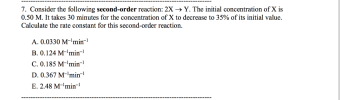 7. Consider the following second-order reaction: 2X ? Y. The initial concentration of X is 0.50 M. It takes 30 minutes for the concentration of X to decrease to 35% of its initial value. Calculate the rate constant for this second-order reaction. A. 0.0330 Mmin B. 0.124 M-min-1 C. 0.185 M-'min-1 D.0.367 Mmin-1 E. 2.48 M-min-1
 5 What are the units of the rate constant (k) for first, second, or zero order reaction? Show how you determined the units of each rate constant. >SO2 + Cla: 6. The following data were obtained at 320°C for the reaction of: SO Cla 0.00 4.00 3,00 2.00 Time, hour 1.00 0.874 [SO Cl), M 0.946 1.024 1,200 1.109 Graph: (a) In [SO Cl2] vs. time Label and attach the graphs to the worksheet. If using Excel, provide the equation...
 Determine the order of the reaction and the rate constant, using
data below.
480.0 0.0190 16. The data below was obtained for the reaction A products, Time (s) 0.0 120.0 240.0 360.0 [A]: (mol/L) 0.122 0.0500 0 .0325 0.0240 Determine the order of the reaction and the rate constant. (a) The reaction is zeroth order, and the rate constant is 1.93x10⁻⁶ mol L"s". (b) The reaction is first order, and the rate constant is 3.71x10s (c) The reaction is first...
Determine the order of the reaction and the rate constant, using
data below.
480.0 0.0190 16. The data below was obtained for the reaction A products, Time (s) 0.0 120.0 240.0 360.0 [A]: (mol/L) 0.122 0.0500 0 .0325 0.0240 Determine the order of the reaction and the rate constant. (a) The reaction is zeroth order, and the rate constant is 1.93x10⁻⁶ mol L"s". (b) The reaction is first order, and the rate constant is 3.71x10s (c) The reaction is first...
 Orders to choose from: First,
Second, Zero
In a study of the decomposition of nitrosyl bromide at 10 °C the concentration of NOBr was followed as a function of time. It was found that a graph of 1/[NOBr] vess time in seconds gave a straight line with a slope of 1.22 M s1 and a y-intercept of 8.55 M Based on this plot, the reaction is order in NOBr and the rate constant for the reaction is In a study...
Orders to choose from: First,
Second, Zero
In a study of the decomposition of nitrosyl bromide at 10 °C the concentration of NOBr was followed as a function of time. It was found that a graph of 1/[NOBr] vess time in seconds gave a straight line with a slope of 1.22 M s1 and a y-intercept of 8.55 M Based on this plot, the reaction is order in NOBr and the rate constant for the reaction is In a study...
 18. From the reaction data below, determine whether the reaction is first-order or second-order. Time (S) Reactant (M) 6.67 1.59 0.74 0.39 0.16 25 a. First-order. b. Second-order. c. Zero-order. d. Cannot determine. 19. In the Question 18, what is the rate constant for the reaction? a. 0.12 b. 0.15 c. 0.24 d. 0.72 20. In the Question 18, what is the half-life for the reaction? a. 0.2 sec b. 0.6 sec c. 1.0 sec d. 1.3 sec
 Most of the time, the rate of a reaction depends on the
concentration of the reactant. In the case of second-order
reactions, the rate is proportional to the square of the
concentration of the reactant.
Select the image to explore the simulation, which will help you
to understand how second-order reactions are identified by the
nature of their plots. You can also observe the rate law for
different reactions.
In the simulation, you can select one of the three different...
Most of the time, the rate of a reaction depends on the
concentration of the reactant. In the case of second-order
reactions, the rate is proportional to the square of the
concentration of the reactant.
Select the image to explore the simulation, which will help you
to understand how second-order reactions are identified by the
nature of their plots. You can also observe the rate law for
different reactions.
In the simulation, you can select one of the three different...
 Consider the reaction below: N2O4 (g) → 2 NO2 (g) Which of the following techniques be used to determine the rate law is second order with respect to the concentration of dinitrogen tetroxide? O A graph of In([N204]) versus time will produce a straight line. A graph of [N204] versus time will produce a curved line. A graph of (N2O.) versus time will produce a straight line. The balanced chemical equation tells us that the reaction is first order with...
 7. Consider the following second-order reaction: 2X ? Y. The initial concentration of X is 0.50 M. It takes 30 minutes for the concentration of X to decrease to 35% of its initial value. Calculate the rate constant for this second-order reaction. A. 0.0330 Mmin B. 0.124 M-min-1 C. 0.185 M-'min-1 D.0.367 Mmin-1 E. 2.48 M-min-1
Most questions answered within 3 hours.
-
Where is the error in this code sequence?
String s1 = "Hello";
String s2 = "ello";...
asked 10 months ago -
Financial data for Joel de Paris, Inc., for last year
follow:
Joel de Paris, Inc.
Balance...
asked 10 months ago -
Consider this reaction:
Al2(SO4)3 (aq)+ BaCl3
(aq) Al2Cl6 (aq)- +
3BaSO4(s) . What is the...
asked 10 months ago -
Suppose that Savneet is considering increasing her
recent random sample from 20 car rentals to 40...
asked 10 months ago -
Trucks arrive at an unloading terminal at an average rate of 120
per hour.
Trucks arrive...
asked 10 months ago -
Why are methanol and ethanol completely soluble in water while
octanol is not very little soluble....
asked 10 months ago -
A facilities manager at a university reads in a research report
that the mean amount of...
asked 10 months ago -
When the CuSO4 is rehydrated by adding water to the anhydrous
compound, is this an endothermic...
asked 10 months ago -
A ray of sunlight is passing from diamond into crown glass; the
angle of incidence is...
asked 10 months ago -
A block of mass 0.249 kg is placed on top of a light, vertical
spring of...
asked 10 months ago -
how do the kidneys compensate in the presences of acidosis
a) trigger hyperventilate
b) reserve acid...
asked 10 months ago -
Question 501 pts
The rental rate of capital to the firm increases. Which of the
following...
asked 10 months ago