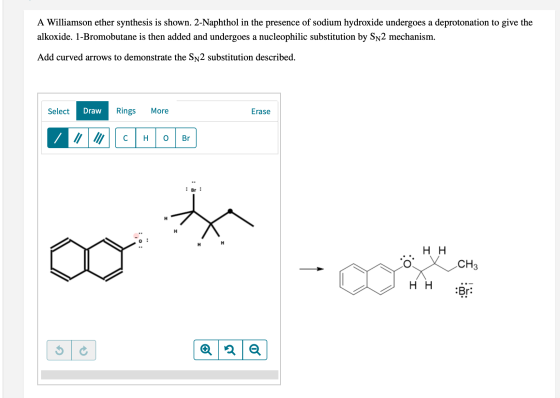
A Williamson ether synthesis is shown. 2‑Naphthol in the presence of sodium hydroxide undergoes a deprotonation to give the alkoxide. 1‑Bromobutane is then added and undergoes a nucleophilic substitution by SN2 mechanism. Add curved arrows to demonstr
Homework Answers
Request Answer!
We need at least 10 more requests to produce the answer.
0 / 10 have requested this problem solution
The more requests, the faster the answer.
Add Answer to:
A Williamson ether synthesis is shown. 2‑Naphthol in the presence of sodium hydroxide undergoes a deprotonation to give the alkoxide. 1‑Bromobutane is then added and undergoes a nucleophilic substitution by SN2 mechanism. Add curved arrows to demonstr
A Williamson ether synthesis is shown below. 2-naphthol in the presence of sodium hydroxide undergoes a...
 A Williamson ether synthesis is shown below. 2-naphthol in the
presence of sodium hydroxide undergoes a deprotonation to give the
alkoxide shown below. 1-Bromooctane is then added and undergoes a
nucleophilic substitution by SN2 mechanism. Add curved arrows to
demonstrate the SN2 substitution described.
A Williamson ether synthesis is shown below. 2-naphthol in the presence of sodium hydroxide undergoes a deprotonation to give the alkoxide shown below. 1-Bromooctane is then added and undergoes a nucleophilic substitution by SN2 mechanism. Add...
A Williamson ether synthesis is shown below. 2-naphthol in the
presence of sodium hydroxide undergoes a deprotonation to give the
alkoxide shown below. 1-Bromooctane is then added and undergoes a
nucleophilic substitution by SN2 mechanism. Add curved arrows to
demonstrate the SN2 substitution described.
A Williamson ether synthesis is shown below. 2-naphthol in the presence of sodium hydroxide undergoes a deprotonation to give the alkoxide shown below. 1-Bromooctane is then added and undergoes a nucleophilic substitution by SN2 mechanism. Add...
In a Williamson ether synthesis with sodium ethoxide and 1-bromobutane, with ethanol as the solvent, which...
In a Williamson ether synthesis with sodium ethoxide and 1-bromobutane, with ethanol as the solvent, which substances would be distilled and which substance would distill first?
Pyridine reacts with hydroxide by nucleophilic aromatic substitution. Complete the mechanism by drawing curved arrows, the...
 Pyridine reacts with hydroxide by nucleophilic aromatic
substitution. Complete the mechanism by drawing curved arrows, the
structure of the charged intermediate, and the structure of the
major uncharged product.
Violation
Pyridine reacts with hydroxide by nucleophilic aromatic
substitution. Complete the mechanism by drawing curved arrows, the
structure of the charged intermediate, and the structure of the
major uncharged product.
Violation
In an SN2 Nucleophilic substitution, 1-bromobutane is synthesized by refluxing 1-butanol with sodium bromide and sulfuric...
In an SN2 Nucleophilic substitution, 1-bromobutane is synthesized by refluxing 1-butanol with sodium bromide and sulfuric acid. Would this reaction produce 1-bromobutane by the same mechanism if 2-methyl-2-butanol was used instead?
2. Provide the full mechanism for the dehydrobromination of 1-bromobutane in the presence of potassium hydroxide.
 2. Provide the full mechanism for the dehydrobromination of 1-bromobutane in the presence of potassium hydroxide.
Step 1: React phenol with sodium hydroxide Step 2: Add 2-Chlorobutane The product(s) is/are __________. an ether...
Step 1: React phenol with sodium hydroxide Step 2: Add 2-Chlorobutane The product(s) is/are __________. an ether an alcohol an ether and an alkene an alkene an alcohol and an alkene In the reaction above, which type of reaction is occurring? free radical halogenation acid-base followed by SN2 and E2 SN1 oxidation-reduction oxidation reduction followed by SN1
1. Using the reaction of 2-chloro-1-methylcyclohexane with hydroxide ion, give the mechanism of Sn1 substitution. &...
1. Using the reaction of 2-chloro-1-methylcyclohexane with hydroxide ion, give the mechanism of Sn1 substitution. Complete the question as in question 1 2. Show how you might synthesise the following compounds given the indicated starting materials and anything else you need. In other words, show the reactions that would lead from starting materials to products. Assume that you can purify the products of each reaction. A synthesis may require more than one reaction (products of one reaction are used as starting materials in the...
Map.com C,H,COCH, 1.NaBH, > ? 2.H,O+ Add curved arrows to show the mechanism of the first...
 Map.com C,H,COCH, 1.NaBH, > ? 2.H,O+ Add curved arrows to show the mechanism of the first step of the reaction. Draw the charged organic intermediate product. Include nonbonding electrons and charges. Omit the counterion. click to edit Nath—B—H → continued below Draw the final product. * continued from above
 A Williamson ether synthesis is shown below. 2-naphthol in the
presence of sodium hydroxide undergoes a deprotonation to give the
alkoxide shown below. 1-Bromooctane is then added and undergoes a
nucleophilic substitution by SN2 mechanism. Add curved arrows to
demonstrate the SN2 substitution described.
A Williamson ether synthesis is shown below. 2-naphthol in the presence of sodium hydroxide undergoes a deprotonation to give the alkoxide shown below. 1-Bromooctane is then added and undergoes a nucleophilic substitution by SN2 mechanism. Add...
A Williamson ether synthesis is shown below. 2-naphthol in the
presence of sodium hydroxide undergoes a deprotonation to give the
alkoxide shown below. 1-Bromooctane is then added and undergoes a
nucleophilic substitution by SN2 mechanism. Add curved arrows to
demonstrate the SN2 substitution described.
A Williamson ether synthesis is shown below. 2-naphthol in the presence of sodium hydroxide undergoes a deprotonation to give the alkoxide shown below. 1-Bromooctane is then added and undergoes a nucleophilic substitution by SN2 mechanism. Add...
 Pyridine reacts with hydroxide by nucleophilic aromatic
substitution. Complete the mechanism by drawing curved arrows, the
structure of the charged intermediate, and the structure of the
major uncharged product.
Violation
Pyridine reacts with hydroxide by nucleophilic aromatic
substitution. Complete the mechanism by drawing curved arrows, the
structure of the charged intermediate, and the structure of the
major uncharged product.
Violation
 2. Provide the full mechanism for the dehydrobromination of 1-bromobutane in the presence of potassium hydroxide.
 Map.com C,H,COCH, 1.NaBH, > ? 2.H,O+ Add curved arrows to show the mechanism of the first step of the reaction. Draw the charged organic intermediate product. Include nonbonding electrons and charges. Omit the counterion. click to edit Nath—B—H → continued below Draw the final product. * continued from above
Most questions answered within 3 hours.
-
Where is the error in this code sequence?
String s1 = "Hello";
String s2 = "ello";...
asked 10 months ago -
Financial data for Joel de Paris, Inc., for last year
follow:
Joel de Paris, Inc.
Balance...
asked 10 months ago -
Consider this reaction:
Al2(SO4)3 (aq)+ BaCl3
(aq) Al2Cl6 (aq)- +
3BaSO4(s) . What is the...
asked 10 months ago -
Suppose that Savneet is considering increasing her
recent random sample from 20 car rentals to 40...
asked 10 months ago -
Trucks arrive at an unloading terminal at an average rate of 120
per hour.
Trucks arrive...
asked 10 months ago -
Why are methanol and ethanol completely soluble in water while
octanol is not very little soluble....
asked 10 months ago -
A facilities manager at a university reads in a research report
that the mean amount of...
asked 10 months ago -
When the CuSO4 is rehydrated by adding water to the anhydrous
compound, is this an endothermic...
asked 10 months ago -
A ray of sunlight is passing from diamond into crown glass; the
angle of incidence is...
asked 10 months ago -
A block of mass 0.249 kg is placed on top of a light, vertical
spring of...
asked 10 months ago -
how do the kidneys compensate in the presences of acidosis
a) trigger hyperventilate
b) reserve acid...
asked 10 months ago -
Question 501 pts
The rental rate of capital to the firm increases. Which of the
following...
asked 10 months ago