
Homework Answers
Add Answer to:
Determine the work (as a factor of x105 joules from the pv diagram shown. The gas...
Determine the work (as a factor of x105 Joules) from the pV diagram shown. The gas...
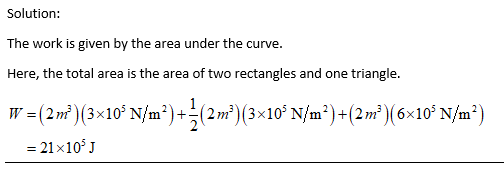
Determine the work (as a factor of x105 Joules) from the pV diagram shown. The gas is taken from point A = (2 m3, 3x10⁵ N/m2) to B = (4 m3, 6x10⁵ N/m2 ) and then to C = (6 m3, 6x10⁵ N/m2). a. 16 b. 21 c. 18 d. 32
An ideal gas undergoes the thermodynamic processes shown by the path ABCDA in the PV diagram...
 An ideal gas undergoes the thermodynamic processes shown by the path ABCDA in the PV diagram below. In the following table, indicate whether each quantity is positive, negative, or zero for each step of the cycle, as well as for the cycle as a whole. P (N/m2) B A D V (m) AT AU Wongas Qon gas AB В - С C-D DA Cycle HTML Editong
An ideal monatomic gas undergoes changes in pressure and volume, as shown in the pV diagram...
 An ideal monatomic gas undergoes changes in pressure and volume, as shown in the pV diagram below. The initial volume is 0.02 m3 and the final volume is 0.10 m3 20 10 01 (a) Calculate the magnitude, or absolute value, of the Work done on the gas in this process. (Be careful with units. Your answer should be in Joules. 1 atm 1.013x 10⁵ Pa.) (b)The work done ON the gas is: O positive O negative (c) The initial temperature...
In the pV diagram shown in the figure(Figure 1), 85.0 J of work was done by...
 In the pV diagram shown in the figure(Figure 1), 85.0 J of work was done by 0.0630 mole of ideal gas during an adiabatic process. Part A How much heat entered or left this gas from a to b? Express your answer in joules. Vα ΑΣφ ? Q = J Request Answer Submit Part B Figure By how many joules did the internal energy of the gas change? 1 of 1 Express your answer in joules. p (atm) Nνα ΑΣφ...
The state of an ideal gas can be represented by a point on a PV(pressure-volume)...
The state of an ideal gas can be represented by a point on a PV (pressure-volume) diagram. If you know the quantity of gas, n, a unique point in pressure (P) and volume (V) can be used to determine a temperature (T). Each point on a PV diagram also has a single internal energy (U) assigned to it. If a process starts at a point and returns to that same point on a PV diagram, it returns to the same...
The state of an ideal gas can be represented by a point on a PV (pressure-volume)...
 The state of an ideal gas can be represented by a point on a PV
(pressure-volume) diagram. If you know the quantity of gas, n, a
unique point in pressure (P) and volume (V) can be used to
determine a temperature (T). Each point on a PV diagram also has a
single internal energy (U) assigned to it. If a process starts at a
point and returns to that same point on a PV diagram, it returns to
the same...
The state of an ideal gas can be represented by a point on a PV
(pressure-volume) diagram. If you know the quantity of gas, n, a
unique point in pressure (P) and volume (V) can be used to
determine a temperature (T). Each point on a PV diagram also has a
single internal energy (U) assigned to it. If a process starts at a
point and returns to that same point on a PV diagram, it returns to
the same...
A gas follows the PV diagram in the figure below. Find the work done on the...
 A gas follows the PV diagram in the figure below. Find the work done on the gas along the paths AB, BC, CD, DA, and ABCDA. (Enter your answers in J.) HINT P(105 Pa) 7.00 -4. 2.00-D 41.00 7.00 v(m 1.00 7.00 (a) AB x J
A heat engine using a monatomic gas follows the cycle shown in the pV diagram. P11...
 A heat engine using a monatomic gas follows the cycle shown in the pV diagram. P11 The gas starts out at point 1 with a volume of V1 = 318 cm", a pressure of p1 = 147 kPa, and a temperature of 317 K. The gas is held at a constant volume while it is heated until its temperature reaches 455 K (point 2). The gas is then allowed to expand adiabatically until its pressure is again 147 kPa (point...
2) Sketch a PV diagram and find the work done by the gas during the following...
 2) Sketch a PV diagram and find the work done by the gas during
the following stages.
(a) A gas is expanded from a volume of 1.0 L to 6.0 L at a
constant pressure of 8.0 atm. _ J
(b) The gas is then cooled at constant volume until the pressure
falls to 1.5 atm. J
(c) The gas is then compressed at a constant pressure of 1.5 atm
from a volume of 6.0 L to 1.0 L. (Note:...
2) Sketch a PV diagram and find the work done by the gas during
the following stages.
(a) A gas is expanded from a volume of 1.0 L to 6.0 L at a
constant pressure of 8.0 atm. _ J
(b) The gas is then cooled at constant volume until the pressure
falls to 1.5 atm. J
(c) The gas is then compressed at a constant pressure of 1.5 atm
from a volume of 6.0 L to 1.0 L. (Note:...
V. PV diagrams Ideal gas processes are often represented graphically. For instance, a PV diagram is...
 V. PV diagrams Ideal gas processes are often represented graphically. For instance, a PV diagram is a graph of pressure versus volume for a given sample of gas. A single point on the graph represents simultancously measured values of pressure and volume These values define a state of the gas A. Sketch the process described in section III on the PV diagram provided to the right Label the initial and final states of the gas. This type of process is...
 An ideal gas undergoes the thermodynamic processes shown by the path ABCDA in the PV diagram below. In the following table, indicate whether each quantity is positive, negative, or zero for each step of the cycle, as well as for the cycle as a whole. P (N/m2) B A D V (m) AT AU Wongas Qon gas AB В - С C-D DA Cycle HTML Editong
 An ideal monatomic gas undergoes changes in pressure and volume, as shown in the pV diagram below. The initial volume is 0.02 m3 and the final volume is 0.10 m3 20 10 01 (a) Calculate the magnitude, or absolute value, of the Work done on the gas in this process. (Be careful with units. Your answer should be in Joules. 1 atm 1.013x 10⁵ Pa.) (b)The work done ON the gas is: O positive O negative (c) The initial temperature...
 In the pV diagram shown in the figure(Figure 1), 85.0 J of work was done by 0.0630 mole of ideal gas during an adiabatic process. Part A How much heat entered or left this gas from a to b? Express your answer in joules. Vα ΑΣφ ? Q = J Request Answer Submit Part B Figure By how many joules did the internal energy of the gas change? 1 of 1 Express your answer in joules. p (atm) Nνα ΑΣφ...
 The state of an ideal gas can be represented by a point on a PV
(pressure-volume) diagram. If you know the quantity of gas, n, a
unique point in pressure (P) and volume (V) can be used to
determine a temperature (T). Each point on a PV diagram also has a
single internal energy (U) assigned to it. If a process starts at a
point and returns to that same point on a PV diagram, it returns to
the same...
The state of an ideal gas can be represented by a point on a PV
(pressure-volume) diagram. If you know the quantity of gas, n, a
unique point in pressure (P) and volume (V) can be used to
determine a temperature (T). Each point on a PV diagram also has a
single internal energy (U) assigned to it. If a process starts at a
point and returns to that same point on a PV diagram, it returns to
the same...
 A gas follows the PV diagram in the figure below. Find the work done on the gas along the paths AB, BC, CD, DA, and ABCDA. (Enter your answers in J.) HINT P(105 Pa) 7.00 -4. 2.00-D 41.00 7.00 v(m 1.00 7.00 (a) AB x J
 A heat engine using a monatomic gas follows the cycle shown in the pV diagram. P11 The gas starts out at point 1 with a volume of V1 = 318 cm", a pressure of p1 = 147 kPa, and a temperature of 317 K. The gas is held at a constant volume while it is heated until its temperature reaches 455 K (point 2). The gas is then allowed to expand adiabatically until its pressure is again 147 kPa (point...
 2) Sketch a PV diagram and find the work done by the gas during
the following stages.
(a) A gas is expanded from a volume of 1.0 L to 6.0 L at a
constant pressure of 8.0 atm. _ J
(b) The gas is then cooled at constant volume until the pressure
falls to 1.5 atm. J
(c) The gas is then compressed at a constant pressure of 1.5 atm
from a volume of 6.0 L to 1.0 L. (Note:...
2) Sketch a PV diagram and find the work done by the gas during
the following stages.
(a) A gas is expanded from a volume of 1.0 L to 6.0 L at a
constant pressure of 8.0 atm. _ J
(b) The gas is then cooled at constant volume until the pressure
falls to 1.5 atm. J
(c) The gas is then compressed at a constant pressure of 1.5 atm
from a volume of 6.0 L to 1.0 L. (Note:...
 V. PV diagrams Ideal gas processes are often represented graphically. For instance, a PV diagram is a graph of pressure versus volume for a given sample of gas. A single point on the graph represents simultancously measured values of pressure and volume These values define a state of the gas A. Sketch the process described in section III on the PV diagram provided to the right Label the initial and final states of the gas. This type of process is...
Most questions answered within 3 hours.
-
Where is the error in this code sequence?
String s1 = "Hello";
String s2 = "ello";...
asked 11 months ago -
Financial data for Joel de Paris, Inc., for last year
follow:
Joel de Paris, Inc.
Balance...
asked 11 months ago -
Consider this reaction:
Al2(SO4)3 (aq)+ BaCl3
(aq) Al2Cl6 (aq)- +
3BaSO4(s) . What is the...
asked 11 months ago -
Suppose that Savneet is considering increasing her
recent random sample from 20 car rentals to 40...
asked 11 months ago -
Trucks arrive at an unloading terminal at an average rate of 120
per hour.
Trucks arrive...
asked 11 months ago -
Why are methanol and ethanol completely soluble in water while
octanol is not very little soluble....
asked 11 months ago -
A facilities manager at a university reads in a research report
that the mean amount of...
asked 11 months ago -
When the CuSO4 is rehydrated by adding water to the anhydrous
compound, is this an endothermic...
asked 11 months ago -
A ray of sunlight is passing from diamond into crown glass; the
angle of incidence is...
asked 11 months ago -
A block of mass 0.249 kg is placed on top of a light, vertical
spring of...
asked 11 months ago -
how do the kidneys compensate in the presences of acidosis
a) trigger hyperventilate
b) reserve acid...
asked 11 months ago -
Question 501 pts
The rental rate of capital to the firm increases. Which of the
following...
asked 11 months ago