
Homework Answers
Add Answer to:
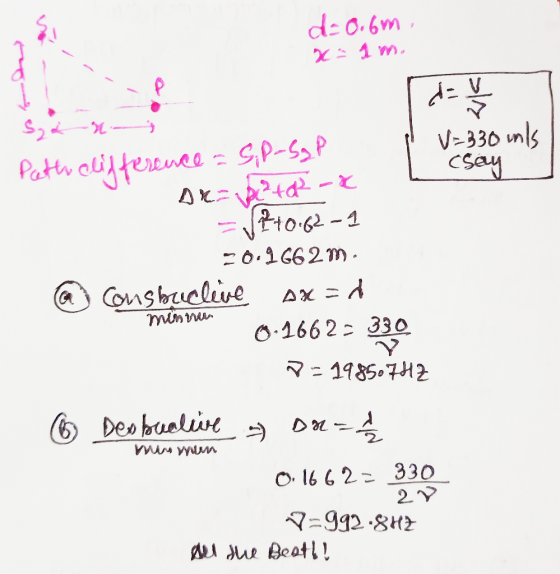
Question 2 A pair of in-phase speakers are placed next to each other 0.60 m apart....
A pair of in-phase stereo speakers is placed side by side, 0.854 m apart. You stand...
A pair of in-phase stereo speakers is placed side by side, 0.854 m apart. You stand directly in front of one of the speakers, 2.94 m from the speaker. Part A What is the lowest frequency that will produce constructive interference at your location? Express your answer using two significant figures.
what is the lowest frequency that will produce constructive interference at your location? <Ch14-HW Problem 14.57...
 what is the lowest frequency that will produce constructive
interference at your location?
<Ch14-HW Problem 14.57 A pair of in-phase stereo speakers is placed side by side, 0.714 m apart. You stand directly in front of one of the speakers, 2.74 m from the speaker.
what is the lowest frequency that will produce constructive
interference at your location?
<Ch14-HW Problem 14.57 A pair of in-phase stereo speakers is placed side by side, 0.714 m apart. You stand directly in front of one of the speakers, 2.74 m from the speaker.
Two loudspeakers in a plane are 2.0 m apart and in phase with each other. The...
 Two loudspeakers in a plane are 2.0 m apart and in phase with each other. The speed of sound is 340 m/s. Assume the amplitude of the sound from each speaker is approximately the same at the position of a listener, who is 3.75 m directly in front of one of the speakers. a) (10pts) For what three lowest frequencies will there be a minimum signal (destructive interference)? b) (10pts) For what three lowest frequencies will there be a maximum...
Two identical speakers are spaced 12 m apart, aimed toward each other. They each play a...
Two identical speakers are spaced 12 m apart, aimed toward each other. They each play a 171.5 Hz tone with the same phase constant. A. If you stand at the center point between the speakers, the result of superposition of the sound waves from the speakers is constructive inteference. Explain. B. How far must you move from the center toward one of the speakers in m to reach the next point of destructive interference?
Speakers A and B are vibrating in phase. They are directly facing each other, are 7.4...
Speakers A and B are vibrating in phase. They are directly facing each other, are 7.4 m apart, and are each playing a 80.0 Hz tone. The speed of sound is 343 m/s. On the line between the speakers there are three points where constructive interference occurs. What is the distance of the farthest point from speaker A?
Speakers A and B are vibrating in phase. They are directly facing each other, are 8.8...
Speakers A and B are vibrating in phase. They are directly facing each other, are 8.8 m apart, and are each playing a 74.0 Hz tone. The speed of sound is 343 m/s. On the line between the speakers there are three points where constructive interference occurs. What is the distance of the farthest point from speaker A?
Speakers A and B are vibrating in phase. They are directly facing each other, are 8.6...
Speakers A and B are vibrating in phase. They are directly facing each other, are 8.6 m apart, and are each playing a 74.0 Hz tone. The speed of sound is 343 m/s. On the line between the speakers there are three points where constructive interference occurs. What is the distance of the farthest point from speaker A?
Two speakers, 1 and 2, are set up with their centers 6.00 m apart. Both are...
 Two speakers, 1 and 2, are set up with their centers 6.00 m apart. Both are playing the same tone of frequency 225 Hz, in phase. Five listeners are standing on a line that is 6.00 m in front of the speakers as shown in the figure. Each listener is separated by 1.00 m and Cal is directly in front of speaker 1. Determine which listener or listeners will experience constructive interference from the sound emitted by the speakers. The...
Two speakers, A and B, are 4.00 m apart and are emitting identical in-phase sound waves....
Two speakers, A and B, are 4.00 m apart and are emitting identical in-phase sound waves. The speed of sound in air is 340 m/s. Consider a line which is the perpendicular bisector of the line connecting the two speakers. The first interference maximum occurs at ±25.15 o from this line. (a) What is the frequency of the sound emitted? (b) Find the rest of the angles where constructive and destructive interference occur. (c) If the speakers are aboard a...
Two speakers are placed along a wall 3 m apart. They are in phase and emitting...
Two speakers are placed along a wall 3 m apart. They are in phase and emitting the same tone (440 Hz). You are standing somewhere along the opposite wall. Where along the wall should you stand to hear the loudest signal? a) directly opposite either speaker b) to the right or left of the speaker c) in the middle, between the speakers d) the intensity is about the same everywhere along the wall
 what is the lowest frequency that will produce constructive
interference at your location?
<Ch14-HW Problem 14.57 A pair of in-phase stereo speakers is placed side by side, 0.714 m apart. You stand directly in front of one of the speakers, 2.74 m from the speaker.
what is the lowest frequency that will produce constructive
interference at your location?
<Ch14-HW Problem 14.57 A pair of in-phase stereo speakers is placed side by side, 0.714 m apart. You stand directly in front of one of the speakers, 2.74 m from the speaker.
 Two loudspeakers in a plane are 2.0 m apart and in phase with each other. The speed of sound is 340 m/s. Assume the amplitude of the sound from each speaker is approximately the same at the position of a listener, who is 3.75 m directly in front of one of the speakers. a) (10pts) For what three lowest frequencies will there be a minimum signal (destructive interference)? b) (10pts) For what three lowest frequencies will there be a maximum...
 Two speakers, 1 and 2, are set up with their centers 6.00 m apart. Both are playing the same tone of frequency 225 Hz, in phase. Five listeners are standing on a line that is 6.00 m in front of the speakers as shown in the figure. Each listener is separated by 1.00 m and Cal is directly in front of speaker 1. Determine which listener or listeners will experience constructive interference from the sound emitted by the speakers. The...
Most questions answered within 3 hours.
-
Where is the error in this code sequence?
String s1 = "Hello";
String s2 = "ello";...
asked 11 months ago -
Financial data for Joel de Paris, Inc., for last year
follow:
Joel de Paris, Inc.
Balance...
asked 11 months ago -
Consider this reaction:
Al2(SO4)3 (aq)+ BaCl3
(aq) Al2Cl6 (aq)- +
3BaSO4(s) . What is the...
asked 11 months ago -
Suppose that Savneet is considering increasing her
recent random sample from 20 car rentals to 40...
asked 11 months ago -
Trucks arrive at an unloading terminal at an average rate of 120
per hour.
Trucks arrive...
asked 11 months ago -
Why are methanol and ethanol completely soluble in water while
octanol is not very little soluble....
asked 11 months ago -
A facilities manager at a university reads in a research report
that the mean amount of...
asked 11 months ago -
When the CuSO4 is rehydrated by adding water to the anhydrous
compound, is this an endothermic...
asked 11 months ago -
A ray of sunlight is passing from diamond into crown glass; the
angle of incidence is...
asked 11 months ago -
A block of mass 0.249 kg is placed on top of a light, vertical
spring of...
asked 11 months ago -
how do the kidneys compensate in the presences of acidosis
a) trigger hyperventilate
b) reserve acid...
asked 11 months ago -
Question 501 pts
The rental rate of capital to the firm increases. Which of the
following...
asked 11 months ago