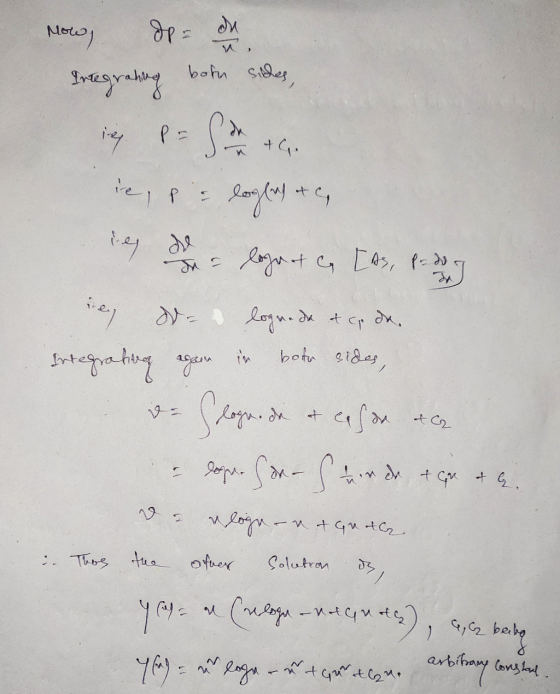
use the fact that y=x is a solution of the homogeneous equation x^2y''-2xy'+2y= 0 to completely...
use the fact that y=x is a solution of the homogeneous equation x^2y''-2xy'+2y= 0 to completely solve thee differential equation x^2y''-2xy'+2y= x^2
Homework Answers

Add Answer to:
use the fact that y=x is a solution of the homogeneous equation
x^2y''-2xy'+2y= 0 to completely...
1. Determine if the differential equation x^2y′=y(x+y) is homogeneous or Bernouilli or both. Give a solution...
1. Determine if the differential equation x^2y′=y(x+y) is homogeneous or Bernouilli or both. Give a solution using any method that applies. 2. Solve the differential equation y′= 2x(y+y^2) using the method of Bernouilli equation. Also give a solution for the same differential equation using the method of separable DE. 3. Consider the differential equation y′′= (y′)^2. It is has both x and y variable missing.Give solutions to the DE using the two different methods corresponding t ox-variable missing, and y-variable...
1. The function: y, = e' is a solution of the homogeneous linear equation: y"-2y'+ y...
 1. The function: y, = e' is a solution of the homogeneous linear equation: y"-2y'+ y = 0. Use Reduction of Order to find a second linearly independent solution, then write the general solution for the differential equation: y" - 2y'+y=0
Solve the differential equation and use matlab to plot the solution 2. dy +2xy f(x), y(0) = 2 dx f(x)=x0sx<1 l...
 Solve the differential equation and use matlab to plot the solution 2. dy +2xy f(x), y(0) = 2 dx f(x)=x0sx<1 l0 x 2 1
Solve the differential equation and use matlab to plot the solution 2. dy +2xy f(x), y(0) = 2 dx f(x)=x0sx
Solve the differential equation and use matlab to plot the solution 2. dy +2xy f(x), y(0) = 2 dx f(x)=x0sx<1 l0 x 2 1
Solve the differential equation and use matlab to plot the solution 2. dy +2xy f(x), y(0) = 2 dx f(x)=x0sx
given y1=x is a solution of the following DEXX+2xy-2y=0, the second solution is x 2 e2...
 given y1=x is a solution of the following DEXX+2xy-2y=0, the second solution is x 2 e2 Question 2 2 pts The differential equation whose general solution is Y=CCos(6x)+C2 Sin (V6 x) y" by 0 Oy -6y=0 y +6y=0 y"+6y'=0 2 pts Question 3 given that y1= x1 is a solution, if we use the reduction of order to solve the ODE 2x2 y + xy - 3y=0 we find that u= AXR+B (Ax512 - Ax+B Axe5124B
2. Solve the differential equation (2xy + y)dx + (x2 + 3.ry2 – 2y)dy = 0....
 2. Solve the differential equation (2xy + y)dx + (x2 + 3.ry2 – 2y)dy = 0. Answer: x²y + xy3 – y2 = C.
Use the reduction of order method to solve the following problem given one of the solution y1. (a) (x^2 - 1)y'' -2xy' +2y = 0 ,y1=x (b) (2x+1)y''-4(x+1)y'+4y=0 ,y1=e^2x (c) (x^...
Use the reduction of order method to solve the following problem given one of the solution y1. (a) (x^2 - 1)y'' -2xy' +2y = 0 ,y1=x (b) (2x+1)y''-4(x+1)y'+4y=0 ,y1=e^2x (c) (x^2-2x+2)y'' - x^2 y'+x^2 y =0, y1=x (d) Prove that if 1+p+q=0 than y=e^x is a solution of y''+p(x)y'+q(x)y=0, use this fact to solve (x-1)y'' - xy' +y =0
solve the differential equation (1 – x?)y" - 2xy'+6y=0 by using the series solution method
 solve the differential equation (1 – x?)y" - 2xy'+6y=0 by using the series solution method
Find the general solution to the following non-homogeneous Cauchy-Euler equation. Use the method of variation of...
 Find the general solution to the following non-homogeneous Cauchy-Euler equation. Use the method of variation of parameters to find a particular solution to the equation *?y" - 2xy' + 2y = x?, x>0.
(1 point) Solve y" + 2y' + 2y = 4te* cos(t). 1) Solve the homogeneous part:...
 (1 point) Solve y" + 2y' + 2y = 4te* cos(t). 1) Solve the homogeneous part: y" + 2y' + 2y = 0 for Yh, using a real basis. Note the coded answer is ordered. If your basis is correct and your answer is not accepted, try again with the other ordering. Yn = C1 te^(-+)*cost +C2 te^(-t)*cost 2) Compute the particular solution y, via complexifying the differential equation: Note that the forcing et cos(t) = Re(el-1+i)t). You will solve...
(1 point) Solve y" + 2y + 2y = 4te-t cos(t). 1) Solve the homogeneous part:...
 (1 point) Solve y" + 2y + 2y = 4te-t cos(t). 1) Solve the homogeneous part: y' + 2y + 2y = 0 for Yh, using a real basis. Note the coded answer is ordered. If your basis is correct and your answer is not accepted, try again with the other ordering. Yn = C1 e^(-t)sin(t) +C2 e^(-t)cos(t) . 2) Compute the particular solution yp via complexifying the differential equation: Note that the forcing e * cos(t) = Re(el 1+i)t)....
 1. The function: y, = e' is a solution of the homogeneous linear equation: y"-2y'+ y = 0. Use Reduction of Order to find a second linearly independent solution, then write the general solution for the differential equation: y" - 2y'+y=0
 Solve the differential equation and use matlab to plot the solution 2. dy +2xy f(x), y(0) = 2 dx f(x)=x0sx<1 l0 x 2 1
Solve the differential equation and use matlab to plot the solution 2. dy +2xy f(x), y(0) = 2 dx f(x)=x0sx
Solve the differential equation and use matlab to plot the solution 2. dy +2xy f(x), y(0) = 2 dx f(x)=x0sx<1 l0 x 2 1
Solve the differential equation and use matlab to plot the solution 2. dy +2xy f(x), y(0) = 2 dx f(x)=x0sx
 given y1=x is a solution of the following DEXX+2xy-2y=0, the second solution is x 2 e2 Question 2 2 pts The differential equation whose general solution is Y=CCos(6x)+C2 Sin (V6 x) y" by 0 Oy -6y=0 y +6y=0 y"+6y'=0 2 pts Question 3 given that y1= x1 is a solution, if we use the reduction of order to solve the ODE 2x2 y + xy - 3y=0 we find that u= AXR+B (Ax512 - Ax+B Axe5124B
 2. Solve the differential equation (2xy + y)dx + (x2 + 3.ry2 – 2y)dy = 0. Answer: x²y + xy3 – y2 = C.
 solve the differential equation (1 – x?)y" - 2xy'+6y=0 by using the series solution method
 Find the general solution to the following non-homogeneous Cauchy-Euler equation. Use the method of variation of parameters to find a particular solution to the equation *?y" - 2xy' + 2y = x?, x>0.
 (1 point) Solve y" + 2y' + 2y = 4te* cos(t). 1) Solve the homogeneous part: y" + 2y' + 2y = 0 for Yh, using a real basis. Note the coded answer is ordered. If your basis is correct and your answer is not accepted, try again with the other ordering. Yn = C1 te^(-+)*cost +C2 te^(-t)*cost 2) Compute the particular solution y, via complexifying the differential equation: Note that the forcing et cos(t) = Re(el-1+i)t). You will solve...
 (1 point) Solve y" + 2y + 2y = 4te-t cos(t). 1) Solve the homogeneous part: y' + 2y + 2y = 0 for Yh, using a real basis. Note the coded answer is ordered. If your basis is correct and your answer is not accepted, try again with the other ordering. Yn = C1 e^(-t)sin(t) +C2 e^(-t)cos(t) . 2) Compute the particular solution yp via complexifying the differential equation: Note that the forcing e * cos(t) = Re(el 1+i)t)....
Most questions answered within 3 hours.
-
Where is the error in this code sequence?
String s1 = "Hello";
String s2 = "ello";...
asked 11 months ago -
Financial data for Joel de Paris, Inc., for last year
follow:
Joel de Paris, Inc.
Balance...
asked 11 months ago -
Consider this reaction:
Al2(SO4)3 (aq)+ BaCl3
(aq) Al2Cl6 (aq)- +
3BaSO4(s) . What is the...
asked 11 months ago -
Suppose that Savneet is considering increasing her
recent random sample from 20 car rentals to 40...
asked 11 months ago -
Trucks arrive at an unloading terminal at an average rate of 120
per hour.
Trucks arrive...
asked 11 months ago -
Why are methanol and ethanol completely soluble in water while
octanol is not very little soluble....
asked 11 months ago -
A facilities manager at a university reads in a research report
that the mean amount of...
asked 11 months ago -
When the CuSO4 is rehydrated by adding water to the anhydrous
compound, is this an endothermic...
asked 11 months ago -
A ray of sunlight is passing from diamond into crown glass; the
angle of incidence is...
asked 11 months ago -
A block of mass 0.249 kg is placed on top of a light, vertical
spring of...
asked 11 months ago -
how do the kidneys compensate in the presences of acidosis
a) trigger hyperventilate
b) reserve acid...
asked 11 months ago -
Question 501 pts
The rental rate of capital to the firm increases. Which of the
following...
asked 11 months ago