
Homework Answers
Add Answer to:
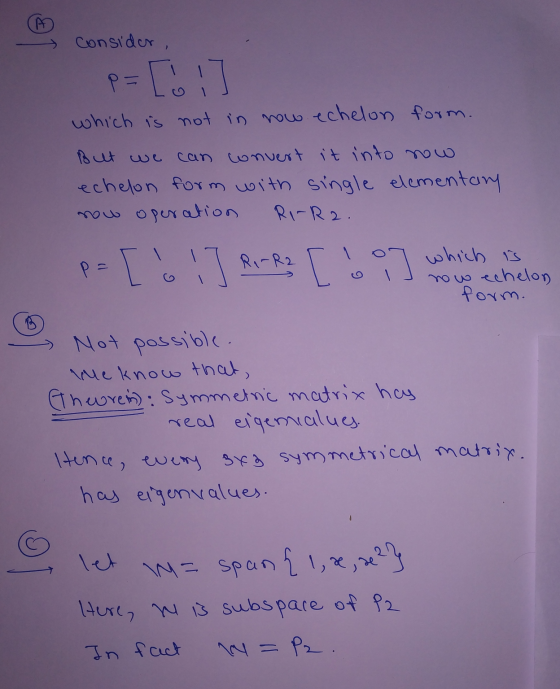
For each question below, show an example or say that it is not possible and justify....
Show an example of a 3 dimensional subspace of P2 (polynomials of degree less than or...
Show an example of a 3 dimensional subspace of P2 (polynomials of degree less than or equal to 2) or show that it is impossible.
Question 4 Solve the system below using an augmented matrix and the method of Gauss reduction...
 Question 4 Solve the system below using an augmented matrix and the method of Gauss reduction Your final matrix must be in row echelon form. Indicate every elementary row operation that you use. + 2y - 52 6 + 3y 2 -X 5y 10z = 6 X
Let p, (t) 6+t, P2(t) =t-3t, p3 (t) = 1 +t-2t. Complete parts (a) and (b) below. Use coordinate vectors to show that th...
 Let p, (t) 6+t, P2(t) =t-3t, p3 (t) = 1 +t-2t. Complete parts (a) and (b) below. Use coordinate vectors to show that these polynomials form a basis for P2. What are the coordinate vectors corresponding to p, p2, and pa? P- Place these coordinate vectors into the columns fa matrix A. What can be said about the matrix A? O A. The matrix A forms a basis for R3 by the Invertible Matrix Theorem because all square matrices are...
Name: PERM: Directions: Read each question carefully and complete the problem. Please justify all of your...
 Name: PERM: Directions: Read each question carefully and complete the problem. Please justify all of your answers and explain your arguments clearly. Answers without justification will not re- ceive credit. and : 1. For parts (a)-(a), consider the following inhomogeneous linear system in variables I, y, 32-6y +9=6 -1 +8y +2 = 8 (a) (2 points) Give the corresponding augmented matrix form of the system. (b) (3 points) Apply elementary row operations to the augmented system until it is in...
Let A and B be nxn matrices. Mark each statement true or false. Justify each answer....
 Let A and B be nxn matrices. Mark each statement true or false. Justify each answer. Complete parts (a) through (d) below. a. The determinant of A is the product of the diagonal entries in A. Select the correct choice below and, if necessary, fill in the answer box to complete your choice. O A. The statement is false because the determinant of the 2x2 matrix A = is not equal to the product of the entries on the main...
Determine if the matrix below is invertible. Use as few calculations as possible. Justify your answer....
 Determine if the matrix below is invertible. Use as few calculations as possible. Justify your answer. 0 3 - 4 0 2 -4 -9 4 Choose the correct answer below. O A. The matrix is not invertible. If the given matrix is A, the equation Ax=b has at least one solution for each b in R3. OB. The matrix is invertible. The given matrix has 3 pivot positions. C. The matrix is invertible. The columns of the given matrix span...
A] Consider the inner product space obtained by equipping ?[0,2] with the inner product given below:...
A] Consider the inner product space obtained by equipping ?[0,2] with the inner product given below: 〈?(?),?(?)〉 = ∫ ?(?)?(?)?? 2 0 Determine the value of each of the following (simplifying where possible; no decimals). You do not have to show the steps of calculating the integrals, but must at least write the integrals used in your calculations. (A.3) ?(??,?? + 10), i.e. the distance between ?? and ?? + 10 . (A.4) Determine the value of ?...
Problem 2: This is a continuation of the above, and I will probably live to regret this question,...
 problem 2: This is a continuation of the above, and I will
probably live to regret this question, because...
Problem 2: This is a continuation of the above, and I will probably live to regret this question, because I am going to ask you to construct examples, which are challenging to grade. To make this work, you need to clearly show everything 1 am asking for. That includes Octave input and output- if there is no clearby labeled input and...
problem 2: This is a continuation of the above, and I will
probably live to regret this question, because...
Problem 2: This is a continuation of the above, and I will probably live to regret this question, because I am going to ask you to construct examples, which are challenging to grade. To make this work, you need to clearly show everything 1 am asking for. That includes Octave input and output- if there is no clearby labeled input and...
[A] Consider the inner product space obtained by equipping ?[0,2] with the inner product given below:...
[A] Consider the inner product space obtained by equipping ?[0,2] with the inner product given below: 〈?(?),?(?)〉 = ∫ ?(?)?(?)?? 2 0 Determine the value of each of the following (simplifying where possible; no decimals). You do not have to show the steps of calculating the integrals, but must at least write the integrals used in your calculations. (A.1) 〈?,1〉 (A.2) ‖ ? − 1 ‖ (A.3) ?(??,?? + 10), i.e. the distance between ?? and ?? +...
[A] Consider the inner product space obtained by equipping ?[0,2] with the inner product given below:...
[A] Consider the inner product space obtained by equipping ?[0,2] with the inner product given below: 〈?(?),?(?)〉 = ∫ ?(?)?(?)?? 2 0 Determine the value of each of the following (simplifying where possible; no decimals). You do not have to show the steps of calculating the integrals, but must at least write the integrals used in your calculations. (A.1) 〈?,1〉 (A.2) ‖ ? − 1 ‖ (A.3) ?(??,?? + 10), i.e. the distance between ?? and ?? +...
 Question 4 Solve the system below using an augmented matrix and the method of Gauss reduction Your final matrix must be in row echelon form. Indicate every elementary row operation that you use. + 2y - 52 6 + 3y 2 -X 5y 10z = 6 X
 Let p, (t) 6+t, P2(t) =t-3t, p3 (t) = 1 +t-2t. Complete parts (a) and (b) below. Use coordinate vectors to show that these polynomials form a basis for P2. What are the coordinate vectors corresponding to p, p2, and pa? P- Place these coordinate vectors into the columns fa matrix A. What can be said about the matrix A? O A. The matrix A forms a basis for R3 by the Invertible Matrix Theorem because all square matrices are...
 Name: PERM: Directions: Read each question carefully and complete the problem. Please justify all of your answers and explain your arguments clearly. Answers without justification will not re- ceive credit. and : 1. For parts (a)-(a), consider the following inhomogeneous linear system in variables I, y, 32-6y +9=6 -1 +8y +2 = 8 (a) (2 points) Give the corresponding augmented matrix form of the system. (b) (3 points) Apply elementary row operations to the augmented system until it is in...
 Let A and B be nxn matrices. Mark each statement true or false. Justify each answer. Complete parts (a) through (d) below. a. The determinant of A is the product of the diagonal entries in A. Select the correct choice below and, if necessary, fill in the answer box to complete your choice. O A. The statement is false because the determinant of the 2x2 matrix A = is not equal to the product of the entries on the main...
 Determine if the matrix below is invertible. Use as few calculations as possible. Justify your answer. 0 3 - 4 0 2 -4 -9 4 Choose the correct answer below. O A. The matrix is not invertible. If the given matrix is A, the equation Ax=b has at least one solution for each b in R3. OB. The matrix is invertible. The given matrix has 3 pivot positions. C. The matrix is invertible. The columns of the given matrix span...
 problem 2: This is a continuation of the above, and I will
probably live to regret this question, because...
Problem 2: This is a continuation of the above, and I will probably live to regret this question, because I am going to ask you to construct examples, which are challenging to grade. To make this work, you need to clearly show everything 1 am asking for. That includes Octave input and output- if there is no clearby labeled input and...
problem 2: This is a continuation of the above, and I will
probably live to regret this question, because...
Problem 2: This is a continuation of the above, and I will probably live to regret this question, because I am going to ask you to construct examples, which are challenging to grade. To make this work, you need to clearly show everything 1 am asking for. That includes Octave input and output- if there is no clearby labeled input and...
Most questions answered within 3 hours.
-
Where is the error in this code sequence?
String s1 = "Hello";
String s2 = "ello";...
asked 10 months ago -
Financial data for Joel de Paris, Inc., for last year
follow:
Joel de Paris, Inc.
Balance...
asked 10 months ago -
Consider this reaction:
Al2(SO4)3 (aq)+ BaCl3
(aq) Al2Cl6 (aq)- +
3BaSO4(s) . What is the...
asked 10 months ago -
Suppose that Savneet is considering increasing her
recent random sample from 20 car rentals to 40...
asked 10 months ago -
Trucks arrive at an unloading terminal at an average rate of 120
per hour.
Trucks arrive...
asked 10 months ago -
Why are methanol and ethanol completely soluble in water while
octanol is not very little soluble....
asked 10 months ago -
A facilities manager at a university reads in a research report
that the mean amount of...
asked 10 months ago -
When the CuSO4 is rehydrated by adding water to the anhydrous
compound, is this an endothermic...
asked 10 months ago -
A ray of sunlight is passing from diamond into crown glass; the
angle of incidence is...
asked 10 months ago -
A block of mass 0.249 kg is placed on top of a light, vertical
spring of...
asked 10 months ago -
how do the kidneys compensate in the presences of acidosis
a) trigger hyperventilate
b) reserve acid...
asked 10 months ago -
Question 501 pts
The rental rate of capital to the firm increases. Which of the
following...
asked 10 months ago