
Homework Answers
Add Answer to:
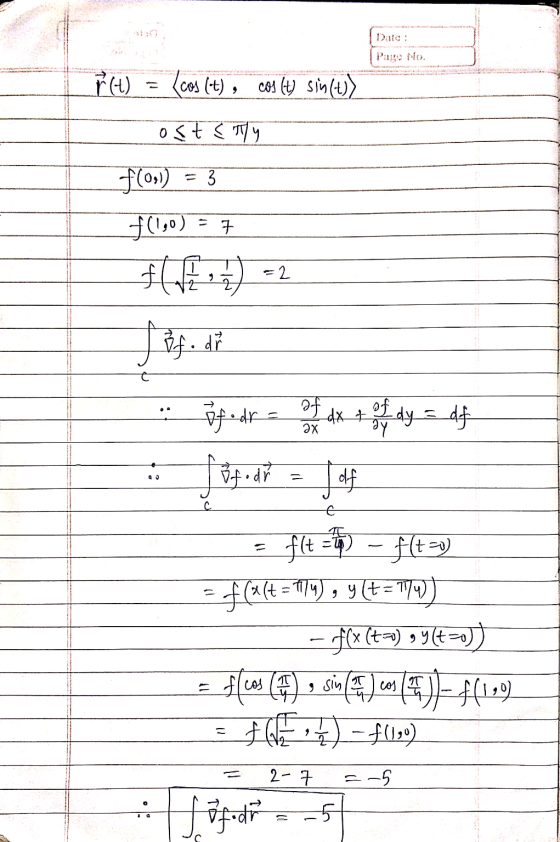
Suppose f(x,y) is such that V f is continuous everywhere. Let C be the smooth curve...
Evaluate the line integral f F dr for the vector field F(x, y, z) curve C...
 Evaluate the line integral f F dr for the vector field F(x, y, z) curve C parametrised by Vf (x, y, z) along the with tE [0, 2 r() -(Vt sin(2πt), t cos (2πi), ?) ,
Evaluate the line integral f F dr for the vector field F(x, y, z) curve C parametrised by Vf (x, y, z) along the with tE [0, 2 r() -(Vt sin(2πt), t cos (2πi), ?) ,
Evaluate the line integral f F dr for the vector field F(x, y, z) curve C parametrised by Vf (x, y, z) along the with tE [0, 2 r() -(Vt sin(2πt), t cos (2πi), ?) ,
Let F(x, y, z) = sin yi + (x cos y + cos z)j – ysin...
 Let F(x, y, z) = sin yi + (x cos y + cos z)j – ysin zk be a vector field in R3. (a) Verify that F is a conservative vector field. (b) Find a potential function f such that F = Vf. (C) Use the fundamental theorem of line integrals to evaluate ScF. dr along the curve C: r(t) = sin ti + tj + 2tk, 0 < t < A/2.
→ (1 point) Let Vf-6xe-r sin(5y) +1 5e* cos(Sy) j. Find the change inf between (0,0) and (1, n/2) in two ways. (a) First, find the change by computing the line integral c Vf di, where C is a curve co...
 → (1 point) Let Vf-6xe-r sin(5y) +1 5e* cos(Sy) j. Find the change inf between (0,0) and (1, n/2) in two ways. (a) First, find the change by computing the line integral c Vf di, where C is a curve connecting (0,0) and (1, π/2) The simplest curve is the line segment joining these points. Parameterize it: with 0 t 1, K) = dt Note that this isn't a very pleasant integral to evaluate by hand (though we could easily...
. Let F(a,y)-(3e +secztan,e -90 (a) Show that F is a conservative. (b) Find a function f (potenti...
 . Let F(a,y)-(3e +secztan,e -90 (a) Show that F is a conservative. (b) Find a function f (potential function) show that F (c) Use above result to evaluate Jc F. V. dr, where C is a smooth curve that begin at the point (2, 1 ) and ends at (0,3). (cos t, sin t) fromtto t particle that moves along the curve. (Write the value of work done without evaluating (d) Find the work done by the force field F(r,...
(1 point) Let Vf =-8xe-r sin(5y) 20e-x. cos(Sy) j. Find the change inf between (0,0) and (1, π/2) in two ways vf . dr, where C is a curve connecting (0,0) and (1.d2). (a) First, find the change by co...
 (1 point) Let Vf =-8xe-r sin(5y) 20e-x. cos(Sy) j. Find the change inf between (0,0) and (1, π/2) in two ways vf . dr, where C is a curve connecting (0,0) and (1.d2). (a) First, find the change by computing the line integral The simplest curve is the line segment joining these points. Parameterize it: with 03t s 1, r(t)- so that Icvf . di- Note that this isn't a very pleasant integral to evaluate by hand (though we could...
11. Show that if F is continuous on Rn and F(X + Y) = F(X) + F(Y) for all X : in R", then A is li...
 Question 12
11. Show that if F is continuous on Rn and F(X + Y) = F(X) + F(Y) for all X : in R", then A is linear. HINT: The rational numbers are dense in the reals. 12. Find F and JF. Then find an affine transformation G such that F(X)-G(Y) lim =0. T x2+y+2z (a) F(x, y,z)coxy. Xo- (1,-1,0) e*yz ex cos y (b) Fe*sin y 1, xo=(0, π/2) 13. Find F. g1 (x)
11. Show that if...
Question 12
11. Show that if F is continuous on Rn and F(X + Y) = F(X) + F(Y) for all X : in R", then A is linear. HINT: The rational numbers are dense in the reals. 12. Find F and JF. Then find an affine transformation G such that F(X)-G(Y) lim =0. T x2+y+2z (a) F(x, y,z)coxy. Xo- (1,-1,0) e*yz ex cos y (b) Fe*sin y 1, xo=(0, π/2) 13. Find F. g1 (x)
11. Show that if...
17 Proposition. Let γ be a rectifiable curve and suppose that f is a function continuous on (y). ...
 17 Proposition. Let γ be a rectifiable curve and suppose that f is a function continuous on (y). Then : 7) sup [lfe): z E (c) If ce C then J,f(z) dz -Jyef(z-c) dz
17 Proposition. Let γ be a rectifiable curve and suppose that f is a function continuous on (y). Then : 7) sup [lfe): z E (c) If ce C then J,f(z) dz -Jyef(z-c) dz
17 Proposition. Let γ be a rectifiable curve and suppose that f is a function continuous on (y). Then : 7) sup [lfe): z E (c) If ce C then J,f(z) dz -Jyef(z-c) dz
Let y: 1 + R2 be a regular parametrised curve which we write as y(t) =...
 Let y: 1 + R2 be a regular parametrised curve which we write as y(t) = (v(t), v(t))" for some smooth maps u,v: 1 R. We assume furthermore that is never equal to zero on I. We define the surface of revolution Exy associated to y as (1) E = {r(t,0) = (v(t) cos(6), y(t) sin(0), v(0))?|tel, 0 € (0,27]} . Below, we consider the chart (U,r) obtained by taking U = I x (0,27), where the map r:U →...
12) Let F(x,y) = yi + x2j. Evaluate Sc F. dr for the parabolic curve C:...
 12) Let F(x,y) = yi + x2j. Evaluate Sc F. dr for the parabolic curve C: r(t) = ti + (4t-t?) Osts 3.
3. Let F(x, y) = (-y, x) and let C be the semicircle with parametrization f(t)...
 3. Let F(x, y) = (-y, x) and let C be the semicircle with parametrization f(t) = (4 cos t, 4 sin t) for 0 <ts. Compute ScF.T ds.
 Evaluate the line integral f F dr for the vector field F(x, y, z) curve C parametrised by Vf (x, y, z) along the with tE [0, 2 r() -(Vt sin(2πt), t cos (2πi), ?) ,
Evaluate the line integral f F dr for the vector field F(x, y, z) curve C parametrised by Vf (x, y, z) along the with tE [0, 2 r() -(Vt sin(2πt), t cos (2πi), ?) ,
Evaluate the line integral f F dr for the vector field F(x, y, z) curve C parametrised by Vf (x, y, z) along the with tE [0, 2 r() -(Vt sin(2πt), t cos (2πi), ?) ,
 Let F(x, y, z) = sin yi + (x cos y + cos z)j – ysin zk be a vector field in R3. (a) Verify that F is a conservative vector field. (b) Find a potential function f such that F = Vf. (C) Use the fundamental theorem of line integrals to evaluate ScF. dr along the curve C: r(t) = sin ti + tj + 2tk, 0 < t < A/2.
 → (1 point) Let Vf-6xe-r sin(5y) +1 5e* cos(Sy) j. Find the change inf between (0,0) and (1, n/2) in two ways. (a) First, find the change by computing the line integral c Vf di, where C is a curve connecting (0,0) and (1, π/2) The simplest curve is the line segment joining these points. Parameterize it: with 0 t 1, K) = dt Note that this isn't a very pleasant integral to evaluate by hand (though we could easily...
 . Let F(a,y)-(3e +secztan,e -90 (a) Show that F is a conservative. (b) Find a function f (potential function) show that F (c) Use above result to evaluate Jc F. V. dr, where C is a smooth curve that begin at the point (2, 1 ) and ends at (0,3). (cos t, sin t) fromtto t particle that moves along the curve. (Write the value of work done without evaluating (d) Find the work done by the force field F(r,...
 (1 point) Let Vf =-8xe-r sin(5y) 20e-x. cos(Sy) j. Find the change inf between (0,0) and (1, π/2) in two ways vf . dr, where C is a curve connecting (0,0) and (1.d2). (a) First, find the change by computing the line integral The simplest curve is the line segment joining these points. Parameterize it: with 03t s 1, r(t)- so that Icvf . di- Note that this isn't a very pleasant integral to evaluate by hand (though we could...
 Question 12
11. Show that if F is continuous on Rn and F(X + Y) = F(X) + F(Y) for all X : in R", then A is linear. HINT: The rational numbers are dense in the reals. 12. Find F and JF. Then find an affine transformation G such that F(X)-G(Y) lim =0. T x2+y+2z (a) F(x, y,z)coxy. Xo- (1,-1,0) e*yz ex cos y (b) Fe*sin y 1, xo=(0, π/2) 13. Find F. g1 (x)
11. Show that if...
Question 12
11. Show that if F is continuous on Rn and F(X + Y) = F(X) + F(Y) for all X : in R", then A is linear. HINT: The rational numbers are dense in the reals. 12. Find F and JF. Then find an affine transformation G such that F(X)-G(Y) lim =0. T x2+y+2z (a) F(x, y,z)coxy. Xo- (1,-1,0) e*yz ex cos y (b) Fe*sin y 1, xo=(0, π/2) 13. Find F. g1 (x)
11. Show that if...
 17 Proposition. Let γ be a rectifiable curve and suppose that f is a function continuous on (y). Then : 7) sup [lfe): z E (c) If ce C then J,f(z) dz -Jyef(z-c) dz
17 Proposition. Let γ be a rectifiable curve and suppose that f is a function continuous on (y). Then : 7) sup [lfe): z E (c) If ce C then J,f(z) dz -Jyef(z-c) dz
17 Proposition. Let γ be a rectifiable curve and suppose that f is a function continuous on (y). Then : 7) sup [lfe): z E (c) If ce C then J,f(z) dz -Jyef(z-c) dz
 Let y: 1 + R2 be a regular parametrised curve which we write as y(t) = (v(t), v(t))" for some smooth maps u,v: 1 R. We assume furthermore that is never equal to zero on I. We define the surface of revolution Exy associated to y as (1) E = {r(t,0) = (v(t) cos(6), y(t) sin(0), v(0))?|tel, 0 € (0,27]} . Below, we consider the chart (U,r) obtained by taking U = I x (0,27), where the map r:U →...
 12) Let F(x,y) = yi + x2j. Evaluate Sc F. dr for the parabolic curve C: r(t) = ti + (4t-t?) Osts 3.
 3. Let F(x, y) = (-y, x) and let C be the semicircle with parametrization f(t) = (4 cos t, 4 sin t) for 0 <ts. Compute ScF.T ds.
Most questions answered within 3 hours.
-
Where is the error in this code sequence?
String s1 = "Hello";
String s2 = "ello";...
asked 11 months ago -
Financial data for Joel de Paris, Inc., for last year
follow:
Joel de Paris, Inc.
Balance...
asked 11 months ago -
Consider this reaction:
Al2(SO4)3 (aq)+ BaCl3
(aq) Al2Cl6 (aq)- +
3BaSO4(s) . What is the...
asked 11 months ago -
Suppose that Savneet is considering increasing her
recent random sample from 20 car rentals to 40...
asked 11 months ago -
Trucks arrive at an unloading terminal at an average rate of 120
per hour.
Trucks arrive...
asked 11 months ago -
Why are methanol and ethanol completely soluble in water while
octanol is not very little soluble....
asked 11 months ago -
A facilities manager at a university reads in a research report
that the mean amount of...
asked 11 months ago -
When the CuSO4 is rehydrated by adding water to the anhydrous
compound, is this an endothermic...
asked 11 months ago -
A ray of sunlight is passing from diamond into crown glass; the
angle of incidence is...
asked 11 months ago -
A block of mass 0.249 kg is placed on top of a light, vertical
spring of...
asked 11 months ago -
how do the kidneys compensate in the presences of acidosis
a) trigger hyperventilate
b) reserve acid...
asked 11 months ago -
Question 501 pts
The rental rate of capital to the firm increases. Which of the
following...
asked 11 months ago