
Homework Answers


Add Answer to:
10,0), ('') and (0,1) 2) Calculate the value of the double integral :) SS itxdA; D...
Q) Calculate ;) SS the value of the double integral triangular region with vertices (0,0), (1,...
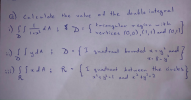 Q) Calculate ;) SS the value of the double integral triangular region with vertices (0,0), (1, 1) and (0,1)) 16. 1} dA 5 & 1 + x2 ;;;) SlxdA ; R R x=8- y² I quadrant between the circles' x² + y² = 1 and x² + y²=2 circles}
1. Use polar coordinates to evaluate the double integral dA z2 +y where R is the...
 1. Use polar coordinates to evaluate the double integral dA z2 +y where R is the region in the first quadrant bounded by the graphs x = 0, y = 1, y=4, and y V3z.
1. Use polar coordinates to evaluate the double integral dA z2 +y where R is the region in the first quadrant bounded by the graphs x = 0, y = 1, y=4, and y V3z.
1. Use polar coordinates to evaluate the double integral dA z2 +y where R is the region in the first quadrant bounded by the graphs x = 0, y = 1, y=4, and y V3z.
need asap Calculate the integral using the type II method after the transformation: I = xy...
 need asap
Calculate the integral using the type II method after the transformation: I = xy dA, where R is the region in the first quadrant bounded by the lines y = x, y = 3x, and the hyperbolas xy = 1, xy = 3. Make the transformation x = u/vand y = v
need asap
Calculate the integral using the type II method after the transformation: I = xy dA, where R is the region in the first quadrant bounded by the lines y = x, y = 3x, and the hyperbolas xy = 1, xy = 3. Make the transformation x = u/vand y = v
Calcule um dado integral colocando-o em coordenadas polares. solve 7,8,9 7)ff D ,x^2 y dA where D...
 Calcule
um dado integral colocando-o em coordenadas polares. solve
7,8,9
7)ff D ,x^2 y dA where D is the upper half of the disc
with center at the origin and radius 5
.
8)ff E (2x-y) dA where R is the region of the first quadrant
bounded by the circuit x ^ 2 + y ^ 2 = 4 and the lines x = 0 and y
= x.
9)ff E sen(x^2+y^2) dA where R is the region of the...
Calcule
um dado integral colocando-o em coordenadas polares. solve
7,8,9
7)ff D ,x^2 y dA where D is the upper half of the disc
with center at the origin and radius 5
.
8)ff E (2x-y) dA where R is the region of the first quadrant
bounded by the circuit x ^ 2 + y ^ 2 = 4 and the lines x = 0 and y
= x.
9)ff E sen(x^2+y^2) dA where R is the region of the...
R is a closed and bounded region in the polar coordinate and it's given by {(x,y): x 0,1 S$2 + y's 49). R 0...
 R is a closed and bounded region in the polar coordinate and it's given by {(x,y): x 0,1 S$2 + y's 49). R 0, y a. Determine the area of R by using double integral in the polar coordinate. Given the surface z - 8xy + 1, determine the volume between the b. surface z and region R by using double integral in the polar coordinate.
R is a closed and bounded region in the polar coordinate and it's given...
R is a closed and bounded region in the polar coordinate and it's given by {(x,y): x 0,1 S$2 + y's 49). R 0, y a. Determine the area of R by using double integral in the polar coordinate. Given the surface z - 8xy + 1, determine the volume between the b. surface z and region R by using double integral in the polar coordinate.
R is a closed and bounded region in the polar coordinate and it's given...
3. Draw the region D and evaluate the double integral using polar coordinates. dA, D= {(x,...
 3. Draw the region D and evaluate the double integral using polar coordinates. dA, D= {(x, y)| x2 + y² <1, x +y > 1} (b) sin(x2 + y2)dA, D is in the third quadrant enclosed by D r? + y2 = 7, x² + y2 = 24, y = 1, y = V3r.
Calculate the integral: I = NSR xy dA, where R is the region in the first...
 Calculate the integral: I = NSR xy dA, where R is the region in the first quadrant bounded by the lines y = x, y = 3x, and the hyperbolas xy = 1, xy = 3. Make the transformation x = u/v and y = v Bonus: If you have done a type I integration, can you give an expression for a type II (no calculation) integral and vice-versa, or can you explain why one integral is preferable over the...
Calculate the integral: I = SSR xy dA, where R is the region in the first...
 Calculate the integral: I = SSR xy dA, where R is the region in the first quadrant bounded by the lines y = x, y = 3x, and the hyperbolas xy = 1, xy = 3. Make the transformation x = u/v and y = v If you have done a type I integration, can you give an expression for a type II (no calculation) integral and vice-versa, or can you explain why one integral is preferable over the other.
3. Evaluate the integral by changing to polar coordinates: SS (x+y) da R Where R is...
 3. Evaluate the integral by changing to polar coordinates: SS (x+y) da R Where R is the region in quadrant 2 above the line y=-x and inside the circle x2 + y2 = 2.
Calculate the integral using the type II method after the transformation: = SSR xy dA, where...
 Calculate the integral using the type II method after the transformation: = SSR xy dA, where R is the region in the first quadrant bounded by the lines y = x, y = 3x, and the hyperbolas xy = 1, xy = 3. Make the transformation x = u/v and y = v
 Q) Calculate ;) SS the value of the double integral triangular region with vertices (0,0), (1, 1) and (0,1)) 16. 1} dA 5 & 1 + x2 ;;;) SlxdA ; R R x=8- y² I quadrant between the circles' x² + y² = 1 and x² + y²=2 circles}
 1. Use polar coordinates to evaluate the double integral dA z2 +y where R is the region in the first quadrant bounded by the graphs x = 0, y = 1, y=4, and y V3z.
1. Use polar coordinates to evaluate the double integral dA z2 +y where R is the region in the first quadrant bounded by the graphs x = 0, y = 1, y=4, and y V3z.
1. Use polar coordinates to evaluate the double integral dA z2 +y where R is the region in the first quadrant bounded by the graphs x = 0, y = 1, y=4, and y V3z.
 need asap
Calculate the integral using the type II method after the transformation: I = xy dA, where R is the region in the first quadrant bounded by the lines y = x, y = 3x, and the hyperbolas xy = 1, xy = 3. Make the transformation x = u/vand y = v
need asap
Calculate the integral using the type II method after the transformation: I = xy dA, where R is the region in the first quadrant bounded by the lines y = x, y = 3x, and the hyperbolas xy = 1, xy = 3. Make the transformation x = u/vand y = v
 Calcule
um dado integral colocando-o em coordenadas polares. solve
7,8,9
7)ff D ,x^2 y dA where D is the upper half of the disc
with center at the origin and radius 5
.
8)ff E (2x-y) dA where R is the region of the first quadrant
bounded by the circuit x ^ 2 + y ^ 2 = 4 and the lines x = 0 and y
= x.
9)ff E sen(x^2+y^2) dA where R is the region of the...
Calcule
um dado integral colocando-o em coordenadas polares. solve
7,8,9
7)ff D ,x^2 y dA where D is the upper half of the disc
with center at the origin and radius 5
.
8)ff E (2x-y) dA where R is the region of the first quadrant
bounded by the circuit x ^ 2 + y ^ 2 = 4 and the lines x = 0 and y
= x.
9)ff E sen(x^2+y^2) dA where R is the region of the...
 R is a closed and bounded region in the polar coordinate and it's given by {(x,y): x 0,1 S$2 + y's 49). R 0, y a. Determine the area of R by using double integral in the polar coordinate. Given the surface z - 8xy + 1, determine the volume between the b. surface z and region R by using double integral in the polar coordinate.
R is a closed and bounded region in the polar coordinate and it's given...
R is a closed and bounded region in the polar coordinate and it's given by {(x,y): x 0,1 S$2 + y's 49). R 0, y a. Determine the area of R by using double integral in the polar coordinate. Given the surface z - 8xy + 1, determine the volume between the b. surface z and region R by using double integral in the polar coordinate.
R is a closed and bounded region in the polar coordinate and it's given...
 3. Draw the region D and evaluate the double integral using polar coordinates. dA, D= {(x, y)| x2 + y² <1, x +y > 1} (b) sin(x2 + y2)dA, D is in the third quadrant enclosed by D r? + y2 = 7, x² + y2 = 24, y = 1, y = V3r.
 Calculate the integral: I = NSR xy dA, where R is the region in the first quadrant bounded by the lines y = x, y = 3x, and the hyperbolas xy = 1, xy = 3. Make the transformation x = u/v and y = v Bonus: If you have done a type I integration, can you give an expression for a type II (no calculation) integral and vice-versa, or can you explain why one integral is preferable over the...
 Calculate the integral: I = SSR xy dA, where R is the region in the first quadrant bounded by the lines y = x, y = 3x, and the hyperbolas xy = 1, xy = 3. Make the transformation x = u/v and y = v If you have done a type I integration, can you give an expression for a type II (no calculation) integral and vice-versa, or can you explain why one integral is preferable over the other.
 3. Evaluate the integral by changing to polar coordinates: SS (x+y) da R Where R is the region in quadrant 2 above the line y=-x and inside the circle x2 + y2 = 2.
 Calculate the integral using the type II method after the transformation: = SSR xy dA, where R is the region in the first quadrant bounded by the lines y = x, y = 3x, and the hyperbolas xy = 1, xy = 3. Make the transformation x = u/v and y = v
Most questions answered within 3 hours.
-
Where is the error in this code sequence?
String s1 = "Hello";
String s2 = "ello";...
asked 11 months ago -
Financial data for Joel de Paris, Inc., for last year
follow:
Joel de Paris, Inc.
Balance...
asked 11 months ago -
Consider this reaction:
Al2(SO4)3 (aq)+ BaCl3
(aq) Al2Cl6 (aq)- +
3BaSO4(s) . What is the...
asked 11 months ago -
Suppose that Savneet is considering increasing her
recent random sample from 20 car rentals to 40...
asked 11 months ago -
Trucks arrive at an unloading terminal at an average rate of 120
per hour.
Trucks arrive...
asked 11 months ago -
Why are methanol and ethanol completely soluble in water while
octanol is not very little soluble....
asked 11 months ago -
A facilities manager at a university reads in a research report
that the mean amount of...
asked 11 months ago -
When the CuSO4 is rehydrated by adding water to the anhydrous
compound, is this an endothermic...
asked 11 months ago -
A ray of sunlight is passing from diamond into crown glass; the
angle of incidence is...
asked 11 months ago -
A block of mass 0.249 kg is placed on top of a light, vertical
spring of...
asked 11 months ago -
how do the kidneys compensate in the presences of acidosis
a) trigger hyperventilate
b) reserve acid...
asked 11 months ago -
Question 501 pts
The rental rate of capital to the firm increases. Which of the
following...
asked 11 months ago