
Homework Answers
Add Answer to:
Match List-I with List-II and select the correct answer: List-I List-II A. Stokes' law 1. Strouhal...
Match List-I with List-II and select the correct answer: List-I List-II A. Stokes' law 1. Strouhal...
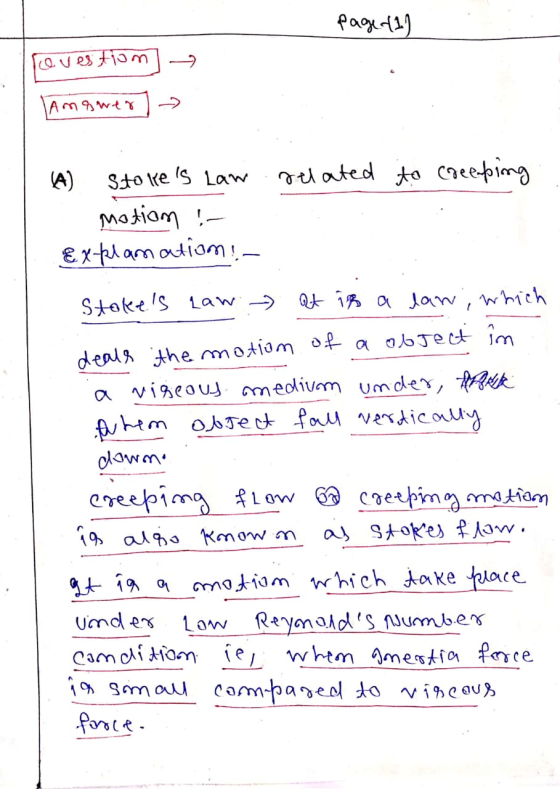
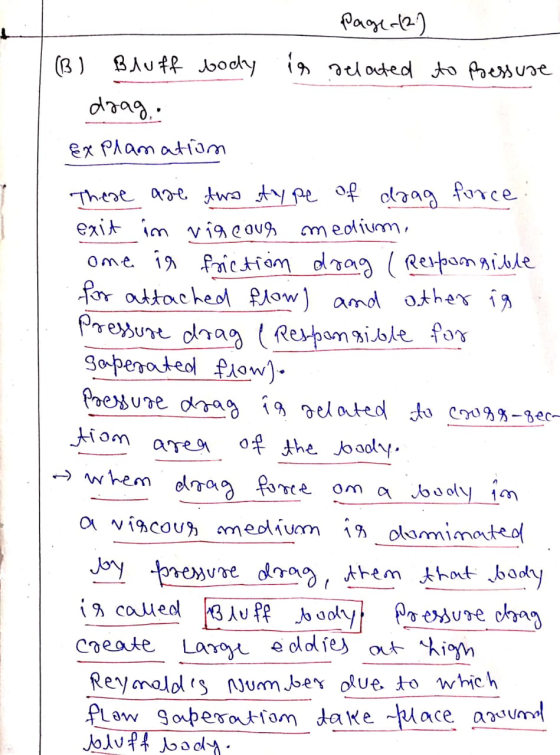
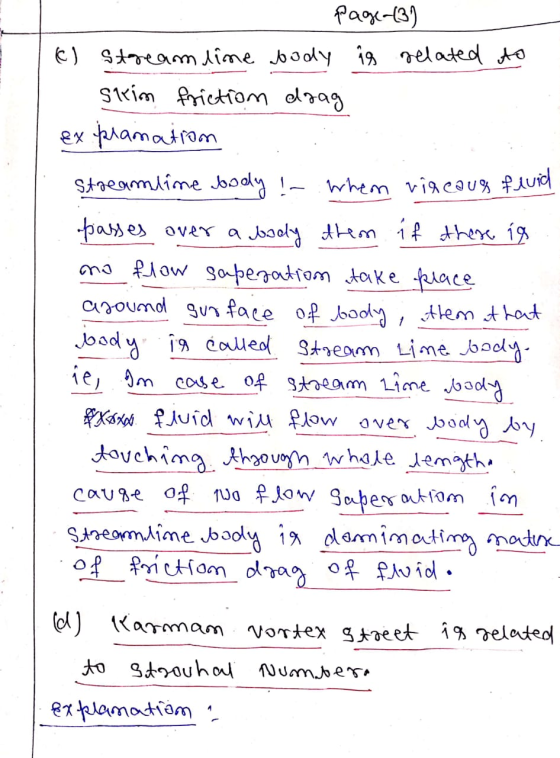
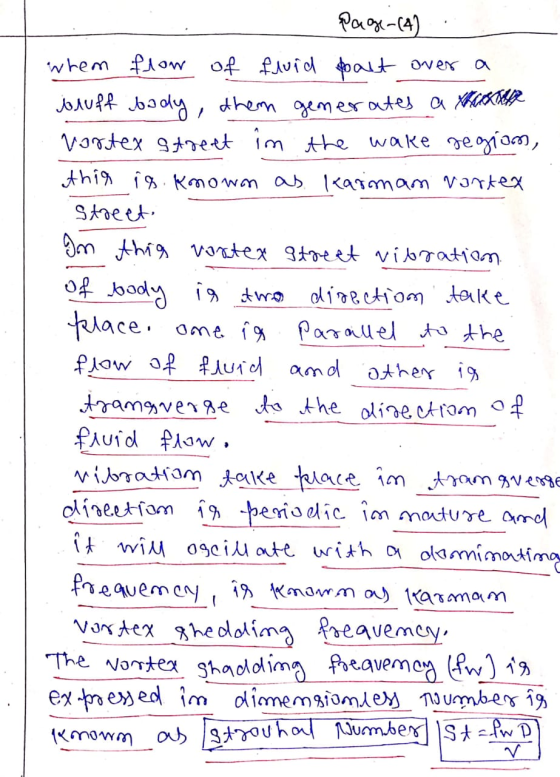
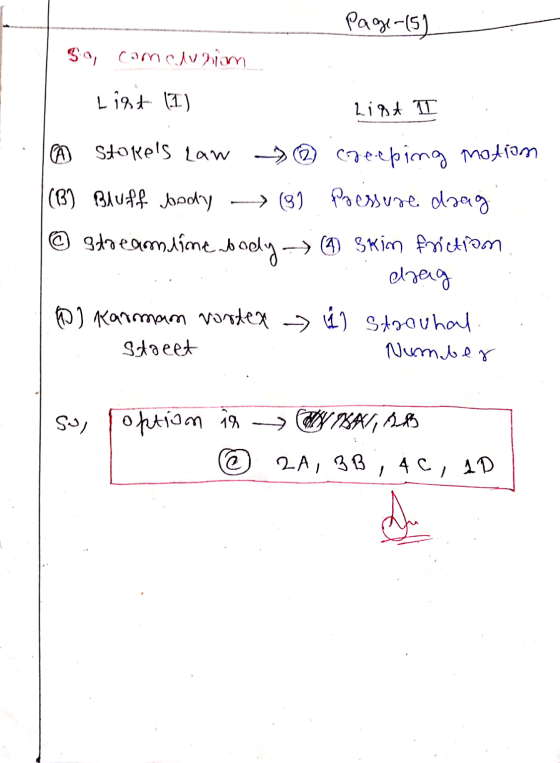
 Match List-I with List-II and select the correct answer: List-I List-II A. Stokes' law 1. Strouhal number B. Bluff body C. Streamline body 2. Creeping motion 3. Pressure drag D. Karman Vortex Street 4. Skin friction drag (a) 2A 3B IC 4D (b) 3A 2B 4C ID (c) 2A 3B 4C ID (d) 3A 2B 1C 4D
Match List-I with List-II and select the correct answer: List-I List-II A. Stokes' law 1. Strouhal...
 Match List-I with List-II and select the correct answer: List-I List-II A. Stokes' law 1. Strouhal number 2. Creeping motion B. Bluff body C. Streamline body 3. Pressure drag D. Karman Vortex Street 4. Skin friction drag (a) 2A 3B 1C 4D (b) 3A 2B 4C ID (c) 2A 3B 4C 1D (d) 3A 2B 1C 4D
4) (1 point) Match List-I with List-II and select the correct answer: List-I List-II A. Stokes'...
 4) (1 point) Match List-I with List-II and select the correct answer: List-I List-II A. Stokes' law 1. Strouhal number B. Bluff body 2. Creeping motion C. Streamline body 3. Pressure drag D. Karman Vortex Street 4. Skin friction drag (a) 2A 3B 1C 4D (b) 3A 2B 4C ID (c) 2A 3B 4C ID (d) 3A 2B 1C 4D
4) (1 point) Match List-I with List-II and select the correct answer: List-I List-II A. Stokes'...
 4) (1 point) Match List-I with List-II and select the correct answer: List-I List-II A. Stokes' law 1. Strouhal number B. Bluff body C. Streamline body 2. Creeping motion 3. Pressure drag 4. Skin friction drag D. Karman Vortex Street (a) 2A 3B 1C 4D (b) 3A 2B 4C ID (c) 2A 3B 4C ID (d) 3A 2B 1C 4D
2) (1 point) Match List-I (Measuring Devices) with List-II (Measured Parameter) and select the correct answer...
 2) (1 point) Match List-I (Measuring Devices) with List-II (Measured Parameter) and select the correct answer using the codes given below: List-I List-II A. Pitot tube 1. Flow static pressure B. Micro-manometer 2. Rate of flow (indirect) C. Pipe band meter 3. Differential pressure D. Wall pressure tap 4. Flow stagnation pressure (a) 1A; 3B; 2C; 4D (b) 4A; 3B; 2C; ID (c) 1A; 2B; 3C; 4D (d) 4A; 2B; 3C; ID
2) (1 point) Match List-I (Measuring Devices) with List-II (Measured Parameter) and select the correct answer...
 2) (1 point) Match List-I (Measuring Devices) with List-II (Measured Parameter) and select the correct answer using the codes given below: List-I List-II A. Pitot tube 1. Flow static pressure B. Micro-manometer 2. Rate of flow (indirect) C. Pipe band meter 3. Differential pressure D. Wall pressure tap 4. Flow stagnation pressure (a) 1A; 3B; 2C; 4D (b) 4A; 3B; 2C; ID (c) 1A; 2B; 3C; 4D (d) 4A, 2B; 3C; ID
Match List-I (Measuring Devices) with List-II (Measured Parameter) and select the correct answer using the codes...
 Match List-I (Measuring Devices) with List-II (Measured Parameter) and select the correct answer using the codes given below: List-I List-II A. Pitot tube 1. Flow static pressure B. Micro-manometer 2. Rate of flow (indirect) C. Pipe band meter 3. Differential pressure D. Wall pressure tap 4. Flow stagnation pressure (a) 1A; 3B; 2C; 4D (b) 4A: 3B; 2C: ID (c) 1A: 2B: 3C; 4D (d) 4A, 2B: 3C, ID
Match List-I (Measuring Devices) with List-II (Measured Parameter) and select the correct answer using the codes...
 Match List-I (Measuring Devices) with List-II (Measured Parameter) and select the correct answer using the codes given below: List-1 List-11 A. Pitot tube 1. Flow static pressure B. Micro-manometer 2. Rate of flow (indirect) C. Pipe band meter 3. Differential pressure D. Wall pressure tap 4. Flow stagnation pressure (a) 1A; 33; 2C; 4D (b) 4A; 33; 2C; ID (c) 1A: 2B; 30, 4D (d) 4A: 2B, 3C, ID
For each pair of transformations "T" and "T-1", find T(T-1(w)) and T-?(T()). Then use T or...
 For each pair of transformations "T" and "T-1", find T(T-1(w)) and T-?(T()). Then use T or F to indicate if these transformations are inverses of one another. 1) Let T(a + bx + cx2 + dx3) = la +16+(-1)c+ld Da +(-1) b+ 1c +(-1)d la + 2b +(-2) c + 3d 0a + 0 + 0c + 1d and T-1 = 1a +06+1c +0d + (4a + (-4) 6+ (-5) c + 3d) x + (-3a +36 +30 + (-2)...
1a. I need ___________mLs? 1b. What syringe syringe/syringe size should I select? _________________ 1c. What is...
 1a. I need ___________mLs?
1b. What syringe syringe/syringe size should I select?
_________________
1c. What is route of administration? _________________
1d. What is the rate of admnistration? _______________
1e. Should I dilute?_______________. If so, how many mLs of
NS?________________. Will I need to transfer into a larger syringe
if dilutent is needed?__________________If so, what syringe size?
__________________
2. Medication Order: Humulin R (Regular insulin) 6 units
subcutaneously now
Medication dispensed: Humulin R (Regular Insulin) 10,000 units/10mL
(100units/mL) vial
2a. I...
1a. I need ___________mLs?
1b. What syringe syringe/syringe size should I select?
_________________
1c. What is route of administration? _________________
1d. What is the rate of admnistration? _______________
1e. Should I dilute?_______________. If so, how many mLs of
NS?________________. Will I need to transfer into a larger syringe
if dilutent is needed?__________________If so, what syringe size?
__________________
2. Medication Order: Humulin R (Regular insulin) 6 units
subcutaneously now
Medication dispensed: Humulin R (Regular Insulin) 10,000 units/10mL
(100units/mL) vial
2a. I...
 Match List-I with List-II and select the correct answer: List-I List-II A. Stokes' law 1. Strouhal number B. Bluff body C. Streamline body 2. Creeping motion 3. Pressure drag D. Karman Vortex Street 4. Skin friction drag (a) 2A 3B IC 4D (b) 3A 2B 4C ID (c) 2A 3B 4C ID (d) 3A 2B 1C 4D
 Match List-I with List-II and select the correct answer: List-I List-II A. Stokes' law 1. Strouhal number 2. Creeping motion B. Bluff body C. Streamline body 3. Pressure drag D. Karman Vortex Street 4. Skin friction drag (a) 2A 3B 1C 4D (b) 3A 2B 4C ID (c) 2A 3B 4C 1D (d) 3A 2B 1C 4D
 4) (1 point) Match List-I with List-II and select the correct answer: List-I List-II A. Stokes' law 1. Strouhal number B. Bluff body 2. Creeping motion C. Streamline body 3. Pressure drag D. Karman Vortex Street 4. Skin friction drag (a) 2A 3B 1C 4D (b) 3A 2B 4C ID (c) 2A 3B 4C ID (d) 3A 2B 1C 4D
 4) (1 point) Match List-I with List-II and select the correct answer: List-I List-II A. Stokes' law 1. Strouhal number B. Bluff body C. Streamline body 2. Creeping motion 3. Pressure drag 4. Skin friction drag D. Karman Vortex Street (a) 2A 3B 1C 4D (b) 3A 2B 4C ID (c) 2A 3B 4C ID (d) 3A 2B 1C 4D
 2) (1 point) Match List-I (Measuring Devices) with List-II (Measured Parameter) and select the correct answer using the codes given below: List-I List-II A. Pitot tube 1. Flow static pressure B. Micro-manometer 2. Rate of flow (indirect) C. Pipe band meter 3. Differential pressure D. Wall pressure tap 4. Flow stagnation pressure (a) 1A; 3B; 2C; 4D (b) 4A; 3B; 2C; ID (c) 1A; 2B; 3C; 4D (d) 4A; 2B; 3C; ID
 2) (1 point) Match List-I (Measuring Devices) with List-II (Measured Parameter) and select the correct answer using the codes given below: List-I List-II A. Pitot tube 1. Flow static pressure B. Micro-manometer 2. Rate of flow (indirect) C. Pipe band meter 3. Differential pressure D. Wall pressure tap 4. Flow stagnation pressure (a) 1A; 3B; 2C; 4D (b) 4A; 3B; 2C; ID (c) 1A; 2B; 3C; 4D (d) 4A, 2B; 3C; ID
 Match List-I (Measuring Devices) with List-II (Measured Parameter) and select the correct answer using the codes given below: List-I List-II A. Pitot tube 1. Flow static pressure B. Micro-manometer 2. Rate of flow (indirect) C. Pipe band meter 3. Differential pressure D. Wall pressure tap 4. Flow stagnation pressure (a) 1A; 3B; 2C; 4D (b) 4A: 3B; 2C: ID (c) 1A: 2B: 3C; 4D (d) 4A, 2B: 3C, ID
 Match List-I (Measuring Devices) with List-II (Measured Parameter) and select the correct answer using the codes given below: List-1 List-11 A. Pitot tube 1. Flow static pressure B. Micro-manometer 2. Rate of flow (indirect) C. Pipe band meter 3. Differential pressure D. Wall pressure tap 4. Flow stagnation pressure (a) 1A; 33; 2C; 4D (b) 4A; 33; 2C; ID (c) 1A: 2B; 30, 4D (d) 4A: 2B, 3C, ID
 For each pair of transformations "T" and "T-1", find T(T-1(w)) and T-?(T()). Then use T or F to indicate if these transformations are inverses of one another. 1) Let T(a + bx + cx2 + dx3) = la +16+(-1)c+ld Da +(-1) b+ 1c +(-1)d la + 2b +(-2) c + 3d 0a + 0 + 0c + 1d and T-1 = 1a +06+1c +0d + (4a + (-4) 6+ (-5) c + 3d) x + (-3a +36 +30 + (-2)...
 1a. I need ___________mLs?
1b. What syringe syringe/syringe size should I select?
_________________
1c. What is route of administration? _________________
1d. What is the rate of admnistration? _______________
1e. Should I dilute?_______________. If so, how many mLs of
NS?________________. Will I need to transfer into a larger syringe
if dilutent is needed?__________________If so, what syringe size?
__________________
2. Medication Order: Humulin R (Regular insulin) 6 units
subcutaneously now
Medication dispensed: Humulin R (Regular Insulin) 10,000 units/10mL
(100units/mL) vial
2a. I...
1a. I need ___________mLs?
1b. What syringe syringe/syringe size should I select?
_________________
1c. What is route of administration? _________________
1d. What is the rate of admnistration? _______________
1e. Should I dilute?_______________. If so, how many mLs of
NS?________________. Will I need to transfer into a larger syringe
if dilutent is needed?__________________If so, what syringe size?
__________________
2. Medication Order: Humulin R (Regular insulin) 6 units
subcutaneously now
Medication dispensed: Humulin R (Regular Insulin) 10,000 units/10mL
(100units/mL) vial
2a. I...
Most questions answered within 3 hours.
-
Where is the error in this code sequence?
String s1 = "Hello";
String s2 = "ello";...
asked 10 months ago -
Financial data for Joel de Paris, Inc., for last year
follow:
Joel de Paris, Inc.
Balance...
asked 10 months ago -
Consider this reaction:
Al2(SO4)3 (aq)+ BaCl3
(aq) Al2Cl6 (aq)- +
3BaSO4(s) . What is the...
asked 10 months ago -
Suppose that Savneet is considering increasing her
recent random sample from 20 car rentals to 40...
asked 10 months ago -
Trucks arrive at an unloading terminal at an average rate of 120
per hour.
Trucks arrive...
asked 10 months ago -
Why are methanol and ethanol completely soluble in water while
octanol is not very little soluble....
asked 10 months ago -
A facilities manager at a university reads in a research report
that the mean amount of...
asked 10 months ago -
When the CuSO4 is rehydrated by adding water to the anhydrous
compound, is this an endothermic...
asked 10 months ago -
A ray of sunlight is passing from diamond into crown glass; the
angle of incidence is...
asked 10 months ago -
A block of mass 0.249 kg is placed on top of a light, vertical
spring of...
asked 10 months ago -
how do the kidneys compensate in the presences of acidosis
a) trigger hyperventilate
b) reserve acid...
asked 10 months ago -
Question 501 pts
The rental rate of capital to the firm increases. Which of the
following...
asked 10 months ago