A ball B is fastened to one end of a 100 cm string and the other...
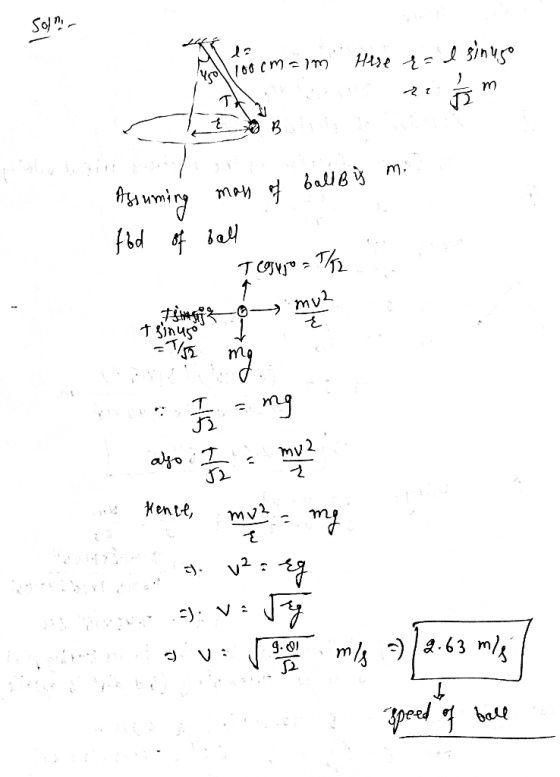
A ball B is fastened to one end of a 100 cm string and the other is held fixed at point O, the ball whirls in the horizontal circle shown. Find the speed of the ball in its circular path if the string makes an angle of 45 degrees to the vertical.
Answer unit in meters
Homework Answers
part 1 of 1 8 points A car is moving at 17 m/s along a curve...
 part 1 of 1 8 points A car is moving at 17 m/s along a curve on a horizontal plane with radius of curvature 46 m. The acceleration of gravity is 9.8. What is the required minimum coefficient of static friction between the road and the car's tires to keep the car from skidding? Question 13 part 1 of 1 8 points A 36 g ball is fastened to one end of a string 79 cm long and the other...
2. A ball tied to the end of a string 65 cm in length swings in...
2. A ball tied to the end of a string 65 cm in length swings in a vertical circle under the influence of gravity. When the string makes an angle of thetha=25 degrees with the vertical, the ball has a speed of 2.0 m/s. a. Find the magnitude and the direction of the total acceleration when thetha=25 degrees.
Please draw the free form diagram and forces if necessary and answer ALL parts A ball...
 Please draw the free form diagram and forces if necessary and
answer ALL parts
A ball of mass Mis attached to one end of a light string of length L. The other end of the string is held fixed and the ball is set in motion in a vertical circle with the string taught. If the ball moves with a constant speed V, find the tension of the string when (a) the string is horizontal (b) the string is vertical...
Please draw the free form diagram and forces if necessary and
answer ALL parts
A ball of mass Mis attached to one end of a light string of length L. The other end of the string is held fixed and the ball is set in motion in a vertical circle with the string taught. If the ball moves with a constant speed V, find the tension of the string when (a) the string is horizontal (b) the string is vertical...
A physics instructor whirls a tennis ball of mass m attached to a string in a...
A physics instructor whirls a tennis ball of mass m attached to a string in a circular path of radius R in horizontal plane over his head. When the ball has a speed s the tension in the string is 10 N. B.) In what direction does the Tension point? Explain. a. tangential to the circular path b. from the center of the circle toward the ball c. from the ball toward the center of the circle
A steel ball of mass 0.440 kg is fastened to a cord that is 38.0 cm...
 A steel ball of mass 0.440 kg is fastened to a cord that is 38.0 cm long and fixed at the far end. The ball is then released when the cord is horizontal, as shown in the figure. At the bottom of its path, the ball strikes a 4.40 kg steel block initially at rest on a frictionless surface. The collision is elastic. Find (a) the speed of the ball and (b) the speed of the block, both just after...
A steel ball of mass 0.630 kg is fastened to a cord that is 39.0 cm...
 A steel ball of mass 0.630 kg is fastened to a cord that is 39.0 cm long and fixed at the far end. The ball is then released when the cord is horizontal, as shown in the figure. At the bottom of its path, the ball strikes a 5.00 kg steel block initially at rest on a frictionless surface. The collision is elastic. Find (a) the speed of the ball and (b) the speed of the block, both just after...
A steel ball of mass 0.470 kg is fastened to a cord that is 92.0 cm long and fixed at the far end. The ball is then rele...
A steel ball of mass 0.470 kg is fastened to a cord that is 92.0 cm long and fixed at the far end. The ball is then released when the cord is horizontal, as shown in the figure. At the bottom of its path, the ball strikes a 2.90 kg steel block initially at rest on a frictionless surface. The collision is elastic. Find (a) the speed of the ball and (b) the speed of the block, both just after...
A steel ball of mass 0.230 kg is fastened to a cord that is 74.0 cm...
A steel ball of mass 0.230 kg is fastened to a cord that is 74.0 cm long and fixed at the far end. The ball is then released when the cord is horizontal, as shown in the figure. At the bottom of its path, the ball strikes a 2.00 kg steel block initially at rest on a frictionless surface. The collision is elastic. Find (a) the speed of the ball and (b) the speed of the block, both just after the collision.
A steel ball of mass 0.790 kg is fastened to a cord that is 99.0 cm...
A steel ball of mass 0.790 kg is fastened to a cord that is 99.0 cm long and fixed at the far end. The ball is then released when the cord is horizontal, as shown in the figure. At the bottom of its path, the ball strikes a 4.90 kg steel block initially at rest on a frictionless surface. The collision is elastic. Find (a) the speed of the ball and (b) the speed of the block, both just after...
A steel ball of mass 0.600 kg is fastened to a cord that is 66.0 cm...
A steel ball of mass 0.600 kg is fastened to a cord that is 66.0 cm long and fixed at the far end. The ball is then released when the cord is horizontal, as shown in the figure. At the bottom of its path, the ball strikes a 4.50 kg steel block initially at rest on a frictionless surface. The collision is elastic. Find (a) the speed of the ball and (b) the speed of the block, both just after...
 part 1 of 1 8 points A car is moving at 17 m/s along a curve on a horizontal plane with radius of curvature 46 m. The acceleration of gravity is 9.8. What is the required minimum coefficient of static friction between the road and the car's tires to keep the car from skidding? Question 13 part 1 of 1 8 points A 36 g ball is fastened to one end of a string 79 cm long and the other...
 A steel ball of mass 0.440 kg is fastened to a cord that is 38.0 cm long and fixed at the far end. The ball is then released when the cord is horizontal, as shown in the figure. At the bottom of its path, the ball strikes a 4.40 kg steel block initially at rest on a frictionless surface. The collision is elastic. Find (a) the speed of the ball and (b) the speed of the block, both just after...
 A steel ball of mass 0.630 kg is fastened to a cord that is 39.0 cm long and fixed at the far end. The ball is then released when the cord is horizontal, as shown in the figure. At the bottom of its path, the ball strikes a 5.00 kg steel block initially at rest on a frictionless surface. The collision is elastic. Find (a) the speed of the ball and (b) the speed of the block, both just after...
Most questions answered within 3 hours.
-
Where is the error in this code sequence?
String s1 = "Hello";
String s2 = "ello";...
asked 11 months ago -
Financial data for Joel de Paris, Inc., for last year
follow:
Joel de Paris, Inc.
Balance...
asked 11 months ago -
Consider this reaction:
Al2(SO4)3 (aq)+ BaCl3
(aq) Al2Cl6 (aq)- +
3BaSO4(s) . What is the...
asked 11 months ago -
Suppose that Savneet is considering increasing her
recent random sample from 20 car rentals to 40...
asked 11 months ago -
Trucks arrive at an unloading terminal at an average rate of 120
per hour.
Trucks arrive...
asked 11 months ago -
Why are methanol and ethanol completely soluble in water while
octanol is not very little soluble....
asked 11 months ago -
A facilities manager at a university reads in a research report
that the mean amount of...
asked 11 months ago -
When the CuSO4 is rehydrated by adding water to the anhydrous
compound, is this an endothermic...
asked 11 months ago -
A ray of sunlight is passing from diamond into crown glass; the
angle of incidence is...
asked 11 months ago -
A block of mass 0.249 kg is placed on top of a light, vertical
spring of...
asked 11 months ago -
how do the kidneys compensate in the presences of acidosis
a) trigger hyperventilate
b) reserve acid...
asked 11 months ago -
Question 501 pts
The rental rate of capital to the firm increases. Which of the
following...
asked 11 months ago