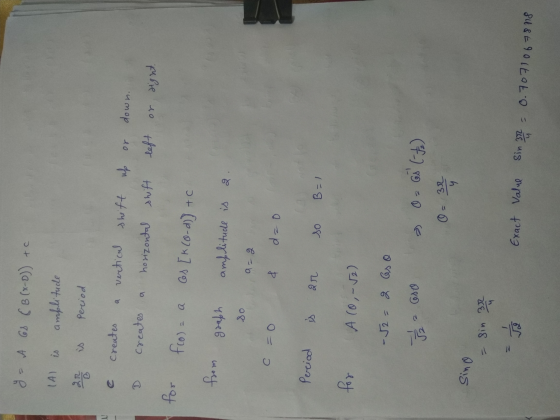
![The graph represents the function f(0) =a cos[k(0-d)]+C. Find the value of 0 in point A, then determine sin 8. Express sin 0](http://img.homeworklib.com/questions/087d2f10-f6f7-11ea-9f71-bf0ed52d3c94.png?x-oss-process=image/resize,w_560)
Homework Answers
Add Answer to:
The graph represents the function f(0) =a cos[k(0-d)]+C. Find the value of 0 in point A,...
QUESTION 12 Use a double-angle or half-angle identity to find the exact value of: cos(0) =...
 QUESTION 12 Use a double-angle or half-angle identity to find the exact value of: cos(0) = and 270° <=< 360°, find sin 5 OAV10 10 B. 10 C. None of these OD 10 3 17 OE 4 QUESTION 13 Use a double-angle or half-angle identity to find the exact value of: 3 sin(0)= and 0° <o<90° , find tan 5 - šar 10 OA. 3 B.V10 Octs OD. -V10 E V30 QUESTION 11 Use a double-angle or half-angle identity to...
(1 point) Sketch the graph of the function K 00 0 Use the graph to express k(t) in terms of shifts of the Heaviside step function h(t). k(t) = (1 point) Sketch the graph of the function K 00 0 U...
 (1 point) Sketch the graph of the function K 00 0 Use the graph to express k(t) in terms of shifts of the Heaviside step function h(t). k(t) =
(1 point) Sketch the graph of the function K 00 0 Use the graph to express k(t) in terms of shifts of the Heaviside step function h(t). k(t) =
(1 point) Sketch the graph of the function K 00 0 Use the graph to express k(t) in terms of shifts of the Heaviside step function h(t). k(t) =
(1 point) Sketch the graph of the function K 00 0 Use the graph to express k(t) in terms of shifts of the Heaviside step function h(t). k(t) = (1 point) Sketch the graph of the function K 00 0 U...
 (1 point) Sketch the graph of the function K 00 0 Use the graph to express k(t) in terms of shifts of the Heaviside step function h(t). k(t) =
(1 point) Sketch the graph of the function K 00 0 Use the graph to express k(t) in terms of shifts of the Heaviside step function h(t). k(t) =
(1 point) Sketch the graph of the function K 00 0 Use the graph to express k(t) in terms of shifts of the Heaviside step function h(t). k(t) =
f(0) = sin (O). g(0) = cos (O). Find the exact value of the function g...
 f(0) = sin (O). g(0) = cos (O). Find the exact value of the function g no(3 if 0 = 300°. Do not use a calculator. Select the correct choice below and fill in any answer boxes within your choice. OA (Simplify your answer. Type an exact answer, using radicals as needed. Use integers or fractions for any numbers in the expression.) O B. The function value is undefined.
2. Consider the function f(x) defined on 0 <x < 2 (see graph (a) Graph the extension of f(x) on the interval (-6,6) that fix) represents the pointwise convergence of the Sine series. At jump di...
 2. Consider the function f(x) defined on 0 <x < 2 (see graph (a) Graph the extension of f(x) on the interval (-6,6) that fix) represents the pointwise convergence of the Sine series. At jump discontinuities, identify the value to which the series converges (b) Derive a general expression for the coefficients in the Fourier Sine series for f(x). Then write out the Fourier series through the first four nonzero terms. Expressions involving sin(nt/2) and cos(nt/2) must be evaluated as...
Given the function value and the quadrant restriction, find θ cos 0-0.6157, interval (180°,270°) (Round to the nearest hundredth as needed.) Enter your answer in the ann Given the function v...
 Given the function value and the quadrant restriction, find θ cos 0-0.6157, interval (180°,270°) (Round to the nearest hundredth as needed.) Enter your answer in the ann
Given the function value and the quadrant restriction, find θ cos 0-0.6157, interval (180°,270°) (Round to the nearest hundredth as needed.) Enter your answer in the ann
Given the function value and the quadrant restriction, find θ cos 0-0.6157, interval (180°,270°) (Round to the nearest hundredth as needed.) Enter your answer in the ann
do question 3 with the info provided f 0 Question 3 Given the graph above represents...
 do question 3 with the info provided
f 0 Question 3 Given the graph above represents a string being plucked at point (g). The wave equation generated when the string is released after being plucked, is given by the wave equation in question 1, and that additionally: 1. u(0, t) 0 u(4, t) 2. u(x, 0) f(x) as in question 2 au 3. atlt-0 Solve wave equation subject to the restrictions above. [10] Question 2 a) In the General Fourier...
do question 3 with the info provided
f 0 Question 3 Given the graph above represents a string being plucked at point (g). The wave equation generated when the string is released after being plucked, is given by the wave equation in question 1, and that additionally: 1. u(0, t) 0 u(4, t) 2. u(x, 0) f(x) as in question 2 au 3. atlt-0 Solve wave equation subject to the restrictions above. [10] Question 2 a) In the General Fourier...
1. Find the Riemann sum for f(x) = cos(z).cos(28) +2 in 1 € (-10,10). Exact solution...
 1. Find the Riemann sum for f(x) = cos(z).cos(28) +2 in 1 € (-10,10). Exact solution is A = 39.12663501441301. (a) Hand calculate the area under the curve using 10 rectangles and mid-point method. Show your work and print the graph using MATLAB built-in function rsums. MATLAB code is given in Appendix. (5 points) (b) Use the same MATLAB code to print the graph with 100 rectangles. Comment on the effect of increasing rectangles on area under the curve (5...
The graph of f is shown to the right. The function F(x) is defined by for . a) Find F(0) and F(3). b) Find F'(1). c) For what value of x does F(x) have its maximum value? What is this maximum val...
 The graph of f is shown to the right. The function F(x) is
defined by
for .
a) Find F(0) and F(3).
b) Find F'(1).
c) For what value of x does F(x) have its maximum value? What is
this maximum value?
d) Sketch a possible graph of F. Do not attempt to find a
formula for F. (You could, but it is more work than necessary.)
We were unable to transcribe this imageWe were unable to transcribe this image9-3....
The graph of f is shown to the right. The function F(x) is
defined by
for .
a) Find F(0) and F(3).
b) Find F'(1).
c) For what value of x does F(x) have its maximum value? What is
this maximum value?
d) Sketch a possible graph of F. Do not attempt to find a
formula for F. (You could, but it is more work than necessary.)
We were unable to transcribe this imageWe were unable to transcribe this image9-3....
The graph of f is shown to the right. The function F(z) is defined by F(z) = f f(t) dt for 0 x 4. a) Find F(0) and F(3). 2 b) Find F (1). c) For what value of z does F(z) have its maximum value? What...
 The graph of f is shown to the right. The function F(z) is defined by F(z) = f f(t) dt for 0 x 4. a) Find F(0) and F(3). 2 b) Find F (1). c) For what value of z does F(z) have its maximum value? What is this maximum value? d) Sketch a possible graph of F. Do not attempt to find a formula for F. (You could, but it is more work than neces- sary.) -1
The graph...
The graph of f is shown to the right. The function F(z) is defined by F(z) = f f(t) dt for 0 x 4. a) Find F(0) and F(3). 2 b) Find F (1). c) For what value of z does F(z) have its maximum value? What is this maximum value? d) Sketch a possible graph of F. Do not attempt to find a formula for F. (You could, but it is more work than neces- sary.) -1
The graph...
 QUESTION 12 Use a double-angle or half-angle identity to find the exact value of: cos(0) = and 270° <=< 360°, find sin 5 OAV10 10 B. 10 C. None of these OD 10 3 17 OE 4 QUESTION 13 Use a double-angle or half-angle identity to find the exact value of: 3 sin(0)= and 0° <o<90° , find tan 5 - šar 10 OA. 3 B.V10 Octs OD. -V10 E V30 QUESTION 11 Use a double-angle or half-angle identity to...
 (1 point) Sketch the graph of the function K 00 0 Use the graph to express k(t) in terms of shifts of the Heaviside step function h(t). k(t) =
(1 point) Sketch the graph of the function K 00 0 Use the graph to express k(t) in terms of shifts of the Heaviside step function h(t). k(t) =
(1 point) Sketch the graph of the function K 00 0 Use the graph to express k(t) in terms of shifts of the Heaviside step function h(t). k(t) =
 (1 point) Sketch the graph of the function K 00 0 Use the graph to express k(t) in terms of shifts of the Heaviside step function h(t). k(t) =
(1 point) Sketch the graph of the function K 00 0 Use the graph to express k(t) in terms of shifts of the Heaviside step function h(t). k(t) =
(1 point) Sketch the graph of the function K 00 0 Use the graph to express k(t) in terms of shifts of the Heaviside step function h(t). k(t) =
 f(0) = sin (O). g(0) = cos (O). Find the exact value of the function g no(3 if 0 = 300°. Do not use a calculator. Select the correct choice below and fill in any answer boxes within your choice. OA (Simplify your answer. Type an exact answer, using radicals as needed. Use integers or fractions for any numbers in the expression.) O B. The function value is undefined.
 2. Consider the function f(x) defined on 0 <x < 2 (see graph (a) Graph the extension of f(x) on the interval (-6,6) that fix) represents the pointwise convergence of the Sine series. At jump discontinuities, identify the value to which the series converges (b) Derive a general expression for the coefficients in the Fourier Sine series for f(x). Then write out the Fourier series through the first four nonzero terms. Expressions involving sin(nt/2) and cos(nt/2) must be evaluated as...
 Given the function value and the quadrant restriction, find θ cos 0-0.6157, interval (180°,270°) (Round to the nearest hundredth as needed.) Enter your answer in the ann
Given the function value and the quadrant restriction, find θ cos 0-0.6157, interval (180°,270°) (Round to the nearest hundredth as needed.) Enter your answer in the ann
Given the function value and the quadrant restriction, find θ cos 0-0.6157, interval (180°,270°) (Round to the nearest hundredth as needed.) Enter your answer in the ann
 do question 3 with the info provided
f 0 Question 3 Given the graph above represents a string being plucked at point (g). The wave equation generated when the string is released after being plucked, is given by the wave equation in question 1, and that additionally: 1. u(0, t) 0 u(4, t) 2. u(x, 0) f(x) as in question 2 au 3. atlt-0 Solve wave equation subject to the restrictions above. [10] Question 2 a) In the General Fourier...
do question 3 with the info provided
f 0 Question 3 Given the graph above represents a string being plucked at point (g). The wave equation generated when the string is released after being plucked, is given by the wave equation in question 1, and that additionally: 1. u(0, t) 0 u(4, t) 2. u(x, 0) f(x) as in question 2 au 3. atlt-0 Solve wave equation subject to the restrictions above. [10] Question 2 a) In the General Fourier...
 1. Find the Riemann sum for f(x) = cos(z).cos(28) +2 in 1 € (-10,10). Exact solution is A = 39.12663501441301. (a) Hand calculate the area under the curve using 10 rectangles and mid-point method. Show your work and print the graph using MATLAB built-in function rsums. MATLAB code is given in Appendix. (5 points) (b) Use the same MATLAB code to print the graph with 100 rectangles. Comment on the effect of increasing rectangles on area under the curve (5...
 The graph of f is shown to the right. The function F(x) is
defined by
for .
a) Find F(0) and F(3).
b) Find F'(1).
c) For what value of x does F(x) have its maximum value? What is
this maximum value?
d) Sketch a possible graph of F. Do not attempt to find a
formula for F. (You could, but it is more work than necessary.)
We were unable to transcribe this imageWe were unable to transcribe this image9-3....
The graph of f is shown to the right. The function F(x) is
defined by
for .
a) Find F(0) and F(3).
b) Find F'(1).
c) For what value of x does F(x) have its maximum value? What is
this maximum value?
d) Sketch a possible graph of F. Do not attempt to find a
formula for F. (You could, but it is more work than necessary.)
We were unable to transcribe this imageWe were unable to transcribe this image9-3....
 The graph of f is shown to the right. The function F(z) is defined by F(z) = f f(t) dt for 0 x 4. a) Find F(0) and F(3). 2 b) Find F (1). c) For what value of z does F(z) have its maximum value? What is this maximum value? d) Sketch a possible graph of F. Do not attempt to find a formula for F. (You could, but it is more work than neces- sary.) -1
The graph...
The graph of f is shown to the right. The function F(z) is defined by F(z) = f f(t) dt for 0 x 4. a) Find F(0) and F(3). 2 b) Find F (1). c) For what value of z does F(z) have its maximum value? What is this maximum value? d) Sketch a possible graph of F. Do not attempt to find a formula for F. (You could, but it is more work than neces- sary.) -1
The graph...
Most questions answered within 3 hours.
-
Where is the error in this code sequence?
String s1 = "Hello";
String s2 = "ello";...
asked 11 months ago -
Financial data for Joel de Paris, Inc., for last year
follow:
Joel de Paris, Inc.
Balance...
asked 11 months ago -
Consider this reaction:
Al2(SO4)3 (aq)+ BaCl3
(aq) Al2Cl6 (aq)- +
3BaSO4(s) . What is the...
asked 11 months ago -
Suppose that Savneet is considering increasing her
recent random sample from 20 car rentals to 40...
asked 11 months ago -
Trucks arrive at an unloading terminal at an average rate of 120
per hour.
Trucks arrive...
asked 11 months ago -
Why are methanol and ethanol completely soluble in water while
octanol is not very little soluble....
asked 11 months ago -
A facilities manager at a university reads in a research report
that the mean amount of...
asked 11 months ago -
When the CuSO4 is rehydrated by adding water to the anhydrous
compound, is this an endothermic...
asked 11 months ago -
A ray of sunlight is passing from diamond into crown glass; the
angle of incidence is...
asked 11 months ago -
A block of mass 0.249 kg is placed on top of a light, vertical
spring of...
asked 11 months ago -
how do the kidneys compensate in the presences of acidosis
a) trigger hyperventilate
b) reserve acid...
asked 11 months ago -
Question 501 pts
The rental rate of capital to the firm increases. Which of the
following...
asked 11 months ago