

Homework Answers

Add Answer to:
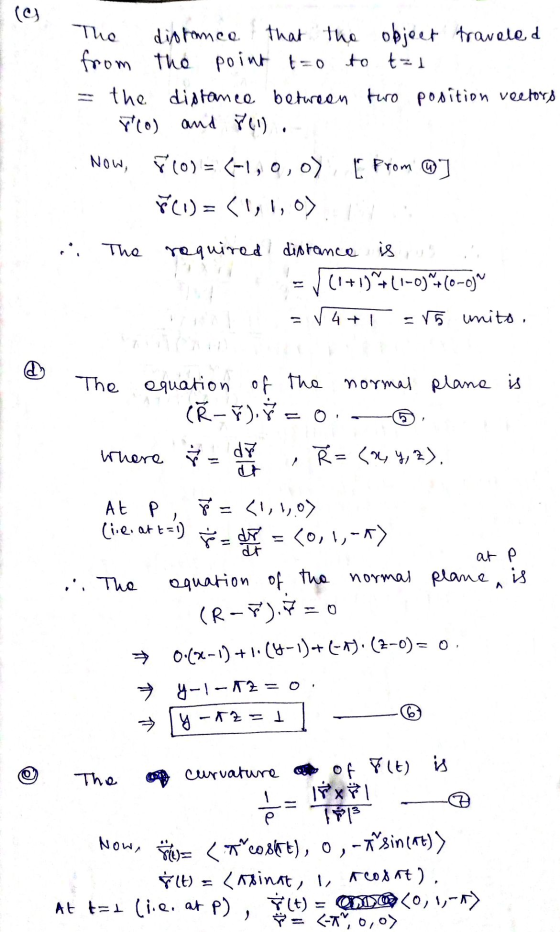
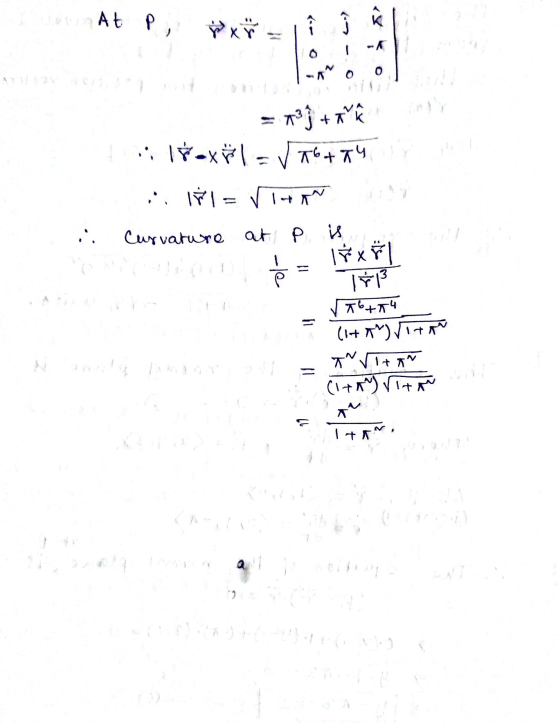
The velocity vector of an object is given by y(t) = (* sin(at), 1, a cos(at))....
- A vector tangent to the parametric curve given by r (t) = <cos (4t); sin...
- A vector tangent to the parametric curve given by r (t) = <cos (4t); sin (4t); e^(t^2)> at the point (0; 1; e^((pi/8)^2)) is a) (0; 1; e^((pi/8)^2)) b) (0; 4; e^((pi/8)^2)) c) (4; 0; e^((pi/8)^2)) d) (4; 4; e^((pi/8)^2)) e) None of the above - The curve c (t) = (cost, sint ,t) lies on which of the following surfaces: (a) cone (b) cylinder (c) sphere (d) plane (e) none of the above
Problem 1: Let F(, y,) be a function given by F(, y, z) (r2+y)e. Let S be the surface in R given ...
 Problem 1: Let F(, y,) be a function given by F(, y, z) (r2+y)e. Let S be the surface in R given by the equation Fr, y, 2) 2. (a) Find an equation of the tangent plane to the surface S at the point p(-1,1,0) (b)Find the directional derivative -1,1,0) of F(,y,2) in the direction of the unit vector u = (ui, t», t's) at the point p(-1,1,0) - In what direction is this derivative maximal? In what direction is...
Consider the surface given as a graph of the function g(x, y) = x∗y 2 ∗cos(y). The gradient of g ...
Consider the surface given as a graph of the function g(x, y) = x∗y 2 ∗cos(y). The gradient of g represents the direction in which g increases the fastest. Notice that this is the direction in the xy plane corresponding to the steepest slope up the surface, with magnitude equal to the slope in that direction. 1. At the point (2, π), find the gradient, and explain what it means. 2. Use it to construct a vector in the tangent...
In a bathtub, the velocity of water near2 the drain is given by the vector field (22 +1)2222 + 1 ...
 Just question 5
Only question 5
In a bathtub, the velocity of water near2 the drain is given by the vector field (22 +1)2222 + 1 where r, y, and z are measured in centimeters and (0, 0,0) is at the center of the drain. 1. Rewriting F as follows, describe in words how the water is moving: Consider each of the three terms in equation (4). (Look at some plots.) For fixed z, what is the flow like? How...
Just question 5
Only question 5
In a bathtub, the velocity of water near2 the drain is given by the vector field (22 +1)2222 + 1 where r, y, and z are measured in centimeters and (0, 0,0) is at the center of the drain. 1. Rewriting F as follows, describe in words how the water is moving: Consider each of the three terms in equation (4). (Look at some plots.) For fixed z, what is the flow like? How...
In a bathtub, the velocity of water near2 the drain is given by the vector field (22 +1)2222 + 1 ...
 Just question 6 Question 5
In a bathtub, the velocity of water near2 the drain is given by the vector field (22 +1)2222 + 1 where r, y, and z are measured in centimeters and (0, 0,0) is at the center of the drain. 1. Rewriting F as follows, describe in words how the water is moving: Consider each of the three terms in equation (4). (Look at some plots.) For fixed z, what is the flow like? How does the flow change...
Question 5
In a bathtub, the velocity of water near2 the drain is given by the vector field (22 +1)2222 + 1 where r, y, and z are measured in centimeters and (0, 0,0) is at the center of the drain. 1. Rewriting F as follows, describe in words how the water is moving: Consider each of the three terms in equation (4). (Look at some plots.) For fixed z, what is the flow like? How does the flow change...
The curvature of vector-valued functions theoretical Someone, please help! 2. The curvature of a vector-valued function r(t) is given by n(t) r (t) (a) If a circle of radius a is given by r(t) (a cos...
 The curvature of vector-valued functions theoretical
Someone, please help!
2. The curvature of a vector-valued function r(t) is given by n(t) r (t) (a) If a circle of radius a is given by r(t) (a cos t, a sin t), show that the curvature is n(t) = (b) Recall that the tangent line to a curve at a point can be thought of as the best approx- imation of the curve by a line at that point. Similarly, we can...
The curvature of vector-valued functions theoretical
Someone, please help!
2. The curvature of a vector-valued function r(t) is given by n(t) r (t) (a) If a circle of radius a is given by r(t) (a cos t, a sin t), show that the curvature is n(t) = (b) Recall that the tangent line to a curve at a point can be thought of as the best approx- imation of the curve by a line at that point. Similarly, we can...
you can skip question 1 Sketch the graph of x(t) sin(2t), y(t) = (t + sin(2t))...
 you can skip question 1
Sketch the graph of x(t) sin(2t), y(t) = (t + sin(2t)) and find the coordinates of the points on the graph where the tangent is horizontal or vertical (please specify), then compute the second derivative and discuss the concavity of the graph. 1. Show that the surface area generated by rotating, about the polar axis, the graph of the curve 2. f(0),0 s asesbsnis S = 2nf(0)sin(0) J(50)) + (r°(®)*)de Find an equation, in both...
you can skip question 1
Sketch the graph of x(t) sin(2t), y(t) = (t + sin(2t)) and find the coordinates of the points on the graph where the tangent is horizontal or vertical (please specify), then compute the second derivative and discuss the concavity of the graph. 1. Show that the surface area generated by rotating, about the polar axis, the graph of the curve 2. f(0),0 s asesbsnis S = 2nf(0)sin(0) J(50)) + (r°(®)*)de Find an equation, in both...
Prove the arithmetic properties of the Cross Product 1. 2. a. Line L1 is parallel to the vector u...
 please answer question 4-7
Prove the arithmetic properties of the Cross Product 1. 2. a. Line L1 is parallel to the vector u Si+j, line L2 is parallel to the vector u-3i +4j and both lines pass through point P(-1,-2). Determine the parametric equations for line L1 and Lz b. Given line L:x(t)-2t+8,y(t)-10-3t. Does L and Ls has common 3. a. Find the equation of the plane A that pass through point P(3,-2,0) with b. Given A2 be the plane...
please answer question 4-7
Prove the arithmetic properties of the Cross Product 1. 2. a. Line L1 is parallel to the vector u Si+j, line L2 is parallel to the vector u-3i +4j and both lines pass through point P(-1,-2). Determine the parametric equations for line L1 and Lz b. Given line L:x(t)-2t+8,y(t)-10-3t. Does L and Ls has common 3. a. Find the equation of the plane A that pass through point P(3,-2,0) with b. Given A2 be the plane...
A detailed explanation would be highly appreciated Question 2 25 (2.1) Consider the vector function C...
 A detailed explanation would be highly appreciated
Question 2 25 (2.1) Consider the vector function C defined by r(t)-ti+2 j. (a) Find the unit tangent, the unit normal and binormal veetors T(t). N(t) and B(t) for C. (6) (b) Find an equation for the normal plane of C at the point (1, 2) (3) (c) Find an equation for the osculating cirele of Gat the turning point of C. (4) (2.2) Reparametrize the curve r(t) (e ,V2t , e) with...
A detailed explanation would be highly appreciated
Question 2 25 (2.1) Consider the vector function C defined by r(t)-ti+2 j. (a) Find the unit tangent, the unit normal and binormal veetors T(t). N(t) and B(t) for C. (6) (b) Find an equation for the normal plane of C at the point (1, 2) (3) (c) Find an equation for the osculating cirele of Gat the turning point of C. (4) (2.2) Reparametrize the curve r(t) (e ,V2t , e) with...
 Problem 1: Let F(, y,) be a function given by F(, y, z) (r2+y)e. Let S be the surface in R given by the equation Fr, y, 2) 2. (a) Find an equation of the tangent plane to the surface S at the point p(-1,1,0) (b)Find the directional derivative -1,1,0) of F(,y,2) in the direction of the unit vector u = (ui, t», t's) at the point p(-1,1,0) - In what direction is this derivative maximal? In what direction is...
 Just question 5
Only question 5
In a bathtub, the velocity of water near2 the drain is given by the vector field (22 +1)2222 + 1 where r, y, and z are measured in centimeters and (0, 0,0) is at the center of the drain. 1. Rewriting F as follows, describe in words how the water is moving: Consider each of the three terms in equation (4). (Look at some plots.) For fixed z, what is the flow like? How...
Just question 5
Only question 5
In a bathtub, the velocity of water near2 the drain is given by the vector field (22 +1)2222 + 1 where r, y, and z are measured in centimeters and (0, 0,0) is at the center of the drain. 1. Rewriting F as follows, describe in words how the water is moving: Consider each of the three terms in equation (4). (Look at some plots.) For fixed z, what is the flow like? How...
 Just question 6 Question 5
In a bathtub, the velocity of water near2 the drain is given by the vector field (22 +1)2222 + 1 where r, y, and z are measured in centimeters and (0, 0,0) is at the center of the drain. 1. Rewriting F as follows, describe in words how the water is moving: Consider each of the three terms in equation (4). (Look at some plots.) For fixed z, what is the flow like? How does the flow change...
Question 5
In a bathtub, the velocity of water near2 the drain is given by the vector field (22 +1)2222 + 1 where r, y, and z are measured in centimeters and (0, 0,0) is at the center of the drain. 1. Rewriting F as follows, describe in words how the water is moving: Consider each of the three terms in equation (4). (Look at some plots.) For fixed z, what is the flow like? How does the flow change...
 The curvature of vector-valued functions theoretical
Someone, please help!
2. The curvature of a vector-valued function r(t) is given by n(t) r (t) (a) If a circle of radius a is given by r(t) (a cos t, a sin t), show that the curvature is n(t) = (b) Recall that the tangent line to a curve at a point can be thought of as the best approx- imation of the curve by a line at that point. Similarly, we can...
The curvature of vector-valued functions theoretical
Someone, please help!
2. The curvature of a vector-valued function r(t) is given by n(t) r (t) (a) If a circle of radius a is given by r(t) (a cos t, a sin t), show that the curvature is n(t) = (b) Recall that the tangent line to a curve at a point can be thought of as the best approx- imation of the curve by a line at that point. Similarly, we can...
 you can skip question 1
Sketch the graph of x(t) sin(2t), y(t) = (t + sin(2t)) and find the coordinates of the points on the graph where the tangent is horizontal or vertical (please specify), then compute the second derivative and discuss the concavity of the graph. 1. Show that the surface area generated by rotating, about the polar axis, the graph of the curve 2. f(0),0 s asesbsnis S = 2nf(0)sin(0) J(50)) + (r°(®)*)de Find an equation, in both...
you can skip question 1
Sketch the graph of x(t) sin(2t), y(t) = (t + sin(2t)) and find the coordinates of the points on the graph where the tangent is horizontal or vertical (please specify), then compute the second derivative and discuss the concavity of the graph. 1. Show that the surface area generated by rotating, about the polar axis, the graph of the curve 2. f(0),0 s asesbsnis S = 2nf(0)sin(0) J(50)) + (r°(®)*)de Find an equation, in both...
 please answer question 4-7
Prove the arithmetic properties of the Cross Product 1. 2. a. Line L1 is parallel to the vector u Si+j, line L2 is parallel to the vector u-3i +4j and both lines pass through point P(-1,-2). Determine the parametric equations for line L1 and Lz b. Given line L:x(t)-2t+8,y(t)-10-3t. Does L and Ls has common 3. a. Find the equation of the plane A that pass through point P(3,-2,0) with b. Given A2 be the plane...
please answer question 4-7
Prove the arithmetic properties of the Cross Product 1. 2. a. Line L1 is parallel to the vector u Si+j, line L2 is parallel to the vector u-3i +4j and both lines pass through point P(-1,-2). Determine the parametric equations for line L1 and Lz b. Given line L:x(t)-2t+8,y(t)-10-3t. Does L and Ls has common 3. a. Find the equation of the plane A that pass through point P(3,-2,0) with b. Given A2 be the plane...
 A detailed explanation would be highly appreciated
Question 2 25 (2.1) Consider the vector function C defined by r(t)-ti+2 j. (a) Find the unit tangent, the unit normal and binormal veetors T(t). N(t) and B(t) for C. (6) (b) Find an equation for the normal plane of C at the point (1, 2) (3) (c) Find an equation for the osculating cirele of Gat the turning point of C. (4) (2.2) Reparametrize the curve r(t) (e ,V2t , e) with...
A detailed explanation would be highly appreciated
Question 2 25 (2.1) Consider the vector function C defined by r(t)-ti+2 j. (a) Find the unit tangent, the unit normal and binormal veetors T(t). N(t) and B(t) for C. (6) (b) Find an equation for the normal plane of C at the point (1, 2) (3) (c) Find an equation for the osculating cirele of Gat the turning point of C. (4) (2.2) Reparametrize the curve r(t) (e ,V2t , e) with...
Most questions answered within 3 hours.
-
Where is the error in this code sequence?
String s1 = "Hello";
String s2 = "ello";...
asked 11 months ago -
Financial data for Joel de Paris, Inc., for last year
follow:
Joel de Paris, Inc.
Balance...
asked 11 months ago -
Consider this reaction:
Al2(SO4)3 (aq)+ BaCl3
(aq) Al2Cl6 (aq)- +
3BaSO4(s) . What is the...
asked 11 months ago -
Suppose that Savneet is considering increasing her
recent random sample from 20 car rentals to 40...
asked 11 months ago -
Trucks arrive at an unloading terminal at an average rate of 120
per hour.
Trucks arrive...
asked 11 months ago -
Why are methanol and ethanol completely soluble in water while
octanol is not very little soluble....
asked 11 months ago -
A facilities manager at a university reads in a research report
that the mean amount of...
asked 11 months ago -
When the CuSO4 is rehydrated by adding water to the anhydrous
compound, is this an endothermic...
asked 11 months ago -
A ray of sunlight is passing from diamond into crown glass; the
angle of incidence is...
asked 11 months ago -
A block of mass 0.249 kg is placed on top of a light, vertical
spring of...
asked 11 months ago -
how do the kidneys compensate in the presences of acidosis
a) trigger hyperventilate
b) reserve acid...
asked 11 months ago -
Question 501 pts
The rental rate of capital to the firm increases. Which of the
following...
asked 11 months ago