
Homework Answers
Let 
(a) 


ANSWER: 
(b) Let  be the circle
  in
in  -plane, oriented clockwise. So,
is a closed path in
-plane.
-plane, oriented clockwise. So,
is a closed path in
-plane.
By Stoke's theorem,  since
where
since
where  is the surface on
-plane bounded by the circle
.
is the surface on
-plane bounded by the circle
.
(c) Let
be any closed curve in
-plane. Again by Stoke's theorem
since
where
is the surface bounded by the closed curve
.
(d) Let
be the half-circle
in
-plane with  , transversed from
  to
to  . Let's first draw
and show it's direction/orientation.
. Let's first draw
and show it's direction/orientation.

Now, let  denotes the line joining the endpoints of
i.e.
and
, traversed from
to
.
denotes the line joining the endpoints of
i.e.
and
, traversed from
to
.
In other words 

Let's plot draw in on the graph.

Now, observe
and
together constitute a closed curve on
-plane traversing counter clockwise. We call  .
.
From the part (c), we know that  as
as  is a closed curve.
Now, 


So if we can compute  , we can get
  . So, let's find
.
. So, let's find
.
By definition,  where
and
where
and 
So,  and
and  .
.
Thus 


Hence, 


So, from  we get,
ANSWER: 
(1 point) Let +4z + 4 sin (a) Find curl F. curl F- (b) What does your answer to part (a) tell you...
 (1 point) Let +4z + 4 sin (a) Find curl F. curl F- (b) What does your answer to part (a) tell you about JcF dr where C is the circle (x 30)2 + (y - 10)2 1 in the xy-plane, oriented clockwise? (e) If C is any closed curve, what can you say about fcFdr? (d) Now let C be the half circle (-30)2-cy-10)2-1 in the xy-plane with y 10, traversed from (31, 10) to (29, 10). Find F...
Assignment 5: Problem 8 Previous Problem List Next (1 point) Let F = (7z+ 7x®) i...
 Assignment 5: Problem 8 Previous Problem List Next (1 point) Let F = (7z+ 7x®) i + (7y + 3z + 3 sin(y)); + (7x + 3y + 7e3") ** (a) Find curl FC curl F (b) What does your answer to part (a) tell you about ScF. dr where C is the circle (x - 15)2 + (y – 25)2 = 1 in the xy-plane, oriented clockwise? (F. dr = (C) If C is any closed curve, what can...
Let F(x, y, z) = (2xsin(ay) - e3z)i + 2x+cos(2y)j + bre3zk. a) Find the values...
 Let F(x, y, z) = (2xsin(ay) - e3z)i + 2x+cos(2y)j + bre3zk. a) Find the values of a, b such that the vector field is conservative. b) Evaluate ScF. dr where C is the curve from (1,0,0) and (3, 5, 1)
Suppose F = (y + 4x, 3x + 2z, 9y + 2x) and S is a...
 Suppose F = (y + 4x, 3x + 2z, 9y + 2x) and S is a surface bounded by C, a circle with radius 3, center at (3,0,0), in the plane x = 3, and oriented counterclockwise as viewed from the origin (0,0,0). Find the flux of curl(F) across S and then evaluate the circulation $cF. dr.
Let S be the surface of z= 9 – 2x2 – 2y which is above the...
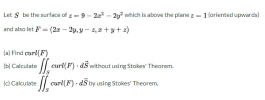 Let S be the surface of z= 9 – 2x2 – 2y which is above the plane z = 1 (oriented upwards) and also let F = (2x – 2y, y - 2,2+y+z) (a) Find curl(F) (b) Calculate Il curl(F) . 15 without using Stokes' Theorem. Il curl(F) . dſ by using Stokes' Theorem (c) Calculate
(1 point) For each of the following vector fields F, decide whether it is conservative or...
 (1 point) For each of the following vector fields F, decide whether it is conservative or not by computing the appropriate first order partial derivatives. Type in a potential function f (that is, V f = F) with f(0,0) = 0. If it is not conservative, type N. A. F(x, y) = (-6x - y)i + (-x + 14y)j f (x, y) = B. F(x, y) = -3yi – 2xj f (x, y) = C. F(x, y) = (-3 sin...
(c) Let F be the vector field on R given by F(x, y, z) = (2x...
 (c) Let F be the vector field on R given by F(x, y, z) = (2x +3y, z, 3y + z). (i) Calculate the divergence of F and the curl of F (ii) Let V be the region in IR enclosed by the plane I +2y +z S denote the closed surface that is the boundary of this region V. Sketch a picture of V and S. Then, using the Divergence Theorem, or otherwise, calculate 3 and the XY, YZ...
(1 point) Consider the vector field F(x, y, z) = (2z + 3y)i + (2z +...
 (1 point) Consider the vector field F(x, y, z) = (2z + 3y)i + (2z + 3x)j + (2y + 2x)k. a) Find a function f such that F = Vf and f(0,0,0) = 0. f(x, y, z) = b) Suppose C is any curve from (0,0,0) to (1,1,1). Use part a) to compute the line integral / F. dr. (1 point) Verify that F = V and evaluate the line integral of F over the given path: F =...
Let ?⃗ =(5z+5x^3)i+(6?+7?+7sin(?^3))j+(5?+7?+6?^(?3))k (a) Find curl ?⃗ curl ?⃗ = (b) What does your answer to...
Let ?⃗ =(5z+5x^3)i+(6?+7?+7sin(?^3))j+(5?+7?+6?^(?3))k (a) Find curl ?⃗ curl ?⃗ = (b) What does your answer to part (a) tell you about ∫??⃗ ⋅??⃗ where C is the circle (?−25)^2+(?−30)^2=1 in the xy-plane, oriented clockwise? ∫??⃗ ⋅??⃗ =∫CF→⋅dr→= (c) If C is any closed curve, what can you say about ∫C ?⃗ ⋅??⃗ ? ∫C ?⃗ ⋅??⃗ = d. Now let ? be the half circle (?−25)^2+(?−30)^2=1 in the ??-plane with ?>30, traversed from (26,30) to (24,30). Find ∫C ?⃗ ⋅??⃗ by...
(a) Find curl F curl F (b) What does your answer to part (a) tell you...
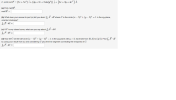 (a) Find curl F curl F (b) What does your answer to part (a) tell you aboFwhere C is the circle (a 5)2(5) in the ry-plane, oriented clockwise? e) It C is any closed curve, what can you say about Jc F.r (d) Now let C be the half circle (5)2 5)2 in the zy-plane with y 5, traversed from (6,5) to (4,5). Find JF dr by using your result from (c) and considering C plus the line segment connecting...
 (1 point) Let +4z + 4 sin (a) Find curl F. curl F- (b) What does your answer to part (a) tell you about JcF dr where C is the circle (x 30)2 + (y - 10)2 1 in the xy-plane, oriented clockwise? (e) If C is any closed curve, what can you say about fcFdr? (d) Now let C be the half circle (-30)2-cy-10)2-1 in the xy-plane with y 10, traversed from (31, 10) to (29, 10). Find F...
 Assignment 5: Problem 8 Previous Problem List Next (1 point) Let F = (7z+ 7x®) i + (7y + 3z + 3 sin(y)); + (7x + 3y + 7e3") ** (a) Find curl FC curl F (b) What does your answer to part (a) tell you about ScF. dr where C is the circle (x - 15)2 + (y – 25)2 = 1 in the xy-plane, oriented clockwise? (F. dr = (C) If C is any closed curve, what can...
 Let F(x, y, z) = (2xsin(ay) - e3z)i + 2x+cos(2y)j + bre3zk. a) Find the values of a, b such that the vector field is conservative. b) Evaluate ScF. dr where C is the curve from (1,0,0) and (3, 5, 1)
 Suppose F = (y + 4x, 3x + 2z, 9y + 2x) and S is a surface bounded by C, a circle with radius 3, center at (3,0,0), in the plane x = 3, and oriented counterclockwise as viewed from the origin (0,0,0). Find the flux of curl(F) across S and then evaluate the circulation $cF. dr.
 Let S be the surface of z= 9 – 2x2 – 2y which is above the plane z = 1 (oriented upwards) and also let F = (2x – 2y, y - 2,2+y+z) (a) Find curl(F) (b) Calculate Il curl(F) . 15 without using Stokes' Theorem. Il curl(F) . dſ by using Stokes' Theorem (c) Calculate
 (1 point) For each of the following vector fields F, decide whether it is conservative or not by computing the appropriate first order partial derivatives. Type in a potential function f (that is, V f = F) with f(0,0) = 0. If it is not conservative, type N. A. F(x, y) = (-6x - y)i + (-x + 14y)j f (x, y) = B. F(x, y) = -3yi – 2xj f (x, y) = C. F(x, y) = (-3 sin...
 (c) Let F be the vector field on R given by F(x, y, z) = (2x +3y, z, 3y + z). (i) Calculate the divergence of F and the curl of F (ii) Let V be the region in IR enclosed by the plane I +2y +z S denote the closed surface that is the boundary of this region V. Sketch a picture of V and S. Then, using the Divergence Theorem, or otherwise, calculate 3 and the XY, YZ...
 (1 point) Consider the vector field F(x, y, z) = (2z + 3y)i + (2z + 3x)j + (2y + 2x)k. a) Find a function f such that F = Vf and f(0,0,0) = 0. f(x, y, z) = b) Suppose C is any curve from (0,0,0) to (1,1,1). Use part a) to compute the line integral / F. dr. (1 point) Verify that F = V and evaluate the line integral of F over the given path: F =...
 (a) Find curl F curl F (b) What does your answer to part (a) tell you aboFwhere C is the circle (a 5)2(5) in the ry-plane, oriented clockwise? e) It C is any closed curve, what can you say about Jc F.r (d) Now let C be the half circle (5)2 5)2 in the zy-plane with y 5, traversed from (6,5) to (4,5). Find JF dr by using your result from (c) and considering C plus the line segment connecting...
Most questions answered within 3 hours.
-
Where is the error in this code sequence?
String s1 = "Hello";
String s2 = "ello";...
asked 11 months ago -
Financial data for Joel de Paris, Inc., for last year
follow:
Joel de Paris, Inc.
Balance...
asked 11 months ago -
Consider this reaction:
Al2(SO4)3 (aq)+ BaCl3
(aq) Al2Cl6 (aq)- +
3BaSO4(s) . What is the...
asked 11 months ago -
Suppose that Savneet is considering increasing her
recent random sample from 20 car rentals to 40...
asked 11 months ago -
Trucks arrive at an unloading terminal at an average rate of 120
per hour.
Trucks arrive...
asked 11 months ago -
Why are methanol and ethanol completely soluble in water while
octanol is not very little soluble....
asked 11 months ago -
A facilities manager at a university reads in a research report
that the mean amount of...
asked 11 months ago -
When the CuSO4 is rehydrated by adding water to the anhydrous
compound, is this an endothermic...
asked 11 months ago -
A ray of sunlight is passing from diamond into crown glass; the
angle of incidence is...
asked 11 months ago -
A block of mass 0.249 kg is placed on top of a light, vertical
spring of...
asked 11 months ago -
how do the kidneys compensate in the presences of acidosis
a) trigger hyperventilate
b) reserve acid...
asked 11 months ago -
Question 501 pts
The rental rate of capital to the firm increases. Which of the
following...
asked 11 months ago