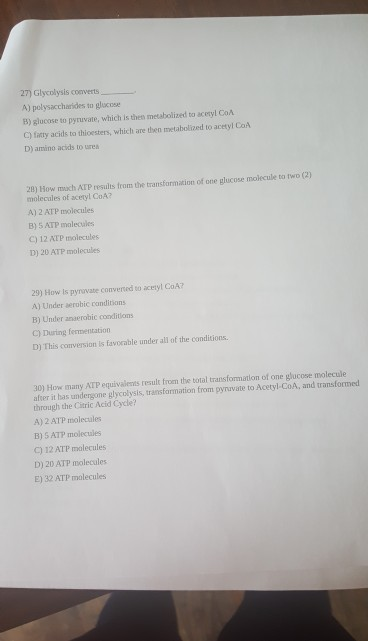
please help me answer questions 27 to 30. thank you
Homework Answers
Request Answer!
We need at least 10 more requests to produce the answer.
0 / 10 have requested this problem solution
The more requests, the faster the answer.
Add Answer to:
please help me answer questions 27 to 30. thank
you
27) Glycolysis converts A) polysaccharides to...
30) How many ATP equivalents result from the total transformation of one glucose molecule after it...
 30) How many ATP equivalents result from the total transformation of one glucose molecule after it has undergone glycolysis, transformation from pyruvate to Acetyl-CoA, and transformed through the Citric Acid Cycle? A) 2 ATP molecules B) 5 ATP molecules C) 12 ATP molecules D) 20 ATP molecules E) 32 ATP molecules
FOR BIOCHEMISTRY: 1. The end products of glycolysis are all except ______________ NADH citrate pyruvate Acetyl...
FOR BIOCHEMISTRY: 1. The end products of glycolysis are all except ______________ NADH citrate pyruvate Acetyl CoA 2. What substance is produced by the oxidation of pyruvate and feeds into the citric acid cycle? glucose Acetyl CoA O2 CO2 3. Pyruvate can only oxidize in a presence of oxygen true false 4. Which of the following is Uncharacteristic of ATP? It is formed by attaching a phosphate group to ADP with a high-energy bond When dephosphorylated, ATP becomes ADP It...
Select ALL of the statements that correctly describe the Krebs cycle. A. Pyruvic acid must be...
Select ALL of the statements that correctly describe the Krebs cycle. A. Pyruvic acid must be converted to acetyl CoA prior to entering the cycle B. The molecule oxaloacetic acid picks up the acetyl group from acetylCoA, and in the last step of the cycle, oxaloacetic acid is regenerated. C. Electrons removed during oxidation steps are picked up by NAD or FAD. D. Each turn of the cycle generates one ATP molecule for a total of two per molecule of...
Please help and explain answers! 1. In a series of chemical reactions, glucose is first converted...
Please help and explain answers! 1. In a series of chemical reactions, glucose is first converted into __________. a) pyruvate b) glycerol c) acetyl CoA 2. In the process of glycose breaking down, hydrogen and electrons are carried by coenzymes made from the ___. a) B vitamin biotin b) B vitamin niacin c) vitamin thiamine 3. In the Cori Cycle, the conversion of lactate to glycose by anaerobic glycolysis in the muscle requires energy from ___________. a) acetyl CoA b)...
42. The end result of glycolysis includes the a creation of 38 molecules of ATP. b....
 42. The end result of glycolysis includes the a creation of 38 molecules of ATP. b. reduction of eight molecules of NAD to NADH. c.formation of two molecules of pyruvate. d. conversion of one molecule of glucose to lactic acid. e. None of the above 43. During the energy investing portion of glycolysis, the phosphates from ATP molecules are a. added to the first and sixth carbons of glucose. b. added to the second and fourth carbons of glucose. c....
Please help me with this Nutrition homework assignment for my nursing class. It involves proteins Answer...
Please help me with this Nutrition homework assignment for my nursing class. It involves proteins Answer Choices: a. citric acid / Krebs cycle b. glycogenesis c. electron transport chain d. glycogenolysis e. lipogenesis f. lipolysis g. beta oxidation h. acetyl CoA i. gluconeogenesis j. glycolysis Answer Fill in: (some filled in already) 1. The conversion of glucose to pyruvate J 2. The conversion of fatty acids to acetyl CoA 3. Oxaloacetate and Citrate (citric acid) are intermediates in A 4....
Stage 2: Monosaccharide Degradation to Acetyl CoA (Glycolysis + Pyruvate Conversion) Pyruvate: Aerobic and Anaerobic Conversion...
 Stage 2: Monosaccharide Degradation to Acetyl CoA (Glycolysis + Pyruvate Conversion) Pyruvate: Aerobic and Anaerobic Conversion 1. Define what it means for a biochemical reaction to be aerobic vs. anaerobic. List what pyruvate will be converted to under each set of conditions. Conditions Definition Pyruvate Conversion Product aerobic anaerobic 2. In the space below, write the coupled reaction for the aerobic conversion of pyruvate, labeling the name of each reactant and product in the reaction. 3. Even though oxygen is...
13) When a molecule of glucose gets split during the energy investment phase of glycolysis, the...
 13) When a molecule of glucose gets split during the energy investment phase of glycolysis, the products are two molecules of that then move to the energy payoff phase. A) Glyceraldehyde-3-phospahte B) Pyruvate C) Acetyl-COA D) NADH 14) Following glycolysis and the citric acid cycle, but before the electron transport chain and oxidative phosphorylation, the carbon skeleton of glucose has been broken down to CO2 with some net gain of ATP. Most of the energy from the original glucose molecule...
2 NAD NADII and FAD/TADHa s bo (a) function as coenaymes b) ageats to anfer elesrons...
 2 NAD NADII and FAD/TADHa s bo (a) function as coenaymes b) ageats to anfer elesrons in beokugical oxidalion reduction reactions a source of energy in the comunon casabolic pathway (d) function as an agent to transfer 26 The final product of the common catabolic pathway ts aHO (b) ATP () NAD () co, (e all of these (a. b, c and d) 27. The molecule used by the body to transfer and store energy is (a) NAD (b) ATP...
12. How are glycolysis, ethanol fermentation, and lactate fermentation all related? A. All are regulated by...
 12. How are glycolysis, ethanol fermentation, and lactate fermentation all related? A. All are regulated by the ATP/ADP mass-action ratio. D. All three produce carbon dioxide. B. All can occur in anaerobic conditions. E. All require the presence of oxygen. C. All three produce NADH. 13. Which is the most exothermic reaction of glycolysis under standard conditions? A. Enolase B. Triose phosphate isomerase C. Pyruvate kinase D. Phosphofructokinase-1 E. Aldolase
 30) How many ATP equivalents result from the total transformation of one glucose molecule after it has undergone glycolysis, transformation from pyruvate to Acetyl-CoA, and transformed through the Citric Acid Cycle? A) 2 ATP molecules B) 5 ATP molecules C) 12 ATP molecules D) 20 ATP molecules E) 32 ATP molecules
 42. The end result of glycolysis includes the a creation of 38 molecules of ATP. b. reduction of eight molecules of NAD to NADH. c.formation of two molecules of pyruvate. d. conversion of one molecule of glucose to lactic acid. e. None of the above 43. During the energy investing portion of glycolysis, the phosphates from ATP molecules are a. added to the first and sixth carbons of glucose. b. added to the second and fourth carbons of glucose. c....
 Stage 2: Monosaccharide Degradation to Acetyl CoA (Glycolysis + Pyruvate Conversion) Pyruvate: Aerobic and Anaerobic Conversion 1. Define what it means for a biochemical reaction to be aerobic vs. anaerobic. List what pyruvate will be converted to under each set of conditions. Conditions Definition Pyruvate Conversion Product aerobic anaerobic 2. In the space below, write the coupled reaction for the aerobic conversion of pyruvate, labeling the name of each reactant and product in the reaction. 3. Even though oxygen is...
 13) When a molecule of glucose gets split during the energy investment phase of glycolysis, the products are two molecules of that then move to the energy payoff phase. A) Glyceraldehyde-3-phospahte B) Pyruvate C) Acetyl-COA D) NADH 14) Following glycolysis and the citric acid cycle, but before the electron transport chain and oxidative phosphorylation, the carbon skeleton of glucose has been broken down to CO2 with some net gain of ATP. Most of the energy from the original glucose molecule...
 2 NAD NADII and FAD/TADHa s bo (a) function as coenaymes b) ageats to anfer elesrons in beokugical oxidalion reduction reactions a source of energy in the comunon casabolic pathway (d) function as an agent to transfer 26 The final product of the common catabolic pathway ts aHO (b) ATP () NAD () co, (e all of these (a. b, c and d) 27. The molecule used by the body to transfer and store energy is (a) NAD (b) ATP...
 12. How are glycolysis, ethanol fermentation, and lactate fermentation all related? A. All are regulated by the ATP/ADP mass-action ratio. D. All three produce carbon dioxide. B. All can occur in anaerobic conditions. E. All require the presence of oxygen. C. All three produce NADH. 13. Which is the most exothermic reaction of glycolysis under standard conditions? A. Enolase B. Triose phosphate isomerase C. Pyruvate kinase D. Phosphofructokinase-1 E. Aldolase
Most questions answered within 3 hours.
-
Where is the error in this code sequence?
String s1 = "Hello";
String s2 = "ello";...
asked 10 months ago -
Financial data for Joel de Paris, Inc., for last year
follow:
Joel de Paris, Inc.
Balance...
asked 10 months ago -
Consider this reaction:
Al2(SO4)3 (aq)+ BaCl3
(aq) Al2Cl6 (aq)- +
3BaSO4(s) . What is the...
asked 10 months ago -
Suppose that Savneet is considering increasing her
recent random sample from 20 car rentals to 40...
asked 10 months ago -
Trucks arrive at an unloading terminal at an average rate of 120
per hour.
Trucks arrive...
asked 10 months ago -
Why are methanol and ethanol completely soluble in water while
octanol is not very little soluble....
asked 10 months ago -
A facilities manager at a university reads in a research report
that the mean amount of...
asked 10 months ago -
When the CuSO4 is rehydrated by adding water to the anhydrous
compound, is this an endothermic...
asked 10 months ago -
A ray of sunlight is passing from diamond into crown glass; the
angle of incidence is...
asked 10 months ago -
A block of mass 0.249 kg is placed on top of a light, vertical
spring of...
asked 10 months ago -
how do the kidneys compensate in the presences of acidosis
a) trigger hyperventilate
b) reserve acid...
asked 10 months ago -
Question 501 pts
The rental rate of capital to the firm increases. Which of the
following...
asked 10 months ago