
Homework Answers
PAGE 1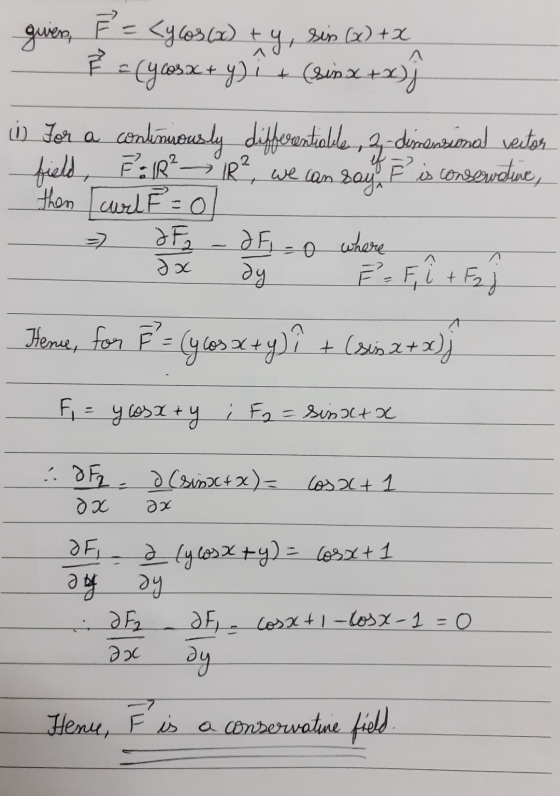
PAGE 2
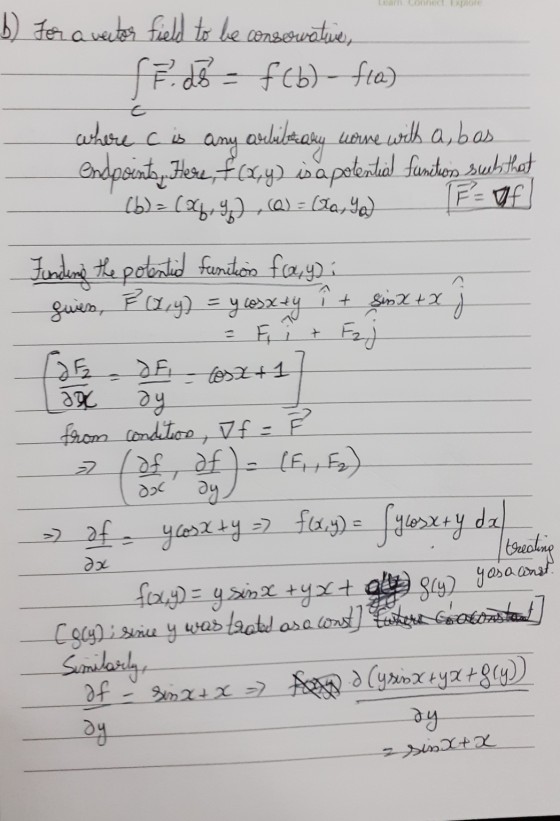
PAGE 3
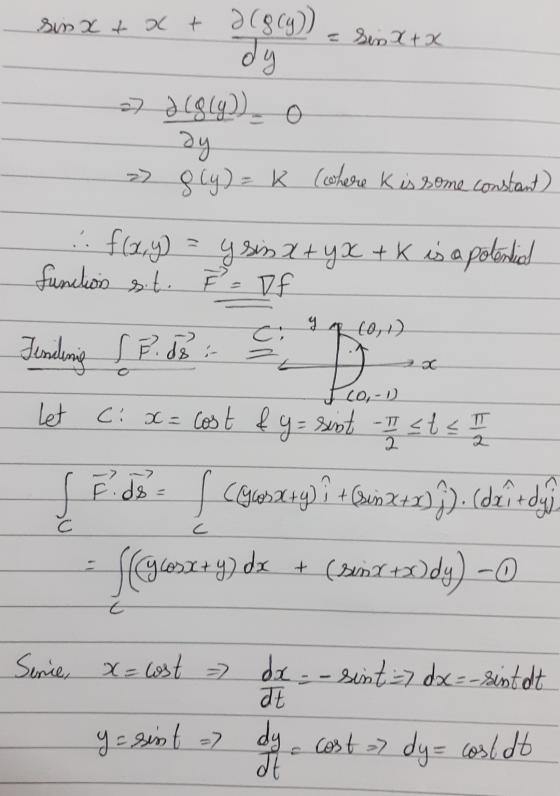
PAGE 4 SCREENSHOT:
![In[3] = ClearAll Out[3]= Clearali In[2] = N( Integrate [cos [t] Sin[Cos[t]] - (Sin[t])? Cos [Cos [t]] + Cos [2t], {t, t, {t,](http://img.homeworklib.com/questions/865650c0-f773-11ea-a9b3-7578005c829d.png?x-oss-process=image/resize,w_560)
SUMMARY:
The proof and Mathematica screenshot has been attached. There is no certain answer that needs to be summarised. The vector field is conservative, is shown in two ways, one by showing it's path independence and the other one by showing its curl is zero, hence it is a gradient of some scalar function (thus, the definition of conservative vector field).
Add Answer to:
Give 2 different proofs that F is conservative. F = (ycos(x) + y, sin(x) + x)...
The vector field + (x,y) = (ycos (xy) + 2e*, xcos(xy) + 2ycos (y2)) is conservative....
 The vector field + (x,y) = (ycos (xy) + 2e*, xcos(xy) + 2ycos (y2)) is conservative. Find f(x,y) such that F = Of. f=sin(x?y) + ye* + 2ys in (y? a. f = 2sin(xy) +2e* + sin(y? O b. 2 f=sin(xy) +2e* + sin(y?) OC f=sin(x+y) + 2ye* + sin(y) O d. sin (2) f=sin(x) + 2ye* + e. 2
Detailed answer Find the solution to the differential equation ysin(y) dx + x(sin y, ycos y)...
 Detailed answer
Find the solution to the differential equation ysin(y) dx + x(sin y, ycos y) dy = 0
Detailed answer
Find the solution to the differential equation ysin(y) dx + x(sin y, ycos y) dy = 0
+ cos(y) is conservative by responding to the 2. Show that the vector field F(x,y) =...
 + cos(y) is conservative by responding to the 2. Show that the vector field F(x,y) = (ye* + sin(y))i + ( following steps: a.) Determine both P(x,y) and Q(x,y) given F. b.) Demonstrate your answers in a.) satisfy Clairaut's theorem. c.) Partially integrate P with respect to r to obtain the potential S(= y) = P(x,y)da = (1.x) + C) where (a,b) is the anti-derivative of P(x,y) with respect to r and C(y) is a function of y such that...
2. The force F(x, y) = (y + 2x) sin(xy + x)i + x sin(xy +...
 2. The force F(x, y) = (y + 2x) sin(xy + x)i + x sin(xy + x2) is conservative. (a) Find a potential V such that F = -VV. [2 marks] (b) Is F central? Provide a reason for your answer. [2 marks]
3. 8p] Show that the force field F(x,y, z) sin y, x cos y + cos z, -y sin z) is conservative and use this fact to evalu...
 3. 8p] Show that the force field F(x,y, z) sin y, x cos y + cos z, -y sin z) is conservative and use this fact to evaluate the work done by F in moving a particle with unit mass along the curve C with parametrization r(t (sin t, t, 2t), 0 <t<T/2. 4. 8p] A thin wire has the shape of a helix x = sin t, 0 < t < 27r. If the t, y = cos t,...
(6) Show that F(x, y) = (x+y)i + (**)is conservative. (a) Then find such that S...
 (6) Show that F(x, y) = (x+y)i + (**)is conservative. (a) Then find such that S = F (potential function). (5) Use the results in part(a) to cakulae ( F. ds along C which the curve y = a* from (0,0) to (2,16). (2) Use Green's Theorem to evaluate 1. F. ds. F(1,y) =(yº+sin(26))i + (2xy2 + cos y)and C is the unit circle oriented counter clockwise (6) Evaluate the surface integral || 9. ds. F(x,y,z) = xi +++where S...
1. (algebra review) Solve the equation 3x'z+4x-e'z+5z-sin(x) for z. Clearly show your work and thinking. 2. (algebra review) Solve the equation sin(o)('y+21)-y'+5-ycos() for y. Clearl...
 1. (algebra review) Solve the equation 3x'z+4x-e'z+5z-sin(x) for z. Clearly show your work and thinking. 2. (algebra review) Solve the equation sin(o)('y+21)-y'+5-ycos() for y. Clearly show your work and thinking. dy 2 + y2|and difference between the meanings of the symbols d and x2+yj 4. Explain the difference between writing. That is, explain the dx dxdx
1. (algebra review) Solve the equation 3x'z+4x-e'z+5z-sin(x) for z. Clearly show your work and thinking. 2. (algebra review) Solve the equation sin(o)('y+21)-y'+5-ycos() for y....
1. (algebra review) Solve the equation 3x'z+4x-e'z+5z-sin(x) for z. Clearly show your work and thinking. 2. (algebra review) Solve the equation sin(o)('y+21)-y'+5-ycos() for y. Clearly show your work and thinking. dy 2 + y2|and difference between the meanings of the symbols d and x2+yj 4. Explain the difference between writing. That is, explain the dx dxdx
1. (algebra review) Solve the equation 3x'z+4x-e'z+5z-sin(x) for z. Clearly show your work and thinking. 2. (algebra review) Solve the equation sin(o)('y+21)-y'+5-ycos() for y....
2. a) Find a potential of the vector field f(x, y) = (a2 +2xy - y2,...
 2. a) Find a potential of the vector field f(x, y) = (a2 +2xy - y2, a2 - 2ry - y2) b) Show that the vector field (e" (sin ry + ycos xy) +2x - 2z, xe" cos ry2y, 1 - 2x) is conservative.
Let F(x, y, z) = sin yi + (x cos y + cos z)j – ysin...
 Let F(x, y, z) = sin yi + (x cos y + cos z)j – ysin zk be a vector field in R3. (a) Verify that F is a conservative vector field. (b) Find a potential function f such that F = Vf. (C) Use the fundamental theorem of line integrals to evaluate ScF. dr along the curve C: r(t) = sin ti + tj + 2tk, 0 < t < A/2.
F(x, y) = (3x2 + sin y)i + (x cos y + 2 sin y)j. Question...
 F(x, y) = (3x2 + sin y)i + (x cos y + 2 sin y)j. Question 1 (8 points) Find a potential function for the vector field F. Enter this function in the answer box. - Format B I U , . A X Question 2 (6 points) Use the potential function you found in problem 1 to evaluate F. dr, where Cis given by r(t) = (2-t)i + (ret/2), 0 st < 1.
 The vector field + (x,y) = (ycos (xy) + 2e*, xcos(xy) + 2ycos (y2)) is conservative. Find f(x,y) such that F = Of. f=sin(x?y) + ye* + 2ys in (y? a. f = 2sin(xy) +2e* + sin(y? O b. 2 f=sin(xy) +2e* + sin(y?) OC f=sin(x+y) + 2ye* + sin(y) O d. sin (2) f=sin(x) + 2ye* + e. 2
 Detailed answer
Find the solution to the differential equation ysin(y) dx + x(sin y, ycos y) dy = 0
Detailed answer
Find the solution to the differential equation ysin(y) dx + x(sin y, ycos y) dy = 0
 + cos(y) is conservative by responding to the 2. Show that the vector field F(x,y) = (ye* + sin(y))i + ( following steps: a.) Determine both P(x,y) and Q(x,y) given F. b.) Demonstrate your answers in a.) satisfy Clairaut's theorem. c.) Partially integrate P with respect to r to obtain the potential S(= y) = P(x,y)da = (1.x) + C) where (a,b) is the anti-derivative of P(x,y) with respect to r and C(y) is a function of y such that...
 2. The force F(x, y) = (y + 2x) sin(xy + x)i + x sin(xy + x2) is conservative. (a) Find a potential V such that F = -VV. [2 marks] (b) Is F central? Provide a reason for your answer. [2 marks]
 3. 8p] Show that the force field F(x,y, z) sin y, x cos y + cos z, -y sin z) is conservative and use this fact to evaluate the work done by F in moving a particle with unit mass along the curve C with parametrization r(t (sin t, t, 2t), 0 <t<T/2. 4. 8p] A thin wire has the shape of a helix x = sin t, 0 < t < 27r. If the t, y = cos t,...
 (6) Show that F(x, y) = (x+y)i + (**)is conservative. (a) Then find such that S = F (potential function). (5) Use the results in part(a) to cakulae ( F. ds along C which the curve y = a* from (0,0) to (2,16). (2) Use Green's Theorem to evaluate 1. F. ds. F(1,y) =(yº+sin(26))i + (2xy2 + cos y)and C is the unit circle oriented counter clockwise (6) Evaluate the surface integral || 9. ds. F(x,y,z) = xi +++where S...
 1. (algebra review) Solve the equation 3x'z+4x-e'z+5z-sin(x) for z. Clearly show your work and thinking. 2. (algebra review) Solve the equation sin(o)('y+21)-y'+5-ycos() for y. Clearly show your work and thinking. dy 2 + y2|and difference between the meanings of the symbols d and x2+yj 4. Explain the difference between writing. That is, explain the dx dxdx
1. (algebra review) Solve the equation 3x'z+4x-e'z+5z-sin(x) for z. Clearly show your work and thinking. 2. (algebra review) Solve the equation sin(o)('y+21)-y'+5-ycos() for y....
1. (algebra review) Solve the equation 3x'z+4x-e'z+5z-sin(x) for z. Clearly show your work and thinking. 2. (algebra review) Solve the equation sin(o)('y+21)-y'+5-ycos() for y. Clearly show your work and thinking. dy 2 + y2|and difference between the meanings of the symbols d and x2+yj 4. Explain the difference between writing. That is, explain the dx dxdx
1. (algebra review) Solve the equation 3x'z+4x-e'z+5z-sin(x) for z. Clearly show your work and thinking. 2. (algebra review) Solve the equation sin(o)('y+21)-y'+5-ycos() for y....
 2. a) Find a potential of the vector field f(x, y) = (a2 +2xy - y2, a2 - 2ry - y2) b) Show that the vector field (e" (sin ry + ycos xy) +2x - 2z, xe" cos ry2y, 1 - 2x) is conservative.
 Let F(x, y, z) = sin yi + (x cos y + cos z)j – ysin zk be a vector field in R3. (a) Verify that F is a conservative vector field. (b) Find a potential function f such that F = Vf. (C) Use the fundamental theorem of line integrals to evaluate ScF. dr along the curve C: r(t) = sin ti + tj + 2tk, 0 < t < A/2.
 F(x, y) = (3x2 + sin y)i + (x cos y + 2 sin y)j. Question 1 (8 points) Find a potential function for the vector field F. Enter this function in the answer box. - Format B I U , . A X Question 2 (6 points) Use the potential function you found in problem 1 to evaluate F. dr, where Cis given by r(t) = (2-t)i + (ret/2), 0 st < 1.
Most questions answered within 3 hours.
-
Where is the error in this code sequence?
String s1 = "Hello";
String s2 = "ello";...
asked 10 months ago -
Financial data for Joel de Paris, Inc., for last year
follow:
Joel de Paris, Inc.
Balance...
asked 10 months ago -
Consider this reaction:
Al2(SO4)3 (aq)+ BaCl3
(aq) Al2Cl6 (aq)- +
3BaSO4(s) . What is the...
asked 10 months ago -
Suppose that Savneet is considering increasing her
recent random sample from 20 car rentals to 40...
asked 10 months ago -
Trucks arrive at an unloading terminal at an average rate of 120
per hour.
Trucks arrive...
asked 10 months ago -
Why are methanol and ethanol completely soluble in water while
octanol is not very little soluble....
asked 10 months ago -
A facilities manager at a university reads in a research report
that the mean amount of...
asked 10 months ago -
When the CuSO4 is rehydrated by adding water to the anhydrous
compound, is this an endothermic...
asked 10 months ago -
A ray of sunlight is passing from diamond into crown glass; the
angle of incidence is...
asked 10 months ago -
A block of mass 0.249 kg is placed on top of a light, vertical
spring of...
asked 10 months ago -
how do the kidneys compensate in the presences of acidosis
a) trigger hyperventilate
b) reserve acid...
asked 10 months ago -
Question 501 pts
The rental rate of capital to the firm increases. Which of the
following...
asked 10 months ago