
Homework Answers
Request Answer!
We need at least 10 more requests to produce the answer.
0 / 10 have requested this problem solution
The more requests, the faster the answer.
Add Answer to:
Question 3 Intermolecular (IM) Forces are: stronger than covalent bonds stronger than ionic bonds but weaker...
Describe dipole-dipole attractions by selecting all true statements. They are much stronger than covalent bonds. They...
 Describe dipole-dipole attractions by selecting all true statements. They are much stronger than covalent bonds. They are much weaker than covalent bonds. They require that the interacting molecules be nonpolar. They require that the interacting molecules be polar. None of these.
Which type of intermolecular forces of attraction may be observed between AsCl3 molecules? Check all that...
 Which type of intermolecular forces of attraction may be observed between AsCl3 molecules? Check all that apply, there can be more than one answers to this question. dipole-dipole forces London dispersion forces Ionic bonds Covalent bonds Hydrogen bonds
Question 15 (5 points) Which of the following halogens would have stronger intermolecular forces? O a)...
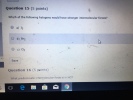 Question 15 (5 points) Which of the following halogens would have stronger intermolecular forces? O a) 12 O b) Br2 Ps Save Question 16 (5 points) What predominate intermolecular force is in HCI? e n
Question 6 0.2 pts Which statement about intermolecular forces is true? Only occur in ionic bonds....
 Question 6 0.2 pts Which statement about intermolecular forces is true? Only occur in ionic bonds. They have to be overcome to decompose a substance. These forces hold atoms together in a molecule. They are responsible for the physical properties of matter. Question 7 0.2 pts What intermolecular force is responsible for the attraction between an ion and a polar molecule? O Dipole-dipole interaction Hydrogen bonding lon-dipole interaction London dispersion forces Question 8 0.2 pts of liquids will be related...
7. If an ionic bond is stronger than a dipole-dipole interaction, how can water dissolve an...
7. If an ionic bond is stronger than a dipole-dipole interaction, how can water dissolve an ionic compound? None of these The ion-dipole interactions of a bunch of water molecules gang up on the strong ionic bond and pull it into the solution. The ions never overcome their interatomic attraction and therefore are not soluble. The ionic bond is weakened by the ion-dipole interactions and ionic repulsion ejects the ions from the crystal. The ion-dipole...
oblem 6.149 Part A indicate the major type of intermolecular forces ) ionic bonds. (2) dipol-dipole...
 oblem 6.149 Part A indicate the major type of intermolecular forces ) ionic bonds. (2) dipol-dipole attractions. (3) hydrogen bonds. (4) dispersion forces that occurs between particles of the following Drag the appropriate items to their respective bins. Reset Help Na O mama wa @ lonie bonds Dipol-dipole attractions Hydrogen bonds Dispersion forces Submit Request Answer Provide Feedback
Question 3 1 pts Ionic bonds form due to of electrons between bonded atoms. Covalent bonds...
 Question 3 1 pts Ionic bonds form due to of electrons between bonded atoms. Covalent bonds form due to of electrons between bonded atoms. Question 4 1 pts Polar covalent bonds have a difference in electronegativity between and
Chemistry 2 help with lab questions! Intermolecular forces are not chemical bonds. Explain the difference. When...
Chemistry 2 help with lab questions! Intermolecular forces are not chemical bonds. Explain the difference. When answering the rest of the essay questions, use language that clearly distinguishes between chemical bonds and intermolecular forces. Why do compounds with higher intermolecular forces have higher boiling points? Show that you understand why a higher temperature is needed to boil a compound that has stronger intermolecular forces. Which has greater dispersion forces, hexane or pentane? How can you use their molecular formulas to...
INTERMOLECULAR FORCES INTRODUCTION LEARNING OBJECTIVES To relate the effecet of intermolecular fo...
 INTERMOLECULAR FORCES INTRODUCTION LEARNING OBJECTIVES To relate the effecet of intermolecular forces on relative melting points and vapour pressures of some organic substances THEORY Weak attractive forces that occur between individual molecules in substances are called intermolecular forces. These include London dispersion forces, dipole-dipole forces and hydrogen-bonding forces. Collectively, the three types of intermolecular forces are referred to as Van der Waals forces. These attractive forces are much weaker than the chemical bonds between atoms in a molecule. Note that...
The most significant non-covalent intermolecular force between water molecules is: O hydrogen bonding O ionic bonding...
 The most significant non-covalent intermolecular force between water molecules is: O hydrogen bonding O ionic bonding o dipole-dipole O ion-dipole O London dispersion forces QUESTIONS The physical state change process by which a gas is converted to a solid is called: O A condensation B. deposition oc. sublimation O D. freezing O E vaporization QUESTION 9 How many moles of oxygen atoms are contained in 2.0 moles of oxygen 02 gas? OA 3 OBO O C2 O 0.1 O E.4
 Describe dipole-dipole attractions by selecting all true statements. They are much stronger than covalent bonds. They are much weaker than covalent bonds. They require that the interacting molecules be nonpolar. They require that the interacting molecules be polar. None of these.
 Which type of intermolecular forces of attraction may be observed between AsCl3 molecules? Check all that apply, there can be more than one answers to this question. dipole-dipole forces London dispersion forces Ionic bonds Covalent bonds Hydrogen bonds
 Question 15 (5 points) Which of the following halogens would have stronger intermolecular forces? O a) 12 O b) Br2 Ps Save Question 16 (5 points) What predominate intermolecular force is in HCI? e n
 Question 6 0.2 pts Which statement about intermolecular forces is true? Only occur in ionic bonds. They have to be overcome to decompose a substance. These forces hold atoms together in a molecule. They are responsible for the physical properties of matter. Question 7 0.2 pts What intermolecular force is responsible for the attraction between an ion and a polar molecule? O Dipole-dipole interaction Hydrogen bonding lon-dipole interaction London dispersion forces Question 8 0.2 pts of liquids will be related...
 oblem 6.149 Part A indicate the major type of intermolecular forces ) ionic bonds. (2) dipol-dipole attractions. (3) hydrogen bonds. (4) dispersion forces that occurs between particles of the following Drag the appropriate items to their respective bins. Reset Help Na O mama wa @ lonie bonds Dipol-dipole attractions Hydrogen bonds Dispersion forces Submit Request Answer Provide Feedback
 Question 3 1 pts Ionic bonds form due to of electrons between bonded atoms. Covalent bonds form due to of electrons between bonded atoms. Question 4 1 pts Polar covalent bonds have a difference in electronegativity between and
 INTERMOLECULAR FORCES INTRODUCTION LEARNING OBJECTIVES To relate the effecet of intermolecular forces on relative melting points and vapour pressures of some organic substances THEORY Weak attractive forces that occur between individual molecules in substances are called intermolecular forces. These include London dispersion forces, dipole-dipole forces and hydrogen-bonding forces. Collectively, the three types of intermolecular forces are referred to as Van der Waals forces. These attractive forces are much weaker than the chemical bonds between atoms in a molecule. Note that...
 The most significant non-covalent intermolecular force between water molecules is: O hydrogen bonding O ionic bonding o dipole-dipole O ion-dipole O London dispersion forces QUESTIONS The physical state change process by which a gas is converted to a solid is called: O A condensation B. deposition oc. sublimation O D. freezing O E vaporization QUESTION 9 How many moles of oxygen atoms are contained in 2.0 moles of oxygen 02 gas? OA 3 OBO O C2 O 0.1 O E.4
Most questions answered within 3 hours.
-
Where is the error in this code sequence?
String s1 = "Hello";
String s2 = "ello";...
asked 10 months ago -
Financial data for Joel de Paris, Inc., for last year
follow:
Joel de Paris, Inc.
Balance...
asked 10 months ago -
Consider this reaction:
Al2(SO4)3 (aq)+ BaCl3
(aq) Al2Cl6 (aq)- +
3BaSO4(s) . What is the...
asked 10 months ago -
Suppose that Savneet is considering increasing her
recent random sample from 20 car rentals to 40...
asked 10 months ago -
Trucks arrive at an unloading terminal at an average rate of 120
per hour.
Trucks arrive...
asked 10 months ago -
Why are methanol and ethanol completely soluble in water while
octanol is not very little soluble....
asked 10 months ago -
A facilities manager at a university reads in a research report
that the mean amount of...
asked 10 months ago -
When the CuSO4 is rehydrated by adding water to the anhydrous
compound, is this an endothermic...
asked 10 months ago -
A ray of sunlight is passing from diamond into crown glass; the
angle of incidence is...
asked 10 months ago -
A block of mass 0.249 kg is placed on top of a light, vertical
spring of...
asked 10 months ago -
how do the kidneys compensate in the presences of acidosis
a) trigger hyperventilate
b) reserve acid...
asked 10 months ago -
Question 501 pts
The rental rate of capital to the firm increases. Which of the
following...
asked 10 months ago