
Homework Answers
Value at risk is based on normal probability distribution with mean and standard deviation as parameters. It is also said as Bell curve distribution
Add Answer to:
2) The Value at Risk methodology is based on which probability distribution? I
2. Statistical measures of stand-alone risk Remember, the expected value of a probability distribution is a...
 2. Statistical measures of stand-alone risk Remember, the expected value of a probability distribution is a statistical measure of the average (mean) value expected to occur during all possible circumstances. To compute an asset's expected return under a range of possible circumstances (or states of nature), multiply the anticipated return expected to result during each state of nature by its probability of occurrence. Consider the following case: David owns a two-stock portfolio that invests in Celestial Crane Cosmetics Company (CCC)...
2. Statistical measures of standalone risk Remember, the expected value of a probability distribution is a...
 2. Statistical measures of standalone risk Remember, the expected value of a probability distribution is a statistical measure of the average (mean) value expected to occur dur circumstances. To compute an asset's expected return under a range of possible circumstances (or states of nature), multiply the antic expected to result during each state of nature by its probability of occurrence Consider the following case: Joshua owns a two-stock portfolio that inwests in Celestial Crane Cosmetics Company (CCC) and Lumbering Ox...
2. Statistical measures of stand-alone risk Remember, the expected value of a probability distribution is a...
 2. Statistical measures of stand-alone risk Remember, the expected value of a probability distribution is a statistical measure of the average (mean) value expected to occur during all possible circumstances. To compute an asset's expected return under a range of possible circumstances (or states of nature), multiply the anticipated return expected to result during each state of nature by its probability of occurrence. Consider the following case: Tyler owns a two-stock portfolio that invests in Blue Llama Mining Company (BLM)...
Aa Aa 1. Statistical measures of standalone risk Remember, the expected value of a probability distribution...
 Aa Aa 1. Statistical measures of standalone risk Remember, the expected value of a probability distribution is a statistical measure of the average (mean) value expected to occur during all possible circumstances. To compute an asset's expected return under a range of possible circumstances (or states of nature), multiply the anticipated return expected to result during each state of nature by its probability of occurrence Consider the following case: Ethan owns a two-stock portfolio that invests in Blue Llama Mining...
Statistical measures of stand-alone risk Remember, the expected value of a probability distribution is a statistical...
Statistical measures of stand-alone risk Remember, the expected value of a probability distribution is a statistical measure of the average (mean) value expected to occur during all possible circumstances. To compute an asset’s expected return under a range of possible circumstances (or states of nature), multiply the anticipated return expected to result during each state of nature by its probability of occurrence. Consider the following case: James owns a two-stock portfolio that invests in Blue Llama Mining Company (BLM) and...
1. Statistical measures of standalone risk Aa Aa Remember, the expected value of a probability distribution...
 1. Statistical measures of standalone risk Aa Aa Remember, the expected value of a probability distribution is a statistical measure of the average (mean) value expected to occur during all possible circumstances. To compute an asset's expected return under a range of possible circumstances (or states of nature), multiply the anticipated return expected to result during each state of nature by its probability of occurrence. Consider the following case: Juan owns a two-stock portfolio that invests in Falcon Freight Company...
1. Statistical measures of standalone risk Aa Aa Remember, the expected value of a probability distribution...
 1. Statistical measures of standalone risk Aa Aa Remember, the expected value of a probability distribution is a statistical measure of the average (mean) value expected to occur during all possible circumstances. To compute an asset's expected return under a range of possible circumstances (or states of nature), multiply the anticipated return expected to result during each state of nature by its probability of occurrence. Consider the following case: Tyler owns a two-stock portfolio that invests in Celestial Crane Cosmetics...
2. Statistical measures of stand-alone risk Remember, the expected value of a probability distribution is a...
2. Statistical measures of stand-alone risk Remember, the expected value of a probability distribution is a statistical measure of the average (mean) value expected to occur during all possible circumstances. To compute an asset’s expected return under a range of possible circumstances (or states of nature), multiply the anticipated return expected to result during each state of nature by its probability of occurrence. Consider the following case: James owns a two-stock portfolio that invests in Blue Llama Mining Company (BLM)...
10% 7. Given an experiment with 2 dice. What is the value of the probability distribution...
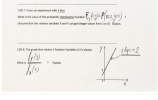 10% 7. Given an experiment with 2 dice. What is the value of the probability distribution function Fylkey=P(x<2.405) ? What is the value of the probability distribution function (Assume that the random variables X and Y can get integer values from 1 to 6) Explain. 10% 8. The graph that relates 2 Random Variables X,Y is shown. abes XY is shown. Y f / slepe=2 tyly What is ? Explain.
2. The random variable, X has the following probability mass function (i) Find the value of...
 2. The random variable, X has the following probability mass function (i) Find the value of the constant c. HINT: It will help to use the identity = (i) Find the cumulative distribution function of X and sketch both the probability mass function and the cumulative distribution function NOTE: Think carefully about the values of r for which you need to define the distribution function. (ii) Calculate P(X 2 50) and PX 2 50 x2 40
 2. Statistical measures of stand-alone risk Remember, the expected value of a probability distribution is a statistical measure of the average (mean) value expected to occur during all possible circumstances. To compute an asset's expected return under a range of possible circumstances (or states of nature), multiply the anticipated return expected to result during each state of nature by its probability of occurrence. Consider the following case: David owns a two-stock portfolio that invests in Celestial Crane Cosmetics Company (CCC)...
 2. Statistical measures of standalone risk Remember, the expected value of a probability distribution is a statistical measure of the average (mean) value expected to occur dur circumstances. To compute an asset's expected return under a range of possible circumstances (or states of nature), multiply the antic expected to result during each state of nature by its probability of occurrence Consider the following case: Joshua owns a two-stock portfolio that inwests in Celestial Crane Cosmetics Company (CCC) and Lumbering Ox...
 2. Statistical measures of stand-alone risk Remember, the expected value of a probability distribution is a statistical measure of the average (mean) value expected to occur during all possible circumstances. To compute an asset's expected return under a range of possible circumstances (or states of nature), multiply the anticipated return expected to result during each state of nature by its probability of occurrence. Consider the following case: Tyler owns a two-stock portfolio that invests in Blue Llama Mining Company (BLM)...
 Aa Aa 1. Statistical measures of standalone risk Remember, the expected value of a probability distribution is a statistical measure of the average (mean) value expected to occur during all possible circumstances. To compute an asset's expected return under a range of possible circumstances (or states of nature), multiply the anticipated return expected to result during each state of nature by its probability of occurrence Consider the following case: Ethan owns a two-stock portfolio that invests in Blue Llama Mining...
 1. Statistical measures of standalone risk Aa Aa Remember, the expected value of a probability distribution is a statistical measure of the average (mean) value expected to occur during all possible circumstances. To compute an asset's expected return under a range of possible circumstances (or states of nature), multiply the anticipated return expected to result during each state of nature by its probability of occurrence. Consider the following case: Juan owns a two-stock portfolio that invests in Falcon Freight Company...
 1. Statistical measures of standalone risk Aa Aa Remember, the expected value of a probability distribution is a statistical measure of the average (mean) value expected to occur during all possible circumstances. To compute an asset's expected return under a range of possible circumstances (or states of nature), multiply the anticipated return expected to result during each state of nature by its probability of occurrence. Consider the following case: Tyler owns a two-stock portfolio that invests in Celestial Crane Cosmetics...
 10% 7. Given an experiment with 2 dice. What is the value of the probability distribution function Fylkey=P(x<2.405) ? What is the value of the probability distribution function (Assume that the random variables X and Y can get integer values from 1 to 6) Explain. 10% 8. The graph that relates 2 Random Variables X,Y is shown. abes XY is shown. Y f / slepe=2 tyly What is ? Explain.
 2. The random variable, X has the following probability mass function (i) Find the value of the constant c. HINT: It will help to use the identity = (i) Find the cumulative distribution function of X and sketch both the probability mass function and the cumulative distribution function NOTE: Think carefully about the values of r for which you need to define the distribution function. (ii) Calculate P(X 2 50) and PX 2 50 x2 40
Most questions answered within 3 hours.
-
Where is the error in this code sequence?
String s1 = "Hello";
String s2 = "ello";...
asked 10 months ago -
Financial data for Joel de Paris, Inc., for last year
follow:
Joel de Paris, Inc.
Balance...
asked 10 months ago -
Consider this reaction:
Al2(SO4)3 (aq)+ BaCl3
(aq) Al2Cl6 (aq)- +
3BaSO4(s) . What is the...
asked 10 months ago -
Suppose that Savneet is considering increasing her
recent random sample from 20 car rentals to 40...
asked 10 months ago -
Trucks arrive at an unloading terminal at an average rate of 120
per hour.
Trucks arrive...
asked 10 months ago -
Why are methanol and ethanol completely soluble in water while
octanol is not very little soluble....
asked 10 months ago -
A facilities manager at a university reads in a research report
that the mean amount of...
asked 10 months ago -
When the CuSO4 is rehydrated by adding water to the anhydrous
compound, is this an endothermic...
asked 10 months ago -
A ray of sunlight is passing from diamond into crown glass; the
angle of incidence is...
asked 10 months ago -
A block of mass 0.249 kg is placed on top of a light, vertical
spring of...
asked 10 months ago -
how do the kidneys compensate in the presences of acidosis
a) trigger hyperventilate
b) reserve acid...
asked 10 months ago -
Question 501 pts
The rental rate of capital to the firm increases. Which of the
following...
asked 10 months ago