
Homework Answers
r(t)=⟨2t,5t,1-5t²⟩
r'(t) = ⟨2,5, -10t⟩
r"(t)= ⟨0,0, -10⟩
Curvature at 1 : k= ||r'(1)×r"(1)||/||r'(t)||³
r'(1) =⟨2,5,-10⟩
r"(1)= ⟨0,0, -10⟩
r'(1)×r"(1) = 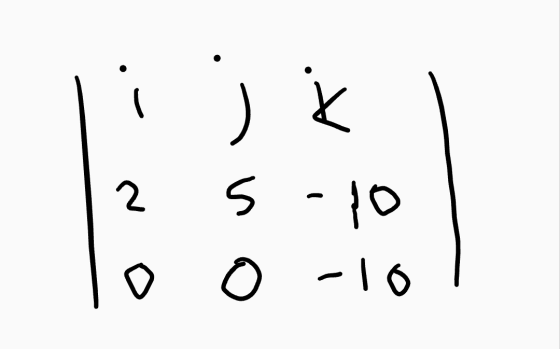
= -50i +20j
r'(t)×r"(t)= ⟨-50 ,20,0⟩ at t=1.
||r'(1)×r"(1)||=√((-50)²+(20)²+0) =√(2500+400) =√2900
||r'(1)||=√((2)²+(5)²+(-10)²) = √(4+25+100) =√(129)
K(1)=√(2900)/(√(129))³ = 0.036754831
Add Answer to:
(1 point) For the curve given by r(t) = (2t, 5t, 1 – 5t), Find the...
Let r(t) = <cos(5t), sin(5t), v7t>. (a) (7 points) Find |r'(t)|| (b) (7 points) Find and...
 Let r(t) = <cos(5t), sin(5t), v7t>. (a) (7 points) Find |r'(t)|| (b) (7 points) Find and simplify T(t), the unit tangent vector. Upload Choose a File
Find the length of spiral curve T() = ----- 0 < > < 2”
 Find the length of spiral curve T() = ----- 0 < > < 2”
Consider a particle moving in the plane along the curve r(t) = (R cos(wt), R sin(wt)),...
 Consider a particle moving in the plane along the curve r(t) = (R cos(wt), R sin(wt)), where tER, for some constants Row >0. (i) (_marks:) Determine the distance the particle travels for t € [T, 47]. (ii) marks) Suppose the plane has a voltage given by V(x, y) = xy +3. Determine the rate of change in voltage the particle experiences at time t.
Find the Laplace Transform of f(t)= -1 if t <= 4; f(t) = 1 if t>4...
 Find the Laplace Transform of f(t)= -1 if t <= 4; f(t) = 1 if
t>4
Find the Laplace Transform of f(t) = - 1 ifts 4; f(t) = 1 if t> 4.
Find the Laplace Transform of f(t)= -1 if t <= 4; f(t) = 1 if
t>4
Find the Laplace Transform of f(t) = - 1 ifts 4; f(t) = 1 if t> 4.
Find a general solution to the given Cauchy-Euler equation for t> 0. 12d²y dy + 2t-...
 Find a general solution to the given Cauchy-Euler equation for t> 0. 12d²y dy + 2t- dt - 6y = 0 dt² The general solution is y(t) =
Given: r(t) = <t, <t,>, a) sketch the plane curve represented byř (indicate the orientation), b)...
 Given: r(t) = <t, <t,>, a) sketch the plane curve represented byř (indicate the orientation), b) find the velocity, acceleration and speed functions, c) find the values of t for which the speed is increasing, d) find and sketch the vectors: ř(1), 7(1), and ā(l), (on your graph), and e) find ī (1) and N(1).
QUESTION 9 Find the Laplace Transform of f(t)= - 1 if ts 4; f(t) = 1...
 QUESTION 9 Find the Laplace Transform of f(t)= - 1 if ts 4; f(t) = 1 if t> 0.
Find a polar equation of the form r = f(@), where r > 0, for the...
 Find a polar equation of the form r = f(@), where r > 0, for the curve represented by the Cartesian equation x2 + y2 = 9. Note: Since is not a symbol on your keyboard, use t in place of 0 in your answer. =
1) For this problem use the following space curve: r(t) =< t, 3 sin(t), 3 cos(t)...
 1) For this problem use the following space curve: r(t) =< t, 3 sin(t), 3 cos(t) > a) Determine the unit tangent vector: T. b) Determine the unit normal vector: Ñ. c) Determine the curvature of this space curve at the point: (0,0,3). d) Determine the arc length of the curve between t = 0 and t = 1.
1) For this problem use the following space curve: r(t) =< t, 3 sin(t), 3 cos(t)...
 1) For this problem use the following space curve: r(t) =< t, 3 sin(t), 3 cos(t) > a) Determine the unit tangent vector: T. b) Determine the unit normal vector: Ñ. c) Determine the curvature of this space curve at the point: (0,0,3). d) Determine the arc length of the curve between t = 0 and t = 1.
 Let r(t) = <cos(5t), sin(5t), v7t>. (a) (7 points) Find |r'(t)|| (b) (7 points) Find and simplify T(t), the unit tangent vector. Upload Choose a File
 Find the length of spiral curve T() = ----- 0 < > < 2”
 Consider a particle moving in the plane along the curve r(t) = (R cos(wt), R sin(wt)), where tER, for some constants Row >0. (i) (_marks:) Determine the distance the particle travels for t € [T, 47]. (ii) marks) Suppose the plane has a voltage given by V(x, y) = xy +3. Determine the rate of change in voltage the particle experiences at time t.
 Find the Laplace Transform of f(t)= -1 if t <= 4; f(t) = 1 if
t>4
Find the Laplace Transform of f(t) = - 1 ifts 4; f(t) = 1 if t> 4.
Find the Laplace Transform of f(t)= -1 if t <= 4; f(t) = 1 if
t>4
Find the Laplace Transform of f(t) = - 1 ifts 4; f(t) = 1 if t> 4.
 Find a general solution to the given Cauchy-Euler equation for t> 0. 12d²y dy + 2t- dt - 6y = 0 dt² The general solution is y(t) =
 Given: r(t) = <t, <t,>, a) sketch the plane curve represented byř (indicate the orientation), b) find the velocity, acceleration and speed functions, c) find the values of t for which the speed is increasing, d) find and sketch the vectors: ř(1), 7(1), and ā(l), (on your graph), and e) find ī (1) and N(1).
 QUESTION 9 Find the Laplace Transform of f(t)= - 1 if ts 4; f(t) = 1 if t> 0.
 Find a polar equation of the form r = f(@), where r > 0, for the curve represented by the Cartesian equation x2 + y2 = 9. Note: Since is not a symbol on your keyboard, use t in place of 0 in your answer. =
 1) For this problem use the following space curve: r(t) =< t, 3 sin(t), 3 cos(t) > a) Determine the unit tangent vector: T. b) Determine the unit normal vector: Ñ. c) Determine the curvature of this space curve at the point: (0,0,3). d) Determine the arc length of the curve between t = 0 and t = 1.
 1) For this problem use the following space curve: r(t) =< t, 3 sin(t), 3 cos(t) > a) Determine the unit tangent vector: T. b) Determine the unit normal vector: Ñ. c) Determine the curvature of this space curve at the point: (0,0,3). d) Determine the arc length of the curve between t = 0 and t = 1.
Most questions answered within 3 hours.
-
Where is the error in this code sequence?
String s1 = "Hello";
String s2 = "ello";...
asked 11 months ago -
Financial data for Joel de Paris, Inc., for last year
follow:
Joel de Paris, Inc.
Balance...
asked 11 months ago -
Consider this reaction:
Al2(SO4)3 (aq)+ BaCl3
(aq) Al2Cl6 (aq)- +
3BaSO4(s) . What is the...
asked 11 months ago -
Suppose that Savneet is considering increasing her
recent random sample from 20 car rentals to 40...
asked 11 months ago -
Trucks arrive at an unloading terminal at an average rate of 120
per hour.
Trucks arrive...
asked 11 months ago -
Why are methanol and ethanol completely soluble in water while
octanol is not very little soluble....
asked 11 months ago -
A facilities manager at a university reads in a research report
that the mean amount of...
asked 11 months ago -
When the CuSO4 is rehydrated by adding water to the anhydrous
compound, is this an endothermic...
asked 11 months ago -
A ray of sunlight is passing from diamond into crown glass; the
angle of incidence is...
asked 11 months ago -
A block of mass 0.249 kg is placed on top of a light, vertical
spring of...
asked 11 months ago -
how do the kidneys compensate in the presences of acidosis
a) trigger hyperventilate
b) reserve acid...
asked 11 months ago -
Question 501 pts
The rental rate of capital to the firm increases. Which of the
following...
asked 11 months ago