
Homework Answers
Answer is boxed

Add Answer to:
15-5. A hockey puck is traveling to the left with a velocity of *1 = 10...
A stationary hockey puck is struck by a player and is given a velocity of 35.0...
 A stationary hockey puck is struck by a player and is given a velocity of 35.0 m/s. The collision between the stick and the puck lasts for 5.0 milliseconds and the mass of the pack is 0.160 kg. Find the average force exerted on the puck during the collision. The puck gradually slows to a speed of 30.0 m/s over a time of 3.00 seconds. Find the value of the coefficient of kinetic friction between the puck and the ice.
A hockey puck (mass = 2 kg) leaves the players stick (moving to the left) with...
 A hockey puck (mass = 2 kg) leaves the players stick (moving to the left) with a speed of 10 m/s and slides on the ice before coming to rest. The coefficient of friction between the puck and the ice is 0.4 What is the normal force on the puck? Submit Answer Tries 0/2 What is the friction force exerted on the puck due to the ice? Submit Answer Tries 0/2 What is the magnitude of the acceleration of the...
The hockey puck struck by a hockey stick, is given an initial speed of 20.0 m/s...
The hockey puck struck by a hockey stick, is given an initial speed of 20.0 m/s on a frozen pond. The puck remains on the ice and slides 100 m, slowing down steadily until it comes to rest. Determine the coefficient of kinetic friction between the puck and the ice.
QUESTION 3 A 100-gram hockey puck is initially moving horizontally to the left at a speed...
 QUESTION 3 A 100-gram hockey puck is initially moving horizontally to the left at a speed of 10 m/s, but is then slapped with a hockey stick to the right and moves off with a speed of 20 m/s. If the collision time between the hockey stick and the puck is At = 0.030 s, what is the average force of the hockey stick on the puck, in Newtons? a. 30 OOO b. 33 OC. 67 d. 100
A hockey puck (mass = 2.5 kg) leaves the players stick with a speed of 25...
A hockey puck (mass = 2.5 kg) leaves the players stick with a speed of 25 m/s and slides on the ice for 90 meters before coming to rest. A) What is the magnitude of the acceleration on the puck? m/s2 Tries 0/2 B) What is the magnitude of the friction force exerted on the puck due to the ice? N Tries 0/2 C) What is the normal force on the puck? N Tries 0/2 D) What is the friction...
A hockey goalie is standing on ice. Another player fires a puck (m = 0.17 kg) at the goalie with...
A hockey goalie is standing on ice. Another player fires a puck (m = 0.17 kg) at the goalie with a velocity of +62 m/s. Instead of catching the puck, the goalie slapsit with his stick and returns the puck straight back to the player with a velocity of -65 m/s. The puck and the stick are in contact for a time of 4.30 10-3 s. Nowwhat is the average force exerted on the goalie by the puck?
A hockey puck (mass = 3.5 kg) leaves the players stick with a speed of 25...
A hockey puck (mass = 3.5 kg) leaves the players stick with a speed of 25 m/s and slides on the ice for 50 meters before coming to rest. What is the magnitude of the acceleration on the puck? m/s2 What is the magnitude of the friction force exerted on the puck due to the ice? N What is the normal force on the puck? N What is the friction coefficient between the puck and the ice? (unitless)
A hockey puck of mass 1 kg is traveling at 2 m/s in a direction 40º...
A hockey puck of mass 1 kg is traveling at 2 m/s in a direction 40º south of east. It collides with a stationary puck of mass 0.9 kg. After the collision, the 1 kg puck is traveling at an angle of 60º south of west at a speed of 0.8 m/s. What is the speed and direction of the 0.9 kg puck?
V2 40° V1 True O False QUESTION 10 A hockey puck hits the stick at v1...
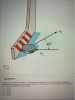 V2 40° V1 True O False QUESTION 10 A hockey puck hits the stick at v1 = 5 m/s and bounces off at V2 = 15mis as shown in the figure. Determine the change in momentum of the puck in the direction of vi if the mass of the puck is 20 gm. Take the direction of v1 as positive. 0 -0.1766 0 -0.2532 -0.3298 0 -0.6064
A 0.15 kg hockey puck slides to the left at 2.0 m/s. It is kicked by...
A 0.15 kg hockey puck slides to the left at 2.0 m/s. It is kicked by a skate that exerts the force shown. What is its approximate final speed? A 0.15 kg hockey puck slides to the left at 2.0 m/s. It is Besides the basic question can you please go into finding Favg, I know it should be simple but I cannot figure out how to determine it from this graph :/ Thank you A 0.15 kg hockey puck...
 A stationary hockey puck is struck by a player and is given a velocity of 35.0 m/s. The collision between the stick and the puck lasts for 5.0 milliseconds and the mass of the pack is 0.160 kg. Find the average force exerted on the puck during the collision. The puck gradually slows to a speed of 30.0 m/s over a time of 3.00 seconds. Find the value of the coefficient of kinetic friction between the puck and the ice.
 A hockey puck (mass = 2 kg) leaves the players stick (moving to the left) with a speed of 10 m/s and slides on the ice before coming to rest. The coefficient of friction between the puck and the ice is 0.4 What is the normal force on the puck? Submit Answer Tries 0/2 What is the friction force exerted on the puck due to the ice? Submit Answer Tries 0/2 What is the magnitude of the acceleration of the...
 QUESTION 3 A 100-gram hockey puck is initially moving horizontally to the left at a speed of 10 m/s, but is then slapped with a hockey stick to the right and moves off with a speed of 20 m/s. If the collision time between the hockey stick and the puck is At = 0.030 s, what is the average force of the hockey stick on the puck, in Newtons? a. 30 OOO b. 33 OC. 67 d. 100
 V2 40° V1 True O False QUESTION 10 A hockey puck hits the stick at v1 = 5 m/s and bounces off at V2 = 15mis as shown in the figure. Determine the change in momentum of the puck in the direction of vi if the mass of the puck is 20 gm. Take the direction of v1 as positive. 0 -0.1766 0 -0.2532 -0.3298 0 -0.6064
Most questions answered within 3 hours.
-
Where is the error in this code sequence?
String s1 = "Hello";
String s2 = "ello";...
asked 11 months ago -
Financial data for Joel de Paris, Inc., for last year
follow:
Joel de Paris, Inc.
Balance...
asked 11 months ago -
Consider this reaction:
Al2(SO4)3 (aq)+ BaCl3
(aq) Al2Cl6 (aq)- +
3BaSO4(s) . What is the...
asked 11 months ago -
Suppose that Savneet is considering increasing her
recent random sample from 20 car rentals to 40...
asked 11 months ago -
Trucks arrive at an unloading terminal at an average rate of 120
per hour.
Trucks arrive...
asked 11 months ago -
Why are methanol and ethanol completely soluble in water while
octanol is not very little soluble....
asked 11 months ago -
A facilities manager at a university reads in a research report
that the mean amount of...
asked 11 months ago -
When the CuSO4 is rehydrated by adding water to the anhydrous
compound, is this an endothermic...
asked 11 months ago -
A ray of sunlight is passing from diamond into crown glass; the
angle of incidence is...
asked 11 months ago -
A block of mass 0.249 kg is placed on top of a light, vertical
spring of...
asked 11 months ago -
how do the kidneys compensate in the presences of acidosis
a) trigger hyperventilate
b) reserve acid...
asked 11 months ago -
Question 501 pts
The rental rate of capital to the firm increases. Which of the
following...
asked 11 months ago