
Homework Answers

Add Answer to:
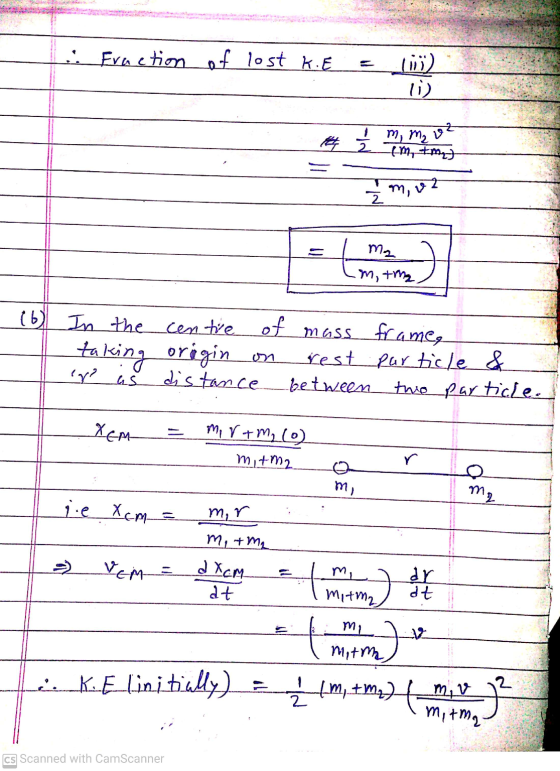
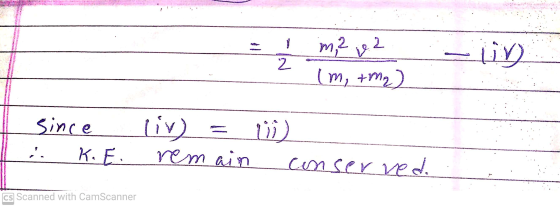
Consider a completely inelastic collision in which a particle of
mass m1 with initial velocity v...
Consider a completely inelastic collision in which a particle of mass with initial velocity collides head...
 Consider a completely inelastic collision in which a particle
of mass with
initial velocity collides head on with a particle of mass ,
initially at rest.(a) What fraction of the initial kinetic energy
was lost? (b)View the collision from the center of mass frame and
determine if the kinetic energy of the colliding particle remain
conserved.
Consider a completely inelastic collision in which a particle of mass with initial velocity collides head on with a particle of mass , initially...
Consider a completely inelastic collision in which a particle
of mass with
initial velocity collides head on with a particle of mass ,
initially at rest.(a) What fraction of the initial kinetic energy
was lost? (b)View the collision from the center of mass frame and
determine if the kinetic energy of the colliding particle remain
conserved.
Consider a completely inelastic collision in which a particle of mass with initial velocity collides head on with a particle of mass , initially...
need help with all portion in this prblem can i get all the steps 1. Consider...
 need help with all portion in this prblem can i get all the
steps
1. Consider a completely inelastic collision in which a particle of mass m, with initial velocity y collides head on with a particle of mass my, initially at rest(a) What fraction of the initial kinetic energy was lost? (b)View the collision from the center of mass frame and determine if the kinetic energy of the colliding particle remain conserved. (7-points)
need help with all portion in this prblem can i get all the
steps
1. Consider a completely inelastic collision in which a particle of mass m, with initial velocity y collides head on with a particle of mass my, initially at rest(a) What fraction of the initial kinetic energy was lost? (b)View the collision from the center of mass frame and determine if the kinetic energy of the colliding particle remain conserved. (7-points)
Two equal mass object experience a totally inelastic collision. Case 1: Mass 1 has an initial...
Two equal mass object experience a totally inelastic collision. Case 1: Mass 1 has an initial velocity of 10.0 m/s in the negative y-direction, while mass 2 has an initial velocity of 5.00 m/s in the positive x-direction. (2-D collision) Case 2: Mass 1 has an initial velocity of 10.0 m/s in the positive x-direction, while mass 2 has an initial velocity of 10.0 m/s in the negative x-direction. (1-D collision) What was kinetic energy conserved in each of the...
Two carts experience a completely inelastic collision. Before the collision, cart A, which has a mass...
Two carts experience a completely inelastic collision. Before the collision, cart A, which has a mass of 1.00 kg, is traveling to the right at 7.00 m/s, while cart B, with a mass of 3.00 kg, is traveling to the left at 1.00 m/s. a) What is the velocity of the two carts after the collision? Define right as positive, so enter a negative value if you determine that the velocity is to the left. _______ m/s b) What percentage...
Suppose in a reference frame S, two objects collide elastically. Particle 1 of mass m1 =...
Suppose in a reference frame S, two objects collide elastically. Particle 1 of mass m1 = 2m is initally at rest, and particle 2 of mass m2 = m is moving with an initial velocity of u2i = −0.75c (negative means moving in the −x direction). The two particles collide elastically. Using classical momentum and energy conservation, an observer in frame S calculates the velocities after collision to be u1f = −0.5c, u2f = 0.25c. (a) Verify that the kinetic...
A block of mass m1 = 1.60kg moving at v1 = 2.00m/s undergoes a completely inelastic collision with a stationary block of mass m2 = 0.100kg
 A block of mass m1 = 1.60kg moving at v1 =
2.00m/s undergoes a completely inelastic collision with a stationary
block of mass m2 = 0.100kg . The blocks then move, stuck
together, at speed v2. After a short time, the two-block
system collides inelastically with a third block, of massm3 = 2.70kg , which is initially at rest. The three blocks
then move, stuck together, with speed v3.(Figure 1) Assume that the
blocks slide without friction.Part AFind v2v1, the...
A block of mass m1 = 1.60kg moving at v1 =
2.00m/s undergoes a completely inelastic collision with a stationary
block of mass m2 = 0.100kg . The blocks then move, stuck
together, at speed v2. After a short time, the two-block
system collides inelastically with a third block, of massm3 = 2.70kg , which is initially at rest. The three blocks
then move, stuck together, with speed v3.(Figure 1) Assume that the
blocks slide without friction.Part AFind v2v1, the...
5. The figures on the right show a disk with radius, a = 0.20 m, and mass, M = 0.80 kg, resting on a frictionless table. One particle with mass, m1-M/4, with velocity, v- 4 m/s, slides along the stab...
 5. The figures on the right show a disk with radius, a = 0.20 m, and mass, M = 0.80 kg, resting on a frictionless table. One particle with mass, m1-M/4, with velocity, v- 4 m/s, slides along the stable, and collides with the disk at the point shown. A second particle with mass, m2, moving with velocity v2-4v collides with the disk at the point shown. The two masses collide with the disk at the same time, and after...
Particle A is at rest, and particle B collides head-on with it. The collision is completely...
Particle A is at rest, and particle B collides head-on with it. The collision is completely inelastic, so the two particles stick together after the collision and move off with a common velocity. The masses of the particles are different, and no external forces act on them. The de Broglie wavelength of particle B before the collision is 1.8 × 10⁻³⁴ m. What is the de Broglie wavelength of the object that moves off after the collision?
One particle of mass m1 = 1.00 kg with an initial velocity of 5.40 m/s i...
 One particle of mass m1 = 1.00 kg with an initial velocity of 5.40 m/s i collides with a second particle of mass m2 = 2.00 kg that is initially at rest. After the collision mı goes off with a final speed of 4.20 m/s in a direction 32.0° above i. V 5.4 ms (a) Find the final velocity (in terms of magnitude AND direction) of m2. agnitude AND direction) of m. Vi = 4.2 m/s (HINT: Find the direction...
1 Elastic collision A bumper car of mass m1 = 300kg is initially moving to the...
 1 Elastic collision A bumper car of mass m1 = 300kg is initially moving to the right at velocity V1, before = 8m/s and collides head-on with another bumper car of mass m2 = 200kg that is motionless, V2, before = 0. After the collision, the heavy bumper car is moving at a speed of v1,after = 1.6m/s. (a) (5 pts) Calculate the total kinetic energy before the collision (b) (5 pts) Calculate the kinetic energy of the heavy car...
 Consider a completely inelastic collision in which a particle
of mass with
initial velocity collides head on with a particle of mass ,
initially at rest.(a) What fraction of the initial kinetic energy
was lost? (b)View the collision from the center of mass frame and
determine if the kinetic energy of the colliding particle remain
conserved.
Consider a completely inelastic collision in which a particle of mass with initial velocity collides head on with a particle of mass , initially...
Consider a completely inelastic collision in which a particle
of mass with
initial velocity collides head on with a particle of mass ,
initially at rest.(a) What fraction of the initial kinetic energy
was lost? (b)View the collision from the center of mass frame and
determine if the kinetic energy of the colliding particle remain
conserved.
Consider a completely inelastic collision in which a particle of mass with initial velocity collides head on with a particle of mass , initially...
 need help with all portion in this prblem can i get all the
steps
1. Consider a completely inelastic collision in which a particle of mass m, with initial velocity y collides head on with a particle of mass my, initially at rest(a) What fraction of the initial kinetic energy was lost? (b)View the collision from the center of mass frame and determine if the kinetic energy of the colliding particle remain conserved. (7-points)
need help with all portion in this prblem can i get all the
steps
1. Consider a completely inelastic collision in which a particle of mass m, with initial velocity y collides head on with a particle of mass my, initially at rest(a) What fraction of the initial kinetic energy was lost? (b)View the collision from the center of mass frame and determine if the kinetic energy of the colliding particle remain conserved. (7-points)
 A block of mass m1 = 1.60kg moving at v1 =
2.00m/s undergoes a completely inelastic collision with a stationary
block of mass m2 = 0.100kg . The blocks then move, stuck
together, at speed v2. After a short time, the two-block
system collides inelastically with a third block, of massm3 = 2.70kg , which is initially at rest. The three blocks
then move, stuck together, with speed v3.(Figure 1) Assume that the
blocks slide without friction.Part AFind v2v1, the...
A block of mass m1 = 1.60kg moving at v1 =
2.00m/s undergoes a completely inelastic collision with a stationary
block of mass m2 = 0.100kg . The blocks then move, stuck
together, at speed v2. After a short time, the two-block
system collides inelastically with a third block, of massm3 = 2.70kg , which is initially at rest. The three blocks
then move, stuck together, with speed v3.(Figure 1) Assume that the
blocks slide without friction.Part AFind v2v1, the...
 5. The figures on the right show a disk with radius, a = 0.20 m, and mass, M = 0.80 kg, resting on a frictionless table. One particle with mass, m1-M/4, with velocity, v- 4 m/s, slides along the stable, and collides with the disk at the point shown. A second particle with mass, m2, moving with velocity v2-4v collides with the disk at the point shown. The two masses collide with the disk at the same time, and after...
 One particle of mass m1 = 1.00 kg with an initial velocity of 5.40 m/s i collides with a second particle of mass m2 = 2.00 kg that is initially at rest. After the collision mı goes off with a final speed of 4.20 m/s in a direction 32.0° above i. V 5.4 ms (a) Find the final velocity (in terms of magnitude AND direction) of m2. agnitude AND direction) of m. Vi = 4.2 m/s (HINT: Find the direction...
 1 Elastic collision A bumper car of mass m1 = 300kg is initially moving to the right at velocity V1, before = 8m/s and collides head-on with another bumper car of mass m2 = 200kg that is motionless, V2, before = 0. After the collision, the heavy bumper car is moving at a speed of v1,after = 1.6m/s. (a) (5 pts) Calculate the total kinetic energy before the collision (b) (5 pts) Calculate the kinetic energy of the heavy car...
Most questions answered within 3 hours.
-
Where is the error in this code sequence?
String s1 = "Hello";
String s2 = "ello";...
asked 1 year ago -
Financial data for Joel de Paris, Inc., for last year
follow:
Joel de Paris, Inc.
Balance...
asked 1 year ago -
Consider this reaction:
Al2(SO4)3 (aq)+ BaCl3
(aq) Al2Cl6 (aq)- +
3BaSO4(s) . What is the...
asked 1 year ago -
Suppose that Savneet is considering increasing her
recent random sample from 20 car rentals to 40...
asked 1 year ago -
Trucks arrive at an unloading terminal at an average rate of 120
per hour.
Trucks arrive...
asked 1 year ago -
Why are methanol and ethanol completely soluble in water while
octanol is not very little soluble....
asked 1 year ago -
A facilities manager at a university reads in a research report
that the mean amount of...
asked 1 year ago -
When the CuSO4 is rehydrated by adding water to the anhydrous
compound, is this an endothermic...
asked 1 year ago -
A ray of sunlight is passing from diamond into crown glass; the
angle of incidence is...
asked 1 year ago -
A block of mass 0.249 kg is placed on top of a light, vertical
spring of...
asked 1 year ago -
how do the kidneys compensate in the presences of acidosis
a) trigger hyperventilate
b) reserve acid...
asked 1 year ago -
Question 501 pts
The rental rate of capital to the firm increases. Which of the
following...
asked 1 year ago