
Homework Answers
Add Answer to:
Consider the following linear transformation T: RS → R3 where T(X1, X2, X3, Xa, Xs) =...
Please show work Consider the following linear transformation T: RS → R3 where T(X1, X2, X3,...
 Please show work
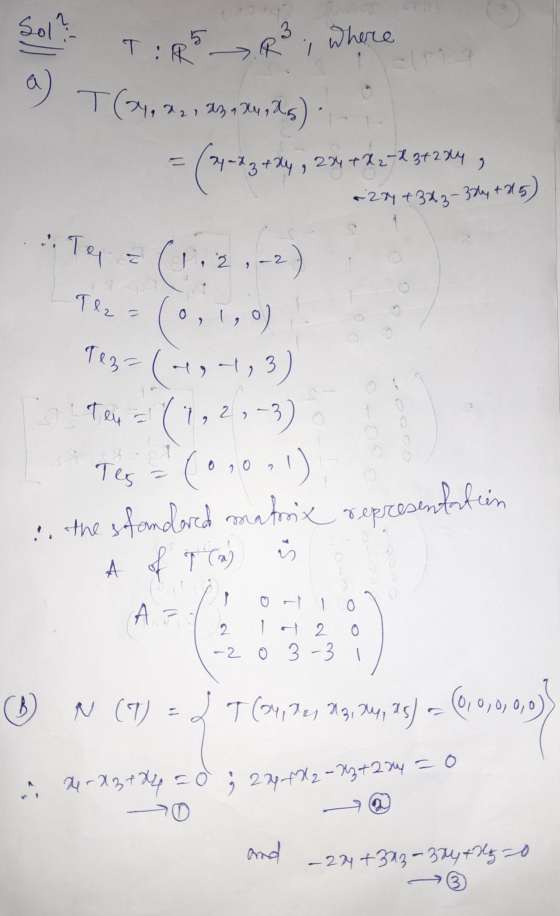
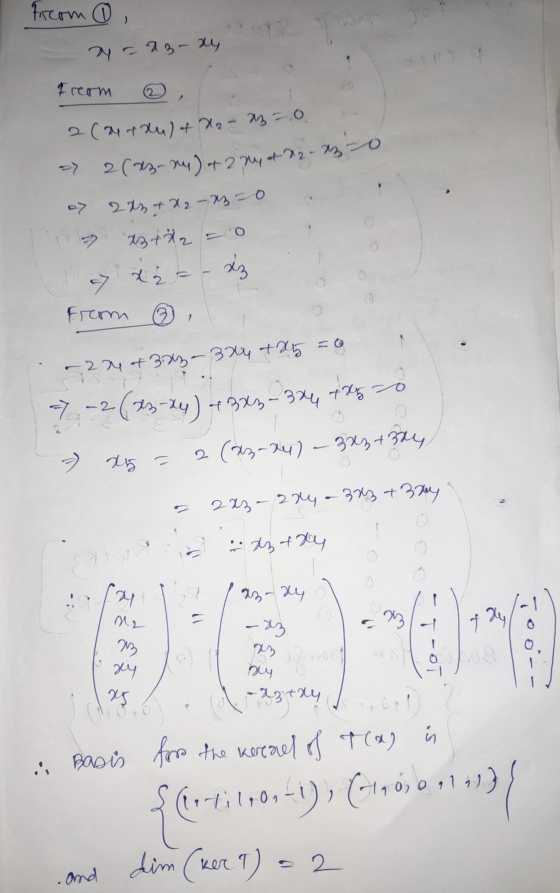
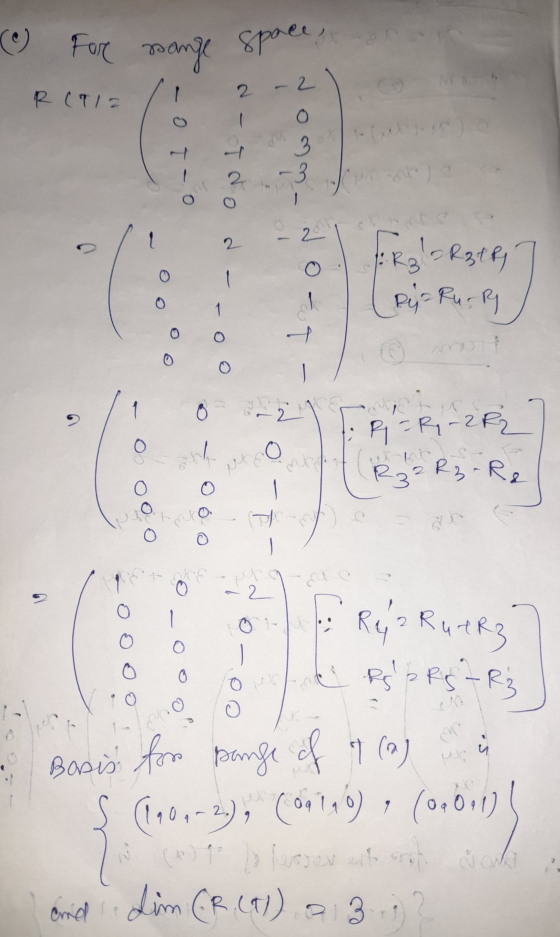
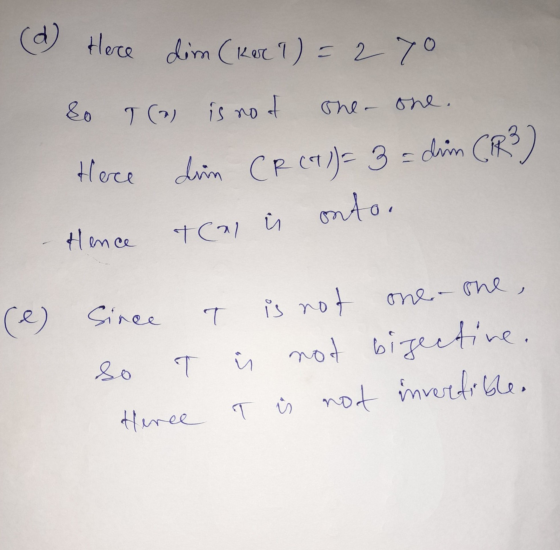
Consider the following linear transformation T: RS → R3 where T(X1, X2, X3, X4, Xs) = (x1-X3+X4, 2x1+x2-X3+2x4, -2x1+3x3-3x4+xs) (a) Determine the standard matrix representation A of T(x). (b) Find a basis for the kernel of T(x). (c) Find a basis for the range of T(x). (d) Is T(x) one-to-one? Is T(x) onto? Explain. (e) Is T(x) invertible? Explain
Please show work
Consider the following linear transformation T: RS → R3 where T(X1, X2, X3, X4, Xs) = (x1-X3+X4, 2x1+x2-X3+2x4, -2x1+3x3-3x4+xs) (a) Determine the standard matrix representation A of T(x). (b) Find a basis for the kernel of T(x). (c) Find a basis for the range of T(x). (d) Is T(x) one-to-one? Is T(x) onto? Explain. (e) Is T(x) invertible? Explain
Consider the following linear transformation T: R5 → R3 where T(X1, X2, X3, X4, X5) =...
 Consider the following linear transformation T: R5 → R3 where T(X1, X2, X3, X4, X5) = (*1-X3+X4, 2X1+X2-X3+2x4, -2X1+3X3-3x4+x5) (a) Determine the standard matrix representation A of T(x). (b) Find a basis for the kernel of T(x). (c) Find a basis for the range of T(x). (d) Is T(x) one-to-one? Is T(x) onto? Explain. (e) Is T(x) invertible? Explain
Consider the following linear transformation T: RS → R3 where T(X1, X2, X3, X4, X5) =...
 Consider the following linear transformation T: RS → R3 where T(X1, X2, X3, X4, X5) = (x1-X3+X4, 2X1+X2-X3+2x4, -2X1+3x3-3x4+x5) (a) Determine the standard matrix representation A of T(x).
[E] Consider the linear transformation T: R3 → R3 given by: T(X1, X2, X3) = (x1...
 [E] Consider the linear transformation T: R3 → R3 given by: T(X1, X2, X3) = (x1 + 2xz, 3x1 + x2 + 4x3, 5x1 + x2 + 8x3) (E.1) Write down the standard matrix for the transformation; i.e. [T]. (E.2) Obtain bases for the kernel of T and for the range of T. (E.3) Fill in the blanks below with the appropriate number. The rank of T = The nullity of T = (E.4) Is T invertible? Justify your response....
; Let at be a linear transformation as follows : T{x1,x2,x3,x4,x5} = {{x1-x3+2x2x5},{x2-x3+2x5},{x1+x2-2x3+x4+2x5},{2x2-2x3+x4+2x5}] a.) find the...
; Let at be a linear transformation as follows : T{x1,x2,x3,x4,x5} = {{x1-x3+2x2x5},{x2-x3+2x5},{x1+x2-2x3+x4+2x5},{2x2-2x3+x4+2x5}] a.) find the standard matrix representation A of T b.) find the basis of Col(A) c.) find a basis of Null(A) d.) is T 1-1? Is T onto?
Consider the following linear transformation T: RR where TX, 22, X, X, Xs) - (******4,2x1******+2x4,2x:+36-32+x) (al...
 Consider the following linear transformation T: RR where TX, 22, X, X, Xs) - (******4,2x1******+2x4,2x:+36-32+x) (al Determine the standard matrix representation A of Tix) (b) Find a basis for the kernel of T(x). (c) Find a basis for the range of Tix) (d) Is Tix) one-to-one? Is Tix) onto? Explain. le) is Tix) invertible? Explain
Let x = [X1 X2 X3], and let T:R3 → R3 be the linear transformation defined...
 Let x = [X1 X2 X3], and let T:R3 → R3 be the linear transformation defined by x1 + 5x2 – x3 T(x) - X2 x1 + 2x3 Let B be the standard basis for R3 and let B' = {V1, V2, V3}, where 4 4. ---- 4 and v3 -- 4 Find the matrix of T with respect to the basis B, and then use Theorem 8.5.2 to compute the matrix of T with respect to the basis B”....
Question 1: Let T: R3 ---> R2 defined by T(x1,x2,x3) = (x1 + 2x2, 2x1 - x2). Show that T as defined above is a Liner Transformation. Question 2: Determine whether the given set of vectors is a basi...
Question 1: Let T: R3 ---> R2 defined by T(x1,x2,x3) = (x1 + 2x2, 2x1 - x2). Show that T as defined above is a Liner Transformation. Question 2: Determine whether the given set of vectors is a basis for S = {(1,2,1) , (3,-1,2),(1,1,-1)} R3 Need answers to both questions.
Let T R3 R4 be the linear transformation defined by T(π1, Ο2, 73) - ( 3α1...
 Let T R3 R4 be the linear transformation defined by T(π1, Ο2, 73) - ( 3α1 -4 , X3, 12.x2 3.x3, 6x1-25x3, 10x2 + 10x3) (a) Determine the standard matrix representation of T (b) Find a basis for the image of T, Im(T), and determine dim(Im(T)) (c) Find a basis for the kernel of T, ker(T), and determine dim(ker(T))
Problem 1 (20 pts) Consider the mathematical program max 3x1+x2 +3x3 s.t. 2x1 +x2 + x3 +x2 x1 + 2x2 + 3x3 +2xs 5 2x 2x2 +x3 +3x6-6 Xy X2, X3, X4, Xs, X620 Three feasible solutions ((a) through (c...
 Problem 1 (20 pts) Consider the mathematical program max 3x1+x2 +3x3 s.t. 2x1 +x2 + x3 +x2 x1 + 2x2 + 3x3 +2xs 5 2x 2x2 +x3 +3x6-6 Xy X2, X3, X4, Xs, X620 Three feasible solutions ((a) through (c)) are listed below. (0.3, 0.1, 0.4, 0.9, 1.65, 1.6) (c) x Please choose one appropriate interior point from the list, and use the Karmarkar's Method at the interior point and determine the optimal solution. 25
Problem 1 (20 pts) Consider...
Problem 1 (20 pts) Consider the mathematical program max 3x1+x2 +3x3 s.t. 2x1 +x2 + x3 +x2 x1 + 2x2 + 3x3 +2xs 5 2x 2x2 +x3 +3x6-6 Xy X2, X3, X4, Xs, X620 Three feasible solutions ((a) through (c)) are listed below. (0.3, 0.1, 0.4, 0.9, 1.65, 1.6) (c) x Please choose one appropriate interior point from the list, and use the Karmarkar's Method at the interior point and determine the optimal solution. 25
Problem 1 (20 pts) Consider...
 Please show work
Consider the following linear transformation T: RS → R3 where T(X1, X2, X3, X4, Xs) = (x1-X3+X4, 2x1+x2-X3+2x4, -2x1+3x3-3x4+xs) (a) Determine the standard matrix representation A of T(x). (b) Find a basis for the kernel of T(x). (c) Find a basis for the range of T(x). (d) Is T(x) one-to-one? Is T(x) onto? Explain. (e) Is T(x) invertible? Explain
Please show work
Consider the following linear transformation T: RS → R3 where T(X1, X2, X3, X4, Xs) = (x1-X3+X4, 2x1+x2-X3+2x4, -2x1+3x3-3x4+xs) (a) Determine the standard matrix representation A of T(x). (b) Find a basis for the kernel of T(x). (c) Find a basis for the range of T(x). (d) Is T(x) one-to-one? Is T(x) onto? Explain. (e) Is T(x) invertible? Explain
 Consider the following linear transformation T: R5 → R3 where T(X1, X2, X3, X4, X5) = (*1-X3+X4, 2X1+X2-X3+2x4, -2X1+3X3-3x4+x5) (a) Determine the standard matrix representation A of T(x). (b) Find a basis for the kernel of T(x). (c) Find a basis for the range of T(x). (d) Is T(x) one-to-one? Is T(x) onto? Explain. (e) Is T(x) invertible? Explain
 Consider the following linear transformation T: RS → R3 where T(X1, X2, X3, X4, X5) = (x1-X3+X4, 2X1+X2-X3+2x4, -2X1+3x3-3x4+x5) (a) Determine the standard matrix representation A of T(x).
 [E] Consider the linear transformation T: R3 → R3 given by: T(X1, X2, X3) = (x1 + 2xz, 3x1 + x2 + 4x3, 5x1 + x2 + 8x3) (E.1) Write down the standard matrix for the transformation; i.e. [T]. (E.2) Obtain bases for the kernel of T and for the range of T. (E.3) Fill in the blanks below with the appropriate number. The rank of T = The nullity of T = (E.4) Is T invertible? Justify your response....
 Consider the following linear transformation T: RR where TX, 22, X, X, Xs) - (******4,2x1******+2x4,2x:+36-32+x) (al Determine the standard matrix representation A of Tix) (b) Find a basis for the kernel of T(x). (c) Find a basis for the range of Tix) (d) Is Tix) one-to-one? Is Tix) onto? Explain. le) is Tix) invertible? Explain
 Let x = [X1 X2 X3], and let T:R3 → R3 be the linear transformation defined by x1 + 5x2 – x3 T(x) - X2 x1 + 2x3 Let B be the standard basis for R3 and let B' = {V1, V2, V3}, where 4 4. ---- 4 and v3 -- 4 Find the matrix of T with respect to the basis B, and then use Theorem 8.5.2 to compute the matrix of T with respect to the basis B”....
 Let T R3 R4 be the linear transformation defined by T(π1, Ο2, 73) - ( 3α1 -4 , X3, 12.x2 3.x3, 6x1-25x3, 10x2 + 10x3) (a) Determine the standard matrix representation of T (b) Find a basis for the image of T, Im(T), and determine dim(Im(T)) (c) Find a basis for the kernel of T, ker(T), and determine dim(ker(T))
 Problem 1 (20 pts) Consider the mathematical program max 3x1+x2 +3x3 s.t. 2x1 +x2 + x3 +x2 x1 + 2x2 + 3x3 +2xs 5 2x 2x2 +x3 +3x6-6 Xy X2, X3, X4, Xs, X620 Three feasible solutions ((a) through (c)) are listed below. (0.3, 0.1, 0.4, 0.9, 1.65, 1.6) (c) x Please choose one appropriate interior point from the list, and use the Karmarkar's Method at the interior point and determine the optimal solution. 25
Problem 1 (20 pts) Consider...
Problem 1 (20 pts) Consider the mathematical program max 3x1+x2 +3x3 s.t. 2x1 +x2 + x3 +x2 x1 + 2x2 + 3x3 +2xs 5 2x 2x2 +x3 +3x6-6 Xy X2, X3, X4, Xs, X620 Three feasible solutions ((a) through (c)) are listed below. (0.3, 0.1, 0.4, 0.9, 1.65, 1.6) (c) x Please choose one appropriate interior point from the list, and use the Karmarkar's Method at the interior point and determine the optimal solution. 25
Problem 1 (20 pts) Consider...
Most questions answered within 3 hours.
-
Where is the error in this code sequence?
String s1 = "Hello";
String s2 = "ello";...
asked 10 months ago -
Financial data for Joel de Paris, Inc., for last year
follow:
Joel de Paris, Inc.
Balance...
asked 10 months ago -
Consider this reaction:
Al2(SO4)3 (aq)+ BaCl3
(aq) Al2Cl6 (aq)- +
3BaSO4(s) . What is the...
asked 10 months ago -
Suppose that Savneet is considering increasing her
recent random sample from 20 car rentals to 40...
asked 10 months ago -
Trucks arrive at an unloading terminal at an average rate of 120
per hour.
Trucks arrive...
asked 10 months ago -
Why are methanol and ethanol completely soluble in water while
octanol is not very little soluble....
asked 10 months ago -
A facilities manager at a university reads in a research report
that the mean amount of...
asked 10 months ago -
When the CuSO4 is rehydrated by adding water to the anhydrous
compound, is this an endothermic...
asked 10 months ago -
A ray of sunlight is passing from diamond into crown glass; the
angle of incidence is...
asked 10 months ago -
A block of mass 0.249 kg is placed on top of a light, vertical
spring of...
asked 10 months ago -
how do the kidneys compensate in the presences of acidosis
a) trigger hyperventilate
b) reserve acid...
asked 10 months ago -
Question 501 pts
The rental rate of capital to the firm increases. Which of the
following...
asked 10 months ago