1. The reaction N2 + 3 H2 2NH3 is used to produce ammonia. When 450. g of hydrogen...
1. The reaction N2 + 3 H2 2NH3 is used to produce ammonia. When 450. g of hydrogen is reacted with nitrogen, 2550 g of ammonia should be produced. If a chemist actually obtains 1,977 g of ammonia in the lab, what is the percent yield of this reaction? Report your answer to the correct degree of certainty. Do not included units (% yield is understood).
2.Calculate the volume of 2.12 moles of nitrogen gas at temperature of 31.7 oC and a pressure of 1.35 atm. Report your answer as a numeric response to the correct degree of certainty and include the symbol (g, mL, L, etc.) of the proper final units.
(R = 0.0821 L*atm / mol * k
3.
Calculate the density of CO2 gas at STP. Report your answer to three significant figures and include the proper symbols (g, L, mL, etc.) for the units.
Homework Answers
Request Answer!
We need at least 10 more requests to produce the answer.
0 / 10 have requested this problem solution
The more requests, the faster the answer.
Add Answer to:
1. The reaction N2 + 3
H2 2NH3 is used to produce
ammonia. When 450. g of hydrogen...
question 27 Remaining Time: 27 minutes, 33 seconds. Question completion Status QUESTION 27 po Calculate the...
 question 27
Remaining Time: 27 minutes, 33 seconds. Question completion Status QUESTION 27 po Calculate the volume of 2.12 moles of nitrogen gas at temperature of 31.7°C and a pressure of 1.35 atm. Report your answer as a numeric response to the correct degree of certainty and include the symbol (g. mL, L, etc.) of the proper final units (0.0821 L'atm mol-K QUESTION 28 The reaction N2 + 3 H2 → 2NH3 is used to produce ammonia. When 450. g...
question 27
Remaining Time: 27 minutes, 33 seconds. Question completion Status QUESTION 27 po Calculate the volume of 2.12 moles of nitrogen gas at temperature of 31.7°C and a pressure of 1.35 atm. Report your answer as a numeric response to the correct degree of certainty and include the symbol (g. mL, L, etc.) of the proper final units (0.0821 L'atm mol-K QUESTION 28 The reaction N2 + 3 H2 → 2NH3 is used to produce ammonia. When 450. g...
Nitrogen gas (N2) and hydrogen gas (H2) react to make ammonia gas (NH3) N2(g)+3H2(g)-->2NH3(g) you know...
Nitrogen gas (N2) and hydrogen gas (H2) react to make ammonia gas (NH3) N2(g)+3H2(g)-->2NH3(g) you know tat this process gives a 55% yield for ammonia. Your job is to make 610g of ammonia. what mass of nitrogen do you need?
For the synthesis of ammonia from H2(g) and N2(g) by the reaction below, K = 6.2x10^5...
For the synthesis of ammonia from H2(g) and N2(g) by the reaction below, K = 6.2x10^5 at 298 K and K = 9.06x10^-2 at 500 K. 3H2(g) + N2(g) 2NH3(g) The reaction is exothermic by 92.23 kJ/mole. Suppose that hydrogen and nitrogen are reacted in the proper 3:1 stoichiometric ratio at 500K. If the initial pressure is 1 atm, what is the % yield of ammonia?
A sample of ammonia gas was allowed to come to equilibrium at 400 K. 2NH3(g) N2(g) +...
A sample of ammonia gas was allowed to come to equilibrium at 400 K. 2NH3(g) N2(g) + 3H2(g) At equilibrium, it was found that the concentration of H2was 0.0572 M, the concentration of N2was 0.0191 M, and the concentration of NH3was 0.412 M. What is Kpfor this equilibrium? (R= 0.0821 L · atm/(K · mol))
Nitrogen and hydrogen react to create ammonia. N2 + 3 H2 + 2NH3 Bob Cat reacted...
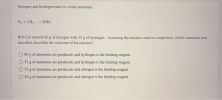 Nitrogen and hydrogen react to create ammonia. N2 + 3 H2 + 2NH3 Bob Cat reacted 42 g of nitrogen with 15 g of hydrogen. Assuming the reaction went to completion, which statement best describes describes the outcome of his reaction? 85 g of ammonia are produced, and hydrogen is the limiting reagent. 51 g of ammonia are produced, and hydrogen is the limiting reagent. 51 g of ammonia are produced, and nitrogen is the limiting reagent. 85 g of...
pts) The synthesis of ammonia from nitrogen and hydrogen is exothermic N2(g) + 3H2(g) → 2NH3(g)...
 pts) The synthesis of ammonia from nitrogen and hydrogen is exothermic N2(g) + 3H2(g) → 2NH3(g) + Heat )If heat is removed, will the forward rate of the reaction increase or decrease? Why? ) If nitrogen gas is added, will the forward rate of the reaction increase or decrease? Why? If the volume of the reaction container is increased, how will this affect the rate of the forward reaction? Why? )
Ammonia is produced by the reaction of nitrogen and hydrogen according to the equation N2(g) + 3H2(g) → 2NH3(g) Calculat...
Ammonia is produced by the reaction of nitrogen and hydrogen according to the equation N2(g) + 3H2(g) → 2NH3(g) Calculate the mass of ammonia produced when 32.0 g of nitrogen react with 13.5 g of hydrogen. ___________NH3 Which is the excess reactant and how much of it will be left over when the reaction is complete? hydrogen or nitrogen ________ g
In the Haber process, ammonia is synthesized from nitrogen and hydrogen: N2(g) + 3H2(g) → 2NH3(g) ΔG° at 298 K for thi...
In the Haber process, ammonia is synthesized from nitrogen and hydrogen: N2(g) + 3H2(g) → 2NH3(g) ΔG° at 298 K for this reaction is -33.3 kJ/mol. The value of ΔG at 298 K for a reaction mixture that consists of 1.9 atm N2, 1.6 atm H2, and 0.65 atm NH3 is ________. -3.86 × 10³ -1.8 -7.25 × 10³ -104.5 -40.5
The Haber process for production of ammonia is as follows: N2 (g) + 3H2(g) → 2NH3...
 The Haber process for production of ammonia is as follows: N2 (g) + 3H2(g) → 2NH3 (g) An experiment ran this process using 5.75 moles of N2 and excess hydrogen gas. The reaction produced 7.50 moles of NH3. Calculate the percent yield for this experiment. Round your answer to the nearest whole number. Do not use scientific notation. Do not include the percent sign!
9 please. Nitrogen gas reacts with hydrogen gas to produce ammonia. N2(g) + 3H2(g) — 2NH3(g)...
 9 please.
Nitrogen gas reacts with hydrogen gas to produce ammonia. N2(g) + 3H2(g) — 2NH3(g) a. If you have 3.64 g of H, how many grams of NH3 can be produced? b. How many grams of H, are needed to react with 2.80 g of N? c. How many grams of NH; can be produced from 12.0 g of H? DO
9 please.
Nitrogen gas reacts with hydrogen gas to produce ammonia. N2(g) + 3H2(g) — 2NH3(g) a. If you have 3.64 g of H, how many grams of NH3 can be produced? b. How many grams of H, are needed to react with 2.80 g of N? c. How many grams of NH; can be produced from 12.0 g of H? DO
 question 27
Remaining Time: 27 minutes, 33 seconds. Question completion Status QUESTION 27 po Calculate the volume of 2.12 moles of nitrogen gas at temperature of 31.7°C and a pressure of 1.35 atm. Report your answer as a numeric response to the correct degree of certainty and include the symbol (g. mL, L, etc.) of the proper final units (0.0821 L'atm mol-K QUESTION 28 The reaction N2 + 3 H2 → 2NH3 is used to produce ammonia. When 450. g...
question 27
Remaining Time: 27 minutes, 33 seconds. Question completion Status QUESTION 27 po Calculate the volume of 2.12 moles of nitrogen gas at temperature of 31.7°C and a pressure of 1.35 atm. Report your answer as a numeric response to the correct degree of certainty and include the symbol (g. mL, L, etc.) of the proper final units (0.0821 L'atm mol-K QUESTION 28 The reaction N2 + 3 H2 → 2NH3 is used to produce ammonia. When 450. g...
 Nitrogen and hydrogen react to create ammonia. N2 + 3 H2 + 2NH3 Bob Cat reacted 42 g of nitrogen with 15 g of hydrogen. Assuming the reaction went to completion, which statement best describes describes the outcome of his reaction? 85 g of ammonia are produced, and hydrogen is the limiting reagent. 51 g of ammonia are produced, and hydrogen is the limiting reagent. 51 g of ammonia are produced, and nitrogen is the limiting reagent. 85 g of...
 pts) The synthesis of ammonia from nitrogen and hydrogen is exothermic N2(g) + 3H2(g) → 2NH3(g) + Heat )If heat is removed, will the forward rate of the reaction increase or decrease? Why? ) If nitrogen gas is added, will the forward rate of the reaction increase or decrease? Why? If the volume of the reaction container is increased, how will this affect the rate of the forward reaction? Why? )
 The Haber process for production of ammonia is as follows: N2 (g) + 3H2(g) → 2NH3 (g) An experiment ran this process using 5.75 moles of N2 and excess hydrogen gas. The reaction produced 7.50 moles of NH3. Calculate the percent yield for this experiment. Round your answer to the nearest whole number. Do not use scientific notation. Do not include the percent sign!
 9 please.
Nitrogen gas reacts with hydrogen gas to produce ammonia. N2(g) + 3H2(g) — 2NH3(g) a. If you have 3.64 g of H, how many grams of NH3 can be produced? b. How many grams of H, are needed to react with 2.80 g of N? c. How many grams of NH; can be produced from 12.0 g of H? DO
9 please.
Nitrogen gas reacts with hydrogen gas to produce ammonia. N2(g) + 3H2(g) — 2NH3(g) a. If you have 3.64 g of H, how many grams of NH3 can be produced? b. How many grams of H, are needed to react with 2.80 g of N? c. How many grams of NH; can be produced from 12.0 g of H? DO
Most questions answered within 3 hours.
-
Where is the error in this code sequence?
String s1 = "Hello";
String s2 = "ello";...
asked 11 months ago -
Financial data for Joel de Paris, Inc., for last year
follow:
Joel de Paris, Inc.
Balance...
asked 11 months ago -
Consider this reaction:
Al2(SO4)3 (aq)+ BaCl3
(aq) Al2Cl6 (aq)- +
3BaSO4(s) . What is the...
asked 11 months ago -
Suppose that Savneet is considering increasing her
recent random sample from 20 car rentals to 40...
asked 11 months ago -
Trucks arrive at an unloading terminal at an average rate of 120
per hour.
Trucks arrive...
asked 11 months ago -
Why are methanol and ethanol completely soluble in water while
octanol is not very little soluble....
asked 11 months ago -
A facilities manager at a university reads in a research report
that the mean amount of...
asked 11 months ago -
When the CuSO4 is rehydrated by adding water to the anhydrous
compound, is this an endothermic...
asked 11 months ago -
A ray of sunlight is passing from diamond into crown glass; the
angle of incidence is...
asked 11 months ago -
A block of mass 0.249 kg is placed on top of a light, vertical
spring of...
asked 11 months ago -
how do the kidneys compensate in the presences of acidosis
a) trigger hyperventilate
b) reserve acid...
asked 11 months ago -
Question 501 pts
The rental rate of capital to the firm increases. Which of the
following...
asked 11 months ago